Tag: S-Bahn

  • Expansion of the S-Bahn infrastructure in Frankfurt

    Expansion of the S-Bahn infrastructure in Frankfurt

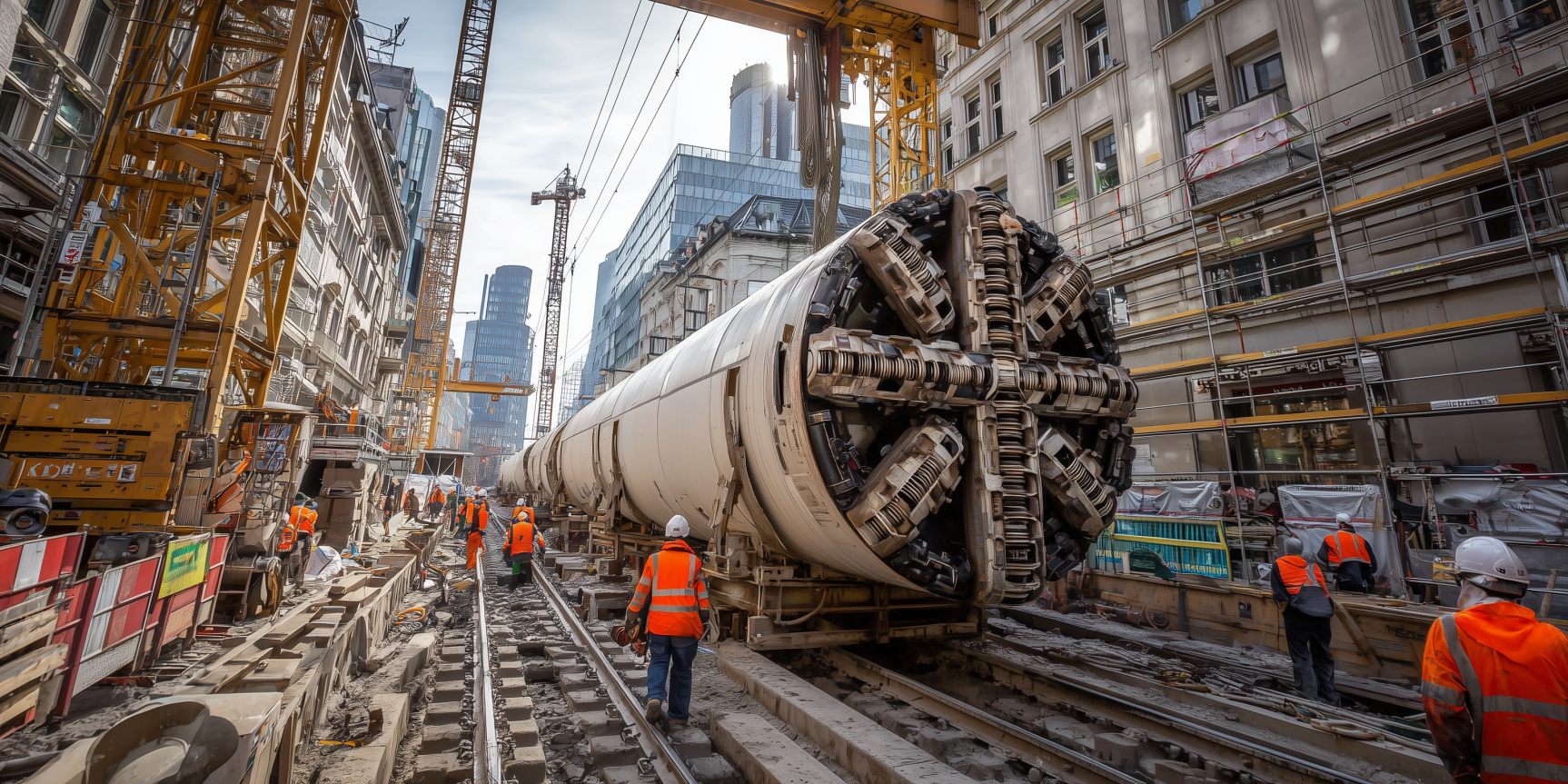
    DB InfraGO AG has commissioned Implenia to build the inner-city section of the Nordmain suburban railway in Frankfurt. Specifically, the construction and real estate company from Opfikon is to realise the underground section of the S-Bahn from Konstablerwache via the new S-Bahn station Frankfurt (Main) Ost (tief) to Fechenheim for the Deutsche Bahn subsidiary. The contract is worth over 200 million euros, Implenia announced in a press release.

    The contract includes the starting excavation pit Trog and the excavation pit for the underground S-Bahn station Frankfurt (Main) Ost (tief), a series of ancillary excavation pits and engineering structures, as well as two tunnel tubes approximately 1.2 kilometres long. They will be constructed by mechanised tunnelling. Implenia will also carry out extensive dewatering measures and provide a range of specialised civil engineering services. Work is scheduled to start at the beginning of 2026 and be completed by 2031.

    “The further expansion of a functioning transport infrastructure is central to the sustainable development of our cities,” said Erwin Scherer, Head Division Civil Engineering at Implenia, in the press release. “I am delighted that Implenia, with its many years of experience and extensive expertise, is able to contribute to improving public transport in the densely populated Rhine-Main region.”

  • Trinational S-Bahn: 33 new Flirt Evo France trains for the Basel area

    Trinational S-Bahn: 33 new Flirt Evo France trains for the Basel area

    New S-Bahn connections for the Basel area
    Every day, 60,000 people commute in the border triangle of Switzerland, France and Germany – including 30,000 commuters between Alsace and north-west Switzerland. Around 90 per cent of them currently use the car. This is set to change: From the end of 2030, a direct S-Bahn connection will be introduced between north-west Switzerland and Alsace. The aim is to get as many commuters as possible onto the railway, including the more than 6,000 employees in the EuroAirport catchment area and the approximately eight million air passengers a year.

    Introduction in stages
    The new cross-border S-Bahn lines will be introduced in stages:

    • From December 2030: Commissioning of the S2 (Olten-Basel-Mulhouse) and S4 (Laufen-Basel-St. Louis) lines every 30 minutes.
    • From 2034/35: Connection of EuroAirport to both lines, together with the French regional express line Strasbourg-Mulhouse-Basel (TER200) every 10 minutes between EuroAirport and Basel SBB.

    Procurement of the new trains
    SBB is procuring 33 Flirt Evo France trains from Stadler to operate the new railway service. These vehicles are characterised by two special features:

    • A standardised fleet:
      The trains can be used in both countries, which reduces complexity and increases operational flexibility. The vehicles can be efficiently coupled as single or multiple traction and replace the previous vehicles on the Mulhouse-Basel line (TEROmnibus).
    • Two systems:
      The trains are technically equipped to be authorised in Switzerland and France. They have two integrated traction current and railway safety systems to ensure smooth cross-border operation.

    Investment and project management
    The investment for the procurement of the 33 trains amounts to around 320 million Swiss francs. SBB and SNCF Voyageurs jointly founded EuroBasilea AG in July 2023 to ensure efficient preparation and timely commissioning of the new service. Further information is available at www.eurobasilea.com

  • Milestone at Basel railway station

    Milestone at Basel railway station

    Basel SBB railway station is facing a problem. It is reaching the limits of its capacity. The increasing number of trains and travellers, especially at peak times, requires urgent measures to avoid bottlenecks.

    From December 2025, it is planned that the S-Bahn trains between Basel and Liestal will run every quarter of an hour. This ambitious goal requires considerable investment in the railway facilities between Basel and Liestal, which the federal government is financing to the tune of around CHF 1 billion. SBB is responsible for realising these projects on behalf of the federal government, while the federal government and the cantons are jointly ordering and financing the additional S-Bahn connections.

    Most of the investments are included in the 2025 expansion phase, which is part of the “Financing and expansion of the railway infrastructure” (FABI) bill that was approved by the Swiss electorate in February 2014. These expansions not only enable the quarter-hourly S-Bahn service between Basel and Liestal, but also lay the foundation for further improvements in passenger and freight transport.

    Two main measures are required to create the capacity for the planned quarter-hourly service and the extended timetable.

    Additional stops for trains: The planned quarter-hourly frequency will increase the number of trains at Basel SBB station. Additional stopping points and platform edges are therefore required to ensure smooth operations. This is the main objective of the “Basel SBB performance enhancement” project.

    Additional crossing options for travellers: The increasing number of trains leads to more travellers and thus to higher utilisation of the Passerelle at Basel SBB station. In order to cope with this increase, the creation of additional crossing facilities is urgently required. The “Provisional Passerelle” project aims to realise this increase in capacity quickly until further crossings, such as the Margarethen platform access, can be built.

    The temporary pedestrian crossing is a temporary solution until long-term measures can be implemented. The planning and construction of further crossings are planned for the 2035 expansion phase and will also be financed by the federal government.

  • Ceneri Base Tunnel receives the green light

    Ceneri Base Tunnel receives the green light

    The New Railway-Alpen-Transversale ( NEAT ) is largely completed. The Federal Office of Transport ( FOT ) has issued the permit for the scheduled operation of the Ceneri base tunnel, it writes in a message . This means that the tunnel will be available for scheduled passenger and freight trains from the timetable change on December 13th.

    The Ceneri Base Tunnel was inaugurated on September 4th. Since then, around 5,800 commercial passenger and freight trains have been run through the tunnel in a trial run.

    The 15 kilometer long tunnel is the third of the three large base tunnels that were built as part of the NEAT. It also enables direct connections between Lugano and Locarno. These form a central element of the Ticino S-Bahn.

    The Lötschberg Base Tunnel with a length of 35 kilometers was the first of the three large tunnels to go into operation in 2007, the Gotthard Base Tunnel with a length of 57 kilometers followed in 2016. The almost 20 kilometers long Simplon Tunnel has been in operation since 1906. Switzerland now has two flat rail routes through the Alps.