Tag: Sanieren

  • Feld school in Azmoos wins architecture prize

    Feld school in Azmoos wins architecture prize

    The Feld school in Azmoos has won first place in this year's Constructive Alps architecture prize, the Federal Office for Spatial Development ( ARE ) reports in a statement . It represents Switzerland in the competition organized jointly with Liechtenstein. Constructive Alps recognizes sustainable building and renovation in the Alps. With the competition, the two countries want to promote the implementation of the Alpine Convention for the sustainable development of the mountain region.

    The Feld schoolhouse was built on the site of the old schoolhouse in Azmoos. It offers space for more than twice as many children as the old school building on the same built-up area. The socially and ecologically sustainable timber construction also impressed with its own photovoltaic system, among other things.

    The second prize was awarded jointly to the headquarters of the heating specialist ÖkoFEN France in Saint-Baldoph and the Ghiringhelli residential development in Bellinzona. Third place went to the renovated Falkenhütte in Hinterriss in the Austrian Karwendel Mountains.

    Switzerland will hold the presidency of the Alpine Convention in 2021/22. The internationally binding agreement between the eight Alpine states and the European Union has set itself the goal of developing the Alps into a model region for climate protection and adaptation to climate change. Under the aegis of Switzerland, the focus was on climate, sustainable mobility, Alpine towns, sustainable construction and modal shift.

  • Whitepaper: Energetic renovations as an opportunity

    Whitepaper: Energetic renovations as an opportunity

    Knowing that the building sector is responsible for around a quarter of emissions, there is an urgent need to renovate the building stock. Because the few climate-friendly and energy-efficient new buildings will not have a major effect on the entire sector. At the moment we are in a renovation backlog. The current renovation rate of one percent must be doubled in order to achieve the climate targets.

    Practical experience shows that during renewal processes, too little attention is paid to energy-related refurbishment compared to replacement new buildings. The landowners often lack basic information that shows them the economic, ecological and social potential of energy-related renovations. The whitepaper is intended to make a contribution to precisely this. There is a basic overview of the urgency, legal framework, benefits, opportunities and possible strategies of energy-related renovations.

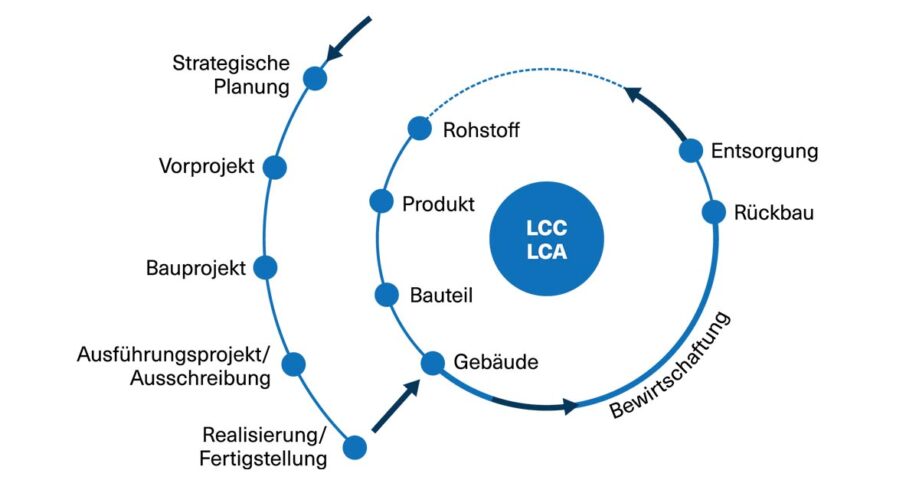
    The results of an ecological balance sheet (life cycle analysis, LCA) and an analysis of the life cycle costs (LCC), for example, form an excellent basis for decision-making. These quantitative assessment methods take into account the entire building life cycle.

    To the white paper

    Comprehensive redevelopment of the Webermühle housing estate
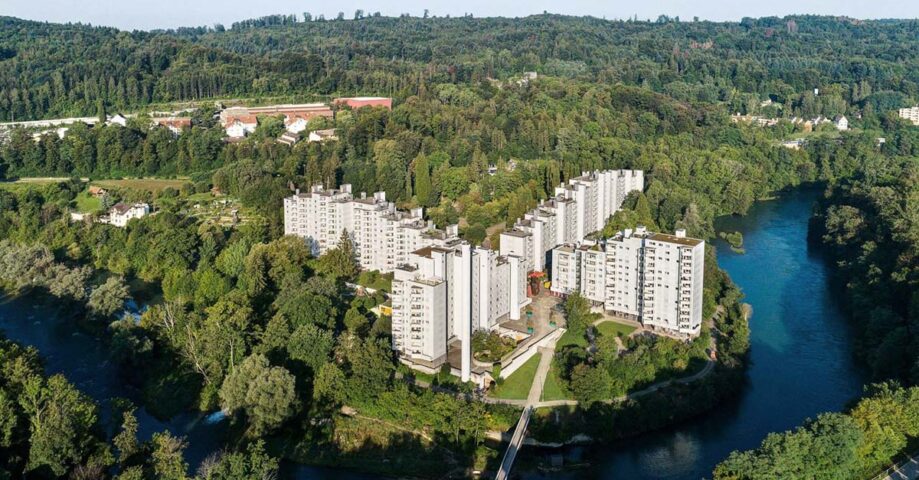
    One example of a successful renovation is the large Webermühle development in Neuenhof. The former Göhner settlement, which was occupied in 1984 and has been owned by a real estate fund from Credit Suisse Asset Management since 2008, houses 368 rental apartments with around 1,500 residents.

    The core of the energetic renovation of the Webermühle is the reorientation of the heat supply. To this end, the client defined a clear goal right from the start: in the future, the heat supply should be at least 70% CO₂-free. Due to the size of the facility, Credit Suisse Asset Management wanted to have the heating system replaced by a contractor instead of producing heat itself. The sustainability of the solution proposed by ewz with a river water heat pump convinced the client.

    Find out more

  • Canton releases 2.5 million Swiss francs for Uri energy funding program

    Canton releases 2.5 million Swiss francs for Uri energy funding program

    Residents of the canton of Uri can access a total of 2.5 million francs from the Energy Uri 2022 funding program this year. The government council recently passed this sum, according to a media release . This is intended to renovate and insulate buildings, replace old heating systems and finance photovoltaic systems and charging stations for e-cars.

    Building owners can have the insulation of the roof and facade subsidized at 60 francs per square meter. According to the press release, this covers a large part of the total costs. Applicants who also opt for a photovoltaic system integrated into the façade or roof can receive an additional CHF 200 per square meter occupied by modules.

    What is new in this funding period is that the plants must be designed for electricity production in the winter months. "The angle of the modules must be 60 to 90 degrees and thus optimized for the production of valuable winter electricity." The canton wants to increase the spread of photovoltaic systems in facades, "where the electricity production is higher in the winter months with the appropriate orientation". , contribute.

    The funding program also provides for subsidies for consultations. After a free initial consultation at the Energy Office, interested parties can receive 700 francs for more detailed advice on the façade, roof, windows and other parts of the building envelope. The funding amount was increased by CHF 300 this year. Advice on replacing oil heating systems with more sustainable types of heating is CHF 350 for buildings with fewer than five apartments. Owners of six or more apartments receive a subsidy of CHF 700.

    Owners of apartment buildings who want to equip at least ten parking spaces with charging options for electric cars will be supported with a flat-rate amount of CHF 2,000. This is intended to cover part of the cost of a load management system. This is necessary if several e-cars are to be charged at the same time.

    The canton has been supporting energy-efficient refurbishments in buildings since 2000 with the funding programme. "In the last two years, the funding budget has been fully utilized, which can be seen as a success," says the press release. It proves that owners take their responsibility seriously and make a contribution to the energy transition and climate protection.

  • Empa proposes a plan for building renovation

    Empa proposes a plan for building renovation

    The Dübendorfer Urban Energy Systems Laboratory of the Eidgenössische Materialprüfungs- und Forschungsanstalt ( Empa ) has developed measures to reduce the greenhouse gases of the 1.8 million buildings in the country. The laboratory wants to show what the appropriate steps are and in which order they should be taken, it says in a message . The goal is a decisive reduction in CO2 emissions for heating and cooling in order to achieve Switzerland's net zero target by 2050. If the ecological renovation of the building stock progressed at the current pace, it would take another 100 years, Empa calculates.

    Led by Kristine Orehounig, the researchers used data mining to divide all residential and commercial buildings in Switzerland into over 100 archetypes, depending on the year of construction, heating type, location and number of users. Then all of them were checked for their suitability for photovoltaics and connection to a heating network.

    According to Empa, this sorting work has shown that it is worthwhile to start renovating the roofs and windows of older buildings particularly quickly. This should be followed by the renovation of heating systems in almost all house types. It is important to replace fossil fuels as quickly as possible with photovoltaics on roofs and facades. The research team recommends generating heat using heat pumps and biomass heating. "If the proposed measures are taken," believes Kristine Orehounig, "the greenhouse emissions in Switzerland's existing building stock can be reduced by 60 to 80 percent".

  • Agricultural Center Salez wins architecture award

    Agricultural Center Salez wins architecture award

    Constructive Alps is awarded to projects that are convincing in terms of sustainable building and renovation in the Alps. Switzerland and Liechtenstein have now awarded this prize for the fifth time, according to a media release . A total of almost 330 projects were submitted. A jury selected ten entries, of which the first three received a total of 50,000 francs. The Salez Agricultural Center took first place.

    The Agricultural Center Salez is one of the projects that show that architecture can combine aesthetics and climate protection, as stated in the communication from the Federal Office for Spatial Development (ARE). The building of the center relies on the simplest possible construction and a long lifespan. Canton and architect Andy Senn would have set new standards in terms of climate efficiency. An assembly hall in Vorarlberg and a mountain inn in Glarus made it into second and third place. In addition to seven recognition prizes, an audience award has also been determined for the first time.

    The Agricultural Center Salez consists of a conference center, farm, state farm and orchard. It is operated by the Agricultural Center SG (LZSG) together with the practical trial plots in Flawil. This also has advice centers in Kaltbrunn and Sargans.