Tag: SBB

  • A milestone in the Ticino SBB Arbedo-Castione plant

    A milestone in the Ticino SBB Arbedo-Castione plant

    Commissioning is scheduled for mid-2028, with SBB, the canton of Ticino, the city of Bellinzona and the federal government investing a total of around CHF 755 million in the ultra-modern site. In doing so, SBB is not only securing its maintenance of new multiple-unit trains, but also sending a strong signal for the economic development of the region.

    Investment in Ticino as a centre of industry
    In future, the NSIF will offer 360 full-time jobs and 80 apprenticeships, a clear commitment to the future of Ticino as a centre of industry. The new facility represents a milestone in the maintenance and repair of the modern Giruno, ETR and Flirt TILO multiple-unit trains. Compared to the existing Bellinzona plant, the level of digitalisation will be significantly increased. One focus is on electromechanical work, with digitalisation and automation making processes more efficient, flexible and sustainable. The green roof with solar panels and the renunciation of fossil fuels emphasise the ecological focus of the project.

    Sustainability and infrastructure
    With a total area of 150,000 square metres, the plant also sets new standards in terms of sustainability and infrastructure. The main building measures 40,000 square metres, as much as eight football pitches. In addition to the factory building, a modern train washing facility, rooms for apprentice training and common areas for staff are being built. The building integrates a comprehensive sustainability concept that minimises the ecological footprint with solar panels and green spaces.

    Progress with the construction work
    Initial work began in June 2025 with site installation, excavation and the design of the foundations. Construction will be accompanied by extensive adjustments to the railway infrastructure. New tracks, points and technical buildings will ensure optimal connections and logistics. In December 2024, the new track group 600 was put into operation in order to efficiently control operating processes and better connect the Coop distribution centre. The extensive railway construction work will run in parallel until the plant is completed.

    Agriculture and compensation
    A total of around 150,000 square metres are required for the NSIF, including 8.4 hectares of crop rotation areas. Together with the Ticino Farmers’ Association, SBB has found alternative agricultural land in Camorino, Bellinzona, Preonzo, Iragna and Biasca in order to fulfil the legal compensation obligations in full.

    Significance for the region
    The ground-breaking ceremony was attended by prominent representatives from politics and business. SBB is thus emphasising the importance and significance of the canton of Ticino and the long-term safeguarding of jobs. In a region that is particularly affected by industrial change, this project symbolises the future, stability and innovation.

    The new SBB Arbedo-Castione plant will bring innovation and sustainability to the Swiss railway sector, consolidate Ticino as an industrial centre and offer prospects for future generations. A ground-breaking ceremony with symbolic power and a project that accelerates the pulse of the region.

  • Ground-breaking ceremony for SBB plant in Arbedo-Castione

    Ground-breaking ceremony for SBB plant in Arbedo-Castione

    The new SBB plant, officially called Nuovo stabilimento industriale ferroviario (NSIF), replaces the existing plant in Bellinzona, which no longer meets the maintenance requirements of modern multiple units. The new facility creates space for 360 full-time jobs and 80 apprenticeships and specializes in the future maintenance and repair of Giruno, ETR and FLIRT-TILO multiple units. The high degree of automation and the focus on electromechanical work make the facility the most modern SBB industrial plant in Europe.

    SBB CEO Vincent Ducrot was particularly proud at the ground-breaking ceremony. The canton of Ticino is an extremely important region for SBB, which is investing in jobs, expertise and technology with this project. The new site covers an area of 150,000 square meters, equivalent to more than 20 football pitches, and also sets an example for sustainability with a green roof and integrated solar panels.

    Sustainability and major construction progress
    Work began back in June 2025 with the establishment of the construction site, excavation and foundation work as well as initial measures for the future train washing facility. The expansion of the railroad infrastructure is running in parallel. New points, additional tracks and modern control technology will ensure an optimal connection to the network. SBB attaches great importance to ecological compensation; 8.4 hectares of high-quality crop rotation areas are being compensated for at alternative locations in Ticino.

    The new plant will go into operation in stages from mid-2028. The relocation of the existing Bellinzona plant to Arbedo-Castione will give the region and its employees a sustainable future. The new SBB plant stands for innovation, growth and sustainable development in a strategically important region for Switzerland.

  • Alpine solar project launched over 2000 metres

    Alpine solar project launched over 2000 metres

    Axpo, based in Baden, has commissioned STRABAG to realise an alpine solar project next to the Lai da Nalps reservoir above the village of Serdun in Graubünden. Around 1,500 solar panels and a technology centre will be installed in the NalpSolar project at over 2,000 metres above sea level, the Schlieren-based construction company announced in a press release. The first 10 per cent of the plant is due to go into operation this December.

    “The construction work is technically demanding, logistically challenging and ecologically sensitive, but above all a milestone for the energy transition in Switzerland,” writes STRABAG. The individual solar tables and other components have to be transported along a narrow, single-lane mountain road. The road, which is normally closed, was built by Axpo in the 1960s as an access road for the reservoir.

    As there are no storage facilities on the construction site, only the material that is immediately needed is transported. “The logistics now run like clockwork,” explains construction foreman François Borner in the press release. “Instead of being stressful, it is now easy to plan.” In the press release, STRABAG cites the uneven ground and respect for the nature conservation zones in the construction area as further challenges in the project.

    Due to the altitude, NalpSolar will produce a lot of electricity, especially in the winter months, explains STRABAG. The construction company is aiming to complete the work in 2028. The electricity from NalpSolar is reserved for the SBB power grid for the next 20 years.

  • First trains travel through the west tunnel of the Gotthard Base Tunnel again

    First trains travel through the west tunnel of the Gotthard Base Tunnel again

    Following the successful completion of test operations, the first trains once again travelled through the repaired west tunnel of the Gotthard Base Tunnel on 19 August 2024. The first commercial train, an early train from Chiasso to Basel, marked this important milestone. Another goods train followed, operated by SBB Cargo International. SBB will continue to carry out test runs in the coming weeks in preparation for the full reopening on 2 September 2024.

    Gradual return to normality
    Cleaning work will take place repeatedly in the run-up to the full reopening. From 2 September, the half-hourly frequency for all InterCity and EuroCity trains between German-speaking Switzerland and Ticino will be restored. This will provide travellers with a significantly faster connection through the Gotthard Base Tunnel, reducing journey times by an hour.

    Important progress on the road to normalisation
    With the trial operation in the west tunnel and the successful tests, SBB is ensuring that the Gotthard Base Tunnel will soon be fully available again. This is of key importance not only for passenger transport, but also for freight transport. The tunnel remains one of the most important transport routes in Switzerland and Europe.

    Work on the tunnel is continuing as planned and SBB is confident that regular operations can be resumed from the beginning of September 2024.

  • Winning project for the first new building on the Werkstadt site in Zurich

    Winning project for the first new building on the Werkstadt site in Zurich

    Used rails as supporting structure
    The winning project “GLEIS X”, which was developed by Leuthard AG Baumanagement and Gigon/Guyer Architekten AG, impresses with its consistent reuse strategy. The concept uses 12 kilometres of used rails from the SBB ReSale as supports and ceiling beams for the main floors. The building envelope also consists of reused windows and corrugated fibre cement panels. This innovative use of used components was particularly recognised by the jury, as it picks up on the history of the site and continues it architecturally. For SBB, which attaches great importance to the preservation and further development of its architectural and railway heritage, this approach was decisive.

    Six commercial floors and one city floor
    The planned new building comprises seven floors, six of which are to be used as commercial space. These areas are intended for small to medium-sized businesses and offer a mix of traditional and innovative commercial space. The first floor, the so-called “city floor”, will house services or cultural offerings and thus promote interaction with the neighbourhood. The ground floor will initially be used for car parking and goods handling, but will also be converted into a commercial floor at a later stage.

    Public project exhibition
    Interested parties can view the competition entries on the mezzanine floor of Building U, Hohlstrasse 400, 8084 Zurich. The exhibition is open until 19 June 2024 from Monday to Friday from 5pm to 7pm and at weekends from 12pm to 4pm.

    Werkstadt Zürich – a place for urban production
    An innovative centre for urban production and commerce is being built on the approximately 43,000 square metre “Werkstadt Zürich” site. SBB is refurbishing the existing buildings and creating jobs close to the neighbourhood for trades, services and highly specialised professionals. The transformation of the site is being carried out in close cooperation with the City of Zurich and the cantonal monument preservation authorities. Around 35 companies currently provide jobs on the site and contribute to the lively development of the neighbourhood.

  • Clara Millard Dereudre proposed as new member of the SBB Board of Directors

    Clara Millard Dereudre proposed as new member of the SBB Board of Directors

    Clara Millard Dereudre has been Director of Smart City at Service Industriels de Genève (SIG) and a member of the General Management since 2021. Her team works on engineering projects, shared services and solutions for smart cities. She is also responsible for IT and data management at SIG.

    Clara Millard Dereudre (52) has excellent knowledge and experience in the areas of operational and strategic marketing, sustainability strategy, innovation, digitalisation, cybersecurity and energy. She is French and has lived in Switzerland for 18 years, currently in Prangins (VD).

    After graduating from the École des hautes études commerciales du Nord Lille (EDHEC, FR) in 1994, Clara Millard Dereudre worked for the Dow Chemical Company for 25 years, including in Zurich as Global Senior Director Marketing, Strategy & Sustainability and in Indianapolis, USA, as Global Director Corporate Strategy and North America Director Sales & Marketing Operations. During her last position at Dow Chemical, she was appointed Senior Corporate Marketing Fellow and received several awards for innovation and sustainability.

    The Federal Council today approved the SBB Board of Directors’ nomination. Clara Millard Dereudre will be elected at the SBB Annual General Meeting on 24 April 2024 and will take office upon her election.

    She succeeds Alexandra Post, who has been a member of the SBB Board of Directors since 2012 and cannot stand for re-election due to the twelve-year term limit.

    The SBB Board of Directors would like to thank Alexandra Post for her great commitment and valuable collaboration over the past few years.

  • Dietikon and SBB present winning project for station area

    Dietikon and SBB present winning project for station area

    SBB and the town of Dietikon have selected the winning project of the architectural competition to redesign the station area. The jury chose the design by Hosoya Schaefer Architekten from Zurich and BRYUM Landschaftsarchitekten from Basel. The three best competition projects are now on display in the foyer of the Stadthaus.

    According to a press release, the Dietikon railway station area is to become a contemporary transport hub and a lively urban district. To this end, the station square and bus station will be redesigned over the next few years, the station building from 1977 will be renovated and extended, and new residential and commercial space will be created on the station site.

    The winning project of the tender envisages a tree canopy varying in density from the centre of Dietikon to the railway station and connecting the station building to the market square and town centre on foot. The final stops of the bus station are divided between the north and south bus islands separated by the tree canopy. Under the tree canopy is a chaussiered area that is intended as both a movement and recreation space. There will be space for event areas, fountains and seating.

    The city council followed the jury’s recommendation and decided to continue working on the winning project with the corresponding planning team. The completion of the redesign of the station square and bus station is planned for between 2027 and 2030.

    In addition to the three best architectural projects, the SBB design plan will also be available for public inspection for 60 days. After the public display, the documents will be revised, approved by the city council and submitted to the municipal council for approval. The design plan is expected to become legally binding in 2025.

  • Canton and city want to open up future development focal points

    Canton and city want to open up future development focal points

    In addition to short- and medium-term measures such as a new bus concept in Zurich North and the Affoltern tram, longer-term service expansions are also planned for public transport in the canton and city of Zurich. Part of this expansion is a project that was presented in more detail today by Zurich Cantonal Councillor and Director of Economic Affairs Carmen Walker Späh and Councillor Michael Baumer, Head of the Department of Industrial Operations: the North Tram Tangent from Zurich Affoltern via Oerlikon to Stettbach.

    Public transport ring system with new tangential connection

    The project is an integral part of the ZVV strategy 2025-2029 as well as the VBZ network development strategy based on the “Public Transport Vision 2050”, which among other things envisages a public transport ring system with a new tangential connection from Affoltern via Oerlikon to Stettbach. “Zurich North has enormous potential and radiates far beyond the city limits into the canton,” says Councillor and ZVV Transport Council President Carmen Walker Späh. “It therefore makes sense, after the Affoltern tram, to examine the northern tram tangent more closely”. This is all the more true as the Tramtangente Nord is also to use part of the tracks of the Affoltern tram, which is to be built from 2026.

    The role and task of public transport in the canton and city of Zurich are demanding: it should ensure large traffic flows on as climate-neutral a basis as possible and thus continue to be the backbone of modern, climate-friendly and efficient mobility in the future. Already today, a large part of transport is handled by public transport – in the canton one third, in the city about 40 %. With a view to climate protection measures and on the basis of the cantonal and urban strategies, these shares should be further increased.

    Councillor Michael Baumer sums up the strategy: “Only with short travel times, punctuality and a dense network can we remain attractive. The planned ring system with the tram tangent north as a first step brings public transport in the city decisively further”. In order to absorb the population growth in the neighbourhoods of Zurich North, a targeted expansion of the tram and bus network is necessary.

    The expansion of public transport is one of the foundations of the spatial development strategy of the city of Zurich to promote the centres in the north and west of the city. The project is now being tackled quickly with the aim of being able to submit the project to the federal government for co-financing as part of the 6th generation agglomeration programmes. The federal government requires a completed preliminary project for each of the major light rail projects. This summer, as part of the ZVV strategy 2025-2029, the cantonal government of Zurich decided to give the green light for initial clarifications and to create the basis for a corresponding project credit. The next steps in this project are now being taken by the city of Zurich with a potential and feasibility study.

  • Tunnel instead of bottleneck: SBB upgrades line between Zurich and Winterthur

    Tunnel instead of bottleneck: SBB upgrades line between Zurich and Winterthur

    Today, all rail traffic between Zurich and Winterthur uses the only double-track connection via Effretikon. This section of the line is therefore a veritable bottleneck. To eliminate the bottleneck, SBB is upgrading the line on behalf of the federal government. A new double-track line through the Brüttener Tunnel as well as the expansion of four stations and existing lines should bring relief.

    The core of the Zurich-Winterthur multi-track project is the Brüttener Tunnel. It will be about 9 kilometres long and have two tunnel tubes with one track each. Trains will travel at 160 kilometres per hour. The journey time in the tunnel is around 3 minutes.

    The northern portal of the Brüttener Tunnel is at Tössmühle before Winterthur. The tunnel tubes divide and end in two tunnel portals in the south: at Bassersdorf and at Dietlikon. This route is the fastest and most efficient connection between Zurich and Winterthur, as it connects both Zurich Airport (via Bassersdorf) and Zurich HB (via Dietlikon) directly to Winterthur. Because most of the new double track runs underground, no major interventions in the landscape will be visible after construction.

    The project will increase the rail capacity between Zurich and Winterthur by 30 per cent to around 900 trains and 156,000 passengers per day. Two long-distance lines will run between Zurich and Winterthur every quarter of an hour in future.

    The project will be made public at the end of May 2023. If the project progresses without any appeal proceedings, construction work is currently expected to start in the mid-2020s and the service could be put into operation in the mid-2030s.

    With the “2035 expansion stage”, the federal government is investing around CHF 12.89 billion in numerous projects to expand the railway infrastructure throughout Switzerland. The “Zurich-Winterthur multi-track” project is the largest of these projects, with estimated costs of around CHF 2.9 billion.

  • Winning project for the Horgen Oberdorf station area has been decided

    Winning project for the Horgen Oberdorf station area has been decided

    SBB is planning new residential and commercial space and a modern transport hub on the approximately 2,100 square metre Horgen Oberdorf station site. SBB commissioned a study to find a convincing and sustainable urban development project for the site. A jury of external experts, representatives of the client and the municipality has now selected the winning project. The winning team – consisting of Galli Rudolf Architekten AG, Westpol Landschaftsarchitektur and Schnetzer Puskas Ingenieure AG – delivered the most convincing overall concept: the planning team’s proposal takes into account the local conditions and skilfully combines open space and urban development. In its unanimous decision, the jury praised the way in which the building, consisting of different volumes, blends into the townscape. The project takes up the structures of the quarter on the valley side and those of the quarter south of Neugasse.

    45 flats with communal roof gardens
    The basis of the new development is a base level that covers and connects the entire length of the railway station. Above this are five buildings with residential and commercial spaces facing the lake. A photovoltaic system will be installed on the roof of the commercial building, and communal roof gardens will be created on the four residential buildings. The spaces between the buildings become private green spaces. With its façade grid of timber frame and photovoltaic elements, the building envelope refers to the Schweiter industrial site on the hillside. At the level of the tracks, a special static construction ensures a space free of supports and thus obstacles, which benefits passenger, bus and taxi traffic. Two pedestal buildings provide shopping and gastronomy facilities for travellers and station visitors. The new station square will have a restaurant/café and seating. A row of trees with benches and waiting shelters along the edge of the slope frame the square and create a village square atmosphere. The staircase between Bahnhofplatz, Stadtterrasse and Passerelle creates a new neighbourhood connection. Oberdorfstrasse will be redesigned as a pedestrian zone and will have a wider pavement on the lake side. This will increase safety for pedestrians and cyclists and make crossing the road easier.

    With the development at Horgen Oberdorf station, SBB is creating around 45 flats in an excellent location, one third of which will be in the affordable segment. The flat sizes vary between 1.5 and 4.5 rooms. Approximately 240 square metres are available for gastronomy and retail, and 750 square metres for services. 20 P+R parking spaces, around 100 Bike+Rail parking spaces and two taxi ranks allow for convenient transfers between the various means of transport. The buildings will be constructed according to the DGNB sustainability standards. Implementation is expected from the end of 2025.

    Public project exhibition at the municipal administration
    The competition entries will be exhibited for the interested public: on 25 May 2023 to 2 June 2023 during opening hours at the municipal administration Horgen, Bahnhofstrasse 10, 8810 Horgen.

  • Major project MehrSpur Zurich-Winterthur goes on public display

    Major project MehrSpur Zurich-Winterthur goes on public display

    On behalf of the federal government, SBB is planning a new double track through the Brüttener tunnel, the expansion of the Dietlikon, Bassersdorf, Wallisellen and Winterthur Töss stations as well as other construction measures on the railway infrastructure between Zurich and Winterthur. The planned infrastructure upgrades of the major Zurich-Winterthur MehrSpur project will eliminate the current bottleneck in the railway network. Thanks to the second double track through the Brüttener Tunnel, two long-distance lines will run every quarter of an hour between Zurich and Winterthur in future. On Zurich’s S-Bahn network, the quarter-hourly service will become the basic service.

    The project will be open to the public in the municipalities concerned from 30 May to 28 June 2023. The documents can be viewed during the official opening hours of the municipal administrations. During the public display, SBB project managers will be on site at certain times to answer questions from residents in the project perimeter. Information and registration for the event on the SBB website “MehrSpur Zürich-Winterthur”.

    Expansion enables 30 percent more capacity
    The expansion of the Zurich-Winterthur railway line includes the following projects:

    • Around nine-kilometre-long Brüttener tunnel between Dietlikon / Bassersdorf and Winterthur
    • Expansion of the four stations Dietlikon, Bassersdorf, Wallisellen, Winterthur Töss
    • Construction of two bridges and two short tunnels. These structures will connect the new tracks to the existing railway network and unbundle traffic: Trains can cross each other without obstructing oncoming traffic.
    • The project also includes the planning and realisation of projects by the Canton of Zurich (bicycle connections), cities and municipalities, as well as investments by the federal government for the maintenance of the railway infrastructure.

    With the large-scale project MehrSpur Zurich-Winterthur, the railway capacity between Zurich and Winterthur will be expanded by 30 percent: Every day, 900 trains will be able to transport around 156,000 passengers. This will make travelling faster, easier and more comfortable.

    Around ten years construction time
    If the project proceeds without appeal proceedings, from today’s perspective, construction can start in the mid-2020s and the service can go into operation in the mid-2030s. SBB will be able to draw up a definitive construction programme as soon as it has received the legally binding construction permit from the federal government and the construction work has been awarded.

    Largest project in the federal government’s 2035 expansion plan
    The costs for the planned extensions between Zurich and Winterthur amount to around 2.9 billion Swiss francs. This makes MehrSpur Zurich-Winterthur the largest project in the federal government’s 2035 expansion stage. Financing is provided by the federal government’s railway infrastructure fund, which is fed by contributions from the federal government and the cantons, among others.

  • Plans for Bern’s West railway expansion project are on the table

    Plans for Bern’s West railway expansion project are on the table

    Bottlenecks occur time and again at the Bern railway junction, which have an impact on all long-distance traffic in Switzerland. With the Federal Expansion Plan 2025 (AS25), such bottlenecks will be eliminated and rail operations in Switzerland will be further optimised: There will be more stable and more connections between Bern and Zurich, a half-hourly service to Lucerne and Neuchâtel, and more trains on the Bern-Thun line. In future, there will be an S-Bahn train every quarter of an hour between Bern and Münsingen, and there will also be more connections between Bern and Burgdorf.

    Various projects planned
    Five sub-projects are planned for the overall AS25 project “Performance improvement Bern West”:
    – the Holligen disentanglement with the 1.7 km long new Holligentunnel
    – the Aebimatt stabling facility
    – the west end of Bern railway station
    – the Europaplatz Nord stop
    – the Steigerhubel passerelle for pedestrian and bicycle traffic

    The new Europaplatz Nord stop also includes a new pedestrian subway for the city of Bern. A separate planning approval procedure will be submitted later to the Federal Office of Transport (FOT) for the west end of Bern station.

    Construction work will take twelve years
    Construction is scheduled to start in spring 2025. The new station with the project name Europaplatz Nord will go into operation in 2028 and will thus replace the existing Stöckacker stop located a few hundred metres to the west. Passengers are expected to travel through the Holligentunnel for the first time in 2034. As things stand today, it will take until 2036 for the entire project to be completed.

    In February 2023, SBB submitted the dossier for the planning approval procedure to the Federal Office of Transport. The public consultation will take place in Bern from 15 May 2023 to 13 June 2023.

    As things stand today, the estimated costs for the “Bern West service enhancement” amount to around CHF 750 million (+/- 10%). The project will be financed through the federal government’s extension step 2025 (AS25).

    Information room opens its doors
    An information room will be open during the planning period so that residents and interested parties can obtain comprehensive information about the project. It is located in the BLS building at Stöckackerstrasse 25 in 3018 Bern.

    Further information on the project can be found at sbb.ch/bernwest

  • Plans for “Unbundling Gümligen South” are on the table

    Plans for “Unbundling Gümligen South” are on the table

    In order to be able to implement the service improvements ordered in the Federal Expansion Plan 2025 (AS25), a new railway tunnel is to be built near Gümligen. Together with other projects from the AS25, the “Unbundling Gümligen South” will make it easier for trains to cross. In the long term, this will make it possible to run a quarter-hourly service on the Berne-Muensingen S-Bahn, coupled with a half-hourly service on the Berne-Langnau S-Bahn, as well as additional capacities for long-distance traffic and freight traffic in the Aare Valley. The “unbundling of Gümligen South” provides passengers with more stability in the timetable and, together with other projects, more connections.

    450 metres of tunnel for easier crossing of trains
    Specifically, SBB is planning a new, 450-metre-long railway tunnel underneath the existing railway line between Muri and Rüfenacht/Allmendingen, in the Hüenli forest. In order to be able to operate the new tunnel, SBB must also replace the existing Gümligen signal box and relocate the transmission line in the affected area.

    Around 5 years construction time
    As things stand today, construction is scheduled to begin in May 2024. The new transmission line is scheduled to go into operation one year later and the new signal box another year later. Passengers are expected to travel through the new tunnel for the first time in mid-2028; according to current planning, it will take until the end of 2029 to complete the entire project.

    In December 2022, SBB submitted the dossier for the planning approval procedure to the Federal Office of Transport. The planning documents will be open to the public from 1 May 2023 to 30 May 2023 at the municipal administrations of Muri bei Bern, Allmendingen, Worb, Ostermundigen, Vechigen, Stettlen and Krauchthal.

    The estimated costs for the “Unbundling Gümligen South” are around CHF 200 million (+/- 10%). The project is being financed through the federal government’s 2025 expansion stage.

    Further information on the project can be found at sbb.ch/guemligen.

  • Everything will be new on the Rösslimatt site by 2040

    Everything will be new on the Rösslimatt site by 2040

    The Rösslimatt site in the middle of Lucerne borders railway tracks on both sides. It is to be completely redesigned by 2040.

    The area is divided into different construction sites and will be realised in three stages. In the first stage between 2018 and 2025, construction sites A to C will be developed and Güterstrasse 7 will be gently redeveloped. In the second stage, from 2025 to 2040, an interim use is planned for the exposed areas. In the third stage and after the realisation of the Lucerne through station from around 2040, the development of new uses with a focus on housing is planned on construction sites D to F. The development of a new residential building is planned on construction site A.

    A 180-metre-long, sustainable building designed by architect Rolf Mühlethaler is being built on construction site A. It will be realised on the site of an old goods shed that was demolished in 2020. The façade of the new building is characterised by surrounding verandas as well as a two-storey arcade on the side of the new Walter-von-Moos-Promenade with a weather-protected wood and glass façade made of local wood.

    The new building has around 21,600 square metres of lettable space. At the end of 2019, the Lucerne University of Applied Sciences and Arts was secured as the main tenant. It intends to start its university operations on around 16,000 square metres from the autumn semester of 2025. The ground floor will be characterised by public-oriented uses such as a cafeteria, a café, meeting zones and a large lecture hall. In particular, the track loggia, a striking two-storey opening in the long building, and the newly designed Bürgenplatz, together with the planned catering uses, will form new urban meeting places.

    A mixed-use building is to be constructed on construction sites B and C. After the architectural competition concluded in February 2020, the winning project by the consortium Demuth Hagenmüller Lamprecht Architekten with Alessandra Villa Architektur was recommended for further work by the monitoring committee and is currently under construction.

    In September 2020, the pharmaceutical company MSD committed itself to the Lucerne site. It will move into around 15,000 square metres of office space on construction sites B and C. Site preparation began in the second quarter of 2021, and occupation is planned for 2025.

    Both new buildings have space that has not yet been let.

    The building at Güterstrasse 7 was erected in 1905 and is listed as an object worthy of preservation in the building inventory of the city of Lucerne. This building with its historic façade design is a 7-storey masonry structure consisting of a basement, five upper floors and an attic. It includes commercial and residential space. The building was refurbished in 2020 and the space occupied in 2021. The gentle refurbishment made it possible to make the flats available again at moderate rents.

    The Rösslimatt site is being developed in a sustainable, demand-oriented and high-quality manner. The connection of the site to the district heating and cooling network of Energie Wasser Luzern guarantees 100 percent sustainable generation of heat and cooling. The central location allows optimal use of the existing public transport services as well as several offers for car and bike sharing.

    In addition to the criteria of the 2000-watt society, the goals of the Swiss Society for Sustainable Real Estate at the silver level are met. In September 2019, the Rösslimatt was awarded for its demonstrable and exemplary results according to the 2000-watt site criteria in the development phase and recertified in 2021.

  • The future of Berne railway station: traffic measures are launched

    The future of Berne railway station: traffic measures are launched

    To ensure that Bern station can continue to fulfil its function as a transport hub, it is being expanded as part of the “Zukunft Bahnhof Bern” (ZBB) project: Regional Transport Bern-Solothurn (RBS) is building a new station underneath the existing SBB tracks. SBB is building a second passenger subway with new station accesses at Bubenbergzentrum and Länggasse. Construction work has been underway since 2017; commissioning is planned from 2028.

    Municipal construction and traffic measures
    The city’s task is to ensure that travellers can get to the new station quickly and safely. In order to provide more space for pedestrian traffic at Bubenbergplatz, lanes are to be removed, circulation and recreation areas are to be enlarged and green times for pedestrians are to be extended. To ensure that public transport can continue to circulate smoothly, motorised individual traffic on the Inselplatz-Bubenbergplatz-Bahnhofplatz-Bollwerk axis must be reduced by around 60 percent – this will be achieved by adjusting the traffic regime on Bubenbergplatz and at Bollwerk/Henkerbrünnli. In order to be able to cope with the sharp increase in passenger flows following the opening of the new station access, an underground passenger passage is also required at the already congested Bubenbergplatz, leading from the new SBB public facility directly into Hirschengraben.

    “A well-connected and efficient railway station is the main artery of sustainable urban mobility,” says municipal councillor Marieke Kruit, Director of Civil Engineering, Transport and Urban Greening. “The city of Bern must also do its part.” In addition to financing, a prerequisite for the urban construction and transport measures is a zoning ordinance. These will be open to the public for almost five weeks from 26 April 2023.

    Hirschengraben sub-project has been revised
    The voters of the city of Berne approved the implementation loan for the urban construction and transport measures in March 2021. In the wake of the referendum, the plans for Hirschengraben were adjusted based on the recommendations of several expert opinions requested by the Federal Commission for the Preservation of Historical Monuments (EKD). The project adjustments were commissioned by the municipal council in November 2022 (see the media release of 22 November 2022). The project, which has been revised in the meantime, features various changes compared to the original plans (see box) – the most important: the chestnut trees in Hirschengraben are to be preserved in their current locations as far as possible; the five trees that have to be removed as a result of the construction work in the area of the passage and the tram loop will be replaced after the work is completed. “The initial situation at Hirschengraben is complex, but we have now been able to find a coherent and resilient solution. From the point of view of the municipal council, the adapted project meets the various concerns in the best possible way,” says Marieke Kruit.

    Steps towards realisation
    The development regulations, which are now open to the public, will have to be adopted by the city council and then approved by the Cantonal Office for Municipalities and Spatial Planning. According to current planning, the main elements of the urban transport measures can be implemented in April 2028, at the same time as the opening of the new railway station access. However, delays cannot be ruled out if appeals are lodged during the approval process and these are taken to higher legal authorities.

  • The expansion of Basel SBB station is in full swing

    The expansion of Basel SBB station is in full swing

    The construction work for the extension of Basel SBB station is on track. On 14 December 2022, the federal government granted SBB the construction permit for the two projects. Construction work started on 2 January 2023. The CHF 210 million project package includes, on the one hand, the Basel SBB performance enhancement project with the additional 460-metre-long platform track 19/20 and capacity-increasing measures on the approach tracks towards Basel St. Johann and Münchenstein. On the other hand, the package includes a provisional 147-metre-long and approximately 10-metre-wide passerelle in the area between the existing passerelle and the Margarethen Bridge.

    One of the prerequisites for future service extensions
    At a media conference in Basel, Wolfgang Stolle, SBB overall project manager, and Thomas Staffelbach, SBB overall coordinator Basel, provided information on the status of the work and the other extension projects in the region. Marco Galli, coordinator of the Basel rail hub at the canton of Basel Stadt, emphasised the importance of the project package for the canton. Because from the end of 2025, northwestern Switzerland is to receive significantly more trains. This was decided by the federal government, parliament and cantons. From then on, the S-Bahn trains between Basel and Liestal are to run every quarter of an hour and the long-distance trains on the Basel-Delémont-Biel/Bienne line every half an hour. Increased performance and a temporary passerelle will create the necessary capacity at Basel SBB station for more train stops and more passengers, especially during rush hour.

    Drilling machine creates piles for 570-metre-long retaining wall
    The construction team is currently working on the future retaining wall along Meret Oppenheim-Strasse. The approximately 570-metre-long, four to seven-metre-high structure will close off the track field from the Gundeldinger district. The track field must be widened towards the south in order to create enough space for the extended platform and track system. Since the end of January, a drilling machine has been drilling the piles for the retaining wall. The machine will be in use between the Margarethen Bridge and the Peter Merian Bridge until probably June 2023. 119 of the total of 308 bored piles had been constructed by the end of March. The bored piles go to different depths in the ground; the longest are up to 14 metres long.

    Demolition of the houses near the tracks between Passerelle and Hochstrasse
    In order to be able to build the retaining wall, the construction crews have been demolishing the nearby houses between Postpasserelle and Hauptpasserelle since January 2023. From April, the buildings on the track side of the upper Hochstrasse will follow. SBB had to close the southern access to the Postpasserelle for the same reason on 13 February 2023. The construction team will demolish the relevant section of the Postpasserelle from mid-May 2023. After that, the access will be rebuilt about 4.3 metres further south. In this way, it will extend over the wider track field in the future. The new access will go back into operation at the end of 2023.

    The first yoke for the new passerelle is in place
    The first work for the temporary passerelle is also underway. From mid-January to the beginning of April 2023, the construction team built the foundations and supports for the new passerelle at the western end of the platform 11/12. In the meantime, the yoke and the stairway to the passerelle have been built. At the beginning of April, the builders will then move to the western end of the platform 9/10 and do the same there. At the end of June, they will move to platform 7/8. During the work, the length of the platform in question will be restricted.

    Extensive night work in the track area
    Since January, the construction teams have been working at night on the catenary, the tracks and the cable systems. These adjustments are necessary for the foundations of the passerelle and the new platforms. The construction teams are also erecting protective scaffolding. These are to ensure that no construction debris gets onto the operational track systems during the demolition work. For safety reasons, the construction teams can only carry out all this work with the track closed and the overhead line switched off. They must therefore be carried out at night, when there is less traffic. SBB is constantly examining how night-time noise can be reduced depending on the construction phase. However, it is aware that the work will still require a great deal of patience and understanding from residents.

    Restrictions for bicycles and motorised traffic
    There have been and will be restrictions for bicycles and motorised traffic. For example, the number of bicycle parking spaces on the Gundeldinger side has been reduced from 700 to 530. SBB is therefore currently reviewing again with the canton how and where additional parking spaces are possible. The aim is to be able to put these additional spaces into operation in the spring. In the meantime, SBB is asking cyclists to use all the temporary parking spaces, including those at the Meret Oppenheim high-rise. In many cases, there are still spaces available there, especially on the upper floor of the double-storey parking facilities. in 2025, SBB will dismantle the temporary bicycle stands and re-install them on the redesigned south side of the station, along the tracks. The total number of bicycle stands will be increased to around 1100. For safety reasons, road traffic restrictions have been necessary on Meret-Oppenheim-Strasse since the beginning of January and on the upper Hochstrasse from 3 April to 30 June. SBB submits the restrictions to the cantonal police in advance in accordance with the applicable cantonal processes and guidelines and coordinates them with them.

  • Werkstadt Zurich: Transformation into a climate-friendly neighbourhood

    Werkstadt Zurich: Transformation into a climate-friendly neighbourhood

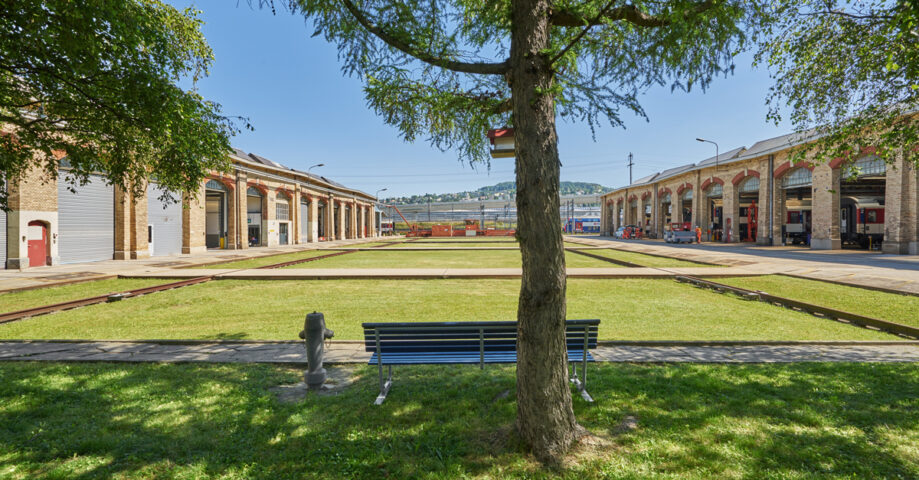
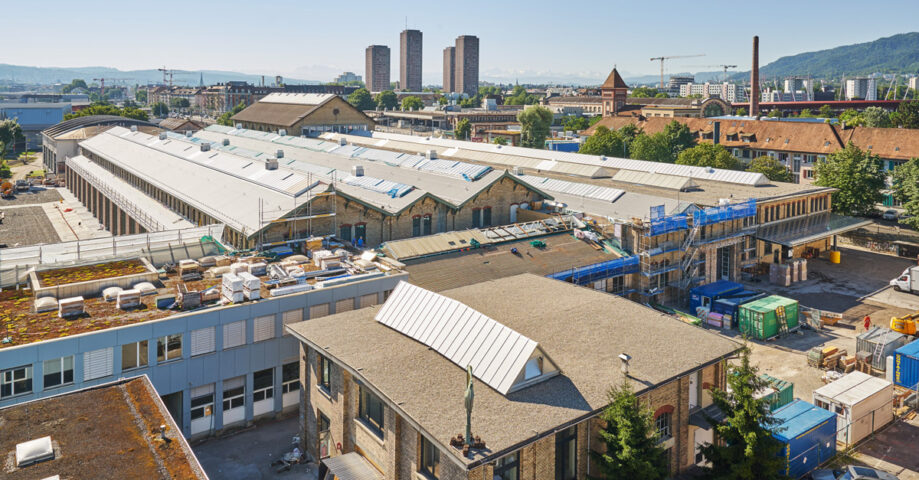
    SBB is transforming the 42,000-square-metre Werkstadt site in Zurich into a vibrant urban space, to be completed by 2035. This will preserve the fabric of its historic buildings, which will one day be joined by both new buildings and extensions to create an exciting cluster. The transformation of the former SBB workshops will be exceptionally sustainable, featuring climate-conscious building measures, circular economy elements and an innovative energy concept.

    Developing existing buildings
    In close coordination with the monument preservation authorities, the existing buildings will be gradually renovated and joined by new buildings and extensions in the coming years. At the heart of the site, the former carriage workshop ‘Building Q’ will allow for a diverse usage mix under one roof from 2023. The development will offer an exciting interplay between the fabric of historic buildings, structural densification and public use of outdoor space.

    © SBB AG, Martin Zeller

    Environmentally friendly construction
    ‘SBB wants to be climate-neutral by 2030, and climate-compatible construction is an important factor in achieving this objective,’ said Gabriele Bühler, Project Manager at SBB. Various climate-conscious building measures have been incorporated into the planning of the site. That includes configuring the new buildings to promote the circulation of cool air currents. Where possible, the roof water will be allowed to seep into an above-ground system for further cooling. Surfaces will remain unsealed where possible. The transformation follows a systemic approach that considers the building along its entire life cycle. The aim is to keep CO2 emissions as low as possible. To ensure circularity, all construction components are recorded on the Madaster platform. There is also a particular focus on reusing components. 

    Energy concept: 100% renewable
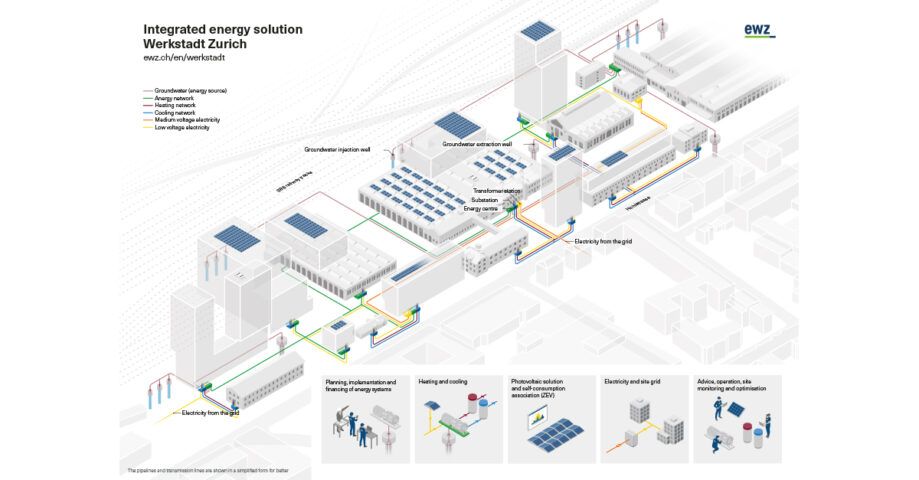
    ewz was able to win SBB’s public tender with an energy solution based on 100 per cent renewable energies. Groundwater, which is collected in four wells on the site, serves as a source of heating and cooling. From these wells, the water flows to the energy centres in the larger buildings, which house heat pumps and cooling machines that bring the water to the required temperature. An anergy network connects all the buildings and ensures that excess energy is exchanged between the building groups. For example, excess heat or cold in one building can be used in another. This system also has the advantage of not requiring groundwater boreholes in every building: the smaller buildings are connected to the energy centres via a local heating network. Heating and cooling is generated without any CO₂ emissions, as the rest of the electricity also comes from renewable sources. The use of a monovalent energy system will ultimately lead to a CO2 reduction of over 2,100 tonnes per year.

    High self-consumption of solar power
    ewz also plans, finances, creates and operates the transformer systems and medium-voltage lines to supply the site with electrical energy. ‘Some of the electricity that the people in the Werkstadt use on the site is produced there using photovoltaics,’ explains Markus Fischer, Head of Sales at ewz Energy Solutions. To this end, SBB and ewz want to make the best possible use of the roof areas for solar power production. Both the roof of Building Q, at the centre of the site, and the roofs of other buildings with a suitable structure and orientation for generating solar power are to be kitted out with photovoltaic systems. SBB requires its tenants on the site to form a self-consumption association (ZEV). ‘When completed, the ZEV will consist of around 300 parties that will use locally produced electricity on the site. This allows us to achieve a high self-consumption rate, which, in turn, makes a significant contribution to the cost-effectiveness of the photovoltaic systems,’ says Markus Fischer. He expects self-consumption on the Werkstadt site to be almost 100 per cent when completed.

    © SBB AG, Martin Zeller

    The benefits of contracting
    For the owner, this form of collaboration has various benefits, including keeping financial risks and management costs very low. If a system fails, ewz makes sure it gets back into operation as quickly as possible. To ensure that the system can be operated efficiently, ewz will start undertaking energy-related operational optimisations shortly after commissioning. As part of an ongoing process, the systems will be optimised and adapted to the actual needs relating to their use. By extension, this ensures that they consume as little energy as possible, generate minimal costs and offer maximum convenience for users.

    Werkstadt Zürich is a successful example of a forward-looking approach to repurposing a historic industrial site. With the targeted renovation and expansion of existing buildings and a ground-breaking energy concept, the developers – together with the planners and ewz – are creating added value for future users and the environment alike. Find out more about the Werkstadt site’s innovative energy concept here.


    https://www.ewz.ch/en/business-customers/real-estate.html

  • Lausanne station will be adapted to future needs

    Lausanne station will be adapted to future needs

    Together with its agents, SBB intensively sought solutions for the elements that had prevented the start of several construction sites in December 2022. In addition, the FOT had requested clarification regarding the statics in October and issued a partial plan approval order for passenger flows where questions were still open. Over the past six months, numerous technical and political consultations have taken place to find sustainable solutions.

    Solutions for the anchorages in the south of the station
    Additional information was requested for the new anchorages that reinforce the retaining wall and the statics of the south façade of the station. Test anchorages were built to check the geological conditions of the site. Now the dossier will be revised accordingly and submitted to the BAV for review in spring 2024.

    Solutions for the basement of Bahnhofplatz
    The FOT has requested additional information on the structural analysis of the basement of Bahnhofplatz. The structural analysis and the dossier will be revised by the end of the year so that the FOT can examine them in 2024.

    Solutions for the platforms and subways
    Aspects relating to the platforms and subways were objected to in the partial planning approval ruling. For this, the SBB project teams looked for improvements. In view of the increasing passenger volumes and services at Lausanne station, congestion-free and safe passenger flows represent a major challenge. In order to avoid the demolition of further buildings south of the station, perrons were defined for the project in 2012 that were narrower than ideal. Now SBB is planning wider platforms with more space for customers, partly due to the development of rail operations and the standards for track spacing in the station. At the same time, the new track geometry also provides the additional information required by the BAV with regard to structural engineering. Thanks to these improvements, Lausanne station can be used for longer without causing congestion.

    The new project requires over 1000 new plans, technical reports and calculation documents. The entire track and platform geometry of the station must be revised. The SBB and its agents need 2.5 years to prepare the documents, the FOT 12 months to review and approve this partial dossier. First, the consistency of the overall planning is assessed, then the various sub-projects are continuously checked and approved, provided they meet the technical and legal requirements. With the approximately 12 months delay that the project already has today, the work should be completed in 2037, i.e. 4.5 years later than originally planned. The additional costs for the new planning will be analysed in the coming months.

    New staging of the construction site
    The release of the planning approval dossiers in three phases leads to a new staging of the construction site. The planners tried to keep the burden on the customers as low as possible. The new planning also minimised the dependence on the metro project. Services at Lausanne station will be maintained during the work.

  • The federal government, cooperatives and SBB are giving impetus to non-profit housing

    The federal government, cooperatives and SBB are giving impetus to non-profit housing

    Apartments are scarce in the larger Swiss cities. This applies in particular to inexpensive apartments. In order to enable more non-profit housing construction, especially in central urban locations, the Federal Housing Office (BWO), Swiss housing cooperatives and the SBB have jointly drawn up framework conditions for a model building rights contract. The BWO also represented the Swiss Housing Association. This protects the interests of both umbrella organizations for non-profit housing construction. The model building rights contract will come into effect in future when SBB hands over land with building rights to non-profit housing developers.

    “We welcome the fact that SBB is making areas available for non-profit housing construction with building rights. This contract ensures that the framework conditions are compatible with the funding criteria for non-profit housing construction,” says Martin Tschirren, director of the BWO.

    “SBB aims to offer around half of its apartments at low prices – either through their own apartments or by paying the building permit.” According to Alexander Muhm, Head of SBB Real Estate, the new contract is an important step in this direction.

    “We are pleased that we have reached an agreement, even if the building lease interest for non-profit housing will be at the upper price limit,” emphasizes Eva Herzog, President of the Swiss housing cooperative. “Now we will take the SBB at its word to give more areas of building rights to cooperatives.”

    Compromise lays a uniform basis for future projects
    The common regulation has the advantage for all partners that future building rights contracts with non-profit housing developers no longer have to be negotiated from scratch for each project, but can be implemented more easily and quickly on the basis of the framework conditions that have now been agreed. The SBB advertises every sale of SBB land in the building law in a competition. In close cooperation with cities and municipalities, it ensures that the best use is found for the respective location.

    In particular, the new agreement regulates the assessment and development of the building lease interest and ensures that the non-profit apartments within the meaning of the Housing Promotion Act (WFG) are also inexpensive in the long term. This is because the building lease interest is based on the so-called cost rent and corresponds to the cost limits of the BWO.

    The new model contract also takes account of the fact that the SBB, as the owner of the land, participates moderately in the increase in value of the areas, as required by the strategic goals of the federal government. As a state-owned company, SBB is bound by clearly formulated tasks and goals. The owner expects SBB to develop railway areas in a targeted manner and thus make a long-term contribution to a financially healthy railway system.

    The promotion of non-profit housing is a constitutional mandate of Swiss housing policy. The non-profit property developers – housing cooperatives, foundations or associations – orientate themselves towards the cost of rent and operate without the intention of making a profit. Your apartments are inexpensive in the long term. Many non-profit property developers offer their tenants various social services in addition to living space, thereby relieving the public sector. In addition, this type of housing promotes social mixing and generational diversity.
    SBB can look back on around 100 years of tradition in working with non-profit housing developers. This is based on the support of the railway workers’ building cooperatives, which were among the pioneers of cooperative housing construction.

  • City Com Baden invites you to the 2nd Shopping City Forum

    City Com Baden invites you to the 2nd Shopping City Forum

    The association of retailers City Com Baden is organizing the 2nd Baden Shopping City Forum on Thursday, June 2nd. According to a message on LinkedIn, the start is at 7 p.m. in the Trafo Culture and Congress Center in Baden in Hall 36.2. The hall opens at 6.30 p.m.

    Michael Wicki, President of City Com Baden, welcomes the participants to the second forum of this kind. According to the programme, the topic of the evening will be questions relating to construction and real estate. The title of the input lecture is: “Construction site shopping city – projects and challenges”. Gabriela Rast, portfolio manager of the SBB pension fund, and Fredy Hasenmaile, head of real estate analysis at Crédit Suisse, will speak about this. Daniel Lorenzi , owner and managing director of the kitchen shop of the same name, reports from practice. Katia Röthlin from the communications agency Röthlin & Röthlin in Baden-Dättwil will moderate the event.

    At 7.30 p.m. there are workshops on the following questions: Conversions and new buildings – how do we remain accessible to customers? Attractive store mix – who will ensure the right tenant successor? New space offers – what do start-ups need? The evaluation of the group discussions is scheduled for 8:15 p.m. and after Michael Wicki’s closing remarks, an aperitif riche awaits.

    The shopping city forum is an initiative of City Com Baden and the contact point for business in the city of Baden, which used to promote the city. The inspiration and discussion platform works in a hybrid way – with physical events on specific topics and as a virtual place where the latest developments in the shopping city are continuously disseminated and negotiated, according to the aim of the event on the LinkedIn page.

  • "The spirit of optimism is palpable"

    "The spirit of optimism is palpable"

    Herr Camenzind, wie hat sich die Urner Standortentwicklung und Wirtschaftsförderung in den vergangenen Jahren verändert?
    Als ich 2012 ins Amt gekommen bin, haben wir die Ansiedlungsstrategie angepasst und sind eine Zusammenarbeit mit der Greater Zurich Area eingegangen. Das war ein wichtiger Schritt. Dann kam die Tourismusentwicklung in Andermatt dazu. Solche Entwicklungen sind wichtige Standortfaktoren und Verkaufsargumente. Man redet heute im Kanton Uri weniger über die Stausituation vor dem Gotthardtunnel sondern mehr über Andermatt. Die Entwicklung im Urner Talboden ist indes anders gelagert. Hier haben wir es in den letzten sechs, sieben Jahre vor allem mit Quartierentwicklungen zu tun gehabt. Wir als Kanton Uri besitzen im Urner Talboden auch Land, welches wir entwickeln möchten und das für Gewerbe und Industrie zum Verkauf steht. Ein weiterer wichtiger Standortfaktor ist der neue Kantonsbahnhof, an dem seit dem letzten Dezember internationale Züge halten. Bei uns ist in letzter Zeit sehr viel passiert. Diese Entwicklungen nehmen wir dankbar im Standortmarketing auf, damit wir spannende Geschichten erzählen können.

    Was sind die Vor- und Nachteile der neuen Destination Andermatt und des Kantons generell?
    Der Vorteil von Andermatt ist ganz klar: Wir sind als Kanton Uri positiv im Gespräch. Wir können unser Image verbessern und etwas für die Ausstrahlung des ganzen Kantons tun. Alleine in Andermatt sind 1000 Arbeitsplätze neu geschaffen worden. Und das nicht etwa durch Umlagerungen oder Umstrukturierungen. Es sind Arbeitsplätze, die wir in der Art und Vielzahl bislang nicht hatten. Das ist sicher sehr positiv. Und es hilft uns wiederum auch auf anderen Gebieten, wo wir vielleicht noch schwächer aufgestellt sind. Dieser Effekt strahlt mittlerweile in die umliegenden Gemeinden aus. All das wirkt sich positiv aus – bis hinunter in den Urner Talboden um Altdorf.
    Die Nachteile sind gestiegene Immobilienpreise – vor allem in Andermatt. Das ist teils schwierig für die lokale Bevölkerung. Ich bin aber überzeugt, dass Andermatt und seine Bevölkerung unter dem Strich von der Tourismusentwicklung profitieren.

    Wie sieht die Situation im Kantonshauptort Altdorf aus?
    Hier in Altdorf sind wir gut unterwegs – insbesondere dank dem neuen Verkehrsknotenpunkt in Altdorf. Dadurch ist der Kanton noch besser erschlossen. Wir haben hier gute Entwicklungen, etwa mit der Dätwyler in Schattdorf, welche unter anderem Kaffee-Kapseln für Nespresso herstellt. Die Perspektiven des Kantons Uri sind wesentlich besser als noch vor 20 Jahren. Vorher haben wir nur von Arbeitsplatzabbau der RUAG, SBB und beim Militär geredet. Das ist nicht mehr das Thema. Heute suchen
    die Firmen hier händeringend nach Arbeitskräften.

    Wie sehen Angebot und Nachfrage auf dem Urner Immobilienmarkt aus?
    In Altdorf und im Urner Talboden ist in den letzten zehn Jahren so viel gebaut worden wie noch nie. Die Befürchtungen, es gebe aufgrund der Neubauten irgendwann hohe Leerstände, haben sich glücklicherweise nicht bewahrheitet. Wir haben keine hohe Leerwohnungsziffer. Es sind in den vergangenen zehn Jahren etwa 3000 Wohnungen im Kanton neu gebaut worden. Das ist für Urner Verhältnisse viel. Die Preise sind hingegen stabil geblieben und nicht unter Druck geraten. Das hat vielleicht auch damit zu tun, dass wir im Verhältnis wenig Wohnfläche pro Einwohner hatten. Bis vor zehn Jahren waren wir noch bei etwa knapp 40 Quadratmeter pro Person. Im Schweizer Schnitt sind wir mittlerweile bei 50 Quadratmeter pro Person. Da haben wir jetzt ein wenig aufgeholt. In den letzten fünf, sechs Jahren ist darüber hinaus auch ein Bevölkerungswachstum im Kanton Uri festzustellen. Dies absorbiert die Wohnungen, die gebaut werden. Der Markt funktioniert.

    Wie geht es dem Gewerbestandort Uri?
    Eine der stärksten Branchen im Kanton Uri war schon immer die Baubranche. Das hat mit den grossen Infrastrukturprojekten zu tun: Kraftwerke, Bahngeleise, Autobahn, Tunnelbau. Das sind alles Baumeisteraufgaben. Da wird etwas gebaut, später stehen dann Sanierungen in regelmässigen Abständen an. Nehmen wir beispielsweise die Autobahn: Die Gotthardautobahn wird – mit der notwendigen Sanierung – jetzt quasi zum dritten Mal gebaut. In diesem Bereich tut sich also immer etwas. Dann ist Dätwyler mit seinen etwa 900 Angestellten in Uri ein sehr wichtiger Akteur. Die Metallverarbeitung war bei uns schon immer stark. Wir haben sehr viele mechanische Metallverarbeitungsbetriebe mit grossem Knowhow.

    Wir kommen auf den Neubau der Urner Kantonalbank zu sprechen: Welche Impulse gehen davon aus?
    Auf den entstandenen Büroflächen konnten bereits spannende Firmen eingemietet oder angesiedelt werden, unter anderem das norwegische Software-Unternehmen Crayon. Das ist eine internationale Firma, die auch weiterwächst und erst vor wenigen Jahren in den Kanton Uri gekommen ist. Das hilft uns und dem Standort. Auch ziehen solche Erfolgsgeschichten immer weitere Ansiedlungen an. Das hat Ausstrahlung über den Standort Altdorf hinaus. Zusätzlich entstehen noch weitere Bauwerke rund um den Kantonsbahnhof wie Wohnungen und Geschäfts- und Gewerbeflächen. Es ist wichtig, dass wir am verkehrsreichsten Punkt von Uri eine weitsichtige und ausgewogene Entwicklung haben, und der Neubau der Urner Kantonalbank ist hierfür ein guter Start.

    Alles in allem finden auf kleinstem Raum im Kanton Uri gerade sehr viele Investitionen statt. Die positive Aufbruchstimmung und Dynamik gilt es jetzt, gewinnbringend zugunsten des Kantons Uri zu verwenden.

  • Four companies have been nominated for the Swiss Logistics Award

    Four companies have been nominated for the Swiss Logistics Award

    The Bern association GS1 Switzerland has nominated four companies for this year’s Swiss Logistics Award. According to a press release , the award recognizes “special market and customer-oriented process solutions” that are considered to be particularly promising.

    The Feldschlösschen Brewery based in Rheinfelden AG is one of the nominees. She was able to convince the jury with a project for the environmentally friendly delivery of drinks. By 2030, Feldschlösschen wants to operate all of its logistics in a CO2-neutral manner. It has already procured 20 new 26-ton electric trucks for this purpose.

    Secondly, Gilgen Logistics from Köniz BE is one of the nominees. The company is digitizing its intralogistics systems. It relies on augmented reality and the cloud, for example. Each element of the system receives a digital twin. In this way, the system can be presented digitally to customers or to service. The retailer Denner has already put a digitized system from Gilgen into operation.

    Thirdly, Kemaro from Eschlikon TG was chosen among the nominees. The company was able to convince with a dry cleaning robot. This can clean autonomously in logistics and without the use of chemicals or water. According to the information, it can reduce cleaning costs by 50 percent.

    The fourth nominated company is SBB Cargo based in Olten. The goods division of SBB was able to convince with the Urban Mining Logistics Zurich project. SBB Cargo is building a plant for recycled concrete together with Zürcher Spross Transport & Recycling AG. This recycles demolition material supplied by the city of Zurich. Primary and secondary raw materials are transported exclusively by rail. According to the announcement, the concept was created through the combination of urban mining, urban logistics and rail logistics.

    The Swiss Logistics Award will be presented on June 8th in the Kursaal Bern.

  • Walo completes work at Kesswil train station

    Walo completes work at Kesswil train station

    Walo Bertschinger completed the renovation of a track section at Kesswil station in the short time available. According to a statement on Facebook and on the company’s dedicatedwebsite for this project, it has rehabilitated 595 meters of track for SBB in just seven days.

    In order to meet the time challenge, the work steps had to be precisely interlinked. The close coordination between the various performance centers for transport and logistics, civil engineering, track construction and road construction was carried out by Raphael Reber, construction manager for track civil engineering, according to Walo.

    In order not to endanger the increased volume of traffic with the replacement buses, a concept was worked out with the municipality and the SBB. A temporary bridge was used to calm the volume of traffic in the town of 1,000 inhabitants and to bring around 1,000 trucks to the construction site by a shorter route. In addition, a 600 meter long construction slope was built along the construction site.

    First the rails were removed and then the old ballast was excavated. This was washed and processed. Due to the washed material and the resulting shorter transport routes, Walo was able to guarantee savings of around 65 tons of CO2. A new drainage system was installed for the substructure renovation.

    After the provisional approval of the SBB for the use of the washed ballast, the laying of the tracks could begin. Around 1,000 new sleepers were used for the 595 meter stretch. A report of the construction work with comments from the construction management can be seen on YouTube.

  • Flooded river Sihl should flow into Lake Zurich

    Flooded river Sihl should flow into Lake Zurich

    From 2026, extreme flood peaks in the Sihl are to be channeled into Lake Zurich via a relief tunnel, according to a statement from the Canton of Zurich ‘s building department. For this purpose, a 2 km long underground tunnel with a diameter of 6.6 m is planned between Langnau am Albis and Thalwil. The start of construction for the project took place on March 18th with the groundbreaking ceremony.

    Extreme flooding of the Sihl could cause severe flooding in the lower Sihl valley and in the city of Zurich, the statement said. The possible damage for the city of Zurich alone is estimated at up to 6.7 billion Swiss francs. They should be averted by the relief tunnel.

    The costs for the planning and construction of the tunnel as well as for the ecological replacement measures on the Sihl and on Lake Zurich are estimated at around 175 million francs. They are largely borne by the canton of Zurich. In addition, the federal government, the city of Zurich, the SBB and the Sihltal Zurich Uetliberg Bahn SZU AG share in the costs. The Canton of Zurich is making further information on the project available on the internet .

  • Station area Wettingen becomes a residential area

    Station area Wettingen becomes a residential area

    Under the aspect of living and working directly on the track, the SBB has announced an architectural competition for the design of their area at the railway station in Wettingen . According to the press release, the results are now available. They can be viewed in an exhibition in the foyer of the Tägi Wettingen until Tuesday, March 8th.

    The winning project is called Stadtlaube and, according to the SBB announcement at Wettingen station, envisages two long, five-storey residential buildings with service, retail and catering areas on the lower floors and a four-storey service building with public-oriented uses. The historical railway buildings are preserved.

    The two buildings to the west of the station form a boundary opposite the track field and thus create living and recreation space in a central location, according to the project announcement. The entrance areas and partly open-plan staircases are intended to provide a view of the railway tracks. There will be small squares and a play street in front of the house entrances. Flexible 2.5 to 4.5 room apartments with private outdoor areas and communal roof terraces are planned.

    A four-storey service building with shops and restaurants is planned to the east of the residential buildings and embedded in the historic station buildings. According to the announcement, the protected individual objects Lokremise, goods shed, station building and turntable will be preserved.

    The winning team of the architectural competition consists of Burkard Meyer Architects from Baden AG, ASP Landscape Architects from Zurich, MWV Civil Engineers from Baden, Leimgruber Fischer Schaub from Ennetbaden AG, Mühlebach Partner from Winterthur and Scherler AG from Lucerne.

  • Planned SBB workshop in Ticino clears hurdle

    Planned SBB workshop in Ticino clears hurdle

    The SBB wants to build a new plant in Bellinzona’s Arbedo-Castione suburb. The Federal Office of Transport has defined a planning zone of around 150,000 square meters for this purpose. In March 2019, complaints were filed with the Federal Administrative Court. The complainants argued that crop rotation areas had been sacrificed too much and also wanted another location in the Bodio/Giornico TI area to be better examined.

    The Federal Administrative Court has now declared the complaints inadmissible due to “lack of legitimation on the part of the complainants”, according to a statement . The judgment can still be appealed to the federal court.

    According to SBB plans , the Ticino plant should be completed by 2027. The total investments amount to 580 million Swiss francs. A total of 360 employees and 80 trainees are to be employed at the plant.

  • Watt d'Or honors innovative companies

    Watt d'Or honors innovative companies

    The Swiss Watt d'Or 2022 Energy Prize was awarded on January 6th. The Federal Office of Energy ( SFOE ) has been presenting this seal of approval for energy excellence every year since 2007 on the occasion of its New Year's event. The prizes are not endowed. They should motivate business, politics and the general public to discover the advantages of innovative energy technologies for themselves.

    Schaerraum ag received the award in the building and space category. In just eight months of construction, she built a climate-neutral multi-storey residential and office building made of regional wood in Horw LU. According to a press release by the SFOE, it produces 50 percent more electricity than it needs. In addition, the rental prices are around 20 percent below the local average. This is made possible by the modular planning principle RaumRaster.

    In the renewable energies category, Verora AG is awarded to a group of farmers from the Zug mountain region. Since 2012, it has been producing biochar from tree and shrub cuttings with a pyrolysis system that has been further developed in-house. As a feed additive, it reduces the formation of gas during the digestion of cows and the smell of ammonia in the barn. It also increases the nutrient content of fertilizer and compost and binds CO2 for centuries.

    No winner was chosen in the mobility category this year. SBB receives the Watt d'Or 2022 in the energy technologies category. It has developed intelligent load management software that replaces the construction of new, expensive electricity production plants. In the event of peak loads, for example when many trains are accelerating at the same time, it switches off the train car and point heating for a short time. In this way, SBB can flexibly control 70 megawatts by 2023, according to the SFOE: "It is thus assuming a role model for the general electricity grid in Switzerland."

  • Dietikons Bahnhofsplatz is being redesigned with the SBB

    Dietikons Bahnhofsplatz is being redesigned with the SBB

    The planned competition program for the redesign of the Dietikon station area can now be started. The Dietiker city council has approved a loan of 56,000 francs for the preparation of the "Bushof / Bahnhofplatz competition program" and the necessary clarifications, according to a message from the city chancellery. The contract for procedural support had been awarded to the Zurich consulting firm Eckhaus AG. In addition to upgrading the public space with quality of stay and a wheelchair accessible hub for public transport, an attractive location for living and working is to be created on the SBB site, according to the city of Dietikon about the project .

    The city of Dietikon and the SBB jointly awarded an urban planning study contract for the Dietikon station area in 2019. The "in-depth study of the Dietikon station area" was exhibited in plans and models in November and December 2020 on the window front of the Dietikon town hall. The results report was also available on the Internet.

    According to the plans of the city of Dietikon, the bus station is to be redesigned around two islands. This creates a largely traffic-calmed space in front of the train station, which is to be landscaped and planted with trees to create a lingering zone. According to the announcement, the SBB wants to develop a lively district from its parcels west of the track field. The station building is to be extended. Two construction sites for an office building and a complex with 200 apartments are planned on the parking lot.

  • A superlative future project

    A superlative future project

    Where the SBB's repair center (Depot G) is located today, a new piece of the city is to be built in the middle of the city in the future. This is done on an area larger than four football fields. Those responsible for the project envision that different offers for living and working as well as spacious public spaces should be created on the Neugasse area for the neighborhood and for the entire city. Also for people who should help shape the space and life there with their ideas. Speaking of co-design: how the Neugasse area will be designed for the future in detail, the SBB will design together with the population, politics and administration.

    75 percent of the area is planned for living – a total of 375 apartments. The following distribution is planned:
    1/3 non-profit housing construction (building rights to cooperatives)
    1/3 limited-price living
    (created by SBB)
    1/3 living for market rent
    (created by SBB)

    25 percent of the area is planned for trade, culture and communal or public uses.
    10 percent school
    (Building rights to the City of Zurich)
    15 percent commercial, cultural and communal uses (1/3 of it in building rights for cooperatives). ■

  • All industry participants must be ready for change

    All industry participants must be ready for change

    What exactly is Building Information Modeling?
    Literally translated, BIM means building information modeling – that's a pretty good idea. With BIM, one is able to determine and further use the data necessary for operation in addition to the digital planning and execution of projects. You work with three-dimensional models that are nothing more than visually represented databases. That sounds complicated now, but it's not at all, it's just a new way of working. We used to have two-dimensional plans, now we have three-dimensional digital building models. It is important that everyone involved can access the same data, in new German: Single Source of Truth. You can therefore be sure that the data stored in databases is not only up-to-date, but also correct and of course relevant for further processing. This is where the greatest benefit lies.

    Why did the SBB decide to use BIM for construction projects?
    We see clear potential here in data processing and in the entire value creation process. The SBB anticipate a sustained reduction in capital-bound expenses for planning, realizing and managing real estate. Of course, this also applies to the entire railway infrastructure owned by SBB.

    We can also work very strongly towards reducing CO2, as we can, for example, use the data to simulate how operations will develop over the next 20, 25 and more years. You can also compare projects with each other and thus learn from other projects. This is how we create transparency over the entire life cycle.

    How is BIM actually used in the construction of the Letziturm project?
    The Letziturm was one of the first building construction projects by SBB Immobilien to be implemented using BIM-supported methods and working methods. It is also a learning project for the management phase. The planning and implementation of such a project will be completed in ten years, but we will manage the building at least four times longer. For example, we will use the knowledge gained from the Letziturm to carry out material samples. We are in the process of implementing plan approvals via the collaboration platforms. We have learned a lot about what we can use to optimize planning and implementation – and we see this as an important first step.


    "You can no longer do it alone as a client."

    What is your current summary of the use of BIM?
    We recognized the potential of BIM for SBB at an early stage and actively promoted development with the BIM @ SBB group program that was set up for this purpose. We have already made important progress in this way. The BIM @ SBB program is based on four pillars that are mutually dependent: development, testing, standardization and the specific take-away of the industry. We share all of our knowledge and experience with our partners at events and receive inputs from the market that we specifically incorporate into the development. We involve our community. It is no longer possible to work alone as a client, it takes a strong, mutual cooperation. This is also reflected in the skills of the employees. We feel that the employees are very interested, they want to learn from one another together. It's incredibly exciting and instructive for everyone involved

    What are the advantages?
    Of course, a now data-driven implementation changes the way in which we work with our partners and develop the projects in close cooperation. In fact, projects are processed faster and more securely if everyone involved is also involved. The already mentioned “Single Source of Truth” is another advantage. The system data is stored in a structured manner, can be found quickly and is always up-to-date. Lengthy searches and verification of the data are largely eliminated. Communication is more targeted than before and is benefit-oriented. Project teams can find solutions much faster, can view problems and pending issues directly on the three-dimensional model and work out variants and alternatives together. That helps for mutual understanding.

    Are there any disadvantages?
    BIM is often only associated with the technology aspect. Of course, it's nice to hover over the construction site in a Hololens. But if the underlying data is not correct, the most modern technology is of no use. Data has to be correct, a new way of working with precision is required. There are only two states of data: correct or not. Not everyone in the value chain is ready to use new technologies and methods. Everyone in the industry must be ready to change and do their part to make it happen.

    What could be the reasons that BIM has not yet caught on in Switzerland?
    Many associate BIM with the use of the latest software or the latest database technology. Often this is necessary, but not yet sufficient. To be successful, our way of thinking and working methods will have to change further. In the BIM environment, we often speak of collaborative project teams that develop solutions together. This process takes time, but the trend makes me positive. It is also up to us public clients to further promote this development and to require the use of BIM when awarding projects, as we did with the Letziturms project.

    What are SBB's goals for the use of BIM?
    We currently have almost two dozen pilot projects that we provide with the basics and try out a wide variety of methods, technologies and techniques. The knowledge gained from this flows into the development. International principles are also taken into account by means of normalization and standardization. In this way we can ensure that we have our finger on the pulse. This knowledge is given back to the industry in a targeted manner. From 2021, the use of BIM will be mandatory for state-related companies in building construction, according to the federal digital strategy, and from 2025 for the infrastructure, as much more has to be worked out here. That is our stated goal.

    SBB BIM project Letziturm:
    Between the train stations in Zurich Altstetten and Hardbrücke, a new urban area is developing along the track area due to the restructuring of existing commercial and industrial areas. The Letziturm as a six-storey building base takes up the edge of the listed warehouse in the east. He thus defines a first urban horizon. The two residential towers are based on the building height of Letzibach D. The planned single tower will thus create an ensemble of three tall buildings.

    Construction started this year. The 178 residential units, consisting of 1.5 room to 7.5 room apartments, should be ready for occupancy from autumn 2022. The ground floor is characterized by the two main entrances and the two commercial rooms, each of which is oriented towards the future square and towards the SBB workshops. Between them are the ground floors of four larger, two-story studio units that combine work and living and, if desired, connect directly to the public space.

    Both the small and the larger residential units are housed in the base building. 2.5 to 4.5 room apartments are planned above the 7th floor, which has a common room