Tag: SBV

  • Decline in orders continues

    Decline in orders continues

    In the first half of 2023, the main construction industry generated 11 billion Swiss francs in turnover, which is practically stagnant compared to the same semester last year. Building construction and civil engineering developed similarly. Accordingly, capacity utilisation is still high and the employment situation is good.

    Lower construction activity in the medium term

    In the medium term, however, the outlook is becoming gloomier. In the first half of the current year, orders in building construction were CHF 0.6 billion lower than in the same period last year, in civil engineering CHF 0.5 billion lower. Overall, this corresponds to a decline of 8.3 percent. Several companies even reported a negative order intake overall. This means that already planned construction projects were temporarily paused, redimensioned or completely put on hold.

    Accordingly, the work in progress has also decreased in the past quarters, standing at 15.9 billion Swiss francs at the end of June 2023, 2.6 percent lower than a year ago.

    From housing surplus to housing shortage

    The stock of housing orders has also declined. The trend is clear, too few flats will be built this year and next. In the last 12 months, the franc volume of approved housing applications has fallen by 9 per cent compared to the previous 12 months. The housing shortage could be solved more quickly with less regulation. In addition, appeals are often used to push through particular interests at the expense of the creation of new housing. SBC will lobby accordingly at the Federal Council’s next round table on the housing shortage so that construction activity can be accelerated again.

    SBC thanks Credit Suisse for very good cooperation – Construction Index to be continued

    The Construction Index predicts a 2% increase in turnover for the next quarter compared to the same period last year. This edition marks the end of SBC’s 14-year partnership with Credit Suisse on the Construction Index. SBC would like to thank Credit Suisse for the always very good cooperation, it has been greatly appreciated. SBC will continue the established forecasting tool, from the 4th quarter of 2023 in an adapted form and with a new look.

  • SBV erwartet das Zinserhöhung ein Prozent Umsatz jährlich kostet

    SBV erwartet das Zinserhöhung ein Prozent Umsatz jährlich kostet

    Am 22. Juni 2023 hat die Schweizerische Nationalbank (SNB) den Leitzins auf 1.75 Prozent erhöht. Damit nicht genug, die SNB dürfte den Zins im Laufe des Jahres weiter erhöhen, weil sich die Inflation hartnäckiger hält als bisher angenommen. Die Inflation wird in der nächsten Zeit etwa von den steigenden Wohnungsmietpreisen und höheren Stromkosten getrieben. Sowohl im 2023, aber auch in den nächsten beiden Jahren dürfte die Inflation gemäss der SNB-​eigenen Prognose bei etwas über 2 Prozent liegen, was über dem Zielkorridor der SNB liegt.

    Mittels fünf Schritten sind die Zinsen von -0.75 auf nun 1.75 Prozent gestiegen. Weitere Erhöhungen bis Jahresende sind absehbar. Da sich die Schweizer Konjunktur dieses Jahr abkühlt und die Wirtschaft nur noch schwach wächst, darf die SNB jedoch nicht über das eigentliche Ziel hinausschiessen. Daher sei an dieser Stelle davon ausgegangen, dass der Zins bis zum Jahresende noch zwei Mal um jeweils 0.25 Prozentpunkte angehoben wird. Es wird ausserdem angenommen, dass ab 2024 keine weiteren Schritte folgen, der Zins also mittelfristig bei 2.25 Prozent stabil bleibt.

    Bis zu 1.4% tieferes Umsatzwachstum im Jahr
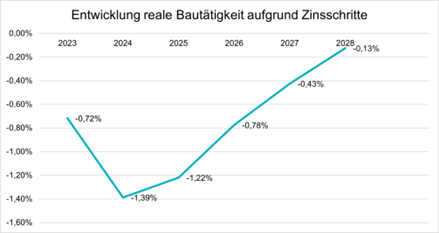
    Ein Rechenmodell des Schweizerischen Baumeisterverbands SBV zeigt, wie stark ein Zinsanstieg die Bautätigkeit negativ beeinflusst. Die Beeinträchtigung dehnt sich langsam und über die Zeit aus. In den ersten beiden Jahren wird das Umsatzwachstum am stärksten beeinträchtigt, aber selbst im fünften Jahr nach den Zinserhöhungen sind noch leichte, negative Auswirkungen spürbar. Die Aussagen beschreiben, wie sich der Umsatz entwickelt im Vergleich zu einer Welt, wenn die Zinsen nicht gestiegen wären.

    In den nächsten fünf Jahren dürfte der Umsatz im Bauhauptgewerbe deswegen kumuliert um 4.65% langsamer wachsen als wenn die Zinsen nicht gestiegen wären. Die grössten realen Umsatzeinbussen sind in den Jahren 2024 (-1.39%) und 2025 (-1.22%) zu erwarten.

    Positive Gegenkräfte könnten Umsatz wachsen lassen
    Die anhaltend starke Zuwanderung, der Nachholbedarf im Tiefbau sowie die Unterstützungsgelder für klimafreundliche Umbauten sind Faktoren, welche den Einbussen durch die Zinsen entgegenstehen und zumindest mittelfristig den Umsatz doch noch positiv wachsen lassen könnten.

    Insgesamt lässt sich also festhalten, dass sich die Leitzinserhöhungen auf den Geschäftsgang der Baufirmen auswirken, auch wenn die Auswirkungen insgesamt begrenzt sind. Das Bauhauptgewerbe bleibt unabhängig vom Zinsniveau eine wichtige Stütze der Schweizer Wirtschaft.

  • Master builders want to respond to the study on the shortage of skilled workers

    Master builders want to respond to the study on the shortage of skilled workers

    “Our industry is doing well after three years of permanent crisis,” said Central President Gian-Luca Lardi, welcoming the more than 550 guests to the Construction Industry Day at the LAC Lugano Arte e Cultura cultural centre. “The master builders have learned to deal with the effects of the Ukraine war, just as they did before with the price increases and supply bottlenecks in the wake of the Corona pandemic.” And the future outlook is also quite positive in the medium to long term, according to Lardi. Construction activity should continue to grow, “albeit at a somewhat slower pace”. While strong growth is forecast for residential construction until 2040, mild growth to stagnation is expected in commercial construction, public building construction and public civil engineering. At the same time, builders can look forward to prices for building materials gradually falling again.

    SBC study shows: Shortage of skilled workers endangers jobs
    The focus of this year’s networking event was on the shortage of skilled workers and what mix of measures can be used to combat it. Today, the search for suitable employees at all levels is a major challenge for many tradespeople, including master builders. And it can be assumed that the situation will get even worse. With far-reaching consequences. “Without enough qualified craftsmen, important construction projects in our country can no longer be realised,” Lardi explained. To prevent such a scenario, the Swiss Association of Master Builders commissioned the Demographics Competence Centre to conduct a “Study on the Long-Term Development of the Economy and Skilled Workers in the Main Construction Industry”. Now the results of the study are public: while the demand for skilled workers in the main construction sector continues to rise, the supply is falling. By 2040, the shortage of skilled workers in the most important professions in the main construction industry – measured in terms of construction volume – is expected to reach 16 percent. Without countermeasures, there would be a shortage of about 30 percent of the required employees, i.e. about 2,500 skilled workers, among bricklayers and masons alone. This has an impact on turnover: If no measures were taken, the construction industry would lose up to 800 million Swiss francs annually due to the lack of skilled workers, or 13 billion Swiss francs in total over the next 20 years, adjusted for prices.

    Digitalisation and personnel recruitment as hopefuls
    The study points to several solutions against the shortage of skilled workers. “If we increase turnover per capita by 0.5 per cent annually, we can make up for 50 per cent of the shortage of skilled workers,” Gian-Luca Lardi reassured, however. This increase in productivity is to be achieved mainly with the help of digitalisation and through innovations. At the same time, the industry must do everything it can to “train more apprentices, keep skilled workers in the profession longer and ultimately recruit more lateral entrants”. In this way, the other half of the skills gap could be closed. The study points out several levers that can be tightened. For foremen and forewomen, where the shortage will develop less precariously than in other construction professions, lateral entrants already play an important role today. With targeted career and junior staff planning and support, the number of people in management positions can be increased. In apprenticeship training, it is very important to motivate young people to successfully complete their bricklaying apprenticeship and also to stay in the main construction trade in the long term. The decisive factor is not only the management and company culture, but above all the many great, “cool” construction projects that the young people can actively shape. Then they see that their work offers meaning and creates sustainable values.

    Lardi ended his speech with an appeal to all project participants, i.e. builders, planners, specialists, construction companies and political decision-makers alike: “We will only be able to realise our future building park and infrastructures if we work together in true partnership and at eye level.”

    Source: https://baumeister.swiss/

  • Association of Master Builders demands increase of the threshold to eight percent

    Association of Master Builders demands increase of the threshold to eight percent

    In a report published on Friday, the State Secretariat for Economic Affairs SECO speaks plainly on the job notification requirement: “The development of the unemployment rate has a delayed effect on the number of occupational types subject to mandatory notification.(…) This means that at times of historically low unemployment, particularly in the second half of 2022, relatively many occupational types were subject to mandatory job notification.” With consequences for various sectors such as the construction industry. “Due to the simultaneous increase in demand for labour, various areas of the labour market entered a phase of shortage of skilled workers and labour,” the SECO report “Enforcement Monitoring of the Mandatory Job Notification” continues. This situation has only calmed down since the list of occupations subject to compulsory notification was reduced to a practical level as of 1 January 2023, thus more than halving the scope of the job notification requirement.

    The Swiss Association of Master Builders (SBA) also notes that the job notification requirement works in principle from a technical point of view and that the information advantage it gives jobseekers also offers advantages for the economy – provided that the regional employment centres (RAV) can actually forward dossiers of suitable candidates to companies for vacancies. This is because the perspective of the past has repeatedly led to a number of occupations with a clear shortage of skilled workers being subject to compulsory registration. This has had consequences in the main construction industry in particular: for jobs as concrete builders, cementers or the collective category that includes “other professions in the main construction industry”, the probability of successful placement has been a mere 1.5 to 2 per cent, according to estimates by the Institute for Economic Studies in Basel. In view of these vanishingly small chances of success, the construction companies rightly complain about the high costs involved in reporting a job to the RAV.

    Corrections to the mandatory job notification system are necessary
    It is therefore all the more important that the motion “Mandatory job notification. Re-introduction of a practical threshold value” by Erich Ettlin of the City Council, which is mentioned in the SECO report as one of several political initiatives on the job notification requirement, should now be dealt with and passed quickly in parliament. If the threshold value is eight percent instead of five percent in future, as called for by the motion, the danger of distorting temporal effects is much smaller. SBC also supports approaches that improve the quality of the survey methodology for the relevant percentage and make greater use of digital tools.

  • Yes to the partial revision of the Environmental Protection Act gives additional impetus to the circular economy

    Yes to the partial revision of the Environmental Protection Act gives additional impetus to the circular economy

    Construction activity in Switzerland produces around 57 million tonnes of excavated material and 17 million tonnes of excavated material per year. The term “waste” should not be used in this context, as it tempts one to confuse the statistics with the volume of rubbish that is disposed of. Rather, this total of 74 million tonnes of material is an indication of how many tonnes of excavated and spoil material accumulates as a valuable resource, much of which can be recycled. In order to make the best possible use of this, ideal legal framework conditions are needed. Such improvements are included in the partial revision of the Environmental Protection Act, which the National Council will deal with on 3 May 2023 during the special session.

    SBC already supported the goal of creating an appropriate framework in the Environmental Protection Act for a modern and environmentally friendly circular economy during the consultation process in February 2022. The chosen regulatory approach consisting of a mixture of incentives, competences for regulation and promotion instruments seems to be purposeful. However, it is important to underline that the companies in the construction industry have long since implemented many of the main concerns of the revision on a voluntary basis. In addition, important legal foundations have already been created, such as the Ordinance on the Prevention and Disposal of Waste (VVEA). This gives high priority to the avoidance, reduction and targeted recycling of waste.

    Close coordination with the construction industry is important
    With life-cycle-optimised buildings, resources and materials can generally be kept in circulation or recycled over several object life cycles without any loss of quality or functionality. The construction industry has already developed many innovative solutions in this regard and will continue to develop them. However, the choice of materials for building projects is made by the clients, architects and planners and not by the building contractors. It is important to convince them to integrate the circular economy at a very early stage in project development. SBC therefore appeals to these stakeholder groups and to politicians to coordinate closely with builders in the implementation of the Environmental Protection Act in order to make use of the know-how of the entire construction industry and to prevent inhibiting framework conditions or false incentives. Another key issue for the SBC is the compatibility of the Swiss Environmental Protection Act with international standards and regulatory requirements. It is explicitly important to take developments in the EU into account in order to prevent a Swiss Finish and the resulting trade barriers.

    Abandonment of national limit values for grey energy
    SBC suggests that national limit values for grey energy be abandoned. In practice, the correct recording of grey energy in new buildings and renovations is tantamount to a Herculean task that is likely to fail – or worse – could deliver distorting results. The end result would be a de facto ban on certain construction methods and materials, which in turn would lead to immense increases in the cost of buildings. Instead of such limit values, which are unsuitable in practice, the tendering of buildings should always be oriented towards the required or desired function and not towards specific building materials. This is determined by the demands on the building. It is important to consider not only the conservation of resources, but also overall sustainability for the environment, the economy and society.

  • Builders' Association pleads for replacement new buildings

    Builders' Association pleads for replacement new buildings

    At its annual media conference, the Swiss Builders’ Association ( SBV ) presented its action plan for the aggressive modernization of buildings . In order to achieve the climate goals, the pace of building renovation must be tripled, the SBV explained in a statement at the media conference. In its action plan, the association advocates new replacement buildings in particular. They are “an integral part of the circular economy and save much more energy and pollutants than old buildings,” says the statement.

    In the action plan, the SBV calls, among other things, for the establishment of a utilization bonus of 30 percent for replacement new buildings. They should also be put on an equal footing with energy-related refurbishments when it comes to funding. In addition, the SBV pleads for a limit to the number of protected buildings and for the equal importance of densification with the protection of the townscape. The recycling of building materials, which is still being tested, should also “not be slowed down by over-regulation”, according to the action plan.

    At the annual media conference, the SBV also addressed the situation in the construction industry. It “proved to be an important and stable pillar of the Swiss economy during the two years of the corona pandemic,” the statement said. Last year, with more than 91,500 full-time positions, the level before the outbreak of the pandemic was reached again.

    Your association sees delivery problems and increased prices for many building materials as a risk for the industry. The SBV explains that six out of ten construction companies have been affected by them in the past few months. The industry is also assuming high prices for building materials for the current year. A rise in interest rates is also expected in the medium term, which could make real estate less attractive as an investment.

  • Construction wages will remain stable

    Construction wages will remain stable

    Despite the pandemic burdening construction activity, wages in the construction industry have remained stable this year compared to 2020, the Swiss Master Builders Association ( SBV ) informs in a message . According to her, the construction industry continues to pay “the best wages for craftsmen”. The pay of building cadres is comparable to that of academics in industry.

    According to surveys by the SBV, the current remuneration for foremen and foremen is currently around 7800 francs a month. The rest of the construction personnel have an average of 13 monthly salaries of 5901 francs each. The monthly wage ranges from 4921 francs for an unskilled worker without qualifications or work experience to 6743 francs per month for a foreman.

    The SBV defines education as central to increasing income in construction. The leap from one wage class to the next is associated with a plus of around 500 francs, explains the association. Anyone who moves up from foreman to foreman earns around 1,000 francs more per month. In contrast, wage increases due to years of work were comparatively small due to the “high minimum wages”.

    Around a third of construction site personnel will retire in the next ten years, the communication further explains. The SBV intends to counter the worsening shortage of skilled workers with “individual wage prospects based on targeted training and further education”. To do this, however, the wage system must be converted from general wage increases to performance-related, individual adjustments, says the association.

  • Builders' Association examines Switzerland of the future

    Builders' Association examines Switzerland of the future

    Last year, the Swiss Master Builders Association ( SBV ) carried out a representative survey on the expectations of the Swiss up to 2040. According to the results, the majority of the country’s residents are in favor of densifying urban space, the SBV informed in a statement on the survey. At the same time, the need for more spacious and sustainable living space is registered.

    For the SBV, the construction industry can make a decisive contribution to the implementation of these ideas. Already today, every dismantled apartment is being replaced by two new ones with a total of three times the building area, writes the association. At the same time, however, the SBV is calling for regulatory obstacles to be removed when renovating the building stock. Specifically, the communication mentions the simplification of building permit processes and the acceleration of complaint procedures. The SBV also sees a need for action in noise protection and homeland security.

    The SBV supports the CO2 Act with its building program. When it is implemented, new replacement buildings should be promoted more intensively, as these represent the most efficient solution in terms of energy technology, writes the association. For peripheral regions and mountain areas, the SBV proposes creating framework conditions, technology and transport infrastructure that can attract working residents or keep them in the region.