Tag: schaffhausen

  • Start of construction of the forest town Im Pantli

    Start of construction of the forest town Im Pantli

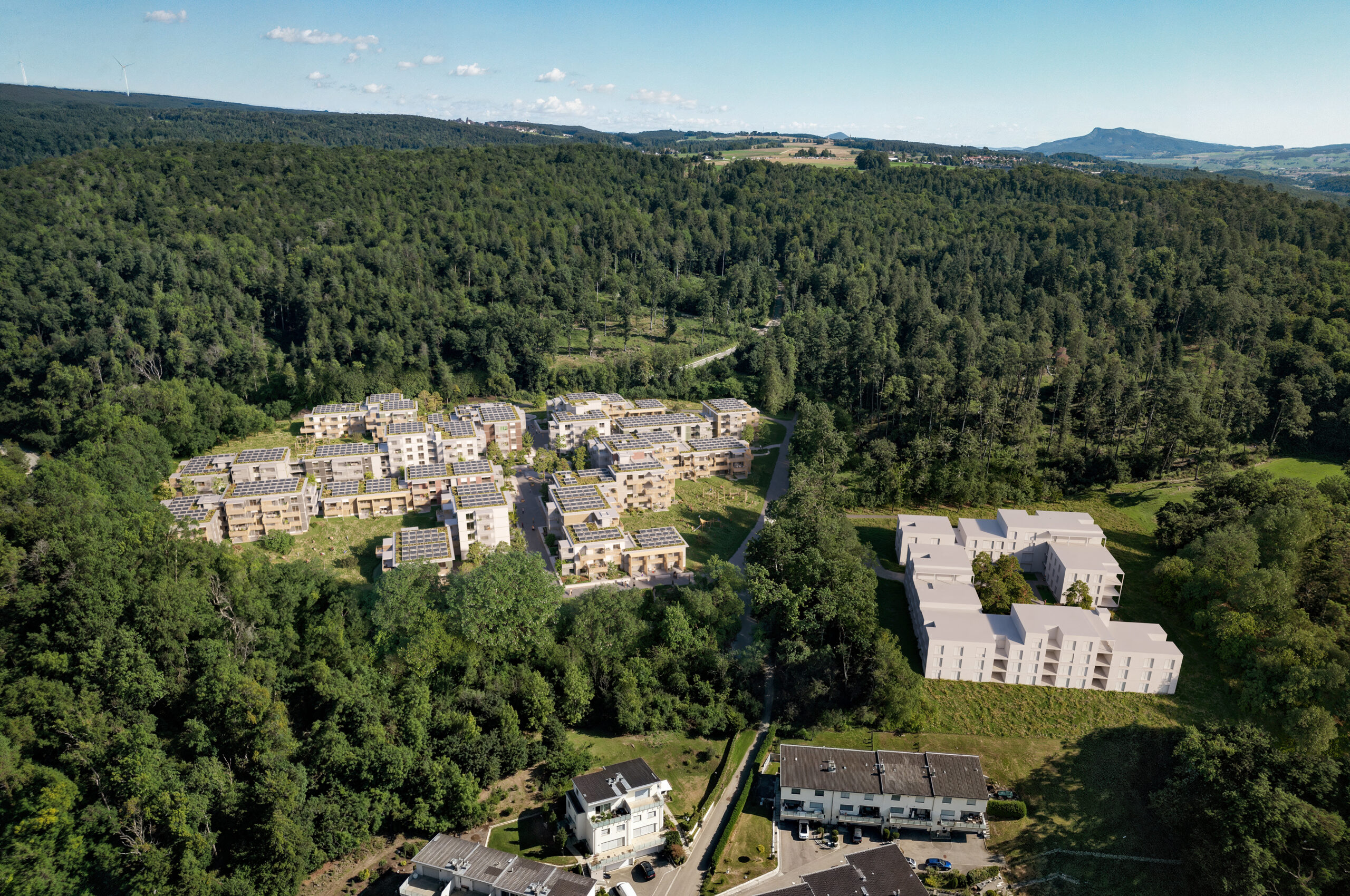
    Halter AG has begun construction of the Waldstadt in Pantli. The ground-breaking ceremony for the residential project in the Pantli forest clearing in Schaffhausen took place on 10 January, the Schlieren-based property developer announced in a press release. The 214 condominiums planned in Waldstadt are being realised by Halter in collaboration with DOST Architektur GmbH from Schaffhausen.

    “The Waldstadt project in Pantli is making a valuable contribution to urban development,” says Mayor Peter Neukomm in the press release, quoting from his speech at the ground-breaking ceremony. “The development should serve as a model for future construction projects and strengthen Schaffhausen as a location for sustainable and innovative living.” Waldstadt is designed as living space for different living models.

    Specifically, the residential project aims to appeal to families and couples as well as singles and commuters. A kindergarten and daycare centre are also planned. Open spaces and communal facilities are intended to create “ideal conditions for harmonious coexistence”, according to the press release.

    Planning and realisation are based on the requirements of the Swiss sustainability standard. Around two and a half years have been estimated as the construction period for the first stage. The first of the 2.5- to 5.5-room flats should be ready for occupancy as early as next year.

  • New indoor swimming pool for theKSS approved

    New indoor swimming pool for theKSS approved

    The decision of the Schaffhausen electorate paves the way for the construction of a new, modern indoor swimming pool on the KSS site. With an investment volume of CHF 80 million, this project represents an important milestone in the further development of the city’s infrastructure. The new building is not only a response to the ageing existing facility, but also a commitment to sustainable and future-oriented urban development.

    The new building will replace the existing indoor swimming pool from 1972, which is no longer up to modern-day standards due to its poor condition and outdated technology. The last refurbishment measures were carried out more than 30 years ago and the facility suffers from serious deficiencies such as water and heat losses, a lack of accessibility and outdated safety equipment. In addition, the current indoor pool can no longer cope with the increasing number of visitors, which leads to considerable conflicts of use.

    An indoor pool for all generations
    The planned new building will not only exceed the previous standard, but will also set new benchmarks. With a swimming pool comprising eight lanes of 25 metres each, as well as a teaching pool, a course pool with a lifting floor, a separate diving pool and a children’s paddling area, the range of facilities will be significantly expanded. There will also be an outdoor warm water pool and a state-of-the-art wellness centre with various saunas, a steam bath and a sauna garden. This facility will not only meet the sporting needs, but also the increasing demands of the population for wellness and relaxation.

    A central element of the new concept is the separation of the pools according to their main uses in order to avoid the current conflicts of use. The new structure makes it possible to use the various facilities simultaneously and without restrictions. The central entrance to the new building will ensure efficient access to all facilities and optimise operations.

    Sustainability as a guiding principle
    The new indoor swimming pool will be built to the “Minergie-P-ECO Standard”, one of the highest standards for energy-efficient and sustainable construction in Switzerland. The project’s energy concept provides for the extensive use of waste heat, in particular from the neighbouring ice rink, as well as a connection to a local heating network. These measures will help to significantly reduce the ecological footprint of the new building and position Schaffhausen as a pioneer in sustainable construction.

    New synergies and sources of income
    The new indoor pool will not only offer sports and health facilities, but will also be of economic importance. A publicly accessible restaurant with 130 indoor and 150 outdoor seats will generate additional income and establish the KSS facility as a meeting place for the entire population. In addition, an underground car park with 150 parking spaces will improve accessibility.
    Additional rental space for health and fitness facilities will round off the concept and contribute to the attractiveness and profitability of the overall project. These synergies between the various uses will strengthen the KSS site as a central focal point for sport, leisure and recreation in Schaffhausen.

    Competition and project management
    Following the approval of the population, the project competition will now begin with the aim of finding an innovative design for the new building that fulfils the high standards of architecture, functionality and sustainability. Twelve qualified teams will develop their proposals by summer 2025 and the winning project will be presented to the public. Construction is scheduled to start in 2027, with the new indoor pool opening in 2029/2030.

    The construction of the new indoor pool in Schaffhausen is more than just a building project – it is a strong signal of the city’s future viability and innovative strength. With state-of-the-art infrastructure, sustainable construction and an expanded range of facilities, the new indoor pool will make the KSS complex an even more attractive and contemporary leisure centre.

  • The Steig school complex is extended and modernised

    The Steig school complex is extended and modernised

    The Steig school complex, the oldest primary school in Schaffhausen, is located in the north-western part of the city, not far from the old town, and comprises several buildings of different ages. The need for renovation is considerable, as the existing infrastructure no longer meets modern requirements. The gymnasium from 1892 and the room capacities for the growing number of pupils no longer meet today’s requirements.

    In order to meet future needs, the city is planning a new building on the existing site. This will include a new single sports hall, additional classrooms and facilities for after-school care. The extension is part of a comprehensive development concept for Schaffhausen’s primary schools.

    The winning project and its elements
    A project competition crowned the “cinque pi” project by Soppelsa Architekten GmbH and Rosenmayr Landschaftsarchitektur GmbH as the winner. This cleverly divides the required programme into five building blocks, which create a harmonious overall impression as an ensemble. A new three-storey building with a gymnasium and classrooms forms the core of the project. The old observatory will be retained as a free-standing building.

    The existing gymnasium will be restored to its historical structure to create space for a new pavilion for the day centre and library. This will become the central hub of the entire complex. Conversions are also planned. The Trotte will now house storage rooms and a public toilet on the ground floor and therapy rooms on the upper floor.

    Redesign of the outdoor facilities
    Not only the buildings, but also the outdoor facilities will be redesigned. Existing qualities are to be further developed with moderate interventions. The observatory and the group of trees by the playground will be retained. The play and sports areas will be rearranged to create space for an all-weather playing field and a hard court.

    Financing and political approval
    The total cost of the project is estimated at CHF 21.7 million. This sum already includes the planning costs approved by the city council. Following the deliberations in the city council, the electorate will make the final decision on the extension of the Steig school complex.

    The “cinque pi” project is a forward-looking response to the growing demands and challenges of the education sector in Schaffhausen. It combines modernity and tradition in a progressive and resource-conserving construction method and the creation of lively learning and living spaces.

  • Schaffhausen renews its Bahnhofstrasse

    Schaffhausen renews its Bahnhofstrasse

    Bahnhofstrasse in Schaffhausen is being modernised as part of a one-year construction project. The aim is to create a spacious and clearly laid out street that optimises traffic flow and increases safety for all road users.

    Optimisation of the traffic infrastructure
    Bahnhofstrasse is a central traffic junction in Schaffhausen. The renovation measures will renew the road surface in order to improve road safety and utilise public spaces more efficiently. At the same time, the space for pedestrians and passengers will be increased, making it easier to get on and off the train.

    Charging stations for electric buses have already been installed in advance of the refurbishment in order to make public transport in Schaffhausen more sustainable. The current work will not only upgrade the functionality of Bahnhofstrasse, but also reposition it as an inviting arrival and meeting point.

    Accessibility and adaptations
    Accessibility is a key concern for the city. The bus stops will be equipped with higher kerbs to ensure barrier-free access for people with disabilities. These measures were developed in close consultation with disability organisations and ensure that Bahnhofstrasse complies with current legal requirements.

  • “Smetterling”: a co-operative project by HGW for the Alpenblick site

    “Smetterling”: a co-operative project by HGW for the Alpenblick site

    The Alpenblick site in Schaffhausen, adjacent to the historic Niklausen neighbourhood, will be redesigned by the end of 2027 with the winning project “Smetterling”. The jury, consisting of representatives from the city of Schaffhausen, HGW, the neighbourhood and neighbourhood meeting place nik. as well as independent experts, praised the project in particular for its precise urban design and the clear zoning of the open spaces. The compact design of the building and its harmonious appearance fit in perfectly with the surroundings and create a link between the listed Niklausen single-family house estate and the neighbouring high-rise building.

    A concept that promotes community
    The “Smetterling” project envisages a tall point building that takes up very little of the surrounding area and marks the transition to the taller houses on the opposite side of the street. The positioning creates two different open spaces. A garden space to the west and an urban space to the east. This arrangement encourages social interaction while at the same time preserving the residents’ privacy.

    The project reflects HGW’s co-operative values by creating communal spaces in addition to living space, thus promoting a lively community life.

    The ground floor of the building will house communal areas such as a laundry room, a co-working space and a commercial space. The upper floors offer 20 flats of different sizes, while the top floor comprises five one-bedroom flats with direct access to the roof garden. The spacious communal areas and the roof garden offer many places of retreat, but also opportunities for neighbourly interaction and the creation of social interaction.

    Wood and recycled concrete
    The winning project favours an ecologically sustainable construction method. The clear, simple geometry of the building also contributes to energy efficiency and makes the project a role model for ecological construction.

    HGW Heimstätten-Genossenschaft Winterthur has been creating affordable living space since 1923 and promotes lively community life and innovative solutions. With over 2,250 flats and more than 5,000 residents, it is the largest independent housing co-operative in the region.

  • A new landmark at the Rhine Falls with great potential

    A new landmark at the Rhine Falls with great potential

    The goal was clearly defined. A third of the 900,000 annual Rhine Falls tourists were to be lured to the other side of the river and attracted to the “Rhyfall Village” area. “Rhyfall Village”, or “RIVI” for short, is the name of the new neighbourhood. With a mix of gastronomy, art and shopping, the area will become a centre of attraction – not only for tourists, but also for the local population.

    The site and its future
    The “RIVI”, once the site of industrial production, is undergoing a reorganisation. The neighbourhood is characterised by two striking high-rise buildings, one of which was acquired by Helvetia. These offer living space with impressive views and space for catering, office and retail areas.

    Potential and challenges
    The visionary project met with broad approval in the region. Beat Hedinger, Managing Director of Schaffhauserland Tourismus, saw the village at the time as a “colourful mosaic piece” in the overall tourism picture. The rooftop restaurant with a view of the Alps in particular promised to be a special highlight. Hedinger also recognised the challenge of skilfully bridging the distance between the Rhine Falls basin and the site.

    Felix Tenger, Mayor of Neuhausen, is optimistic that the “RIVI” will revitalise the centre of Neuhausen and also strengthen the retail trade. Building director Martin Kessler also saw great potential to turn the site into a meeting place that creates synergies with existing facilities and increases the attractiveness of the entire region.

    Good connections and creative solutions
    The site’s location scored highly thanks to its proximity to the Rhine Falls and good public transport connections. The Badische Bahnhof Neuhausen railway station is located directly next to the site and numerous bus connections and over 200 parking spaces are available to visitors. Visitors can travel in comfort between the Rhine Falls basin and the Rhyfall Village on the Rhyfall Express tourist train.

    A project with vision
    Rhyfall Village is more than just another residential neighbourhood in Neuhausen. Whether rooftop restaurant, promenade or art gallery – the RhyTech site stands for a modern, versatile and vibrant future in the immediate vicinity of one of Switzerland’s most impressive natural wonders.

  • Schallhausen brings sound diversity into the digital age

    Schallhausen brings sound diversity into the digital age

    Peter Neukomm emphasises that the continuous adaptation and implementation of the Smart City strategy enables Schaffhausen to respond to technological progress and thus create a more liveable city. With innovative projects, the city is ensuring future-oriented development with a focus on digitalisation and sustainability.

    One example of this constant striving for innovation is the new “Schallhausen” platform, which combines the city’s rich musical heritage with modern digital solutions. The platform is part of the Smart City urban development concept and aims to make the diversity of Schaffhausen’s music scene visible and audible.

    Musical history meets digital innovation
    Schaffhausen has always been a city of music with an impressive diversity in a very small area. With “Schallhausen”, this diversity can now also be experienced digitally. The platform offers both an online platform for musicians and an audio walk through the city’s musical history. From Bach to jazz, from punk to dialect – the musical diversity can be experienced through an innovative digital map that combines the geography of the city with its musical identity.

    Music venues and music trail
    Schallhausen is divided into two sub-projects: “Musikorte” and “Musiktrail”. The “music venues” enable musicians to present their works at various locations in the city. The endlessly expandable map is freely available to all artists with the associated anecdotes and memories. In this way, the city merges into a musical whole.

    The “Musiktrail” will be presented as part of the Schaffhausen Culture Days 2025 and offers a musical tour of the city that connects important places and personalities of Schaffhausen’s music scene. Original recordings, interviews and sound design create a unique musical experience that shows Schaffhausen as a city of music in a new light.

    Projects such as “Schallhausen” position Schaffhausen not only as an innovative city, but also as a culturally rich city worth living in.

  • Schaffhausen economic area – an area for makers

    Schaffhausen economic area – an area for makers

    Schaffhausen has developed very successfully as a business location in recent years. Thanks to the canton’s reliable and targeted location strategy, numerous companies have set up headquarters and expanded their activities in Schaffhausen over the past 25 years. Today, the many companies with internationally oriented headquarters functions are just as much a part of Schaffhausen’s corporate landscape as the innovative manufacturing companies that continue the canton’s industrial tradition. Schaffhausen companies are particularly successful in the pharmaceutical and chemical industries, in mechanical engineering and in the plastics industry. The life science cluster in Schaffhausen is one of the largest in Switzerland and makes up a significant part of the regional economy. Thanks to the traditionally strong manufacturing industry with its focus on exports and the high density of internationally orientated company headquarters, Schaffhausen today has the fifth highest gross domestic product GDP per capita of all cantons. A success for the canton, which accounts for around one per cent of Switzerland’s population.

    With its industrial expertise, Schaffhausen is also successfully positioning itself as a leading region in the development and application of pioneering technologies at the interface of industry and digitalisation. These include smart mobility, food tech and advanced materials. This is why Schaffhausen is investing in the development of expertise networks – with a pioneering spirit and innovative strength.

    Recipe for success for the location
    The targeted investments in the framework conditions are Schaffhausen’s recipe for success. Today, the business location impresses with the best conditions for healthy growth. With moderate taxes, real estate at attractive prices and low labour costs, companies have more to invest in. Thanks to excellent road and rail connections to the nearby Zurich international airport, Schaffhausen is quick and easy to reach. As part of the Zurich metropolitan area and closely networked with the economic region of southern Germany, Schaffhausen companies also benefit from well-trained specialists and the proximity to numerous universities. The quality of life in Schaffhausen with its many attractive residential options attracts companies and new workers, who become new residents. Short distances to authorities and network partners help to find the right contacts. Decisions are made quickly. Schaffhausen as a business location is proud of its pioneering spirit and doer mentality.

    Testimonials

    Christos Asimakopoulos

    CFO EMEA, ASPAdvanced Sterilisation Products

    “The business-friendly attitude, the short distances and the openness of the authorities and the business development organisation – that’s what convinces me about Schaffhausen.”

    Dr Stephanie Striegler

    General Manager Janssen Supply Chain Schaffhausen

    “One of the location’s main strengths is its well-trained, highly qualified specialists”

  • 102. immoTable Schaffhausen on the road to the future

    102. immoTable Schaffhausen on the road to the future

    [smartslider3 slider=”24″]

    Councillor Daniel Preisig gave an overview of Schaffhausen’s economic development in recent decades. After the industrial crisis and stagnation in the 1990s, Schaffhausen has recovered thanks to targeted economic development. in 2023, the population record of 1969 was reached again for the first time. Preisig emphasised how projects such as the conversion of the old steel foundry and the relocation of roads to create traffic-free promenades along the banks of the Rhine contributed to the city’s attractiveness. Schaffhausen is continuously investing in smart, future-orientated urban development and digital administration.

    Dino Tamagni highlighted the impressive economic development of the canton of Schaffhausen. The region’s industrial success story began with the construction of the Moser Dam in the 19th century. The hydroelectric power plant, once the largest of its kind in Switzerland, laid the foundations for the establishment of important industrial pioneers such as Georg Fischer, SIG and IWC, which turned Schaffhausen into a central industrial centre.
    In the 1990s, globalisation led to plant closures, job losses and emigration, resulting in the loss of 11% of jobs. However, targeted economic measures, such as the creation of an economic development agency, enabled Schaffhausen to overcome the challenges and regain its competitiveness.
    Today, the canton has one of the strongest economies in Switzerland, with the highest GDP per capita. Thanks to the promotion of innovation projects and the continuous expansion of the infrastructure, Schaffhausen remains an attractive and future-orientated business location.

    Andreas Campi, Head of Development, Halter AG, presented the “Im Pantli” residential project in the Waldquartier Schaffhausen. A modern residential neighbourhood is being built on the site, which was once used as a workers’ housing estate by Georg Fischer AG. The buildings are arranged around a neighbourhood centre to create urban alleyways and meeting spaces. The car-free development offers spacious, family-friendly flats with private outdoor areas. Childcare facilities and a dedicated bus stop enhance the quality of the location. The project not only promotes modern living, but also a lively community life.

    Pascal Stutz, CEO of SVIT Zurich, Joëlle Zimmerli, Managing Director of Zimraum GmbH and Christian Brütsch, Owner and Managing Director of Stratcraft GmbH, presented solutions to the shortage of skilled labour. A key challenge facing the property sector is the shortage of skilled workers and dissatisfaction among experienced professionals. Around 60 % of the senior professionals surveyed feel that their workload is too high, and over 50 % see large portfolios as problematic. The study presented highlighted the need for action and suggested solutions such as the standardisation of processes, intelligent digitalisation and the promotion of leadership skills in order to better overcome the challenges.

    Tindaro Milone presented a comparison of energy sources for heat pumps at the immoTable. EKZ operates over 1,200 energy systems across Switzerland and favours sustainable solutions. Air is cost-effective, but less powerful. Geothermal energy offers stable energy, but is expensive and location-dependent. Groundwater is efficient, but requires strict authorisations. Waste water provides a lot of energy, but is irregularly available. Seawater is particularly efficient, but expensive and tied to bodies of water. The choice of energy source depends on the project requirements, with EKZ offering customised solutions. We look forward to welcoming you to the next immoTable in Zug, where the focus will once again be on exciting topics and pioneering developments in the property sector. Join us as experts discuss the future of Zug as a property location and the latest innovations in the sector.

    Further information on the event and future dates can be found at www.immotable.ch

  • Rhine bank development as a project for the future

    Rhine bank development as a project for the future

    The city council is pursuing the goal of freeing the banks of the Rhine from motorised traffic and transforming it into a lively centre for leisure, living and business. This redevelopment offers Schaffhausen a unique opportunity to sustainably improve the quality of life in the city and promote tourism at the same time. The focus is on the expansion of green and open spaces as well as new housing and jobs.

    The development strategy includes concrete steps to realise this vision, building on the results of an urban planning study and public consultations.

    Step-by-step implementation in sub-projects
    The implementation will be realised in several sub-projects over a period of twelve years until 2036. The sub-projects include the new connecting road, the development of the Gaswerk site and the upgrading of the Rhine embankment promenade. This division allows for gradual realisation and creates planning security for all parties involved. Interim utilisation is planned for the Gaswerk site until construction begins.

    High added value with manageable investment
    The project requires public sector investment totalling around CHF 35 million, of which the city will bear around CHF 22 million. The remaining costs will be co-financed by the federal government and the canton. Private investment in residential and commercial space significantly increases the economic benefits of the project and promotes urban development.

    Fundamental decision and framework conditions
    In order to implement the project efficiently, a fundamental vote is proposed. At the same time, all operational decisions will be delegated to the City Council in order to minimise the implementation risk and increase planning certainty.

    The City Council has defined clear framework conditions, including an amicable solution for the water sports clubs, the promotion of biodiversity and the urban climate and the creation of a balanced mix of charitable and non-charitable housing on the Gaswerk site. In addition, potential studies are being carried out to clarify the economic feasibility of catering and commercial uses.

    With the redesign of the banks of the Rhine, Schaffhausen is opening a new chapter in its urban development – towards a more sustainable, liveable and economically stronger future.

  • “We are constantly investing in our future”

    “We are constantly investing in our future”

    Mr Tamagni, since taking office in January 2021, you have further strengthened Schaffhausen’s position as an attractive place to live and do business. What specific measures have you taken to achieve this? What has worked well and what has worked less well?
    That’s right – the canton of Schaffhausen is developing very well! More and more people are discovering the advantages of Schaffhausen as a liveable alternative to the greater Zurich area and are moving here. This has long been the case for companies – the canton is particularly attractive for SMEs with a tax burden of 12 to 12.5%. Our framework conditions are excellent, the distances are short and we maintain close co-operation with companies in order to create new impetus together. The canton of Schaffhausen is a region whose environment and dynamism attracts committed people and companies. It is a region where you can put down roots because – despite all the hustle and bustle – it offers proximity and familiarity.

    What specific location promotion measures are you planning in your next term of office to make Schaffhausen even more attractive?
    The Government Council’s top priority remains to further strengthen Schaffhausen as a place to live and do business in the national and international competition for business locations. Tax relief measures are being developed in favour of the population and companies, and we are planning support measures for innovative companies and SMEs. The compatibility of family and career remains a high priority. The completion of the direct train connection to Basel and the dual carriageway expansion of the A4 motorway to Winterthur from around 2027 will be very important for investors in residential and commercial property.

    You want to push ahead with investments in strategic projects such as digitalisation and demographics. Can you tell us more about these projects and their significance for Schaffhausen?
    We drew up the first demographic strategy in Schaffhausen back in 2017 – one of the first cantons to do so. Our strategy is based on four key areas: Measures to maintain the labour pool, ensuring local care and healthcare services with forms of housing that support autonomy in old age. Furthermore, settlement and transport development will be aligned with demographic developments and the education system will be adapted to the increasingly diverse population.

    In terms of digitalisation, the cantonal government is focusing on overarching goals: Digital First for the population and the economy and complete end-to-end digitalisation of the administration. Every service and every process should be optimised and digitally available – to save resources and time.

    As Schaffhausen’s Director of Economic Affairs, how do you see the current property market in the canton and what trends do you expect to see in the coming years?
    Schaffhausen still has affordable living space and building land and therefore potential for residential development. The region will receive an additional boost from the expansion of the direct rail link to Basel and the removal of bottlenecks on the A4 motorway in the direction of Winterthur. This will make Schaffhausen a hub between Zurich, Winterthur and Basel, which will further increase its attractiveness as an economic and residential region.

    How does the canton of Schaffhausen strike a balance between the development of the urban centre and the preservation of Schaffhausen’s natural landscapes and historic architecture?
    Rural areas are a valuable part of the canton’s high quality of life. With regional and location development, the regional nature park and the promotion of tourism, Schaffhausen has specific programmes that take this balance into account and promote the strengthening of the countryside. Schaffhausen stands for proximity to nature and the diversity of gourmet products. The new tourism strategy pays particular attention to these aspects of Schaffhausen.

    With your focus on efficient, citizen-friendly and citizen-oriented public services, are there any plans to streamline processes relating to real estate transactions or building permits?
    With its digitalisation strategy, the cantonal government is laying out the cantonal administration’s path to the digital future. With the “Digital Administration Schaffhausen”, it is utilising the opportunity of digital transformation to expand user-friendly services for the population and the economy. Internal processes are being structured even more efficiently and employee collaboration is being restructured using agile methods and modern technologies. Digitalisation has already been an important topic in the canton of Schaffhausen for several years and individual services are well advanced. For example, the geoportal, where data is openly available. This benefits owners, buyers and also the administration.

    In your opinion, what role do sustainable and energy-efficient buildings play in future property development in Schaffhausen and in other economic sectors?
    The canton’s location policy takes global climate targets into account and has always pursued sustainable economic development. Schaffhausen companies are locally innovative, globally successful and make an important contribution to a sustainable economy with their investments, products and services. When it comes to energy-efficient and sustainable construction, the canton of Schaffhausen endeavours to act as a role model. An exciting regional initiative on this topic is the “Schaffhauser Haus”, which focuses on building with a regional focus. This strengthens the regional economy with craftsmanship, promotes young talent and sustainably closes material cycles.

    Given the growth of the city of Schaffhausen, what strategies are there to create adequate living space for all sections of the population?
    The canton of Schaffhausen has recorded moderate and sustainable population growth of less than one per cent over the last ten years – this is not comparable with other regions. If we take a look at the vacancy rates, it becomes clear that although the vacancy rate is also low, affordable living space is available. There are no queues like in Zurich. With further tax relief measures and investments in childcare, the canton is also improving the situation for families and high earners.

    As head of the Department of Economic Affairs, how do you see your role in implementing the canton’s economic policy goals?
    As Director of Economic Affairs, I am the top, direct point of contact. Short distances, quick decisions, a high level of service-orientation – that is our credo. I am a representative of the cantonal economic development agency, which functions as a “one-stop shop” as a contact point for questions from companies or people interested in relocating. Companies find open doors everywhere in Schaffhausen.

    What long-term effects do you expect your previous political measures to have on the canton of Schaffhausen?
    Looking back over the last 25 years, the effects are clear – the economic development of the region is a success story. The canton was in an economic crisis in the 1990s due to structural change. Today, Schaffhausen is an internationally recognised headquarters location with a strong industrial base. According to UBS, no other canton has improved as much as we have in terms of location factors. The financial situation with high tax revenues speaks for itself. Schaffhausen now belongs to the small group of payers in the national financial equalisation scheme.

    Schaffhausen is a border canton. What advantages and disadvantages does this bring for the canton in the property sector?
    Due to its special location between the Rhine and Germany, Schaffhausen has long been unjustly overshadowed by other cantons – for many, Switzerland ends at the Rhine. This view is changing more and more! Schaffhausen is now on the radar of many companies and investors who recognise its potential. For residents, the moderate development has its advantages: open countryside and nature have been preserved in the canton of Schaffhausen.

    What visions and concrete projects do you have for the future development of Schaffhausen as a place to live and do business?
    Pioneering spirit and industrial tradition characterise Schaffhausen as a business location. The Government Council’s top priority is to strengthen Schaffhausen as a place to live and do business. It is also important to secure, consolidate and strengthen the national and international competitiveness of Schaffhausen as a business location. Thanks to the very good financial situation in the canton, measures and projects in favour of the attractiveness of the location and the population can be developed and implemented. The compatibility of work and family life, the improvement of transport connections by road and rail within the canton and in particular to the Zurich and Basel regions, the implementation of energy and climate targets and the construction of important infrastructure projects are also priorities.

    Where do you see Schaffhausen in the next 20 years?
    In 2022, we developed projects and measures for a successful path into the future in the canton as part of the “next.” 2030 development strategy in a participatory process. The vision of Schaffhausen as a swarm and nest region now forms our overarching compass, from which the cantonal government has identified fields of action that are particularly central to utilising the region’s development potential. To improve the dynamics of the swarm region, for example, ecosystems of new technologies are to be established and the capacity for innovation strengthened. In order to maintain the quality of the nest region, the Government Council wants to ensure excellent location factors – from the training of skilled labour to production areas and framework conditions for companies – and harness social energy. For example, by providing a good range of basic services or strengthening tourism as part of the population’s quality of life. In this way, Schaffhausen can promote a pioneering spirit, be open and innovative and be a place where people want to put down roots and feel at home. With this basic attitude, Schaffhausen is a centre of attraction for companies and individuals who want to become involved in society and economic life.
  • Schaffhausen – an economic success story

    Schaffhausen – an economic success story

    The new high-rise buildings on the former Alusuisse site in Neuhausen am Rheinfall came to life at the beginning of 2024. The flats are occupied, the shops are open and work is underway in the 7000m2 of office and laboratory space. 100 years ago, an aluminium plant stood on what is now the Rhyfall Village. After the Second World War, a research centre for materials technology was established. Decades later, plans grew for new living and working space – which have now been realised. The Schaffhausen steel foundry has also undergone a similar transformation process: instead of heavy industry, there are flats, a school, commercial space and offices. Strategies are developed, patents are managed and markets are cultivated all over the world. Today, people and companies are once again putting down roots in the canton of Schaffhausen. At the end of the 1990s, the reality was different.

    Joining forces to emerge from the crisis
    Structural change hit the industrial canton of Schaffhausen with full force: Within just a few years, the corporate landscape changed drastically and tax revenues collapsed. Eleven per cent of all jobs were lost – more than in any other canton. Those who could, moved away. To turn the tide, the business associations launched the WERS project – Economic Development Region Schaffhausen. The city and canton supported it. 150 demands served as the basis for groundbreaking decisions in Schaffhausen politics in 1997.

    Active location promotion as the key
    One central measure was the creation of a cantonal economic development agency. The mission was clear and still applies today: to publicise the business location, attract new companies and support existing companies in maintaining jobs. In addition to providing impetus for the continuous improvement of the framework conditions for the economic development of the canton, the Economic Development Agency is the central point of contact and information centre between business, politics and administration. The goal: competitive industrial companies and SMEs, globally orientated service providers, more tax revenue.

    The companies came. The first production company, Wunder-Baum, was founded in 1998 and Tyco was the first US multinational with a headquarters. To date, more than 600 other companies have settled here. They have created around 2,800 new jobs and, thanks to a lot of additional tax revenue, scope for investment in favour of the location.

    Improving the “Schaffhausen product”
    Particularly in the early days, some companies decided against Schaffhausen because the location did not fulfil their requirements. There was a lack of centralised offices, generous living space, an international school and good transport links to the airport. In order to change this, the “Schaffhausen product” was gradually improved and the attractiveness of the location was promoted with the help of business development. This includes the establishment of the ISSH international school, the ITS Industry and Technology Centre to promote innovation and technology among SMEs, the go-tec! Laboratory for future STEM specialists. The introduction of the half-hourly service to Zurich main station, the direct connection to the airport and the expansion of the A4 motorway were also supported. In the canton, the regional S-Bahn railway between Trasadingen and Thayngen was expanded to complement the regional buses. The gradual reduction in taxes for individuals and companies was another key factor in favour of the location. Many projects have been successfully realised. Others are still under discussion. These include a university programme tailored to the needs of industry and a campus for innovation and technology.

    From product development to supply development
    On the property side, these developments in the canton have led to an increasing demand for offices, commercial space and living space. Various central sites have been developed over the last two decades. These include the Landhaus and Urba(h)n developments near the railway station in the town of Schaffhausen and the transformation of the former steel foundry into a residential and working quarter close to the town centre. In Neuhausen am Rheinfall, the development along Zentralstrasse, combined with the residential construction activity around the Industrieplatz and the gradual opening up of the SIG site, were decisive factors. While this area is still in the process of transformation, the Rhyfall Village has been filling with life since the beginning of 2024 – thanks to jobs and new residents.

    25 years of joint efforts
    25 years ago, the course was set jointly in the canton of Schaffhausen: Business and politics joined forces and began an active location development policy with common objectives. After WERS came the visions for Schaffhausen in 2008 and the “next.” development strategy in 2022. It is clear that the canton is developing dynamically as a location. Today, not only are the windows of the new flats in converted factories illuminated, but the entire business location and living space shines in a different light. In an intercantonal comparison, Schaffhausen has undergone a unique development: no other canton has improved so much in the comparison of competitiveness indicators (UBS 2023). Schaffhausen has not only become a popular location for international companies, but also for people from Switzerland, as the intercantonal migration balance shows. This is no coincidence, but the result of targeted measures and joint efforts. Continuing this success story is both a mission and a motivation for the committed forces in the canton.

  • Generis AG continues business development

    Generis AG continues business development

    As the current service contract with Generis AG expires at the end of 2024, the Schaffhausen government decided to put the mandate to manage the economic promotion and regional and location development office out to public tender at an early stage. Generis AG prevailed over its competitors in the two-stage tendering process.

    Extension of the mandate until 2032
    The new service contract comes into force on 1 January 2025 and ends on 31 December 2032, ensuring continuity and stability in location development in the canton of Schaffhausen.

    Future-oriented measures
    Generis AG will continue its successful work, with a particular focus on digitalisation and demographic challenges. Close collaboration with local and regional partners remains central to this.

    Trust and stability
    The Schaffhausen cantonal government sees the renewed award of the mandate to Generis AG as a confirmation of its previous successes and expects it to further strengthen Schaffhausen as a business location.

  • Halter takes over residential project near Schaffhausen

    Halter takes over residential project near Schaffhausen

    Schlieren-based property developer Halter AG has acquired the Waldstadt residential development site in Pantli between Schaffhausen and Stetten SH, according to a press release. The seller is DOST Architektur GmbH in Schaffhausen. The two companies will jointly realise the planned construction of 200 owner-occupied flats.

    According to the plans, over 200 condominiums are to be built on 47,600 square metres of land. In a first step, 100 condominiums will be realised. This will be followed seamlessly by the other stages, according to the company press release. Over 40 different types of flat are available for different living requirements. The sizes range from 2.5-room to 5.5-room flats. The flats are orientated on several sides and offer rooms with plenty of natural light and a direct view of nature and the forest. The new living space is suitable for families, couples and commuters from the region.

    A new bus stop and direct access to the motorway in the direction of Schaffhausen, Winterthur and Zurich ensure optimal transport connections. An integrated kindergarten and a day care centre round off the offer and make Waldstadt im Pantli attractive for families too.

    The construction time for the first stage is estimated at around two and a half years. If everything goes according to plan, the first flats can be occupied in 2026, according to Halter AG.

  • SH Power wants to network Herrenacker with other heating networks

    SH Power wants to network Herrenacker with other heating networks

    The Herrenacker heating association has been supplying municipal and private properties around Herrenacker in Schaffhausen’s old town with heat from groundwater since 1993. It belonged to a simple partnership in which the canton held 56 per cent and the city 44 per cent.

    Now SH Power is taking over the heating network with retroactive effect from 1 July. According to a media release, the municipal energy supplier will pay the canton CHF 2.8 million for its share in the simple partnership.

    SH Power intends to supply the entire old town with sustainable heat in the future. The Herrenacker network has a large storage capacity and is to be networked with other heating networks in the future.

  • Environmental regulations in Andermatt Reuss are met

    Environmental regulations in Andermatt Reuss are met

    The environmental monitoring in Andermatt Reuss has announced a positive result, according to a media release by Andermatt Swiss Alps AG . The intensified construction activities would have fulfilled the environmental requirements, it is said. At the start of construction of Andermatt Reuss, Andermatt Swiss Alps AG commissioned the engineering office Hodel Umweltberatung , based in Schaffhausen, to monitor and document the environmental impact.

    As part of the environmental monitoring for 2021, the review extended not only to the operation of the Andermatt Swiss Alps Golf Course and the upcoming revitalization of the Dürstelenbach, but also to the construction measures for a podium extension and the construction of apartment buildings. The increase in construction activities has increased the number of inspections, but has not changed the result of a low burden on the environment, according to the statement.

    The categories of immission control and measurements, water protection, nature conservation, butterfly monitoring and soil protection were examined in accordance with cantonal specifications.

    From an ecological point of view, there is a positive finding for the operation of the Andermatt Swiss Alps Golf Course, which can be attributed to the protection and the practiced care of the nature conservation areas on the golf course.

  • Confederation provides cantons with work assistance on climate protection

    Confederation provides cantons with work assistance on climate protection

    The Federal Office for Spatial Development ( ARE ) wants to support the cantons in countering the spatial causes and effects of climate change, explains the ARE in a statement . It has created a working aid for the cantonal structure plans. With these structural plans, which are binding for all authorities, the cantons control their spatial development.

    The working aid developed by the ARE is intended to supplement the existing guidelines for cantonal structural planning. It offers good and realizable practical examples of how spatial planning can meet the challenges of climate change. Both measures for climate protection and measures for adapting to climate change are discussed.

    As an example of a climate protection measure, the ARE cites the promotion of walking and cycling as anchored in the canton of Geneva’s structure plan. This and “the planning principle of short distances” are “important spatial planning levers for climate protection”.

    When it comes to adapting to climate change, the ARE cites an example from the canton of Schaffhausen. In his structure plan, he stipulated that areas in the settlement area should not be sealed if possible, so that the water can seep away and contribute to the formation of new groundwater reserves.

  • Settlements reach pre-corona level

    Settlements reach pre-corona level

    Company settlements are increasing again after the Corona dip. The Greater Zurich Area AG (GZA), as the location marketing organization for nine cantons, was able to settle a total of 125 companies in 2021, an increase of 36 companies compared to the first Corona year 2020. According to a statement by the GZA, 42 companies came from the USA (+20 ), 19 from Germany (+4), ten from Italy (+5) and five each from China (-6), Great Britain and Singapore.

    Overall, the companies created 582 jobs in the economic area, an increase of 11 percent compared to the previous year. In the next five years there should be a total of 1843 jobs.

    The ICT sectors are most strongly represented with 42 companies, followed by the life sciences with 25 companies and the machine industry with 18 and financial services with 13 companies. The life sciences companies created 235 jobs, followed by the ICT companies with 154 jobs.

    However, the importance of the companies for the location goes beyond the number of new jobs. “We specifically address those companies that achieve high added value and strengthen the existing ecosystem,” said GZA Managing Director Sonja Wollkopf Walt at a digital media conference.

    One of the newly settled companies is Benchling . The American provider of cloud solutions for life sciences wants to create up to 150 jobs in the Circle at Zurich Airport. The Chinese pharmaceutical company Hengrui already has its European headquarters in Basel and is now setting up a research and development site in Zurich.

    The German RegTech company targens will sell its software for compliance solutions to banks in Switzerland and Liechtenstein from Schwanden GL. Ruedi Becker, the Swiss head of the Landesbank Baden-Württemberg subsidiary, was able to convince his superiors of the advantages of Glarus together with the GZA.

    That pleases the Glarner location promoter Christian Zehnder. So far, Glarus has been strong in manufacturing and food production. “We want to get away from our traditional image,” he said. “When companies settle here, however, we depend on the strong partner GZA, who markets the location internationally.”

    Sonja Wollkopf Walt sees it similarly: the settlement of targens strengthens the ecosystem as a whole and sends the signal that the economic area extends beyond Zurich and Zug. “In the Greater Zurich Area there is the ideal location for every company.”

    The Greater Zurich Area includes the cantons of Glarus, Graubünden, Schaffhausen, Schwyz, Solothurn, Ticino, Uri, Zug and Zurich.

  • Schaffhausen receives new data center

    Schaffhausen receives new data center

    The Geneva data center operator Safe Host is investing in the Schaffhausen community of Beringen. He wants to build a data center on the site of the former SIG tennis club. According to a press release, the building application was submitted on April 9th. There are two projects to be approved: On the one hand, the data center itself with its ancillary buildings. On the other hand, a new substation for the electricity company of the canton of Schaffhausen ( EKS ). The latter should, among other things, enable the feed-in of larger amounts of renewable energies.

    The data center will generate solar power itself. Photovoltaic shelves will be installed on all free roof areas and on the south facade. In addition, the office complex is heated with the waste heat generated by the data center itself. The rainwater is also stored where possible and processed for cooling.

    According to the announcement, the municipality of Beringen sees the project as a "further milestone in the development of the industrial quarter". The local council is convinced that such a “high-tech building” has a “signal effect” in Beringen.

    The architectural office Schmidli Architekten + Partner from Rafz ZH is responsible for the planning. This has already been entrusted with the planning of Safe Host's data center in Rafz, which is currently still under construction.

    The Beringer data center is already the fifth owned by Safe Host. In addition to the new data center in Rafz, the company also has three centers in the greater Geneva area.

  • Asking rents continue to rise

    Asking rents continue to rise

    The monthly rent index compiled by the digital real estate marketplace homegate.ch from TX Group in cooperation with Zürcher Kantonalbank closed at 115.6 points in February. Compared to the previous month, the prices for advertised rents have risen by an average of 0.17 percent, explains homegate.ch in a corresponding message. At the beginning of the year, too, prices had risen by an average of 0.17 percent. An increase in rental prices of 0.96 percent has been observed over the past twelve months.

    In a monthly comparison, rents have risen in most cantons, writes homegate.ch. The sharpest increase in asking rents was registered in February in the canton of Schaffhausen, at 1.37 percent. In Zug and Glarus, asking rents also increased at an above-average rate of 0.84 and 0.69 percent, respectively. On the other hand, declines were measured in the cantons of Graubünden, Geneva and Ticino with values between -0.48 percent and -0.19 percent.

    Homegate.ch makes different developments in the cities. The biggest increase was measured in a month-on-month comparison with 0.78 percent in Lugano. The asking rents in Lucerne and St.Gallen each increased by 0.20 percent compared to January. In Lausanne, Geneva and Bern, however, rents fell between 1.18 and 0.49 percent.

    In the quality-adjusted recording of rental price changes for the rental index, the rental prices are corrected for the different quality, location and size of the apartments. This makes it possible to record the actual rental price development, it says in the message.

  • Wind energy project on the Chroobach is making progress

    Wind energy project on the Chroobach is making progress

    The Chroobach Windenergie project community consists of the two regional energy suppliers Elektrizitätswerke des Kantons Schaffhausen AG ( EKS ) and SH POWER . Your goal is to exploit the potential for wind energy on the Chroobach. In total, it wants to produce 25 to 27 million kilowatt hours of renewable electricity there per year, according to a press release . That is roughly twice as much electricity as is currently used by the population of the upper part of the canton each year.

    In 2019, the federal government approved the cantonal structure plan for wind energy. With the establishment of the wind energy area on the Chroobach in the municipality of Hemishofen, he laid an important basis for the project. According to the information, the planning work has been successfully advanced since then. The next step is to apply for a partial revision of the land use planning to the municipality of Hemishofen. The project community is already in dialogue with the community to discuss the next planning steps.

    The project community also wants the local population to participate in the new project. It should be able to participate in the wind farm with a wind share. The project group intends to publish further details on this "shortly".

  • Canton Schaffhausen increases stake in cantonal works

    Canton Schaffhausen increases stake in cantonal works

    The canton of Schaffhausen is buying a temporarily owned 10 percent stake from its power station, informs the canton administration in a message . The shares were sold by the canton to EKS three years ago when the canton took over a total of 25 percent of EKS from Axpo Holding . At that time, the canton had sold the remaining 15 percent to EKT Holding AG ( EKT ) from Thurgau.

    The canton paid Axpo a total of CHF 53 million in 2017 to acquire the block of shares. They were reapplied by reselling 10 percent to EKS at a price of 21.2 million francs and reselling 15 percent to EKT at a price of 31.8 million francs.

    In January of last year, the canton considered buying back the shares held by EKS as part of its ownership strategy, the announcement further explains. The EKS never intended to hold the shares itself in the long term, it says there. As the purchase price, the two partners have agreed the price of 21.2 million francs already paid for the transaction three years ago.

    After the transaction, the canton will hold an 85 percent stake in its cantonal works. The remaining 15 percent of the EKS should remain in the possession of EKT. The canton administration wrote that this was welcomed “particularly with a view to the synergy potential in the network area, both by the government council of the canton of Schaffhausen and the government council of the canton of Thurgau as well as the boards of directors of EKS and EKT”.