Tag: Schalung

  • Foldable and reusable formwork revolutionises concrete construction

    Foldable and reusable formwork revolutionises concrete construction

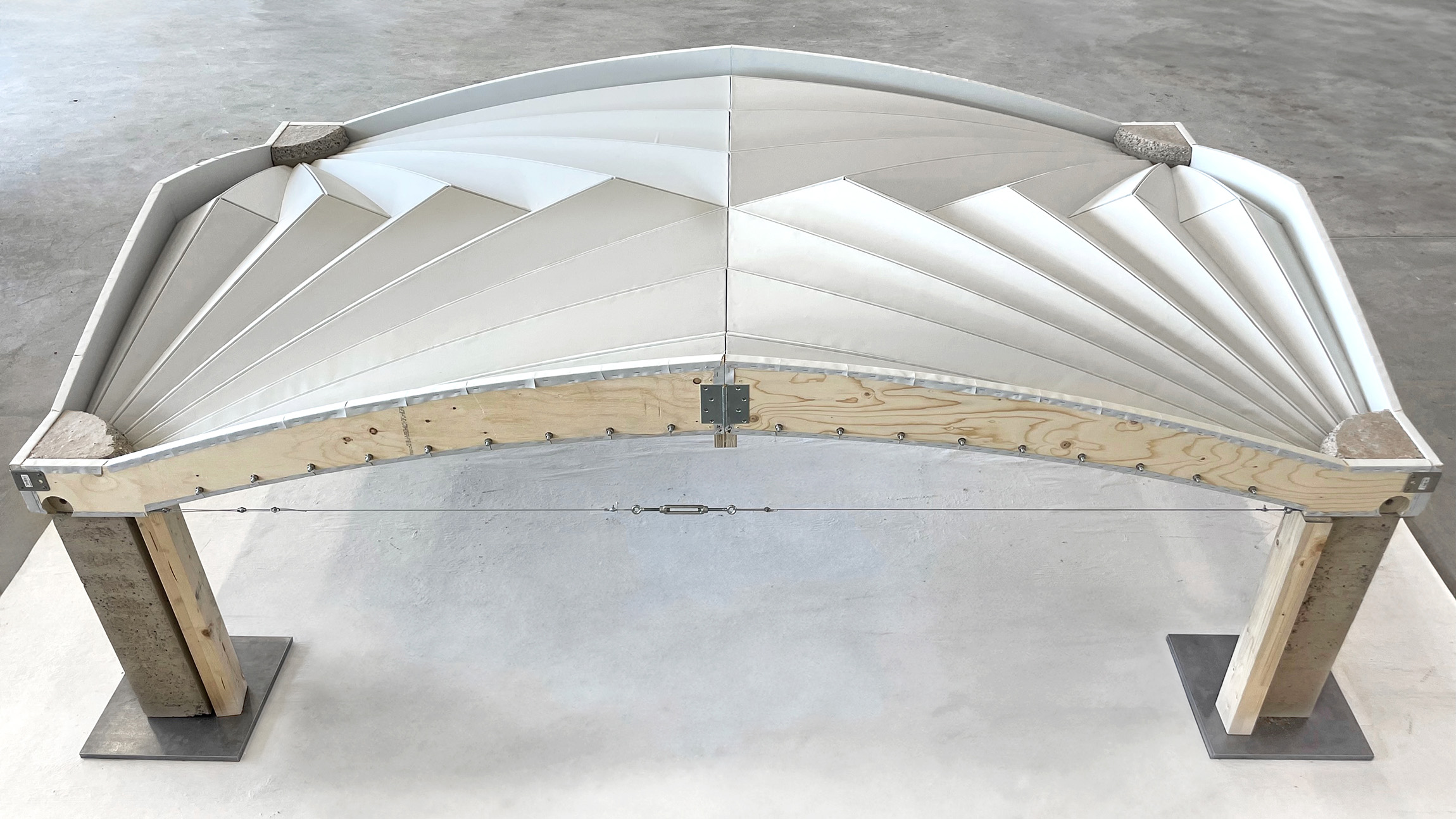
    Unfold Form is the name of the lightweight and reusable formwork for vaulted concrete structures. It was developed by architecture doctoral student Lotte Scheder-Bieschin in Philippe Block’s ETH research group. According to an ETH report, it saves up to 60 per cent concrete and up to 90 per cent steel compared to conventional ceilings.

    Unfold Form consists of thin, flexible plywood strips. They are connected to each other by textile hinges and can be unfolded like fans. Four such moulds are quickly and easily joined together in a wooden frame to form a load-bearing formwork with spikes. The concrete is poured on top. “The concrete absorbs these corrugations as ribs,” says the inventor. “These ribs help to transfer loads.”

    Once the concrete has hardened, the formwork can be removed from below, folded up again and used again. According to the information provided, the entire system for the prototype weighs just 24 kilograms, but can carry up to 1 tonne of concrete.

    “In addition to the material, you only need a template for the mould and a stapler.” The material for the prototype cost 650 francs. As the researcher emphasises, the formwork can be produced and set up without specialist knowledge or high-tech. This means it can be used worldwide, even with limited resources, for example in developing countries. The demand for new buildings is particularly high there.

    The second prototype was cast on site by the South African partner company nonCrete, which is committed to sustainable buildings and affordable housing. “The innovative formwork system,” says Scheder-Bieschin, “will one day be used to build high-quality, dignified and sustainable homes in South African townships.”

  • Customised processes support bridge renovation in Chur

    Customised processes support bridge renovation in Chur

    The AS Chur Süd consortium, consisting of METTLER PRADER AG and Cellere Bau AG, has commissioned STRABAG to replace the bridge edge beams as part of the renovation of the Sommerau subway in Chur. The timber construction department of the Schlieren-based construction company was tasked with developing a customised method for the formwork, explained STRABAG in a press release. “With our experience, we found the right solution,” Dominic Graf, timber construction foreman at STRABAG AG, is quoted as saying.

    Specifically, the work was made more difficult by the limited space available, which, among other things, did not allow for a conventional substructure for the formwork. The STRABAG timber construction team solved this problem by reinforcing the formwork panels with flat steel. Fire hoses were inserted into the gaps. The hoses, filled with compressed air, hold the panels in a stable position during concreting.

    According to the press release, the first bridge edges have now been completed to the complete satisfaction of the master builders on site. According to STRABAG, the other construction phases are currently being realised according to plan with the help of this technically demanding but ideally suited solution.

  • Sika and PERI invest in Zurich construction robots

    Sika and PERI invest in Zurich construction robots

    The Zug-based building materials manufacturer Sika and the German company PERI , which specializes in formwork and scaffolding technology, are investing in Mesh AG . The start-up is behind a new robotic technology for the construction industry. This can be used to produce steel grids for different concrete shapes based on a computer model. This makes it possible to construct buildings with unusual shapes efficiently and cost-effectively. Until now, such special lattice structures had to be manufactured by hand. According to a statement from PERI, Mesh technology is the first of its kind in the world.

    The method is based on many years of research at the Swiss Federal Institute of Technology Zurich ( ETH ), from which Mesh was spun off. In 2018, the Zurich researchers also successfully realized a curved concrete wall in NEST, the modular research and innovation building of the Swiss Federal Laboratories for Materials Research and Testing ( Empa ) in Dübendorf ZH. In cooperation with PERI and Sika, the technology has been transferred to an industrial construction process since 2019. Mesh AG was founded only recently.

    "Through our cooperation with Mesh AG and PERI, a new type of construction method is being established on the market that enables the production of complex geometries and is more cost-effective than conventional methods," said Philippe Jost, Head Construction Sika, in the press release. The entire construction industry benefits from this.