Tag: schlieren

  • Schlieren involves population in overall revision of building and zoning regulations

    Schlieren involves population in overall revision of building and zoning regulations

    The city of Schlieren is working on the overall revision of its building and zoning regulations (BZO), which will determine how the urban area is to be further developed. The previous BZO dates back to 1996, which means that a revision is now necessary, according to a press release. The population is to be actively involved in the overall revision, for which a series of events is also planned.

    The first of two neighbourhood walks will take place on 23 August under the motto “green oases”. The walk on 3 September will then be entitled “Experience building culture”. On 1 October, the city of Schlieren will hold an information event and workshops as a future workshop, before the official online participation takes place between 2 October and 7 November, “where feedback can be incorporated directly into the process”, according to the city of Schlieren. Two neighbourhood dialogues will follow on 22 November and 27 November, as well as the public consultation, planned for the end of the year. In future, the city will provide further information on the overall revision at zukunft-schlieren.ch.

  • Gold-coloured façade modules in Schlieren set new solar standards

    Gold-coloured façade modules in Schlieren set new solar standards

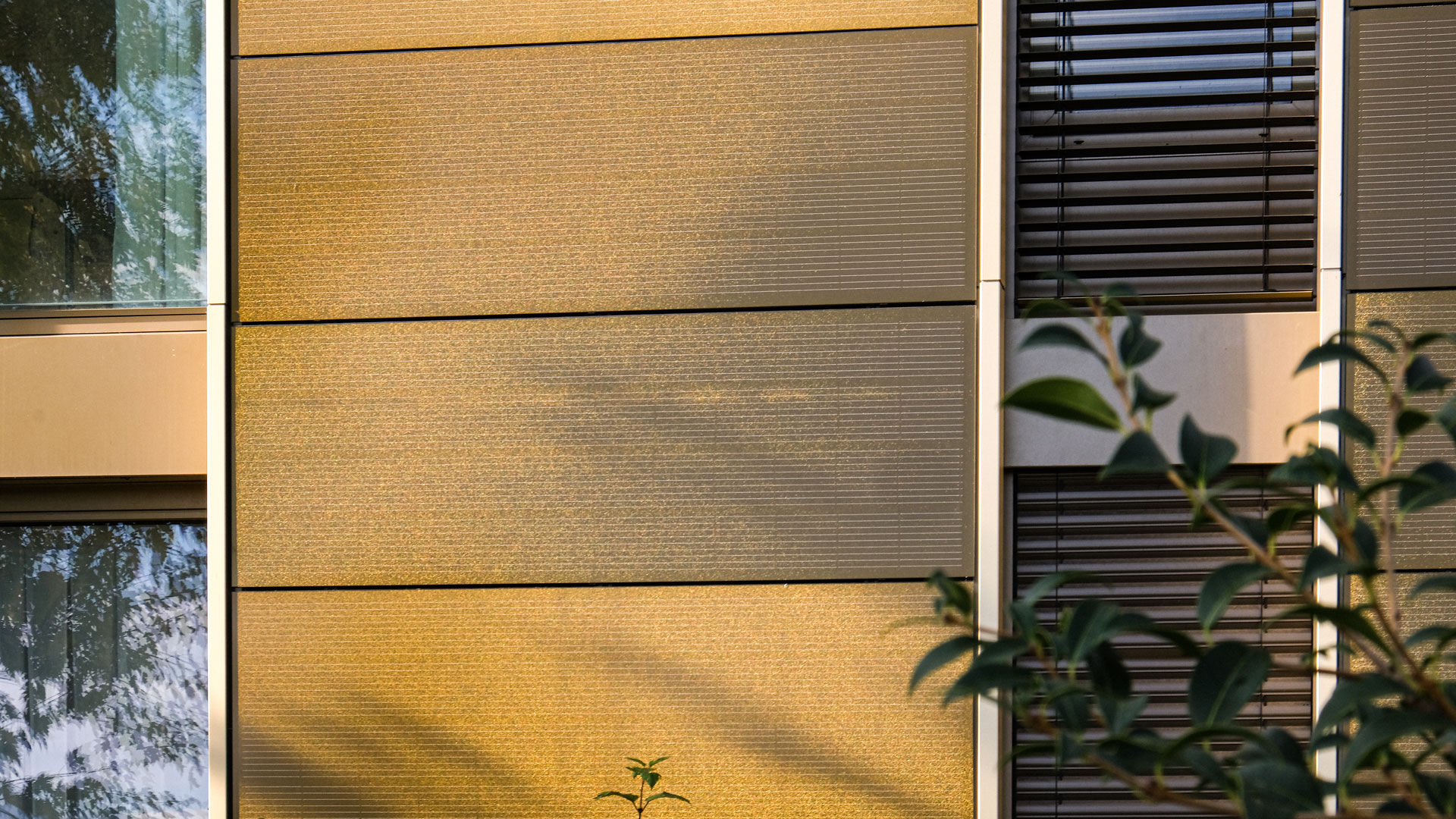
    Megasol Energie AG, based in Deitingen, has launched a new coloured solar module on the market. According to a press release, the modules with their new colour design achieve around 94 percent of the efficiency of conventional black photovoltaic modules.

    The panels under the name SOLARCOLOR Morpho are manufactured for installation as façade elements. For example, they have been installed on two new buildings in the Lacheren area of Schlieren. Depending on the incidence of light, the gold-coloured modules create a lively play of colours, according to the press release.

    The two buildings in Lacheren comprise 36 flats. The roof is also covered with photovoltaic modules and generates peak values of 68 kilowatts with an annual yield of 59,900 kilowatt hours. The façade elements generate peaks of 17 kilowatts and an annual yield of around 16,200 kilowatt hours.

    Megasol Energie AG is one of the five nominated finalists for the Prix SVC Espace Mittelland 2025 sponsored by the Swiss Venture Club (SVC), which will be awarded in Bern on 12 March 2025.

  • Schlieren launches complete revision of building and zoning regulations

    Schlieren launches complete revision of building and zoning regulations

    The Schlieren City Council will apply to the municipal parliament for approval of a credit of CHF 1,063,000 for the upcoming overall revision of the building and zoning regulations (BZO), according to the city council news.

    The aim of the overall revision is to ensure a high quality of life and work in Schlieren through tailor-made legal foundations, according to the press release. It is also intended to further promote the attractiveness of the location for companies in order to attract new investment. The last comprehensive revision of the BZO of the city of Schlieren was carried out in 1996.

    Schlieren has undergone a rapid urban transformation over the past two decades, which has not only shaped the cityscape, but has also significantly influenced the dynamics and priorities of urban development, according to the city council resolution. As the population continues to grow, the demands on the use of limited space will also increase. Further expansion of the settlement area is virtually impossible. The increasing scarcity of space therefore requires denser development throughout the city.

    The City Council emphasizes that Schlieren is not only an attractive place to live, but also an important business location. In particular, an innovative biotechnology and healthtech cluster has established itself in recent years. The overall revision of the building and zoning regulations offers the opportunity to further strengthen this potential.

  • Geistlich invites you to the ground-breaking ceremony at Lymhof

    Geistlich invites you to the ground-breaking ceremony at Lymhof

    Geistlich Immobilia AG invites you to the ground-breaking ceremony for the Lymhof construction project in Schlieren on September 20. The event begins at 4 p.m. with information stations and festivities on the construction site. The official ground-breaking ceremony will take place at 5 p.m. and then there will be a get-together at the Buvette from 6.30 p.m. to 8 p.m.

    The Lymhof will become part of the Schlieren quarter Am Rietpark. According to the project description, the Lymhof will not only create an attractive residential offering for residents of different generations and lifestyles. It will also become a meeting place for the district, with a bistro and hotel, a multifunctional hall, two green courtyards and spaces for small stores and local amenities.

    Excavation work is now starting after the demolition of the Vitis Sport Center with tennis hall has been completed. In February 2024, Schlieren City Council issued the building permit for Lymhof. Although the 350 or so rental apartments will not be ready for occupation until 2027, tenants can already register their interest now.

  • Strabag apprentices help at the federal scout camp in Goms

    Strabag apprentices help at the federal scout camp in Goms

    The Schlierem-based construction company Strabag Switzerland is organizing a joint trainee camp with two other companies from the construction sector. According to the press release , 93 trainees from Strabag, AFRY Schweiz AG and Preisig AG will take part in the camp in Goms from July 10th to 15th and help set up the federal scout camp. The BuLa will then take place there in the upper Rhone valley in Valais from July 23rd to August 6th. Up to 30,000 participants are expected at this federal camp of the Swiss scout movement. The federal camp only takes place every 14 years.

    According to the Strabag statement, the focus is on getting together and getting to know the trainees. “In total, we started with 93 apprentices. In our opinion, the cooperation of the industry creates great added value for construction. It is all the more important that we can already cultivate this with our junior staff,” says Fikri Kosumi, who is responsible for industrial apprentices at Strabag. At Strabag Switzerland there will be a total of 49 trainees in 2022.

    Kosumi organizes the warehouse together with Dominic Graf, timber construction foreman. At dinner together and planned sports activities such as river rafting or climbing in the rope park, fun should not be neglected.

    As a co-partner of the BuLa, Strabag wants to be a part of this major event and promote the valuable exchange between the scouts and their own apprentices, according to the Strabag announcement.

  • Swiss Prime Site Immobilien reports success in the first half of the year

    Swiss Prime Site Immobilien reports success in the first half of the year

    In the first half of 2022, Swiss Prime Site Immobilien doubled its lettings compared to the same period of the previous year. According to a press release from the Zurich-based company, 90,000 square meters have been newly let or re-let across the entire portfolio and across all regions. In the first half of 2021 it was 47,000 square meters.

    Swiss Prime Site Immobilien AG, which belongs to the Swiss Prime Site Group based in Zug, attributes this success to the good market conditions and the associated demand for commercial space. Despite the global economic slowdown, the signals for development in Switzerland remain mostly positive, according to the statement. In the service sector, for example, 105,000 new jobs were created in the past twelve months, an increase of 2.6 percent. The 114,000 vacancies also testified to a robust Swiss labor market.

    The real estate company noticed a particularly positive development in Basel, Zurich and Geneva. According to Swiss Prime Site, the two development projects currently under construction, JED in Schlieren and Stücki Park in Basel, are also enjoying brisk demand. Pre-letting rates of around 90 percent are expected there by the end of the year.

    “With the strong performance of re-lettings and new leases within our portfolio and the still intact economic prospects, we are also optimistic about the low vacancy rate and positive rental income development at the end of the year,” says Martin Kaleja, CEO of Swiss Prime Site Immobilien.

    Swiss Prime Site announces that it will publish the detailed half-year results for 2022 on Thursday, August 25.

  • IJZ Schlieren receives a photovoltaic system and e-charging stations

    IJZ Schlieren receives a photovoltaic system and e-charging stations

    The municipal properties on Rütistrasse in Schlieren will be equipped with a photovoltaic system and e-charging stations by decision of the city council. In its most recent meeting, the city council for installation and operation signed the electricity works of the canton of Zurich ( EKZ ), according to the latest edition of the city council news. The IJZ innovation and start-up center Schlieren is housed in the building complex on Rütistrasse.

    The photovoltaic system will be installed on the roof of the commercial building. According to the city council news, EKZ will install 1080 panels on an area of 4200 square meters. They should produce an output of 355,000 kilowatt hours per year.

    Six charging stations for electric vehicles will also be set up. They are not only available to employees and visitors of the IJZ Schlieren. Outside business hours, they can also be used by the general public.

    For the project, it is envisaged that the electricity works of the Canton of Zurich will finance and install the systems on the two main roofs at Rütistrasse 12/14 and 16/18 as well as an additional six e-charging stations along the Rütistrasse 12/14 facade and for 20 years with one Operate full guarantee. After the end of the contract period, the installations become the property of the property owner.

    The total costs are given as around CHF 554,520.

  • UBS pension fund joins Halter project

    UBS pension fund joins Halter project

    As the new landowner of the Attisholz core area, the UBS pension fund is participating in the Attisholz development project in Riedholz. According to a media release by Halter AG , this core area covers an area of 73,000 square meters. The remaining area of 420,000 square meters will remain in the possession of Halter. The Schlierem-based real estate company will transform the area step by step over the coming years and will implement various construction projects in the process. “By the time it is completed, this part of the site will offer space for around 740 apartments with 1,250 residents. At the same time, several hundred new jobs will be created,” says the project’s goals.

    A cooperation agreement between the canton of Solothurn, the municipality of Riedholz and Halter AG was originally concluded for the project. This has now been expanded to include the UBS pension fund. “The entry of the UBS pension fund immediately after the usage plan came into force is a strong commitment to the Attisholz area and thus also to the Solothurn region as an attractive place to live, work and live,” says Andreas Campi, Managing Director of Halter Developments.

    The municipality and canton are also pleased about the entry of the UBS pension fund. Sandra Morstein, Mayor of Riedholz, sees the “trustworthy and constant cooperation” of all partners strengthened. “For the Canton of Solothurn, the sustainable and future-oriented development of the Attisholz area is a central concern,” says Government Councilor Birgit Wyss. “The investment by the UBS pension fund is an important signal for the canton of Solothurn as an investment location.”

  • Plans for the Attisholz area are issued

    Plans for the Attisholz area are issued

    A competition for landscape architects was carried out for the design of the Attisholz area in Riedholz. According to a media release from Halter AG , those that are to be pursued have been selected from the six projects submitted. The Schlieremer construction group is the landowner of the area. The projects will now be presented to the public. The exhibition opened on Thursday, May 19, at 5 p.m. in the evaporation plant building. The exhibition will remain open until June 2nd.

    The government council of the canton of Solothurn approved the usage plan for the Attisholz area in Riedholz in December. The project page from Halter states that cellulose was industrially produced on the site for 130 years. Since the end of 2016, Halter AG has been working with the local municipality of Riedholz and the canton of Solothurn to find a new use for the area.

    Six teams led by landscape architecture offices took part in the competition that has now been held. In the program, the creation of a sustainable and changeable basis for the development of a living space for all users was formulated as a core task. The aim was to design the mostly public open spaces on the eastern part of the site in detail.

    The assessment committee consisted of experts in landscape architecture and urban planning, representatives of the municipality of Riedholz, the office for spatial planning of the canton of Solothurn and the landowner Halter AG. The committee unanimously recommended the study by DnD Landschaftsplanung ZT Wien and Freimüller-Söllinger Stadtbau ZT Wien for further processing.

  • Two women strengthen the board of the SVSM

    Two women strengthen the board of the SVSM

    At the General Assembly of the Swiss Association for Site Management ( SVSM ) in Baden on March 31, the members elected two new board members: Jasmina Ritz and Katharina Hopp. According to the announcement on the association’s website , the general assembly took place as part of the SVSM Dialogue Site Management 2022 in the garden hall of the Villa Boveri in Baden. During the dialogue, more than 30 people followed the practical presentations on site management in Baden, in the Wil region and in Upper Valais.

    With the election of Jasmina Ritz, Managing Director of the Limmatstadt AG location promotion, there are now three Limmattal residents on the seven-strong SVSM board. President Beny Ruhstaller is also head of the office of the Niderfeld landowners’ association, Albert Schweizer is a founding member of the SVSM and head of Schlieren location promotion.

    When asked, Ritz explains her motivation for the position on the board: “I would like to campaign for more visibility and awareness of our profession, to make our performance and impact more recognizable. Our work cannot be reduced to company settlements. We are designers, drive projects forward, bring people together, open doors and are ambassadors for our locations.”

    Katharina Hopp, who was also elected to the SVSM board, worked until 2021 as head of site development at the Baselland location promotion. From summer 2022 she will work at AXA Investment Managers as an ESG/Asset Management Analyst.

  • Swiss Prime Site Immobilien enters into a partnership with Superlab Suisse

    Swiss Prime Site Immobilien enters into a partnership with Superlab Suisse

    Laboratory and research space provider soon with locations in Basel and Schlieren
    The company Superlab Suisse, which already operates a location in Lausanne, provides operational and fully equipped research and laboratory space ("Lab as a Service"). The offer also includes operating services and other important services. Swiss Prime Site Immobilien and Superlab Suisse are planning to develop locations in Basel and Schlieren with a total area of over 10,000 m2 from 2022. The Stücki Park in Basel already houses a laboratory building and a technology park in which various life science start-ups come together. Right next door, another state-of-the-art building with laboratory and research areas is to be built by Superlab Suisse over the next 18 months. The second location is planned in Schlieren near the city of Zurich. The Limmattal is the seat of the Swiss Federal Institute of Technology (ETH), the University of Zurich (UZH) and research centers of numerous national and international pharmaceutical companies. There is correspondingly strong demand for laboratory space. Swiss Prime Site Immobilien is planning a modern new building project on the JED site in Schlieren. In cooperation with Superlab Suisse, research and laboratory areas for start-ups, spin-offs or established companies are to be created on two floors. «We are very pleased about the cooperation with Swiss Prime Site for the two upcoming locations in Basel and Zurich, the two most important life science clusters in Switzerland. Due to the direct proximity to the Wagi area in Schlieren and the technology park in Basel, companies from the life sciences sector can benefit from significant synergy effects of these ecosystems," says Zhang Xi, CEO of Superlab.

    Great strides are being made towards making the areas more flexible .
    The demand for flexible office and commercial space has been increasing for years. The market trend towards making rental space more flexible for other types of use is also steadily increasing. Swiss Prime Site Immobilien recognized this early on and successfully implemented it through the development projects YOND in Zurich and JED in Schlieren (existing buildings). Martin Kaleja, CEO of Swiss Prime Site Immobilien: “The key success factors are the modern standard of construction, the flexibility of the space and the guarantee of support and services. As with other areas that have already been made more flexible, the needs of our customers are also in the foreground in the Life Science area.» Swiss Prime Site Immobilien and Superlab Suisse together have the necessary know-how to ensure the space required in the laboratory and research area. While Superlab Suisse provides its innovative platform, Swiss Prime Site Immobilien manages the necessary
    Real estate knowledge and related development resources. Martin Kaleja, CEO of Swiss Prime Site Immobilien, once again: “We are very pleased to have found the perfect partner for making laboratory and research areas more flexible and scaling in Superlab Suisse. While Superlab Suisse contributes the 'software', we have the right knowledge of the real estate market, the knowledge of what our customers want
    and thus provide the 'hardware' in this partnership.»

  • Limmattal communities are committed to "room for more"

    Limmattal communities are committed to "room for more"

    The new motto “Space leads more” of the Limmatstadt AG location promotion will be adopted by several municipalities in the Limmattal and, according to the media release, will be used as a logo in the communication. Limmatstadt AG operates location promotion in the Limmattal across cantons.

    For example, since Thursday the Schlieren website has read: “Schlieren. part of the Limmat city. Room for more.” According to the statement, the large brackets around the statement symbolize the sense of unity in the region and the understanding that the Limmat Valley towns and communities have more power with a common self-image. In this way, the municipalities, together with the Zurich Planning Group Limmattal ( ZPL ), show their commitment to the region. According to the announcement, the appearance was created as a joint effort in workshops with the municipalities and the Baden agency Kommpakt .

    According to the press release, the Limmatstadt municipalities of Bergdietikon, Dietikon, Geroldswil, Schlieren, Turgi, Uitikon, Unterengstringen, Urdorf and Weiningen as well as the ZPL maintain service agreements with the Limmatstadt location promotion. Since it was founded in 2014, Limmatstadt AG has been committed to regional awareness, a common living and economic area, increased networking, sustainable development and joint positioning. At the General Assembly in August 2021 in the JED in Schlieren, the new motto “Room for more.” was approved.

  • Schlieren relies on a sustainable real estate strategy

    Schlieren relies on a sustainable real estate strategy

    The city council of Schlieren has adopted a new real estate strategy for 2035 . According to a press release , it serves as a binding basic document for the management of urban properties. The focus is on efficiency and sustainability.

    With the real estate strategy 2035, a modern real estate management should be introduced, which puts the active space management in the foreground, it says in the announcement of the city. The revision is necessary due to the strong population growth in recent years. As a result, the space requirements of the city of Schlieren, in particular for schools and childcare as well as administration, are constantly increasing. The focus was therefore more on the development of construction projects than on inventory management.

    The real estate master plan will be introduced as part of the real estate strategy 2035. It is intended to enable long-term investment planning for the real estate portfolio. In the master plan, renovation, expansion and demolition measures are to be planned, property acquisitions and disposals are to be coordinated and the investment needs to be assessed. The city is relying on the simplification of processes and increased efficiency through digitization.

    In order to maintain the real estate portfolio, it means that buildings owned by the city should be maintained according to the principles of future viability, energy efficiency, functionality and sustainability.

    As an energy city with the European Energy Award Gold, Schlieren is committed to sustainable development and the reduction of CO2 emissions. The city council included this in its real estate strategy. This also includes building with wood. The city pledges itself as a role model to promote the use of sustainably produced wood in its own buildings and facilities.

    A flyer from the city explains the sustainable real estate strategy concisely and clearly.

  • Schlieren expands planning for Zelgli school complex

    Schlieren expands planning for Zelgli school complex

    The city council of Schlieren has initiated an extended strategic plan for the Zelgli school complex. According to the city council news, the increasing number of students makes new planning necessary. In order to optimally determine the future development of the Zelgli school complex, the city council approved a loan for a feasibility study in July 2019. In April 2020, based on the current figures, two to four additional classrooms, two additional kindergartens and a triple after-school care center were planned. As early as September 2020, the latest figures showed that four new classrooms, two kindergartens and a quadruple day-care center are needed, according to the city council news.

    Structural adjustments are therefore necessary, such as enlarging the teachers’ room or installing additional sanitary facilities. Due to the changed order volume, a loan is now required for strategic planning. The city council has now approved it with 80,000 francs.

    According to the detailed message about the city council resolutions available on the website of the city of Schlieren, the school space requirements are calculated and planned twice a year based on the currently known data. The first order for spatial planning and open space planning with a volume of around 39,000 francs has already been placed with Metron Architektur AG in Brugg AG.

  • City of Schlieren adopts economic strategy

    City of Schlieren adopts economic strategy

    Schlieren has developed into a strong business location just outside the gates over the past two decades. There are now 1162 companies based in the city. There are 18,500 jobs for every 19,500 inhabitants. Schlieren now ranks 20th out of 132 municipalities in the city ranking of “Bilanz”.

    The city wants to expand this strong position. This emerges from the economic strategy 2021-2025 , which was drawn up with over 80 business representatives and has now been presented .

    Schlieren starts with its existing strengths. In the field of biotech around the Bio-Technopark Schlieren , the city is to further expand its international position. On a national level, Schlieren wants to position itself even more strongly as a location for start-ups. In Schlieren, clusters in the field of medtech and health care and in ICT are also to be added to match these two topics. Schlieren wants to establish itself as a node in networks that extend far beyond the city.

    This also requires increased communication. In the future, the city also wants to communicate in English and French on selected topics.

    But the city also wants to maintain its other clusters. For example, a service agreement with Shopping Schlieren is planned in the purchasing area. Important actors are to be retained and niche providers to settle in Schlieren. The automobile cluster should also be looked after and preserved.

    A good location needs space: Areas such as the Gasi, Geistlich-Areal, Wagi, Rüti and others should receive tailor-made development strategies. A good location also needs people: the leisure and service offers should be expanded.

    The city wants to further develop the location with partners such as Limmatstadt AG and the Greater Zurich Area. An economic council made up of representatives of the companies in Schlieren is also planned to support the city in the further development of the location. There will also be a change at the top of location promotion: Albert Schweizer built it up in over two decades. He will retire in around five years; the successor should be prepared in the next few years.

  • JED wins design award

    JED wins design award

    The real estate development JED in Schlieren was able to convince in an international architecture competition. She received the Silver Award at theA 'Design Award and Comeptition . As part of the global competition, 2094 winners from 108 countries and in 104 design disciplines were chosen.

    JED was honored for its interior design, according to a message from real estate developer Swiss Prime Site on LinkedIn. In addition to Swiss Prime Site, the Zurich architecture firm Evolution Design is behind the design.

    JED was created on the former printing center of the “Neue Zürcher Zeitung” in Schlieren. The development offers space for workplaces and events. JED sees itself as a “center for knowledge transfer, innovation and entrepreneurship”.

    "The project shows how industrial premises can be transformed into attractive destinations that revitalize local (economic) activities and create a platform for entrepreneurship," said the jury of the A 'Design Award and Competition. The architectural concept emphasizes the special features of the individual halls and gives the original structure a contemporary profile. The jury also praised the rooms in such a way that they enable knowledge transfer, creativity and innovation.

    The aim of the A 'Design Award and Competition is to make special architectural projects from all over the world known. This is intended to inspire new projects.

  • JED gets neon and icons

    JED gets neon and icons

    The JED in Schlieren is to be supplemented by art in architecture, informs a corresponding report on the website of the center in Schlieren. Art in architecture creates identity and meaning and shows the way, it says at the beginning. The owner Swiss Prime Site hired the artists Roland Ammann and Gregory Gilbert-Lodge to realize the works of art in JED.

    Glassblower Roland Amman comes from Neonhaus Ammann and has dedicated himself to the creation of three-dimensional works of art from neon after the lighting industry switched from neon to LED. For the JED he will create three oversized letters, a J, an E and a D. Amman has already installed the first work of art on the ceiling of the Jake barista bar. At first glance, the object, which looks like a fragile shining ball, turns out to be a J on closer inspection, says the report. “I like it when my art has several levels and the hidden only becomes recognizable at a second or third glance,” artist Ammann is quoted there.

    On the wall of the barista bar, visitors can already see the first work of art by Gregory Gilbert-Lodge in the JED. The independent illustrator has provided the bar with an oversized portrait of its namesake Jake in green. Jake is supposed to represent building J and give the bar “a face”, it says in the report.

    Gilbert-Lodge designed portraits of Eve and Didi for buildings E and D. “The fictional characters in the JED should act as icons,” explains the artist in the report. The values and ideas embodied by them, "even an attitude towards life", are what the icons give to the individual buildings, says Gilbert-Lodge.

  • Timber Corporation is the guardian of our forest

    Timber Corporation is the guardian of our forest

    The Schlieren wood corporation and the forest ranger Limmattal Süd have their diverse tasks under control despite the many challenges. They are pleased that this year, with the new cloakroom in the Zelgli, a building will be built by the city of Schlieren with local wood and that other buildings (after-school care center, new retirement center) will be tendered or planned in wood. This role model function of the city of Schlieren was also carried over to private real estate investors. The “Kesslerplath” project of the Migros Pension Fund is also to be realized in wood.

    Around 100 cubic meters of spruce wood from the Schlierem Forest will be used for the new cloakroom building at the Rohr sports field. Financially this is not a big deal for the Schlieren wood corporation, but President Fredy Füllemann is very pleased that the city of Schlieren not only sets an example for building with local wood with this decision, but also appreciates the work of the wood corporation.

    The Schlieren wood corporation was founded as a private corporation in 1851 and manages a total of around 180 hectares of forest. A milestone in the history of the Schlieren wood corporation was the great amalgamation of forests in 1984. This resulted in large and much easier-to-manage parcels. The city of Schlieren also contributed its forest and has since then been a member with partial rights, like all other private forest owners. Almost without exception, these are long-established Schlierem families.

    The prices for domestic wood are poor. These prices have been falling for a long time and the storm Lothar in 1999 intensified this trend. So there is hardly any more money to be made with the forest and the timber corporations are happy when they can cover the costs of care and maintenance with the proceeds. A further complicating factor is that significantly cheaper wood is delivered to Switzerland from abroad.

    The forest belongs to private individuals, but can be used by the public. Very few people know that the forest owners are responsible for a great deal of work in the forest, including the maintenance of the forest paths, which are highly valued by the population, and that they also have to bear the costs.

    In some Swiss cantons, wood corporations are supported in this area, but unfortunately this has hardly been the case in Zurich so far. "As the price of wood continues to fall, it is becoming more and more difficult for forest owners to cope with the financial burdens," emphasizes Roland Helfenberger and Fredy Füllemann adds: "We will probably have to make ourselves heard more in the canton in the future."

    In our time, the forest has to struggle with various influences. In particular, global warming is causing him a lot of trouble, some tree species will probably disappear in our forests in the long term. While spruce, fir and beech trees suffer from the higher temperatures, oaks, Douglas firs and nut trees have significantly fewer problems.

    It is typical of forest management that everything has to be considered over long periods of time, or – as Revierforster Helfenberger aptly puts it: "We benefit from the work of our ancestors and work for future generations." As the district forester Limmattal Süd, Helfenberger from Aesch has also been responsible for the care and management of the Schlierem forest since 2013. He and his team are faced with great challenges in a variety of ways. The heavy snowfalls in the past few months have caused a lot of extra work and the clean-up work is far from over.

    Ecologically and economically
    This is not the first time that the city is building Schlieren with wood. The multi-part factory building in the city on Bernstrasse was made of wood and even made it into the 20 best best practice examples in Switzerland. The double after-school care center at Schulstrasse 12 was also made entirely of wood in 2007. More wooden structures are to follow. The Migros Pension Fund MPK is currently examining the procurement of wood for the new Kesslerplatz building from the Schlieremer Wald, or from the Limmattal-Süd forest district. Spruce and fir trees are available for the harvest season. At best, the MPK plans to source the wood for the ceilings and facades from the region. The latest study by Wüest Partner AG shows that wooden buildings are not only ecologically convincing, but also keep up economically.

  • Limmat Verwaltungs AG gets a new name

    Limmat Verwaltungs AG gets a new name

    Limmat Verwaltungs AG has become Elicere Real Estate Management AG. Limmat Verwaltungs AG, founded in Schlieren in 1967, has been taken over by Elicere AG in Zug, according to a press release in 2019. The company was renamed from Limmat Bau-, Treuhand- und Verwaltungs AG to Limmat Verwaltungs AG.

    The administration is now to be continued under the new name, which refers to the new owner. The new company Elicere Real Estate Management AG is naturally based in Schlieren on Schulstrasse, at the previous address of the Limmat administration.

    Before the start with the new name, a comprehensive restructuring and especially digitization had been carried out, it says in the message. In addition to the management and valuation services already offered, there is now also the assumption of construction management.

    The new company, which was founded in December, is managed by Rikard Memaj and Roger Priester. Both are members of the Board of Directors. Its President Roger Priester is quoted as saying: "We are convinced that with the transparent and structured set-up in the company, we can lead our customers into a sustainable future with the most modern tools and motivated employees."

  • Schlieren drives the upgrading of Kesslerplatz

    Schlieren drives the upgrading of Kesslerplatz

    The Migros Pension Fund's investment foundation has presented a design plan for Kesslerplatz. After the transfer of the private design plan from the local council to the local parliament, "the city of Schlieren will soon come a big step closer to its goal," as a media release said.

    As part of the planned upgrading of the square, the high-rise is to be preserved. The design plan also provides for four new structures. One of them is intended for commercial use, the other three are intended to provide living space. A total of 103 new apartments, a double kindergarten and a multi-purpose room are to be created as a result. For the realization of the kindergarten, the city of Schlieren has agreed with the investment foundation of the Migros pension fund both an exchange of land and compensation of CHF 2.11 million.

    Work is scheduled to begin in spring or summer 2022, and move-in is to take place from spring / summer 2024. Since the double kindergarten will not be available until a year later, “the Migros Pension Fund's investment foundation will cover 50 percent of the rental costs for a temporary arrangement, the remaining rental costs are also included in the compensation”, according to the city of Schlieren.

    With the upgrading of Kesslerplatz, a “high-quality and attractive entrance gate” to Schlieren should be created, which will also be optimally connected to the Limmattalbahn.

  • Schlieren will be electric in the future

    Schlieren will be electric in the future

    The city of Schlieren has purchased its first electric garbage truck. One of the three refuse vehicles in Schlieren has reached its useful life and needs to be replaced, according to a message . Since the city has been relying on e-mobility when purchasing new vehicles for reasons of sustainability since 2020, an electric model was also selected for the new refuse vehicle. This is being built by Designwerk Products AG in Winterthur.

    At its meeting on January 13, the city council approved the expenditure of 775,000 francs. The municipal parliament approved the budget for the procurement of the refuse vehicle on December 16, 2020.

    According to the announcement, the first electric refuse vehicle in Schlieren offers several advantages in operation. On the one hand there is the CO2 reduction. But the operating costs also pay off. Because the energy costs for electricity are much cheaper compared to diesel. The maintenance and repair costs are also less expensive than with diesel, because there are fewer wearing parts with electric motors than with burn-out motors. In addition, there were no HVF charges – the heavy vehicle charge – or road traffic charges. With a service life of ten years, the electric vehicle is therefore much cheaper than a diesel-powered vehicle, according to the city council's justification.

  • Jasmina Ritz promotes the idea of the Limmatstadt

    Jasmina Ritz promotes the idea of the Limmatstadt

    According to Jasmina Ritz, the Limmat Valley and the idea of the Limmat City is more than just the route between Baden and Zurich. The managing director of Limmatstadt AG , now based in Schlieren, pointed out in an interview in the customer magazine "blue" of the electricity works of the canton of Zurich ( EKZ ) that the change from an agglomeration area to a coherent urban area has long been taking place there. "We accompany this change, bundle resources, combine the advantages and strengths of the individual communities into a common Limmat city", Ritz is quoted as saying. It names four important cornerstones for the realization of the idea of transforming the many municipalities – which are not to be merged – into a city on the Limmat: Networking of municipalities and politicians, the economy and the population. As a second point, Ritz mentions the positioning of the region with a common face, the development of the region as well as image promotion and the creation of a supra-regional awareness.

    From Jasmina Ritz's point of view, the Limmattalbahn is very important for the desired cohesion. The managing director is quoted as saying that it is not just a huge commitment to the federal and cantonal region. The railway networks the communities and is the backbone of urban development, "Without the tram, the Limmat Valley would have been just an agglomeration", Ritz is quoted as saying in "blue".

    This growing together and a shared cross-border vision was made possible by the development in the Limmat Valley. In the past, this was only perceived as an industrial location and a traffic axis. But a common city on the Limmat with its numerous municipalities would have much more economic and political weight. Limmatstadt AG is setting a cultural and economic agenda for the entire region. The regional magazine "36 km" – named after the length of the Limmat between Zurich and Baden – draws attention to regional products or recommends the best hiking trails, bike routes and the like. The daily newsletter “punkt4 Limmatstadt”, in which the activities of the companies are exclusively present, contributes to the “branding strategy”, ie the anchoring of the name Limmatstadt in the consciousness. Ritz: "There is no other region."

  • Limmatstadt AG is now based in Schlieren

    Limmatstadt AG is now based in Schlieren

    The Limmatstadt AG location promotion organization has moved from Zurich to Schlieren. With the new year she is now based in JED , the former NZZ printing company. From the new premises within the Coworking Space Branch Collab on the ground floor of JED, managing director Jasmina Ritz and her employees will continue to campaign for the Limmattal location and are now even closer to the pulse of the region, as a message shows .

    In JED with anchor tenants such as Zühlke and Halter , innovations are promoted and jobs are created. The Coworking Space Branch Collab also contributes to this with its flexible workspaces and as a platform for collaborative work. The companies and entrepreneurs based in JED as well as Limmatstadt AG benefit from the easy accessibility via the Limmattalbahn (Wagonsfabrik stop).

  • EKZ supplies the Limmat Valley with a further 80 megawatts

    EKZ supplies the Limmat Valley with a further 80 megawatts

    With the facility in Oberengstringen, the electricity works of the canton of Zurich (EKZ) put their third substation in Limmat Valley into operation. The Limmattal is now supplied by the three substations Schlieren, Dietikon and Oberengstringen. The new substation with an output of 80 megawatts will gradually be put into operation by next February.

    "This means that we are very well prepared for the steadily growing energy demand in the region", Hans-Peter Häberli, Head of Construction and Systems at EKZ, is quoted in an interview . The economic upswing in the Limmattal with the settlement of new companies, a large data center and the Limmattalbahn is causing the demand for electricity to rise sharply. Häberli: “We have generally seen strong increases in load in the Limmat Valley over the past few years. In the future, the energy demand will be driven by the Limmattalbahn and the establishment of a data center in the region. The Schlieren substation, which previously supplied the region with energy, must therefore be relieved. Its capacity would soon no longer be sufficient. "

    The electrical energy is converted in the new substation. In the case of Oberengstringen, EKZ takes over the electricity with a voltage of 110 kilovolts from the Axpo high-voltage network. The energy is converted to 16 kilovolts with two 40-megawatt transformers, according to the EKZ website. After that, the electricity would be further stepped down until it is fed into the grid for end users such as housing estates.

    The connection of the new plant is to take place gradually by February. According to Häberli, Oberengstringen will then be fully connected to the Axpo high-voltage network. The communities of Ober- and Unterengstringen, Weiningen and parts of Schlieren are then supplied.

  • The development on the Rietpark is larger than 17 football fields

    The development on the Rietpark is larger than 17 football fields

    On the former industrial site of the Geistlich glue factory in Schlieren, the second stage of the new quarter "amRietpark" is being built under the building contractor of Helvetia Insurance and Geistlich Immobilia AG Soccer fields. Where fabrics were once dyed and glue was produced, a total of 921 apartments and the Tertianum AG retirement center will be available from 2020. The Geistlich area alone covers 80,000 square meters and is directly adjacent to Schlieren train station.

    Between 2007 and 2015, 600 apartments, 12,600 square meters of office space and 14,600 square meters of commercial space, 330 square meters of which were for restaurants and bars, were built on the Färbi site. The Geistlich area includes the “Magnolia” project, completed in 2015, with 137 condominiums and the new buildings along Brandstrasse and Engstringerstrasse with a usable area of 55,000 square meters. The public “Rietpark” takes up around half of the new quarter: it is 600 meters long, comprises 42,000 square meters and is the heart of the development.

    Part of the project is a double kindergarten with lunchtime care at Engstringerstrasse 5. This is rented in the residential and commercial building with 84 apartments and commercial space on the ground floor realized by Geistlich lmmobilia AG. Zurich office E2A was hired as the architect. The new building consists of a U-shaped part of the building with residential use from the 1st floor and a continuous basement on the ground floor. All apartments face the park. On the roof, the tenants will find 15 roof gardens based on the former allotment gardens on the site.

    The buildings on Brandstrasse, which were occupied in 2020, were designed by two different architectural offices. Graber Pulver Architects are responsible for the building owner Geistlich Immobilia AG with four towers shifted towards each other like a chessboard at Brandstrasse 1-7. The towers merge into a unit over a two-storey base and guarantee optimal light irradiation and views from all corners of the building. The diverse housing options include classic apartments, maisonettes and cluster apartments as well as commercial and restaurant space and the retirement center for the anchor tenant Tertianum AG. Within the block, a “Rue Interieure” cut lengthways through the ground floor connects the towers.

    Gmür & Gschwentner Architects designed a building with 202 apartments for Helvetia Insurance at Brandstrasse 21. The new building divides the construction site into two structures, each placed around their own courtyards. The center is a hall that residents can use for communal events. A novelty for Schlieren is the pool on the roof with sundeck, which is freely available to the residents. Here, 3.5 to 5.5 room apartments and various commercial spaces were created along Brandstrasse. ■

  • A city quarter including the Limmattalbahn

    A city quarter including the Limmattalbahn

    “Where Zurich has a future” is Schlieren's slogan. This also applies to the new Reitmen district, where 177 rental apartments for different generations and needs will be built in five buildings. All apartments would offer sophisticated floor plans, carefully selected materials and spacious balconies. Each of the five houses has its own character and its own color concept can be read on the homepage on which the project is presented. The urban development stands for the modern Schlieren, emphasize those responsible for the project. The settlement is to become a place with a high quality of life that offers contemporary living and commercial space for a wide audience. In addition, there is 1,500 square meters of commercial space, a spacious park and, from 2022, the stop of the new Limmattalbahn directly in front of the door. ■

  • The new “LimmiCura” care center is under construction

    The new “LimmiCura” care center is under construction

    On the site where the high-rise building of the old Limmattal Hospital from 1970 stood until the end of 2019, the new “LimmiCura” care center will be built from 2020 to 2023. In order for the Limmattal Hospital Association to begin implementing the project, the consent of the population was required. This approved the required loan of 65 million francs. The care center, including the day center, three long-term care wards with palliative beds and a rehabilitation floor, is to have 116 rooms: 73 single and 43 double rooms. The new building will have five floors and will be implemented by the architects' office fsp in Spreitenbach. Architecturally, “LimmiCura” is based on the Limmattal Hospital, which was newly opened at the end of 2018. A dementia department with its own garden and a rehabilitation station on the 5th floor with 48 beds are planned. The day center will be located on the ground floor next to the dementia department. The inner courtyards will be accessible. The nursing department is located on floors 2-4. The "LimmiCura" should open in the first quarter of 2023. ■

  • JED: Innovative office and service space with industrial charm

    JED: Innovative office and service space with industrial charm

    Schlieren's western part has had a new think and worktank since mid-2020: JED (Join. Explore. Dare.). Since 2018, a new center for knowledge transfer, innovation and entrepreneurship has been built on the site of the former NZZ printing company. Not far from Schlieren train station, offices, industry and commerce are brought together. Spread over three buildings and a total of around 38,000 square meters of land, there are various seminar, conference and meeting areas as well as an event hall with space for up to 600 people. A gastronomic offer from the “Eves Kitchen” restaurant and several bars complete the offer.

    The center of JED is formed by the former printing halls (building complex J) with a ceiling height of up to 18 meters. Both service and event areas are located here. Further office and restaurant areas are located in the front building (Building E), which is connected to the halls. The catering business is currently being implemented on the ground floor, while the upper three floors are intended for office space.

    But building D in particular is something to talk about: a new building that is expected to be ready for occupancy at the end of 2022. After completion, this solid construction will provide space for office and service areas and aims to be a pioneer in terms of resource-saving architecture. The “2226” building concept was developed by Professor Dietmar Eberle and his architectural office Baumschlager Eberle. The buildings are designed without technical air conditioning such as heating, cooling or ventilation. Natural drafts are used for cooling. It is heated by the heat emitted by the lighting and electronic devices as well as the people who work in them.

    Solid walls reduce heat exchange. The surfaces and materials also compensate for temperature fluctuations, so that a comfortable temperature of 22 to 26 degrees Celsius can be guaranteed throughout the year. The proportion of windows is deliberately kept small at 16 percent – and the panes are set back in the building in such a way that only seldom rays of sunlight reach the glass. Sensors that measure temperature, humidity and CO2 content control ventilation blades as required. The materials used have a lifespan of 200 years. In addition, the reduced building technology ensures both a high level of space and energy efficiency. As a result, only half of the maintenance and operating costs of conventional real estate will be incurred.

    Meeting and recreation zones will be created in all three buildings. The number of above-ground parking spaces was deliberately kept small in order not to impair the high quality of the outdoor space visually or in terms of area. Photovoltaic systems can be found on all roofs.

    After Zühlke Engineering AG moved in in April 2020, Halter AG will relocate its headquarters to JED at the end of the year. Around 250 workplaces will be set up on an area of over 5,000 square meters. ■

  • Regional 2025 – projects for diversity

    Regional 2025 – projects for diversity

    The Limmattal – a diverse, coherent mosaic
    Despite urban thrusts, the development and the initial situation are not the same everywhere. For example, Spreitenbach and Neuenhof are changing from the formative 1970s modernism to more urban locations, but the dynamic cannot be compared to Schlieren, for example, until now. Wettingen is also discussing densification, and the concept of the garden city, which has been so formative up to now, is being questioned.

    It looks completely different on the right bank of the Limmat. The communities with their large single-family house areas look in amazement at the other side of the valley and watch the development from a distance. They are still villages and want to stay that way. This heterogeneity of the Limmat Valley, which can be interpreted as a difficulty, is above all its strength. In addition, with the formative landscape there is a kit that holds these pieces of the puzzle together. Above all the Limmat as namesake and identity bearer, as a unifying force of nature that meanders through the valley. But “spaces in between”, such as the Sulperg-Rüsler or Hüttikerberg-Sandbühl landscape corridors, are becoming increasingly important and are developing into a park landscape.

    "City" is only of limited use as a guiding term for this diverse fabric and does not do justice to the differences in places and the role of the landscape as a framework for the whole. Experts therefore speak more of “urban landscapes” in order to do justice to this phenomenon. That is why the edge of the block, the square and the boulevard, as tried and tested city elements, are not always the cure-all. In doing so, it is often not considered that this does not correspond to the complex social, economic and spatial structures of the Limmat Valley. The implementation of this idea can be seen, for example, in the Limmatfeld, where the new structures have so far represented an island in the context of the surroundings and have not yet been able to form the desired lively center beyond the railway.

    These new city modules are definitely a good contribution to the discussion about the future of the Limmat Valley, but they ignore many of the realities of the existing Limmat Valley and the sensitivities of the population. The starting point in the Limmat Valley is too complex to take just one approach. Industrial wastelands such as the Rietbach area in Schlieren or the Limmatfeld for consistent new urban building blocks are practically no longer available. Everything that is now added in the course of the consolidation must deal with the existing. The further construction of the Shoppi Tivoli in Spreitenbach requires different strategies than the densification of Wettingen or Neuenhof. And the strategies for the further development of the villages to the right of the Limmat require completely different recipes.

    Overcoming boundaries – spatially and thematically
    The whole thing becomes interesting in the combination of different strategies for the long-term further development of the Limmat Valley. In the longitudinal direction, the Limmattalbahn establishes the linear connection with high-density nodes along the stops. It is also exciting when the cross-connections are considered. So far, hardly trained, they have the potential to form completely new gravity lines: both in built-up space and in the landscape. The axes such as Schlieren-Unterengstringen or Dietikon-Fahrweid-Geroldswil, like the landscape corridors, offer an opportunity to connect the differences spatially and socially and to enable a new interaction across the longitudinal barriers.

    This is also of great importance within the towns and cities themselves. Examples of this are various plans and concepts that must be pursued further: Schlieren would like to link the rapidly emerging new districts on both sides of the railway with the existing districts and the village center. In Dietikon there is the idea of a connection between Silbern and Niederfeld. Spreitenbach would like to extend the central axis as far as the Limmat, and Neuenhof is developing transversely to the main axis into “Neuenhof am See”. This requires new connections and bridges over the railway, the Limmat or over roads. These are not only spatial connections, but also bring long-term residents and newcomers closer to one another.

    Growth and change therefore not only affect the areas of construction and mobility, but all areas of life of the population: The everyday life lived across borders is already reflected today in work, living and leisure behavior as well as in mobility and consumer behavior. What began with a visit to the Shoppi Tivoli in Spreitenbach in the 1970s will intensify with the construction of the Limmattalbahn and result in further investments. The cantons of Zurich and Aargau have therefore decided, together with 16 cities and municipalities in the Limmat Valley, to actively shape the development across borders using a new format. To this end, they founded an association in 2015, the “Regional Project Show Limmattal”.

    To cope with the challenges and also to alleviate the “growing pains” in the Limmattal, the Regionale 2025 is pursuing a thematically broad approach which, in addition to the classic spatial planning issues, also includes the areas of culture and society. ■