Tag: Schulhaus

  • Horw optimises properties in terms of energy technology

    Horw optimises properties in terms of energy technology

    The municipality of Horw wants to gradually optimise the energy efficiency of its municipal properties. The first step will be taken by 2028 with the Kastanienbaum and Hofmatt school buildings, the fire station building, the works yard, a council-owned apartment block on Roseneggweg and the cloakroom building at the Seefeld sports centre, the municipal administration announced in a press release. Further buildings, including the other municipal school buildings and the community centre, are to follow by 2036. Optimisation measures are already planned for a total of 17 buildings.

    The municipal council wants to fulfil the residents’ council’s mandate to reduce the CO2 emissions of the municipal building stock as much as possible before 2040. The plans for the 17 properties that have now been selected are specified in the supplementary report Climate-friendly building stock in the municipality of Horw. According to the report, the CO2 emissions of the 17 properties can be reduced by around 75 per cent. The costs for the corresponding measures are estimated at a total of CHF 17 million.

    When it comes to energy-efficient refurbishments, properties and measures should be prioritised appropriately. “The potential for reducing greenhouse gases, as well as the structural condition of the properties and the life cycle of the individual parts of the building, are essential for prioritising the properties,” the press release states. Thermal insulation, a switch to climate-friendly energy sources or the installation of solar systems are mentioned as possible measures. The costs should “remain at an acceptable level and be spread over the planned period”.

  • Strabag builds a new school building in Neuendorf

    Strabag builds a new school building in Neuendorf

    The district school Gäu in Neuendorf is expanded by a new building. Hochbau Oensingen, a department of the Schliere-based construction company Strabag AG , is responsible for the building shell with core zones and facades. According to Strabag's press release , the new school building consists of four floors: the basement with underground parking, the technical center, the materials store and the meeting room. On the ground floor, the entrance area, the auditorium and the staff room are created. The new classrooms are located on the two upper floors. The existing building and the new building are connected underground with a passage. The new building should be ready for occupancy in autumn 2023.

    Regarding the construction, the announcement states that a building made of exposed concrete with a wooden structure is planned. Glazed formwork elements and wooden panels with vertical indentations are intended to create the desired exposed concrete structure after concreting.

    The district school Gäu in Neuendorf runs the secondary school for Neuendorf and the surrounding communities. The increasing number of pupils in the associated municipalities requires additional school space, according to the statement. According to the website of the Zweckverband Kreisschule Gäu , the upper school students come from the district communities of Egerkingen, Fulenbach, Härkingen, Neuendorf, Niederbuchsiten, Oberbuchsiten and Wolfwil. Around 440 students are currently being taught by 60 teachers.

  • Feld school in Azmoos wins architecture prize

    Feld school in Azmoos wins architecture prize

    The Feld school in Azmoos has won first place in this year's Constructive Alps architecture prize, the Federal Office for Spatial Development ( ARE ) reports in a statement . It represents Switzerland in the competition organized jointly with Liechtenstein. Constructive Alps recognizes sustainable building and renovation in the Alps. With the competition, the two countries want to promote the implementation of the Alpine Convention for the sustainable development of the mountain region.

    The Feld schoolhouse was built on the site of the old schoolhouse in Azmoos. It offers space for more than twice as many children as the old school building on the same built-up area. The socially and ecologically sustainable timber construction also impressed with its own photovoltaic system, among other things.

    The second prize was awarded jointly to the headquarters of the heating specialist ÖkoFEN France in Saint-Baldoph and the Ghiringhelli residential development in Bellinzona. Third place went to the renovated Falkenhütte in Hinterriss in the Austrian Karwendel Mountains.

    Switzerland will hold the presidency of the Alpine Convention in 2021/22. The internationally binding agreement between the eight Alpine states and the European Union has set itself the goal of developing the Alps into a model region for climate protection and adaptation to climate change. Under the aegis of Switzerland, the focus was on climate, sustainable mobility, Alpine towns, sustainable construction and modal shift.

  • CKW lays high-voltage lines in the ground in Littau

    CKW lays high-voltage lines in the ground in Littau

    CKW investiert in der Agglomeration Luzern in mehreren Projekten in die Versorgungssicherheit und in ein weiterhin zuverlässiges Stromnetz. So erfolgte am 19. September 2022 der Baustart zur Verlegung der Freileitung zwischen der Unterstation Ruopigen und Oberwil in Littau. Die Hochspannungsleitung führt aktuell mitten durch Quartiere und über das Schulareal Rönnimoos. CKW verlegt die Leitung auf einer Länge von 1210 Metern in den Boden. Dank der Verlegung der Hochspannungsleitung wird das Gebiet Rönnimoos entlastet. Zudem ermöglicht sie der Stadt Luzern, das Gebiet Längweiher/Udelboden mit einer neuen Überbauung zu erschliessen und das Schulhaus Rönnimoos zu erweitern. Bis Sommer 2023 soll die aufwändige Verkabelung fertig sein. Danach erfolgt der Rückbau der bestehenden Freileitung.

    Aus wirtschaftlicher Sicht wäre für CKW der Zeitpunkt für einen Ersatz der Hochspannungs-Freileitung noch nicht notwendig. Sie erreicht erst in gut 20 Jahren ihr Lebensende. CKW und die Stadt Luzern haben sich darum bereits 2019 in einer Vereinbarung auf einen Kostenteiler geeinigt. Die Stadt Luzern beteiligt sich mit 995’000 Franken an den Gesamtkosten von 3,2 Mio. Franken. Dadurch entstehen den Netzkunden von CKW keine zusätzlichen Kosten.

    Während den Bauarbeiten wird die Luzernstrasse in Littau im Bereich des Schulhauses Rönnimoos zeitweise nur einspurig befahrbar sein. Die Stromversorgung ist gewährleistet.

    Erneuerung der Unterstation Horw ist bald abgeschlossen
    Bevor die neue Leitung in Littau ans Netz gehen kann, muss die Erneuerung der Unterstation in Horw abgeschlossen sein. Sie ist ein wichtiger Knotenpunkt im CKWVerteilnetz und wird unter anderem von der Unterstation Ruopigen gespiesen. Aktuell erneuert CKW das Gebäude und einen Grossteil der Technik der Unterstation Horw.
    Zudem erfolgt an den bestehenden Transformatoren eine Spannungserhöhung von 50’000 auf 110’000 Volt. CKW investiert mit diesen Projekten rund 11,5 Mio. Franken in die Sanierungen und den Ausbau der Netzinfrastruktur. Sie stärkt damit heute und in Zukunft die Versorgungssicherheit in den Regionen Horw, Kriens, Littau und der Stadt Luzern.

  • Let there be light

    Let there be light

    Together with the Seefeld school complex, the Mühlebach school complex forms the Riesbach school unit. In order to cover part of the increased demand for classrooms expected in the Zürichberg school district in the long term, the Mühlebach school complex needs to be repaired and expanded. The range of school rooms is to be expanded to include two kindergarten and six primary school classes in day school by 2025. The completion of the repair and expansion work is planned for 2025.

    The Mühlebach schoolhouse and the sports hall were built by Adolf and Fritz Brunner in 1876 and 1880, respectively. In 1950 Otto Dürr connected the school building and the sports hall with an intermediate building. The school complex is listed in the municipal inventory of monument and garden monument preservation. Comprehensive repairs were last carried out in 1981. The school house and the sports hall are in need of repair today.

    The winning project “Lichtung” is convincing on several levels. The urban unbundling of the two buildings brings a high added value for the ensemble, which is worthy of protection, as well as for the surrounding area and strengthens the permeability of the area. With the partial dismantling of the intermediate building, the winning project creates an open atmosphere and re-establishes important pathways and visual connections between the outside spaces. A small roof for breaks will be added over the connection between the school building and the sports hall. All uses such as primary school, kindergarten, childcare and sports are now clearly separated and accessible.

  • Groundbreaking ceremony for the new Stierenmatt school pavilion

    Groundbreaking ceremony for the new Stierenmatt school pavilion

    The new construction of the Stierenmatt pavilion on the Hunziker area in the Limmatfeld area is scheduled to begin on October 1st. A temporary school building for the Stierenmatt school unit will be created. According to the city of Dietikon , this should offer space for nine primary classes. The creation of classrooms in the Limmatfeld district has been planned for some time. "Due to outstanding cantonal plans, the construction of the planned school building on the Stierenmatt area belonging to the city is delayed and will probably be completed in 2028 at the earliest," said a message from the city of Dietikon on the occasion of the vote on the loan financing of the project to justify a temporary solution .

    In the vote in June, according to the city, 2,056 voters were in favor and 735 were against the loan. This approved the submission for a loan of CHF 15.2 million.

    Construction work for the temporary school is expected to be completed in August 2021. The entire population is invited to the groundbreaking ceremony on Thursday, October 1st at 5.30 p.m. Registration is not necessary. Due to the current pandemic, however, there are no tables, benches and no toilet facilities available. Every visitor is legally obliged to register on an attendance list for contact tracing, the invitation draws attention to.

  • From a listed school building to a private hotel

    From a listed school building to a private hotel

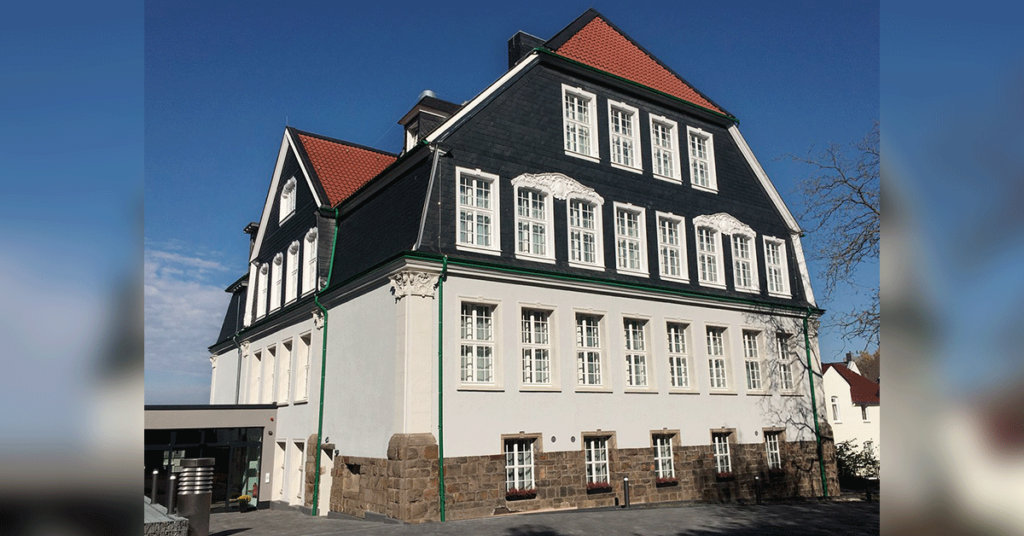
    The vision: A hotel is to be converted from a former school building, in which the original character of use and the original substance are to be retained. The Berlin hotelier Kurt Hermandung and his partner Marc Konopatzki have realized their dream of their own small private hotel. This is close to Düsseldorf, Cologne and the Ruhr metropolises. "We wanted a small, fine house with character that we can make something very special," say the owners. "After a long search, we came across this former elementary school – and an investor who could imagine turning it into a hotel and the former gymnasium into a restaurant." In terms of design and concept, the former schoolhouse from 1915 and the gymnasium added in 1980 were based on the original use of the building.

    Classrooms became elegant hotel rooms
    The local architecture firm Wilde and Wehnau implemented this ambitious conversion concept, from the design to the implementation planning and construction management. Their services also included the concept of the monument protection concept, the planning of the interior design and the lighting design. The exterior facade with its typical slate shingles, the representative bay window and the green rain gutters were restored and preserved under the watchful eye of the listed building. The former classrooms of the primary school have been transformed into elegantly furnished single and double rooms with oak parquet and spacious bathrooms. A junior suite was installed in the attic. The minibars that used to be in the rooms are a thing of the past. The alternative is much more original and ecologically more sensible: A central “school kiosk” on the ground floor offers a variety of drinks.

    A special feature in the house is the restored historical fountain with fresh drinking water, which extends over two floors, emphasize the hotel owners. Old certificates and photos are reminiscent of the earlier school days. You can find yourself in the whole building. Gym boxes serve as luggage racks in the rooms. The gym's old rung climbing wall was also given a new function. It serves as a partition to the stairs in the restaurant.

    Former gym as a restaurant
    The rather unadorned gymnasium was completely dismantled in the course of the renovation work. The result is a modern building which now houses the “Die Turnhalle” restaurant, the lounge and the bar. In the historic school building, a lift provides barrier-free access to all floors and connects the hotel rooms with the restaurant. The latter is also open to the public. A newly installed ceiling divides the former gymnasium into two floors. This enabled the area to be doubled to 800 square meters. This made space for four conference rooms and a small bar for catering in the conference area. The extension with its large glass surfaces is a successful contrast to the old and lovingly restored school building and complements it in an ideal way. ■