Tag: Schwammstadt

  • New open space concept enhances quality of life and biodiversity

    New open space concept enhances quality of life and biodiversity

    According to a press release, Spreitenbach Municipal Council has adopted the open space concept. This establishes a legally binding framework for the future development of open spaces within the municipality’s built-up area. The aim is to safeguard and improve the quality and use of open and green spaces.

    The plan’s objectives include strengthening the identity of neighbourhoods, promoting biodiversity and enhancing climate resilience based on the ‘sponge city’ principle – rainwater runoff should be absorbed locally wherever possible.

    The plan also includes a catalogue of 21 specific measures. The first measures include the planning and implementation of Neumatt Park, the further development of the Ziegelei site, and the creation of temporary open spaces. Immediate measures are intended to improve the quality of the environment, whilst better signage will indicate the route connections. By the end of 2026, responsibilities are to be clarified, priorities set and initial measures prepared.

    The municipal assembly approved the commitment credit for the open space concept, amounting to 170,000 Swiss francs, on 28 November 2023. An interdisciplinary planning team subsequently developed the concept in collaboration with a broadly based steering group.

  • Ein Quartier ohne Einsprache

    Ein Quartier ohne Einsprache

    Der Luzerner Regierungsrat genehmigte den Bebauungsplan Schützenmatt im Januar 2026. Der Emmer Einwohnerrat hatte ihn bereits am 1. Juli 2025 in zweiter Lesung einstimmig verabschiedet. Nach Ablauf der Beschwerdefrist liegt nun Rechtskraft vor, kein einziger Rekurs wurde eingereicht. Das ist bei einem Projekt dieser Grössenordnung keine Selbstverständlichkeit, sondern ein Zeichen breiter Akzeptanz.

    250 Wohnungen, 4000 Quadratmeter Leben
    Auf dem Areal entstehen rund 250 Wohnungen in verschiedenen Grössen sowie Gewerbe-, Gastronomie- und Dienstleistungsflächen von insgesamt rund 4000 Quadratmetern. Der Wohnungsmix reicht von kleineren Einheiten über Familienwohnungen bis zu Alterswohnungen . Bewusst konzipiert für alle Lebensphasen und verschiedene Einkommensstufen. Ein Teil der Wohnungen muss als preisgünstiger Wohnraum realisiert werden.

    Weniger Auto, mehr Velo
    Das Mobilitätskonzept setzt klare Prioritäten sodass Fuss, Velo und öffentlicher Verkehr Vorrang haben. Geplant sind über 970 Veloabstellplätze, darunter eine gedeckte, öffentlich zugängliche Velostation mit mindestens 300 Plätzen direkt an der Bahnhofunterführung. Für Autos stehen maximal 120 Parkplätze in der Tiefgarage bereit. Die Velohauptroute entlang der Gleise wird kreuzungsfrei geführt. Somit entfallen Konflikte mit dem Fussgängerverkehr.

    Die Stadt als Schwamm
    Das städtebauliche Konzept stammt von Fischer Architekten, deren Wettbewerbsbeitrag mit dem ersten Preis ausgezeichnet wurde. Im Zentrum steht das Schwammstadtprinzip. Sickerfähige Beläge, Bäume auf natürlichem Boden und begrünte Dachflächen speichern Regenwasser und geben es kontrolliert wieder ab. Mindestens 60 Prozent der Dachflächen werden intensiv begrünt. Das verbessert das Mikroklima und macht das Quartier klimaresilient.

    Ab 2027 wird gebaut
    Mit der Rechtskraft liegt die Umsetzung nun bei den Grundeigentümerschaften. Die Realisierung ist in vier Etappen geplant, ein Bezug der ersten Wohnungen ist ab rund 2030 realistisch. Christine Bopp, Leiterin Planung der Gemeinde Emmen, spricht von einem abgeschlossenen langen Planungsprozess, der nun Planungssicherheit für alle Beteiligten schafft. Emmenbrücke bekommt sein neues Herz und baut es mit Bedacht.

  • Green living in Basel Dreispitz Nord

    Green living in Basel Dreispitz Nord

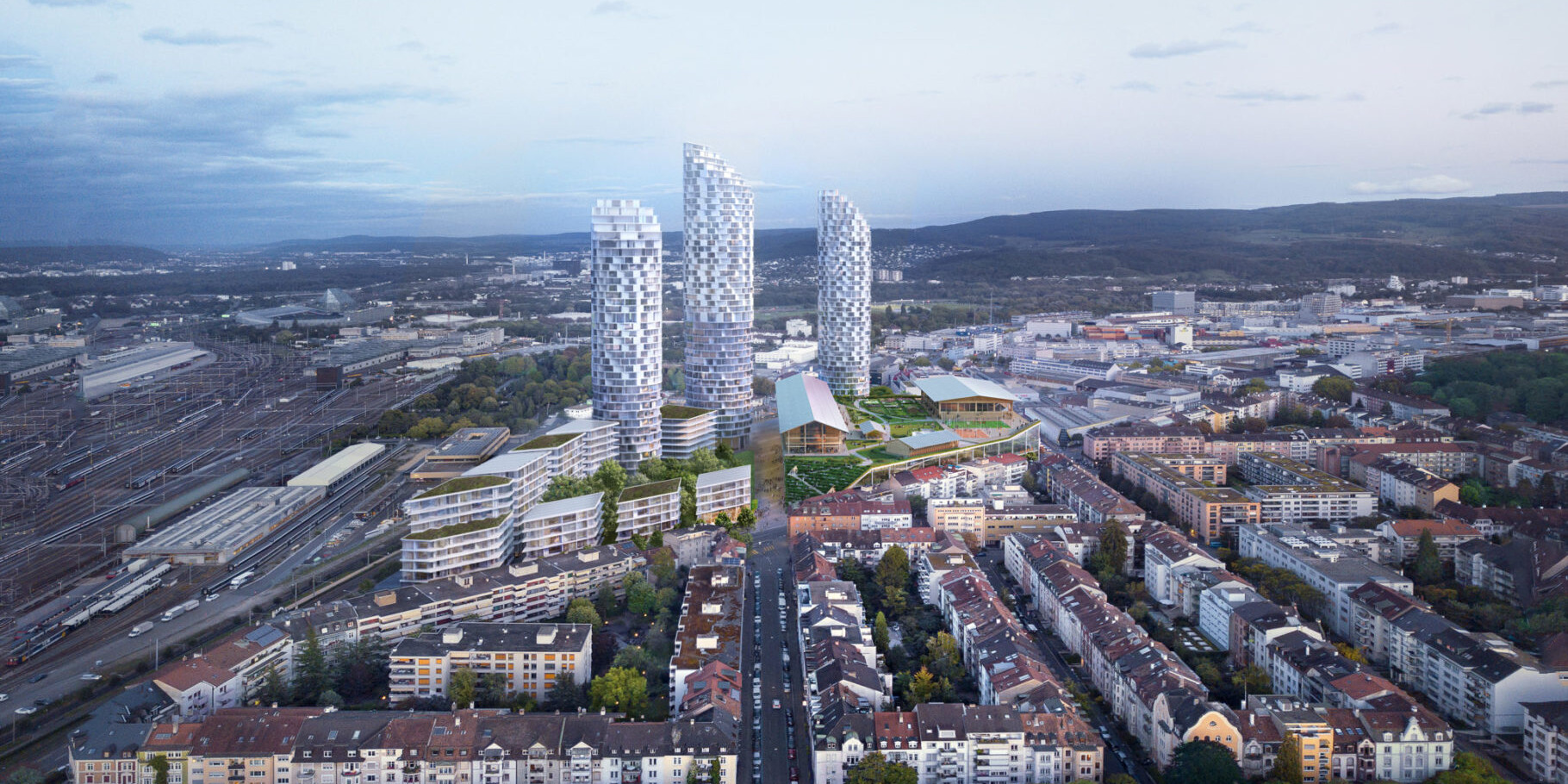
    Dreispitz Nord is transforming a formerly single-use area covering around eight football pitches into an inclusive district. Around 800 flats are being built, a third of which will be affordable and non-profit housing. Three striking round high-rise buildings will offer attractive flats as well as office space, a library and a fitness centre. The focus is on a neighbourhood where everything is within easy reach. Living, working, shopping and leisure activities merge into an urban whole. Pedestrians and cyclists have priority, and the public space is almost completely car-free. A total of 4,000 bicycle parking spaces are planned, and car parking facilities are bundled together and separated from the residential area to minimise traffic in the neighbourhood.

    A green place for urban climate and community
    Two newly planned city parks with large shade trees will transform the area into Basel’s green lungs and improve the microclimate in the long term. Permeable soils and planted roofs fulfil the principles of the sponge city and help to mitigate heat effects. The secondary school for around 600 pupils will be built on the roof of the modernised MParc, opening up new dimensions in terms of land use. The facilities will be complemented by basketball and sports fields, a triple gym and a youth club, which can also be used outside school hours. Direct access from Gundeldingen via a green ramp seamlessly connects Dreispitz Nord with the neighbouring district and creates public spaces that foster a sense of identity.

    Partnership-based planning with vision
    The Christoph Merian Foundation as the landowner, the Migros Basel cooperative as the building leaseholder and the canton of Basel-Stadt as the planning authority are jointly driving the project forward. After an intensive public consultation period with seven objections, all of which were rejected, the cantonal government confirmed the development plan on 14 October 2025 and forwarded it to the cantonal parliament for consideration. In addition to the development plan, adjustments to the zoning plan, noise sensitivity levels and building regulations are also planned. The environmental impact assessment confirms that all requirements have been met.

    Sustainability and social balance
    Dreispitz Nord is a prime example of sustainable neighbourhood development. Instead of grey parking spaces, green open spaces are being created, and the diversity of housing promotes social mixing. The existing building is being integrated into the new complex in a resource-efficient manner. Wide distances between the high-rise buildings ensure good ventilation, shade providers reduce heat stress and permeable surfaces strengthen climate adaptation. With 1,400 new residents, representing 7 per cent of the total population of Gundeldingen, and 1,600 jobs, the district will become a significant economic driver.

    Urban life and economy in harmony
    The new quarter integrates today’s modernised retail spaces, complemented by cafés, restaurants and small shops, which are also easily accessible via the extended tram stop. The interconnection of living, working, shopping and leisure creates an inspiring atmosphere and promotes sustainable mobility over short distances.

    Dreispitz Nord is characterised by its urban compactness, ecological sensitivity and social diversity. The project is a prime example of how comprehensive urban development can harmonise innovation, sustainability and quality of life, strengthening Basel as an attractive city for today and tomorrow.

  • From the depot to a climate-resilient urban district

    From the depot to a climate-resilient urban district

    The starting point for the development is the withdrawal of the CKW depot in the context of the large-scale transformation around Seetalplatz. Based on a two-stage study commissioned by CKW and the city of Lucerne, the “Habitat – Quartier im Hain” project was selected in 2022. The careful handling of existing buildings was decisive. In particular, the Shedhalle and the consistent integration of open spaces and rainwater management.

    The ideas of the winning project were then applied to the entire perimeter of the development plan and enshrined in planning law. The result is a coordinated overall figure that combines private properties and the former factory yard area into an urban development whole.

    Urban development, mixed use and sponge city
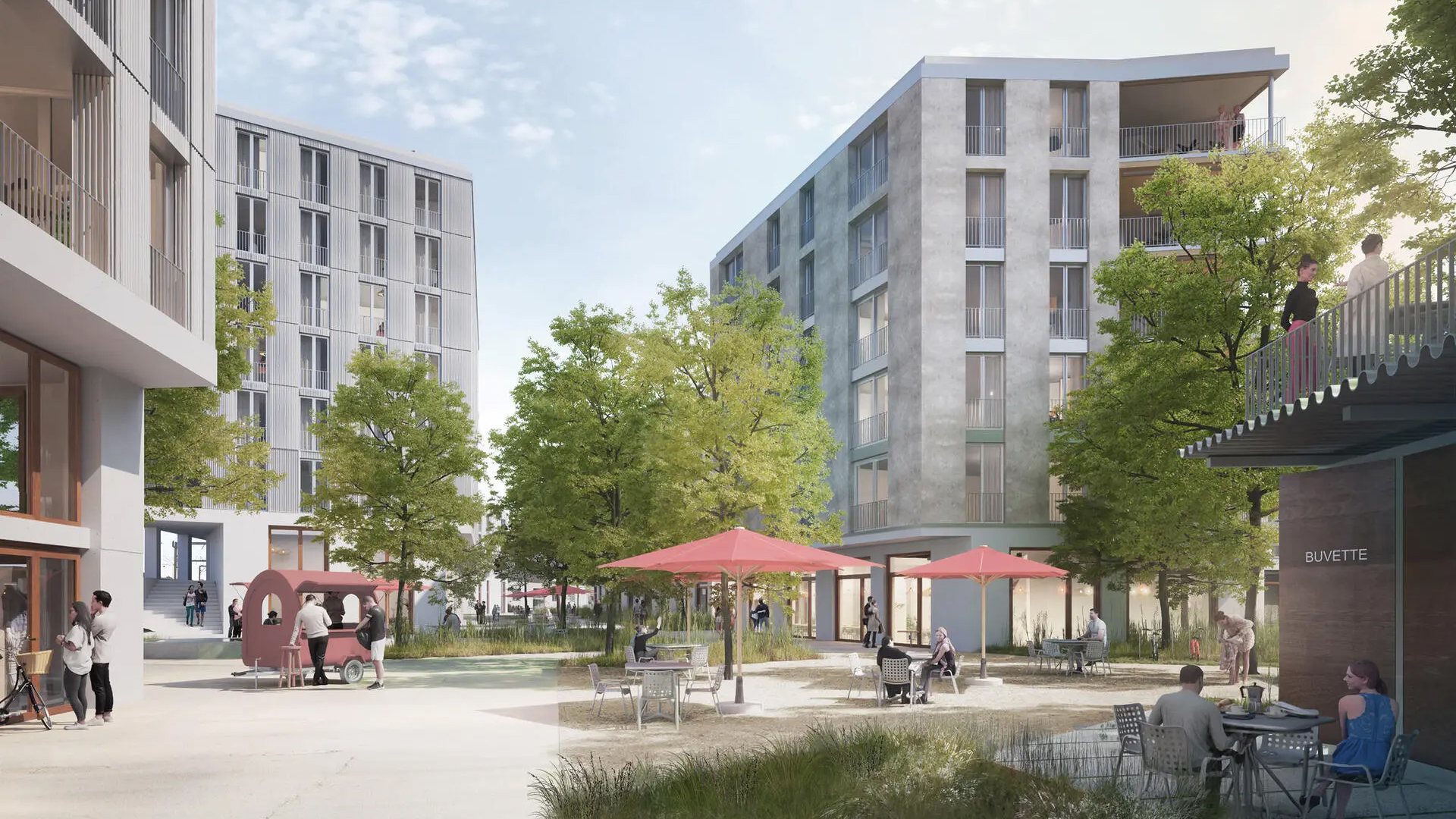
    For reasons of noise and urban space, the north-eastern part of the area is characterized by larger, mixed-use buildings in closed construction. Living, working, services and first floor uses are concentrated here along streets and squares. The western part focuses on open residential buildings, connected green spaces and paths that link the adjacent neighborhoods.

    The central element is a topographical depression in the west, a former floodplain. It serves as a retention area for rainwater and forms the basis of the “urban grove”, which characterizes the district with trees, infiltration areas and a cooling microclimate. Rainwater management, climate-adapted open space design and the sponge city principle thus become key components of the district’s identity.

    Social mix and diversity
    When completed, around 700 to 800 additional apartments are planned for Reussbühl West, at least 20 percent of which will be non-profit. They will be supplemented by multi-purpose rooms and around 15,000 to 18,000 square meters of work space for businesses and services. Short-term rentals will be limited to the areas already available today and are only permitted in construction site C9. This is a deliberate signal in favor of long-term residential and neighborhood structures.

    The existing shed hall will be opened up for public-oriented uses and will function as an address for culture, leisure or small-scale businesses. Together with the first floor uses of the new buildings, a mixed-use, all-day lively environment will be created that closely interlinks living, working and public facilities.

    Legal planning basis and timeline
    The “Reussbühl West” development plan sets out the main elements of the urban design and the distribution of uses in a way that is binding on the landowner and allows for staggered implementation. It is open to the public from November 24 to December 23, 2025. Objections and negotiations will be incorporated into further processing before the plan is submitted to the City Council.

    Together with the “Reussbühl Ost” development plan, which is already legally binding, this will create a legal planning framework for an upgraded, mixed-use district with a total of around 1,000 additional apartments and 15 to 20 percent commercial space. The densification will take place gradually. The first non-profit apartments and new commercial space are already under construction in Reussbühl Ost, marking the transition from an industrial area to the urban city building block of the next generation.
  • Schlieren station shines in new splendor

    Schlieren station shines in new splendor

    The station square in Schlieren has been transformed into a modern meeting zone that creates space for recreation, encounters and visible mobility. In the center is a spacious square with a striking tree as a green landmark. In front of the city library, a fountain with benches invites people to linger, and new recreational areas have also been created by the SBB West underpass and in front of the restaurants.

    A central element is the clear right of way for pedestrians through the meeting zone. Sidewalks have become superfluous and the entire space belongs to public life. Almost 70 new bicycle parking spaces also encourage people to switch from bicycles to public transport.

    Green spaces for the urban climate
    An innovative approach to climate adaptation was chosen with the implementation of the sponge city principle. 1,200 m² were unsealed to allow rainwater to seep away better. Newly planted trees and around 500 m² of additional green space provide shade and evaporation for cooling, especially on hot summer days.

    The planting is not only ecologically valuable, but also aesthetically pleasing. The cityscape looks livelier and more inviting.

    Grand opening for the public
    The new meeting zone will be inaugurated with a two-day celebration on Friday and Saturday, June 20 and 21, 2025. The event will kick off with an official speech by City Councillor Stefano Kunz on Friday at 5.00 pm, accompanied by the Harmonie Schlieren band. This will be followed by the street festival with culinary delights and live music, including country artist Tobey Lucas.

    It continues on Saturday from 11.00 am. Local musicians will perform on the stage at Bahnhofsplatz, including the Schlieren music school teachers’ band, Patrick Harbor, the music school choir and Valerù with their band.

    Bahnhofstrasse will be closed to traffic during the festivities. The town belongs to the people this weekend.

    A project with a signal effect
    The pedestrian zone is an example of future-oriented urban development that combines quality of life, climate resilience and mobility. What was initiated by a referendum in 2021 now stands for a new chapter in urban design in Schlieren.

  • Network meeting on the topic of sponge city and circular construction

    Network meeting on the topic of sponge city and circular construction

    The next TecLab network meeting on circular construction will focus on the concept of the sponge city. TecLab has invited a number of experts to speak at the event on October 28 from 6 p.m. at Jlcoweg 1 in Burgdorf. They will present the sponge city concept and answer questions about its implementation and the resolution of conflicting objectives.

    Michele Steiner from the Institute for Infrastructure and Environment and Moritz Gubler from the Institute of Geography at the University of Bern will kick things off. Pierre Papaux from Fribourg and Rudolf Holzer from Burgdorf will present examples of implementation in their municipalities. Anna-Gesa Meier from Holinger AG in Bern will explain how the concept works for companies and private landowners. Before the concluding discussion over an aperitif riche, a panel will discuss the path from concept to implementation.

    TecLab provides further details on the network meeting in the event announcement. There is also a link for registration.

    TecLab is the result of an initiative of the Bern University of Applied Sciences in collaboration with the Bern University of Applied Sciences, the Bern University of Teacher Education and other partners from the public and private sectors. It offers seminars and courses in mathematics, computer science, natural sciences and technology for school classes as well as events and further training for private individuals and companies on various topics. The focus is on the circular economy, energy and mobility.

  • Symposium examines vegetation systems for heat mitigation

    Symposium examines vegetation systems for heat mitigation

    On 7 September, the Plant Use Research Group of the Zurich University of Applied Sciences(ZHAW) invites you to the next Plant Systems Symposium at the Grüental Campus in Wädenswil. Here the focus will be on sponge city measures to reduce heat, the ZHAW informs in the event announcement. Examples of such measures include root extensions under roads, planting rainwater storage tanks or plant beds as seepage basins.

    At the symposium, the focus will be on selecting the right plants. Here, many requirements are usually met with little choice, writes the ZHAW. Its experts want to give practical examples of “how vegetation systems can be used to meet the challenges of climate change”.

    In addition, they will address questions such as whether and how appropriate systems can be implemented in practice or whether nature-based solutions are superior to technical measures. Furthermore, it will be investigated whether, in addition to vegetation systems for alternating humid sites, dry sites will also have to be considered in the future.

    “The conference series is aimed at landscape architects, urban, open space, traffic and infrastructure planners, environmental engineers, tree and nature conservation officers in cities, municipalities and associations, arborists, as well as research and teaching institutions,” explains the university. Due to the limited number of places at the conference, registration is requested by 27 August at the latest.

  • City of Zurich wants to reduce heat

    City of Zurich wants to reduce heat

    The city of Zurich is reacting to the heat waves of the past summer and wants to arm the city for future temperature-related stresses. On the one hand, measures are planned to be implemented in new construction projects. And on the other hand, the principle of the sponge city is to be implemented in pilot projects, as can be seen in a communication.

    This principle was developed to minimize flooding. To this end, rainfalls in the city are to be held back like a sponge and only gradually channeled into the water and groundwater. However, this principle is also intended to reduce global warming in Zurich. To this end, part of the Giessereistrasse in Zurich has been converted in a pilot project. For the sponge city principle, many factors such as the gradient of the road, the road surface, permeable curbs and lockable mud collectors must be taken into account. The aim is to ensure that rainwater only runs into the sewer system in winter. In the rest of the year, it should be diverted into the vegetation, where it slowly evaporates and thus contributes to cooling. At the end of the structural work, nine new trees have now been planted.

    The project, which will cost 680,000 francs, is currently designed for the period up to 2024. The Zurich University of Applied Sciences (ZHAW) ensures scientific monitoring.