Tag: Schweizerische Nationalbank

  • SBV erwartet das Zinserhöhung ein Prozent Umsatz jährlich kostet

    SBV erwartet das Zinserhöhung ein Prozent Umsatz jährlich kostet

    Am 22. Juni 2023 hat die Schweizerische Nationalbank (SNB) den Leitzins auf 1.75 Prozent erhöht. Damit nicht genug, die SNB dürfte den Zins im Laufe des Jahres weiter erhöhen, weil sich die Inflation hartnäckiger hält als bisher angenommen. Die Inflation wird in der nächsten Zeit etwa von den steigenden Wohnungsmietpreisen und höheren Stromkosten getrieben. Sowohl im 2023, aber auch in den nächsten beiden Jahren dürfte die Inflation gemäss der SNB-​eigenen Prognose bei etwas über 2 Prozent liegen, was über dem Zielkorridor der SNB liegt.

    Mittels fünf Schritten sind die Zinsen von -0.75 auf nun 1.75 Prozent gestiegen. Weitere Erhöhungen bis Jahresende sind absehbar. Da sich die Schweizer Konjunktur dieses Jahr abkühlt und die Wirtschaft nur noch schwach wächst, darf die SNB jedoch nicht über das eigentliche Ziel hinausschiessen. Daher sei an dieser Stelle davon ausgegangen, dass der Zins bis zum Jahresende noch zwei Mal um jeweils 0.25 Prozentpunkte angehoben wird. Es wird ausserdem angenommen, dass ab 2024 keine weiteren Schritte folgen, der Zins also mittelfristig bei 2.25 Prozent stabil bleibt.

    Bis zu 1.4% tieferes Umsatzwachstum im Jahr
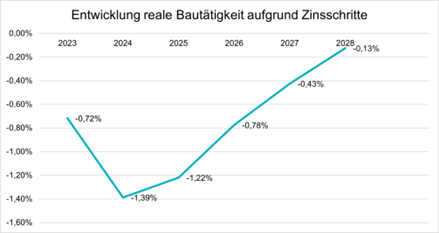
    Ein Rechenmodell des Schweizerischen Baumeisterverbands SBV zeigt, wie stark ein Zinsanstieg die Bautätigkeit negativ beeinflusst. Die Beeinträchtigung dehnt sich langsam und über die Zeit aus. In den ersten beiden Jahren wird das Umsatzwachstum am stärksten beeinträchtigt, aber selbst im fünften Jahr nach den Zinserhöhungen sind noch leichte, negative Auswirkungen spürbar. Die Aussagen beschreiben, wie sich der Umsatz entwickelt im Vergleich zu einer Welt, wenn die Zinsen nicht gestiegen wären.

    In den nächsten fünf Jahren dürfte der Umsatz im Bauhauptgewerbe deswegen kumuliert um 4.65% langsamer wachsen als wenn die Zinsen nicht gestiegen wären. Die grössten realen Umsatzeinbussen sind in den Jahren 2024 (-1.39%) und 2025 (-1.22%) zu erwarten.

    Positive Gegenkräfte könnten Umsatz wachsen lassen
    Die anhaltend starke Zuwanderung, der Nachholbedarf im Tiefbau sowie die Unterstützungsgelder für klimafreundliche Umbauten sind Faktoren, welche den Einbussen durch die Zinsen entgegenstehen und zumindest mittelfristig den Umsatz doch noch positiv wachsen lassen könnten.

    Insgesamt lässt sich also festhalten, dass sich die Leitzinserhöhungen auf den Geschäftsgang der Baufirmen auswirken, auch wenn die Auswirkungen insgesamt begrenzt sind. Das Bauhauptgewerbe bleibt unabhängig vom Zinsniveau eine wichtige Stütze der Schweizer Wirtschaft.

  • Development of the interest rate environment

    Development of the interest rate environment

    The unprecedented circumstances plaguing the global economy are also weighing on Swiss households, which saw an average inflation of 3.5% in August compared to the same month last year. With an increase of 0.10 percentage points more than in the previous month, there is increasing evidence from the data basis for inflation in the remaining segments that were not directly affected by the rising commodity prices. As a result of this unintentional reversal, the perceived inflation in this country is now increasing for both producers and consumers. This perception naturally influences the price and wage negotiations and, in the event of a significant deviation from the SNB's inflation target, pours more expensive fuel into the fire.

    From a monetary policy point of view, it is therefore essential to prevent a fire. The SNB will therefore not hesitate to tighten the interest rate screw further in the exercise of its main mandate – namely to ensure price stability – and also to hold it there until the inflation target of a maximum of 2% in the long term is reached. It is therefore obvious that an increase of the same amount for the coming December meeting cannot be ruled out

    Development of mortgage interest rates
    Inevitably, the future course of monetary policy, obedient to necessity, will weigh on the mortgage markets and ultimately also on borrowers. The zero lower limit for SARON mortgages is now redundant and the interest costs for this loan product increase significantly. Fixed-rate mortgages are also more expensive because interest rates are at their highest levels across all maturities. In addition, the interest rates for credit products are subject to strong fluctuations due to the prevailing uncertainty.

    SARON mortgage forecast
    As of today, the low interest rate level can only be viewed in the rear-view mirror for an indefinite period of time. Further rate hikes are imminent, although we rate a rate of 1.00% as the most likely scenario at the end of the year. What is certain is that the key interest rate will be higher next year than it is today. As long as the uncertainties on the interest rate markets dominate, mortgages will be subject to higher and volatile interest rates. If the key interest rate and thus also the SARON rate rise to 1.00% at the end of the year, the SARON mortgages will also become more expensive accordingly. We expect that mortgage holders – depending on the specified margin – will have to pay between 1.60% and 2.00% for a SARON mortgage at the end of the year.

    Forecast long-term fixed-rate mortgages
    On the side of long-term fixed-rate mortgages, the rise in interest rates is likely to be more modest by the end of the year, since this was expected by the market and has therefore already been priced in in recent months. While the 10-year reference interest rate was below the zero limit a year ago, it has risen to over 2% in a short space of time. A noticeable increase by the end of the year is not to be expected if the measures taken to contain inflation prove effective. For the ten-year fixed-rate mortgage, we expect mortgage interest rates to tend to move sideways, which should be between 2.80% and 3.20% by the end of the year.

    recommendations
    The rapid development on the mortgage market shows how quickly and devastatingly the interest rate environment can turn into troubled waters. Hence, it is highly recommended to know your options as well as risks and make a broad market comparison. Finally, a complete and clean basis of comparison from Property Captain can serve as necessary support in your financing decisions. We at Property Captain are happy to provide you with professional advice and compare offers from numerous financing partners for you.

  • SVIT Swiss Real Estate Forum 2022 – focus on digitization, disruption and flood of data

    SVIT Swiss Real Estate Forum 2022 – focus on digitization, disruption and flood of data

    After the official SVIT delegates’ meeting on Thursday morning, the strategy and innovation consultant Maks Giordano gave a lecture in the conference room of the Swiss Museum of Transport in Lucerne. He showed what happens and how one can react “when the future comes in exponential steps”. Giordano is convinced that after mobile communications and the World Wide Web, our industries are now being fundamentally changed again by the third wave of digital disruption and its exponential developments in technology. “In these times of hyper-innovation and hyper-growth, it is imperative that we all learn the necessary skills to manage this change,” he said.

    Comedy and political gossip
    Afterwards, comedian Kaya Yanar offered a “best of” of his previous work in the television and comedy scene, before the first panel discussion took place in the afternoon. SVIT Forum moderator Urs Gredig welcomed the politicians Hans Egloff (SVP, President HEV Switzerland) and Michael Töngi (Greens, Vice President of the Swiss Tenants’ Association) as well as Martin Tschirren , Director of the BWO Federal Office for Housing, on stage. Together they analyzed the current political and social mood with regard to a possible total revision of Swiss tenancy law, which dates back to 1990. In general, given the majority in the National Council, they only consider minor changes to be possible, even if Egloff and Töngi demanded fundamental modifications and partial revisions. Federal Office Director Tschirren pointed out that the housing shortage is threatening to worsen in the period ahead. This is primarily to be seen in the large cities and centers.

    The Federal Council sees a need for action on rents
    At the end of the first day of the SVIT Forum 2022, Federal Councilor Guy Parmelin , Head of the Federal Department of Economics, Education and Research and President of the Swiss Confederation in 2021, addressed a message of welcome to the SVIT delegates and guests. He emphasized the new meaning for living as a result of the corona pandemic. In view of home office and video conferencing from home, office workers in particular have now given more thought to their living situation. Today it is important to react to sharply rising housing and energy prices. In addition, the home ownership rate in Switzerland is again in reverse gear: While it was still 38.4 percent in 2015, it was only 36.4 percent in 2019, Parmelin quoted from the figures from the BFS and the Federal Office for Housing. He sees a “certain need for action” when it comes to structuring rents. Specifically, he was in a possible review of the site and neighborhood customary. There will soon be a group of experts to deal with this topic. Regarding the latest developments on the interest side, Parmelin said: “The Swiss National Bank is getting back to normal.”

    Boat ride and roller coaster
    The first day of the event was rounded off with a boat trip on Lake Lucerne on the MS Diamant. The second day of the SVIT Forum 2022 on Friday began with an impressive keynote speech by the former AMD boss and current start-up investor Carsten Maschmeyer , who described the ups and downs of his business career and shared his “success formula through opportunities and crises for a fulfilled life» revealed.

    Data rights of digitized service providers
    The second panel discussion, moderated by “Immobilia” editor Ivo Cathomen , dealt with the future of real estate service providers. He had invited Oliver Hofmann , CEO of Wincasa AG, Béatrice Schaeppi , head of the family company of the same name, and Severin Krebs , managing director of Pfannenstiel Immobilien AG, to the podium. The three company leaders described how digitization influences and determines the work of the manager in many ways today. They identified data sovereignty and data protection as well as the satisfaction of different customer needs and the recruitment of specialist staff as the most important construction sites for services in the real estate industry.

    The SVIT Swiss Real Estate Forum 2022 ended on Friday afternoon in the Verkehrshaus Luzern with a farewell by SVIT President Andreas Ingold and finally with a Thai stand-up lunch in the foyer, while the first major thunderstorm of the day fell outside.

  • Tangible assets become indispensable

    Tangible assets become indispensable

    Many are still talking about whether she’s coming – but she’s already here. The turnaround in interest rates has also reached Switzerland. The word turning sounds a bit bigger than what actually happened. It is simply a matter of a change of sign: For the first time in many years, the yields on medium- and long-term Swiss franc bonds are again nominally in positive territory. The same trend can be observed in the euro area and spreads in the peripheral countries are also widening.

    Is the real estate boom coming to an end?
    The reason for the nervousness on the interest rate markets is quickly found. Inflation is rising on both sides of the Atlantic – and now so fast that the US Federal Reserve is now clearly tightening the reins. That’s why everyone is now staring at the European Central Bank (ECB): Will it follow the USA and thus also burden the local economy with higher capital costs? And what would that mean for the Swiss National Bank (SNB)? Are we threatened with an end to the good economic environment and the long-standing real estate and material asset boom?

    Neither nor. Because the situation in Europe is fundamentally different than in the USA. First of all, real interest rates and, in some cases, nominal interest rates have been negative in the euro area and in Switzerland for years. This has never happened in the USA. Negative interest rates, such as those demanded by the ECB and the SNB for deposits for many years, are also unknown in the USA. Just like the negative interest rates for larger sight deposits that are now common here from commercial banks. Second, growth in Europe is structurally weaker than in the US. The American gross domestic product grew by 5.7% last year and even increased by 6.9% in the fourth quarter. This even puts inflation into perspective, which at 7.5% recently reached its highest level in 40 years. Employment in the USA has risen sharply and unemployment is falling. And at the same time, after two years of the pandemic, US citizens are sitting on a lot of money. All of this enables the Fed to fight inflation vigorously.

    Slow rate hikes
    The ECB, on the other hand, is stuck at low interest rates. Even if it did so to curb inflation, there’s no way it can raise rates as quickly and decisively as the Fed. Because the large amount of cheap money that they pumped into the market over the past ten years has increased the debt burden of the EU countries so massively that the central bank not only chokes off the upswing with a rise in interest rates, but also gives their own member states the air to breathe would take. Even the triple-A nation Germany is now stuck in the interest rate trap.

    As a result, the hands of the SNB are largely tied. On the one hand, the franc is stronger against the euro than it has been since January 2015. On the other hand, inflation in Switzerland is currently contained. The economic research center Kof expects consumer prices to rise by 2.0% in 2022 and by 1.3% in 2023. Rising energy costs are having less of an impact on the Swiss economy than the economic areas of the USA and the euro zone, and the strong currency generally has a price-inhibiting effect. If the SNB does not want to take the risk of an even stronger currency, it will have to wait for the ECB’s first interest rate hikes before it can move its key interest rates closer to zero.

    In other words, the monetary policy turnaround is here. But in Europe, including Switzerland, we do it in slow motion. The ECB will scale back its bond-buying programs; it doesn’t have the leeway for large rate hikes. The ECB must and will let inflation run its course for a while. The SNB is unlikely to be under pressure as inflation will remain moderate. It will proceed cautiously with regard to rate hikes.

    Tangible assets remain trumps
    In such an environment, investors are dependent on real assets, the only investments that offer them protection against inflation and prospects for returns. Investments in real estate and other tangible assets are therefore becoming indispensable, and because investment pressure is increasing, prices in the segment are also continuing to rise. What we are witnessing here is not bubble formation. Normal market forces are at work here. Anyone who fears a bubble in the USA can also relax: There, the yield levels for most asset classes – especially on the real estate markets – are structurally higher than in the euro area. This in turn acts as a buffer against rising capital costs. If the Fed is now planning to return to interest rate normality, this is no cause for concern, but rather proof of economic strength.

    We are a long way from that in Europe and in Switzerland. Instead, we must brace ourselves for a phase of persistently low real interest rates. In this environment, which penalizes holding cash and investments that pay nominal interest, equities, real estate and commodities continue to promise the greatest success. Against this background, securities of globally active real estate companies continue to show good prospects. In Switzerland, the real estate market has moved up sharply in terms of prices in recent years. From an economic perspective, however, there is little reason why prices should fall as long as negative real interest rates persist.