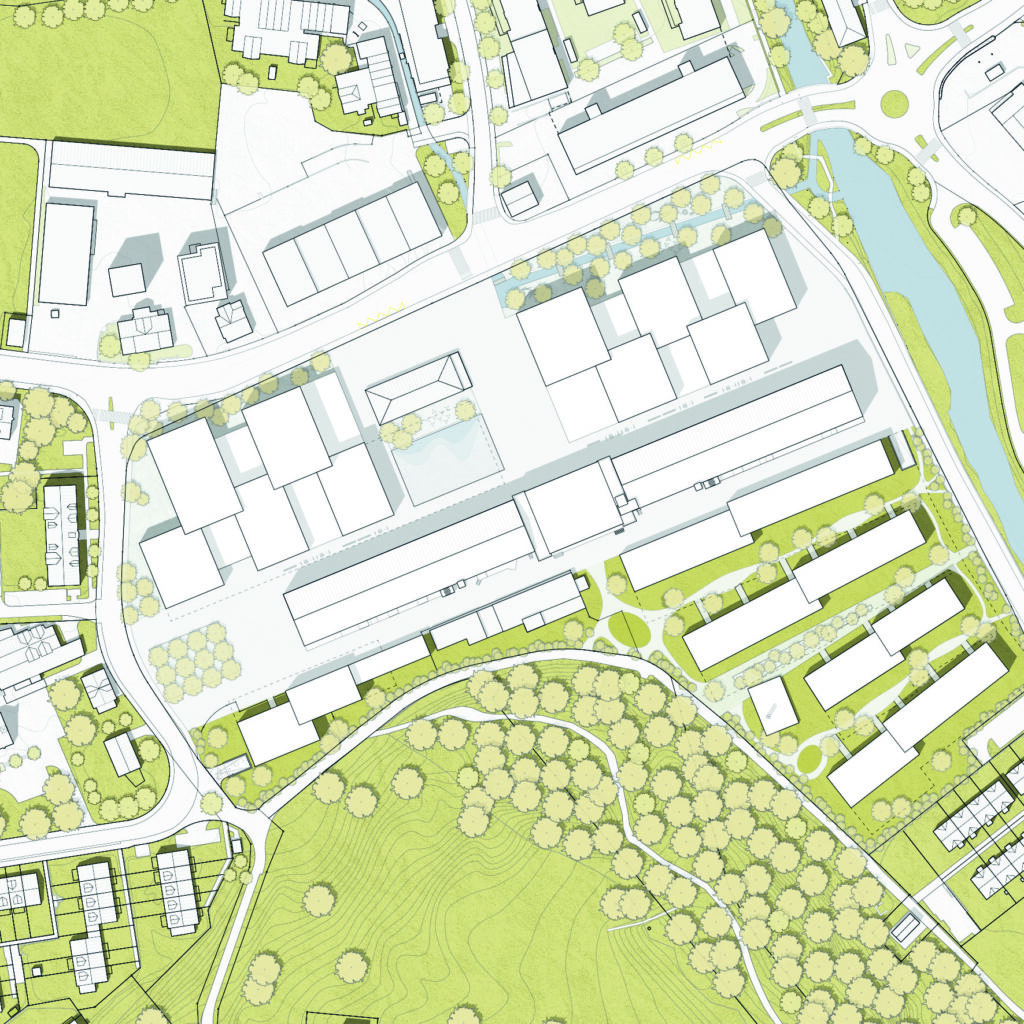
Tag: Siegerprojekt

  • First stage Attisholz with UBS investment

    First stage Attisholz with UBS investment

    The Attisholz site in Riedholz is being given a new lease of life thanks to an investment by the UBS pension fund. The “Kocherei”, once a central location for cellulose production, is being extensively remodelled. The winning project by Burckhardt Architektur from Basel envisages around 150 rental flats and 4,000 m² of commercial space, which will breathe new life into the historic building.

    Collaboration between UBS and Halter AG
    The UBS pension fund, which acquired the 73,000 m² core site back in 2022, has now also confirmed its investment in the “Kocherei”. A work contract was signed between the UBS pension fund and Halter AG on 28 June 2024. While the UBS pension fund will act as investor and owner, Halter AG will be responsible for the planning and realisation of the project as overall provider.

    First stage of the site development
    The development of the Attisholz site, which is to be transformed into a sustainable living space over the next 25 years, begins with the first stage. In addition to the “Kocherei”, this also includes the “Lagerhaus” and publicly accessible open spaces. The design plan for this first stage is currently being drawn up in collaboration with the municipality of Riedholz and the canton of Solothurn and will soon be submitted for public consultation and approval.

    Sustainable and vibrant future
    The transformation of the Attisholz site into a vibrant and sustainable neighbourhood is an important project for the region. The revitalisation of the “Kocherei” and the creation of residential and commercial space are central components of this vision. The realisation of the projects is planned for the period 2025 to 2028 and will contribute significantly to the upgrading of the entire area.

    With the UBS pension fund as a strong partner and Halter AG as an experienced developer, the transformation of the Attisholz site will be driven forward swiftly and professionally in order to create a new, sustainable living space for the municipality of Riedholz.

  • Winning project for the first new building on the Werkstadt site in Zurich

    Winning project for the first new building on the Werkstadt site in Zurich

    Used rails as supporting structure
    The winning project “GLEIS X”, which was developed by Leuthard AG Baumanagement and Gigon/Guyer Architekten AG, impresses with its consistent reuse strategy. The concept uses 12 kilometres of used rails from the SBB ReSale as supports and ceiling beams for the main floors. The building envelope also consists of reused windows and corrugated fibre cement panels. This innovative use of used components was particularly recognised by the jury, as it picks up on the history of the site and continues it architecturally. For SBB, which attaches great importance to the preservation and further development of its architectural and railway heritage, this approach was decisive.

    Six commercial floors and one city floor
    The planned new building comprises seven floors, six of which are to be used as commercial space. These areas are intended for small to medium-sized businesses and offer a mix of traditional and innovative commercial space. The first floor, the so-called “city floor”, will house services or cultural offerings and thus promote interaction with the neighbourhood. The ground floor will initially be used for car parking and goods handling, but will also be converted into a commercial floor at a later stage.

    Public project exhibition
    Interested parties can view the competition entries on the mezzanine floor of Building U, Hohlstrasse 400, 8084 Zurich. The exhibition is open until 19 June 2024 from Monday to Friday from 5pm to 7pm and at weekends from 12pm to 4pm.

    Werkstadt Zürich – a place for urban production
    An innovative centre for urban production and commerce is being built on the approximately 43,000 square metre “Werkstadt Zürich” site. SBB is refurbishing the existing buildings and creating jobs close to the neighbourhood for trades, services and highly specialised professionals. The transformation of the site is being carried out in close cooperation with the City of Zurich and the cantonal monument preservation authorities. Around 35 companies currently provide jobs on the site and contribute to the lively development of the neighbourhood.

  • CSS expands headquarters with Diener und Diener Architekten

    CSS expands headquarters with Diener und Diener Architekten

    The jury of an architectural competition organised by the CSS Group has unanimously decided in favour of the design by Diener und Diener Architekten. According to a press release, the Basel-based architecture firm has been commissioned to expand the CSS headquarters of the health, accident and property insurer in the city of Lucerne. A commercial building on Tribschenstrasse, which CSS purchased in 2015, is to be integrated into the project.

    A total of ten designs were submitted. “Lambris”, says CSS CEO Philomena Colatrella, “embodies urban elegance and best fulfils the architectural, heritage and functional requirements”.

    Originally, CSS had wanted to demolish the commercial building designed by Lucerne architect Carl Mossdorf. However, together with conservation and planning organisations, it finally agreed to preserve it. Now it is to be restored to as original a state as possible.

    In the design by Diener und Diener Architekten called Lambris, the historic building is enclosed by the new building. According to CSS, the winning project connects the different streets and squares and thus blends seamlessly into the cityscape. A bistro open to the public is to be created on the ground floor.

    The building application for the “urgently needed” office building is due to be submitted in the fourth quarter of this year. Provided no appeals are lodged against the building permit, the new building is scheduled to be occupied in the first half of 2027.

  • Kriens electricity suppliers realise heating network

    Kriens electricity suppliers realise heating network

    The two electricity suppliers to the town of Kriens, Energie Wasser Luzern(ewl) and Centralschweizerische Kraftwerke(CKW), are also becoming heating suppliers: according to a press release, the Kriens town council has decided in favour of the Kriens heating network consortium with ewl and CKW following a public tender for the construction and planning of a heating network.

    The heating network will help to supply additional properties in Kriens, namely the Obernau, centre and Kupferhammer-Kehrhof areas, with thermal energy. According to the city council, this is in line with the goals of the city’s climate strategy to achieve net-zero greenhouse gas emissions from buildings by 2045.

    According to the information provided, the winning project assures Kriens a high level of territorial coverage and provides for transitional solutions that guarantee the population a high degree of planning security for the changeover in their heat supply. CKW and ewl are planning their project with a broad mix of different renewable energy sources, including regional wood. According to City Councillor Maurus Frey, this will create an attractive offer “so that together we can take a step towards our climate targets”.

    In the upcoming construction work in Hergiswaldstrasse, the renovation work is to be carried out at the same time as the pipeline construction for the heating network, if possible. The city and ARGE intend to announce further details once the legally prescribed deadlines have expired.

  • The winning project for the Stockhornstrasse development has been finalised

    The winning project for the Stockhornstrasse development has been finalised

    Four architectural firms from the Thun region, all with a renowned reputation for architectural excellence, were invited to participate in this prestigious project. Each of these firms collaborated with a landscape architecture firm to provide a comprehensive and holistic vision for the site. Of note was the participation of the “up-and-coming” firm akkurat bauatelier GmbH, which emphasised the diversity and breadth of the competition.

    The designs submitted were characterised by their creative and diverse approaches, which contributed significantly to the decision-making process. After careful consideration, the committee selected the project by brügger architekten AG & extra Landschaftsarchitekten AG as the winner. The winning design impresses with its well thought-out integration into the existing landscape, its high-quality residential design and its visionary interpretation of the future development of Steffisburg.

    A particular focus of this study commission was the seamless and meaningful integration of the new building project into the existing surroundings. The challenge was to harmonise the transition between the open landscape of the floodplain and the densely populated Steffisburg. The winning project masterfully manages to achieve this balance while offering high-quality living space.

    It is important to emphasise that the result of this study commission not only sets the direction for this particular project, but also serves as a source of inspiration for future construction projects in the region.

  • The winning project for the UZH Irchel campus has been chosen

    The winning project for the UZH Irchel campus has been chosen

    The architectural competition for the UZH portal on the Irchel campus has been decided. According to a press release from the University of Zurich(UZH), the design by the consortium M2N Architekten and Jaeger Baumanagement from Zurich won over the jury the most. A total of 14 teams submitted their designs.

    The planned new building plays a central role in the fundamental redevelopment of the site, where UZH has established natural sciences, human medicine and veterinary medicine departments with their specialised infrastructures for experimental research and teaching. According to the information provided, the campus is in great need of modernisation after 45 years of operation.

    The jury judged that the winning project continues the DNA of the Irchel campus. It is “characterised by its outstanding internal qualities and successful integration into the existing Irchel campus. The team has not only understood the concerns of the University of Zurich, but has also taken them one step further,” said François Chapuis, Director of Real Estate and Operations.

    The consortium is planning a six-storey timber-concrete hybrid building. This will be adjoined by a long laboratory wing that is one storey lower. The two parts of the building are connected by an entrance area with a green roof terrace. Technical and logistics facilities for the entire campus will be installed in the basement.

    The winning project will now be developed further. an approvable construction project should be available in 2025. If it is approved, construction work could begin in 2029 or 2030. Those responsible estimate a period of 25 years for the refurbishment of the entire campus.

  • Architheke builds new parish hall

    Architheke builds new parish hall

    The Reformed Church Wettingen-Neuenhof wants to build a smaller community center in Wettingen. The reason for this is declining membership, which is forcing the church to make savings. According to the municipality on Facebook, the winner of the architectural competition for the project is the Architeke office from Brugg. The Facebook message refers to a report by the "Badener Tagblatt" with the details of the project and the reasons for the decision.

    The conclusion of the project competition is considered an important milestone in the church on the way to implementing the real estate strategy 2030. This states that the church congregation is concentrating on one location. In doing so, they dispensed with the two existing parish houses in Wettingen (built in 1969) and Neuenhof (built in 1956) and built a smaller one instead. The repair of the existing church community buildings would be disproportionately expensive and the available space would be oversized.

    The jury report quoted the following about the winning project by Architheke: "Overall, the project impresses with its independent, clear concept with the spacious and versatile outdoor spaces and an appropriateness and lightness." In addition, it can also be implemented economically and sustainably. The new parish hall should form a new, smaller ensemble with the existing church and rectory.

    From now on, preparations are underway to be able to submit a loan application for the project planning to the parish assembly.

  • Studio DIA allowed to renovate the Swiss embassy in London

    Studio DIA allowed to renovate the Swiss embassy in London

    The Bernese architectural office Studio DIA has the right to renovate and restructure the Swiss embassy in central London. With its Wellington project, the company won the one-stage project competition in the open procedure of the Federal Office for Buildings and Logistics in Bern, according to a press release .

    Accordingly, one of the most important requirements was "to meet the demands of the different users with their different areas of responsibility". In addition to the embassy, the ambassador's apartment and other apartments are located in the partly listed building complex in the district of Marylebone. Switzerland Tourism and other organizations also use the house. The embassy has been in operation for more than 50 years.

    According to the information, Wellington convinced with a clear separation of the various areas of use according to their functions. Above all, the outer facades are to be preserved, which means that the effort for the redesign is kept within limits and the necessary degree of sustainability is given.

    All entries to the competition can be seen from August 19 to 30, 2022 in an exhibition at Fellerstrasse 15a in Bern from Monday to Friday from 4 to 7 p.m. and on Saturday from 10 a.m. to 3 p.m. in Bümpliz.

  • The winning project for the Reussbühl West district has been chosen

    The winning project for the Reussbühl West district has been chosen

    Office of Living Things and Büro Dudler for space and traffic planning.

    The 27’000 square meters

    The assessment committee for the study contract for the redesign of the CKW site in Reussbühl, which is now used for commercial and industrial purposes, unanimously decided in favor of the “Habitat – Quartier im Hain” project. It was developed by the Zurich architects Salewski Nater Kretz in collaboration with the Office of Living Things and the Dudler office for space and traffic planning.

    According to a CKW press release , the 27,000 square meter area is to be “transformed into an attractive, lively and distinctive city quarter”. The energy service provider will give up its location there “in a few years”. In the call for tenders, requirements were made with regard to heat generation and rainwater management. In addition, at least half of the CKW shed hall, a former silk mill, was to be retained. Residential buildings will primarily be built on the remaining area.

    The winning project “convinces in the reinterpretation and further development of the historical landscape”, which was once characterized by floodplains and water-using industry. The design based on the so-called sponge city principle “cleverly” incorporates these historical references. This project will be further developed in the coming months and will then form the basis for the Reussbühl West development plan. The designs of all planning teams are on display at CKW in Rathausen from June 21st to July 4th.

  • Halter realizes winning project in Emmen

    Halter realizes winning project in Emmen

    At the Seetalplatz in Emmen, a new development with a variety of uses for all sections of the population is to be built. There was a competition for this, in which six architects' offices took part. According to the press release , the study drawn up by Westpol Landschaftsarchitektur from Basel together with Dreier Frenzel architecture + communication from Lausanne emerged as the winner and is recommended for further processing.

    On behalf of the Rüüssegg housing cooperative, the planning and implementation of the superstructure will be carried out under the leadership of Halter AG . Completion of the entire development on the relevant construction sites is scheduled for the end of 2026.

    The Rüüssegg housing cooperative based in Lucerne is the holder of the building right. It was founded by Halter AG and the non-profit housing cooperative Wir sind Stadtgarten after they, as a bidding consortium, had been awarded the building lease by the Lucerne government council in June 2021.

    The winning concept "offers an opportunity for social interaction, communication and exchange between residents and users," says the managing director of the Rüüssegg housing cooperative, Thomas Häusler.

    "In addition to a well-balanced mix of apartments in terms of price and space, the project also provides age-appropriate housing, commercial, office and studio space, which allows for a mix and social diversity," says Peter Lötscher, Head of Portfolio Management at the Canton of Lucerne's Real Estate Office. This also fulfills the mandate of the cantonal parliament.

  • Winning project from study contract for further development of Aeschbachquartier Aarau

    Winning project from study contract for further development of Aeschbachquartier Aarau

    Winning project known from the Rockwell site study contract

    The Rockwell area belongs to the western part of the Torfeld Süd and was acquired by Mobimo in 2001. Rockwell Automation GmbH intends to discontinue production at the Aarau location at the beginning of 2022. Only the research and development areas will remain at the long-standing headquarters. This will free a large part of the area – and the further development of the Aeschbach district can be tackled.

    As of today, the Aeschbachquartier comprises 167 rental apartments, 92 condominiums, the Aeschbachhalle, the Oehlerpark and commercial space. The urban planning guidelines designed by the renowned Dutch architect and retired ETH professor Kees Christiaanse and the associated vision of the “Urban Village” – an urban village – with diverse uses should also shape the further development steps.

    Mobimo has invited five renowned architecture firms to take part in a study. In addition to the high demands on the sustainability of the project – it should be made of wood and meet the SNBS Gold standard – the results of the participation process from 2020 were also part of the task package.

    The proposal by Baumberger & Stegmeier Architects from Zurich in collaboration with Hoffmann Müller landscape architects and Pirmin Jung timber construction engineers particularly impressed the jury and was chosen as the winning project. Your project envisages an increase in the historical Hall 5 and a new wooden building (see visualization). In addition to the ecological construction method, the winning project is characterized by many green areas with large trees. The project envisages 110 rental apartments of various sizes and suitable for families and senior citizens. Alternative forms of living such as cluster apartments are also to be created.

    Mobimo will invest around CHF 50 million (amount excluding land value). Realization can probably begin in mid-2023, which means that completion would be possible in mid-2025.

    Quote from project manager Thomas Schaz: “We are delighted to be able to open a new chapter in the Aeschbach district. Rockwell Automation remains an important and valued user of the quarter in a reduced space. "

  • New life for the old spinning mill

    New life for the old spinning mill

    "The winning project was selected on the one hand because of the urban development strategy on the northern area, and on the other hand because of the respectful handling of the listed old buildings", says the lead architect Urs Oechslin from Zurich-based Lilin Architects. The two new building ensembles in the foreground of the spinning mill, which are intended for different uses, create a reference to the context through their urban planning anchored in place. The volumetric differentiation is derived from the existing settlement pattern of the urbanized village. The sub-volumes are staggered in terms of depth and height and allow different views of the spinning mill. The building typology thus mediates with great independence between the individual village buildings and the large-scale spinning mill building. In this way, the spinning mill area is given a new, urban face in which the various identities of the building history are superimposed.

    Desired longevity
    Immediately after the study contract, the overall project was concretized, accompanied by the client, the building authorities, the preservation of monuments and representatives from the assessment committee and the neighborhood: "We are about to submit the draft of the development plan and the guideline project to a first round of official consultation" , so Oechslin. It is not easy to build a building park around the spinning mill that can keep up with the quality of the monument and whose beauty and benefits guarantee the desired longevity. In the immediate vicinity of such a monument, the demands on the architectural quality are very high. The cultural acceptance associated with aesthetics is more decisive for the value of the property than some technical innovations. What is no longer publicly pleasing will sooner or later be torn down. What, on the other hand, enjoys a social and cultural status, remains. The real meaning of a house ultimately lies in the contribution it makes to public life in the long term. Urs Oechslin: “If the population, the Baar community and the owners are successful in promising a place of great attraction, then the project will be approved by all authorities. It will have a political majority and will be supported by the broader population. "

    Sustainable renewal
    For some time now, the «Spinni» has not served the purpose for which it was originally built. Since the end of production, a wide variety of uses have established themselves in the rooms. The clear and simple building structure of the spinning mill building is functionally sustainable because user extensions integrated in it can be easily adapted to changes. The high quality longevity of the basic structure achieved in this way is also aimed at for the new buildings. That is why it is being adapted for the new mixed-use buildings. As a result, the proposed building structure is not tied to a specific use and will survive future renovation processes.

    A coherent whole
    The historically and structurally established strong identity of the area is a large fund from which any number of ideas can be realized. Time and again it is important to find suitable means to further develop, reinterpret and supplement this identity. In this way, the high level of social acceptance that the area enjoys today is to be further expanded. "Our motivation is to design a new, staggered part of the settlement with the intelligent combination of architectural, landscape-architectural and usage-specific interventions on the area of the old spinning mill on the Lorze", says Oechslin. And further: “This takes over the existing qualities and complements them adequately and respectfully. The demanding cultural, social, economic, ecological and building law requirements should be combined in a coherent whole in the interests of all those involved. "

    The new use of «Spinni» needs to be carefully considered and planned.