Tag: Software

  • Digitised road network for the district of Horgen

    Digitised road network for the district of Horgen

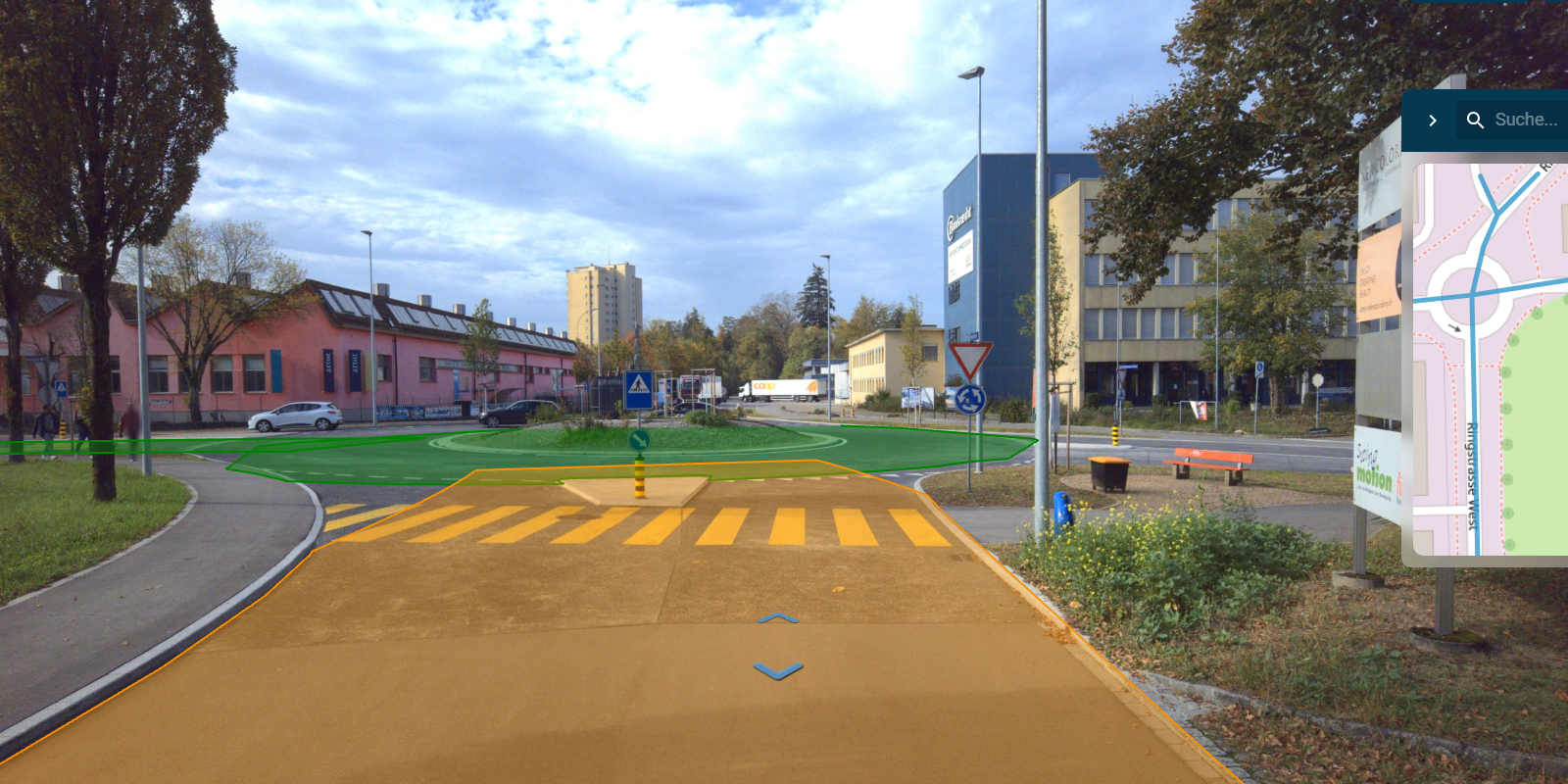
    From mid-July 2025, iNovitas from Baden will be mapping the streets in the district of Horgen. The company is creating a three-dimensional digital image of the public road network, according to a press release. The data obtained from the model is intended to form a basis for the areas of administration, utilities management and planning. The digital image reduces the time and effort required for inspection trips and inspections and should therefore provide an efficient organisation for maintenance and planning directly from the office.

    The municipal and cantonal roads of Adliswil, Kilchberg, Langnau am Albis, Rüschlikon, Thalwil and Oberrieden will be digitised. The municipality of Horgen had already commissioned iNovitas to carry out this work at an earlier stage. The data is recorded exclusively on public roads. According to the press release, people and number plates are anonymised, thereby protecting personal rights. The captured image and geodata is provided via the web-based infra3D platform and is only available to authorised specialists or administrative bodies with the appropriate authorisation.

  • Fresh capital for the decarbonisation of real estate

    Fresh capital for the decarbonisation of real estate

    The software service provider Optiml has secured fresh capital totalling USD 4 million in a pre-seed financing round. According to a press release published on LinkedIn, the company intends to continue supporting the property market with software as it takes steps towards decarbonisation in the sector. As a service provider (Software-as-a-Service/SaaS), Optiml wants to develop programmes that facilitate data management and provide tools for asset and portfolio decisions. In doing so, the company takes into account constantly changing regulations and market conditions, according to the press release. With software supported by artificial intelligence, property companies and owners can plan their refurbishment and renovation work in line with the market and incorporate decarbonisation targets for their properties.

    The refurbishment and decarbonisation software from the spin-off of the Swiss Federal Institute of Technologyin Zurich(ETH), which was founded in 2022, is based on years of research in the ETH Sustainability and Technology Group (SusTec). It uses science-based optimisation algorithms.

  • The new GIS browser as a public service for professionals and private individuals

    The new GIS browser as a public service for professionals and private individuals

    The canton of Zurich offers a huge pool of data with a spatial reference (geodata). Most of it is accessible free of charge via the GIS browser. Around 200 digital maps, grouped according to 21 main themes such as buildings, flora and fauna, leisure and geology, can be accessed online. Most of the data can be used without restrictions and the map content can be downloaded and printed directly.

    Broad benefits for professionals and private individuals
    The GIS browser is a useful planning and decision-making tool not only for professionals, but also for private individuals. Location factors such as the age of a house, proximity to public transport stops, shops, schools or sports facilities, planned building sites and journey times on the road network can be easily checked. Up-to-date and precise facts on numerous issues are available.

    History and development of the GIS browser
    Since its launch in 1999, the GIS browser has undergone continuous development. The new version is the third generation. Most of the publicly relevant maps are already available and the migration of the remaining maps is continuing.

    Advantages of the new GIS browser
    The portal has a new design and the user interface is intuitive and self-explanatory, even on smartphones and tablets. An intelligent search function makes it easier to find the desired map. The map views can be customised and used even better thanks to new functions such as filters and favourites lists.

    Integration into the new cantonal geoportal
    The geodata of the Canton of Zurich is also available in the geodata catalogue and geodata shop. These systems are now centrally accessible via the new geoportal geo.zh.ch. The geoportal also offers news on new maps and a help and support area.

  • Axept and PropBase join forces for property

    Axept and PropBase join forces for property

    The software companies PropBase from Neuhausen am Rheinfall and Axept from St.Gallen have agreed to work together in the property sector. According to a press release, the collaboration will focus in particular on processing large volumes of data in the areas of property ownership, asset management, construction companies, property management, property management and accounting. Both companies want to digitalise this complex data processing to a large extent and thus make the market more transparent and easily accessible for customers. PropBase provides web-based, constantly updated software that offers an overview of properties throughout Switzerland. Axept integrates seamless commercial management with its Abacus-based software. The programme package is specially designed for the Swiss market and complies with all legal requirements.

    According to the press release, the partnership in the software sector is intended to significantly advance the digitalisation of the real estate industry. Axept will also take over the implementation, support and training for PropBase programmes.

  • Revolution in the legal sector Digital solution for law firm management

    Revolution in the legal sector Digital solution for law firm management

    In Wittenbach-St.Gallen, on 22 January 2024, Abacus Research AG announced the successful launch of its new industry software AbaPlato. This is one of the first in Switzerland to be directly connected to Justitia 4.0, the justice platform from Justitia.Swiss. According to COO Raffaelle Grillo, AbaPlato is able to automatically integrate court documents into mandate dossiers and transmit them securely to Justitia.Swiss, including digitally signed acknowledgements of receipt. The direct connection eliminates the need for intermediate storage, which enables immediate availability of the documents in the mandate dossier and a significant increase in efficiency in the law firm’s work. In addition, the entire process is made more secure and transparent.

  • Ecospeed simplifies energy accounting for buildings

    Ecospeed simplifies energy accounting for buildings

    Ecospeed, the Zurich-based software developer specialising in environmental accounting, has integrated new functions into its software. According to a media release, these were developed as part of a relaunch of the Enercoach software and will be available to the company’s customers before the end of the year.

    The software shows users the energy status of buildings and provides an accurate picture of the development of consumption, emissions and costs over a certain period of time. Until now, when calculating the consumption of electricity, heating oil, gas and district heating, the difficulty arose that the accounts did not follow the course of the calendar year. With the software renewal, this problem is to be solved and the calculation simplified.

    “You simply enter the raw data in the corresponding mask, i.e. the current meter reading or the consumption value and the date of recording,” Thomas Herzberger, managing director of Ecospeed, is quoted as saying in the statement. “The software converts the values to the calendar year.”

    Thus, an exact comparison including descriptive visualisation is possible. The data can be displayed in the form of tables, graphs and over a period of several years. Likewise, the effectiveness of improvement measures can be precisely determined.

  • Siemens as a leading provider in security software for smart buildings

    Siemens as a leading provider in security software for smart buildings

    The analyst firm has ranked Siemens Smart Infrastructure as one of the leading providers of security software for smart buildings. The recently published report “Green Quadrant: Integrated Smart Building Security Software 2023” analyses and evaluates ten companies that shape the market. Siemens’ solutions offer state-of-the-art functions for unified security management. The Siemens software evaluated is part of Siemens Xcelerator, an open digital business platform that accelerates customers’ digital transformation.

    “Being ranked as a leading provider of security software for smart buildings underlines the success of our strategy: we want to strengthen our digital portfolio and be the preferred partner for customers in their digital transformation. Because it is our declared goal to make buildings safer and more resilient through software,” says Henning Sandfort, CEO of Building Products at Siemens Smart Infrastructure.

    Property and building managers need integrated solutions to ensure reliable building and security operations and better protect the safety and well-being of their tenants. Digital advances are paving the way for more flexible systems that offer both integrated and targeted operational views, automated workflows, more detailed analytics and richer value propositions.

    Source: www.siemens.com

  • Wincasa switches debt collection to cloud software from Tilbago

    Wincasa switches debt collection to cloud software from Tilbago

    Wincasa AG is switching the handling of debtor processes to the real estate software Garaio REM from the Lucerne-based fintech Tilbago. According to a media release, both the debt collection process and communication with the debt collection offices will be handled using modern cloud software. The real estate service provider based in Winterthur is thus equipping itself for future requirements in debt collection.

    Tilbago knows “the challenges as well as the peculiarities of real estate service providers”, it says. The real estate package of the cloud software provider is tailored to the industry-specific requirements of legal debt collection.

    The software solution’s intuitive usability and location-independent use are arguments in its favour. This fits in with Wincasa’s so-called #weworksmart work culture. “The overall package of complete coverage of the collection process, compliance with the latest eSchKG requirements and the elimination of expensive maintenance contracts convinced us,” Michael Wittwer, Legal Operations Specialist at Wincasa AG, is quoted as saying.

  • Artificial intelligence makes its way into caretaking

    Artificial intelligence makes its way into caretaking

    Facility management is an industry that has been little digitised for a long time. Caretaker services are still planned manually and the result is not recorded anywhere. There is already a lack of recording of the services provided. ImmoTrack founder Ofer Becker explains: “Today, caretaker services are still planned with paper and pen. No one has an overview of maintenance work, much to the chagrin of tenants.” The result is dissatisfied customers and expensive maintenance costs.

    To solve these problems, ImmoTrack has developed new software that uses artificial intelligence to digitise the entire process. In the future, ImmoTrack will optimise and automate the entire process, resulting in significant efficiency improvements. The new product represents more than 3.5 years of development work and a total investment of CHF 2.5 million, making ImmoTrack a pioneer in this field. According to Becker, caretakers were initially sceptical about artificial intelligence, but ImmoTrack is currently benefiting greatly from the ChatGPT moment and caretakers are open to new solutions that automate repetitive work and optimise results.

    However, according to Becker, caretakers do not have to worry about running out of work in the future due to artificial intelligence: “We have found that in the facility management industry, around 40% of planned work is not carried out. By going completely digital, caretakers have more time for pending work, which benefits tenants, property managers and homeowners. This is in line with the recently published study by Amosa, the cantonal labour market authority, according to which low-tech industries, such as caretakers, are less negatively affected by digitalisation. Caretakers are not expected to be replaced by artificial intelligence or robots in the future.

    At the moment, ImmoTrack is conducting a fundraising campaign to further develop the product. For example, weather data is to be networked directly with the system in the future in order to optimise maintenance work. The fundraising campaign is taking place on the new Arcton platform, and investors can invest in ImmoTrack until 30 June.

  • Ecospeed develops software for CO2 balancing of hospitals

    Ecospeed develops software for CO2 balancing of hospitals

    Ecospeed AG will soon begin the so-called roll-out of its software for CO2 balancing of hospitals. According to a media release, the development work is almost complete. “Our goal is to provide hospitals and their operating companies with a very easy-to-use software for the overall balancing of greenhouse gas emissions,” Ecospeed CEO Christoph Hartmann is quoted as saying. “We are building an industry-specific platform for this task.”

    As Hartmann further explains, each hospital will be able to use the software “to determine its individual ‘Corporate Carbon Footprint’. This will enable hospitals to identify fields of action and plan paths for gradual decarbonisation.” It can also be used to document successes. In addition, the hospitals would comply with the future CSR reporting obligation, with which companies in the EU must disclose from 1 January 2024 how and to what extent they fulfil their responsibility with regard to their impact on society and the environment.

    The first pilot customer is a hospital association with 17 clinics in the German state of North Rhine-Westphalia. Initial results are already available. “In terms of direct emissions, there are big differences that can be attributed to the condition of the building envelope and the age and condition of the heating systems,” says Hartmann. “Scope 3 emissions, however, are significantly higher, caused in particular by purchased materials and transport. The collected and processed data give the clinics clear indications of where there is potential for improvement.”

  • On course for expansion – Woonig takes over Scantick

    On course for expansion – Woonig takes over Scantick

    "We are pleased to be able to provide our customers and interested parties with an expanded range of products and services with the acquisition of Scantick" – Erich Linus Birchler, founder and CEO of Woonig AG

    In addition to the smart ticketing module, the communication module will also be expanded to include an innovative component. In the future, for example, pinboard messages from the Woonig Infocenter can be displayed directly at the properties via a “low-power display”.

    About Scantick
    Scantick, based in Zweidlen Zurich, is a ticket system with which messages can be recorded quickly and easily via a QR code and faults and problems can be eliminated. Scantick is active in the real estate management, sanitary and commercial/manufacturing sectors.

    About Woonig
    The IT company Woonig, based in Bottighofen on Lake Constance, offers a "Software as a Service" (SaaS) communication and interaction platform for real estate management (RE Edition) and for service providers (DL Edition), for digitizing and automating the processes between real estate managers , tenants/owners and service providers.

    The Woonig software is easy to integrate, configure and can be used productively in just a few steps. Woonig also offers standard interfaces to common real estate management systems.

  • Siemens Smart Infrastructure acquires Brightly

    Siemens Smart Infrastructure acquires Brightly

    Brightly Software , a software-as-a-service (SaaS) facility and maintenance management company based in Cary, North Carolina, has acquired Siemens Smart Infrastructure . A corresponding agreement has already been signed, Siemens informed in a statement . The purchase price is $1.575 billion plus a performance-based earn-out component.

    The takeover is intended to promote the growth of the Zug-based Siemens subsidiary in the digital and software as a service divisions. In particular, the acquisition will complement the offerings of Siemens Smart Infrastructure for building technology "with established cloud-based solutions in key sectors such as public infrastructure, education and healthcare as well as manufacturing," according to the release. At the same time, Siemens wants to use Brightly's position in the American market. In addition, the Group expects synergies with a net cash value in the mid three-digit million range.

    "With Brightly, we are taking a big leap forward and are taking the operation of buildings to the next level," Matthias Rebellius, Member of the Management Board of Siemens AG and CEO of Smart Infrastructure, is quoted as saying in the press release. The acquisition of Brightly supports Siemens' vision to "create fully autonomous buildings that continuously learn from the people who live in them and adapt to their needs".

  • IWB joins Sympheny

    IWB joins Sympheny

    IWB takes a 30 percent stake in Sympheny . The young company based in Dübendorf has developed software that can compare possible energy solutions for buildings in a matter of seconds. IWB wants to use the knowledge gained from this in its own planning for the climate-friendly conversion of the energy supply.

    “Affordable climate protection requires optimized energy supplies,” IWB introduces a post on LinkedIn about joining Sympheny. According to him, the company for energy, water and telecommunications in the canton of Basel-Stadt wants to support the spin-off of the Federal Materials Testing and Research Institute ( Empa ) with the fresh capital in the further development of their software. IWB writes that they are looking forward to working more closely with Sympheny co-founders Andrew Bollinger, Matthias Sulzer, Boran Morvaj and Julien Marquant.

    According to a report on startupticker.ch, the software from the young company, which was only founded in 2020, has already been used in more than 20 major planning projects. Sympheny’s customers include “energy suppliers and general contractors from all over Switzerland,” it says. The energy planning software developed by Sympheny simulates the energy system to be examined with a digital twin. Algorithms and standardized geographic information data (GIS data) can be used to simulate the production, storage and consumption of energy.

  • Ecospeed Scout enables comprehensive environmental assessment

    Ecospeed Scout enables comprehensive environmental assessment

    The company Ecospeed , founded in 2002, develops web-based software for the accounting of environmental indicators for authorities, companies and people, informs the Zurich company in its online portrait . Ecospeed has launched software that can be used to measure the environmental impact of products, processes and locations. The Ecospeed Scout is based on the standard for comprehensive environmental assessment published in May 2021, eco-scout .

    The history of the life cycle assessment begins as early as 1978, according to a corresponding time table . At that time, the owner of Frisco-Findus AG, which is now part of Nestlé, submitted an environmental assessment for his company entitled "The ecological accounting". In the following years, Migros, the Federal Office for the Environment and the German Volkswagen group took up the method and refined it. The now valid eco-scout standard was then created from 2020 by a German-Swiss working group with the support of large companies, the Federal Office for the Environment, the German Federal Environment Ministry and the German Federal Environment Agency. In 2021, "the first software for environmental assessments based on the eco-scout standard from Ecospeed AG / Zurich" will be launched, according to the online journey through time.

    Over 18,000 entries on materials, processes, modes of transport, energy sources, infrastructure systems and types of waste from the life cycle assessment database of the Swiss ecoinvent center can be used to create the environmental assessment. The software creates an inventory analysis in which the national and EU-wide environmental goals and specifications are also taken into account. Based on the inventory balance, the environmental impact is then calculated in so-called environmental impact points (UBP).

  • Hilti buys software company Fieldwire in the USA

    Hilti buys software company Fieldwire in the USA

    The Schaaner group of companies Hilti is taking over the American tech company Fieldwire for 300 million dollars. Both companies have reached an agreement on this, according to a media release . The aim of the acquisition is to develop a leading digital platform for construction site management. Fieldwire has offered a platform since the company was founded in 2013, which is now used on more than 1 million construction sites.

    “This acquisition expands our software portfolio and is the next logical step in the direction of our vision of becoming the leading digitization partner for our customers,” said Christoph Loos, CEO of the Hilti Group, in the press release. Hilti wants to continue investing in the platform in order to become the market leader in the field of construction project management software.

    This also includes taking on all Fieldwire employees and hiring new ones. The two company founders, Yves Frinault and Javed Singha, will also continue to run the company.

    The tool manufacturer had already invested in the American start-up in 2017 as part of a financing round and has supported the development of Fieldwire since then. A close partnership already exists.

    “In Hilti we have found a partner who shares our values and at the same time enables us to accelerate our product development for our customers in our existing and new markets. We are very pleased to become part of the Hilti Group, ”said Yves Frinault, CEO of Fieldwire, in the press release. The acquisition is expected to close in the fourth quarter of this year.

  • App facilitates energy planning for buildings

    App facilitates energy planning for buildings

    With Polysun, Vela Solaris AG from Winterthur has developed a solution that should facilitate the planning of energy systems for buildings and neighborhoods. It makes it possible to simulate energy systems in these environments. In this way, possible energy systems can be displayed for an initial examination and compared with one another.

    Based on Polysun, Vela Solaris and the building technology association suissetec set up the building technology calculator web app. The association is now making the solution available to its members and customers, as stated in a message .

    “With the building technology computer, we enable our customers to take the step towards the digital conception of energy systems”, Lars Kunath, responsible for digital solutions at suissetec, is quoted as saying. He also emphasizes the “reliability of the simulation results and the high level of professionalism of Vela Solaris as a development partner”.

    “The cooperation with associations as well as manufacturers and dealers represents a real enrichment for Vela Solaris”, says Angela Krainer, Managing Director of Vela Solaris. “We always strive to make our solutions available to as large a user group as possible”.

  • Gilytics convinces with software for the construction of lines

    Gilytics convinces with software for the construction of lines

    Gilytics has raised CHF 1 million as part of a seed financing round, according to a media release . The high-tech start-up fund, the Swiss Startup Group and the Zürcher Kantonalbank have invested.

    Gilytics was able to convince with software that can be used, for example, to plan overhead line and underground cable connections. The software can determine the routes of power lines based on geospatial data. Users can analyze detailed scenarios with 2D, 3D and augmented reality visualization. In addition to laying power lines, the software can also help with the planning of rails or roads.

    "We are impressed by the team's industry knowledge, the proven technology and the commercial traction that has already been generated with leading companies in the industry in Switzerland and across borders," says Fabian Hogrebe, Investment Manager at High-Tech Gründerfonds, quote in the communication.

    Gilytics wants to use the fresh funds to further develop functions to support construction supervision and the operation of solar and wind projects. At the same time, the company wants to expand its operating network.

    Gilytics was spun off from the Swiss Federal Institute of Technology Zurich ( ETH ) in 2017 and is based in Zurich.

  • Zühlke modernizes Wincasa's digital presence

    Zühlke modernizes Wincasa's digital presence

    IT innovation service provider Zühlke from Schlieren brings the software used at Wincasa up to date, which meets today's market requirements. The real estate service provider from Winterthur has so far worked with the programs developed in-house. According to Zühlke's press release , these programs, which have been developed in the company over the last 15 years, are "extremely functional", but are not sufficient for Wincasa's expansion strategy. So far, data exchange with third-party applications has not been possible, nor is the software cloud-based. But both are necessary in order to use omni-channel marketing – the forwarding of product information to all sales channels and media – and to offer tenants and owners appropriate services.

    Zühlke helps the Wincasa experts to modernize the existing system. It should not be set up completely from scratch. For this purpose, the three existing areas of corporate planning, property management and construction project management are made cloud-enabled and prepared for use in the Microsoft Azure environment. The data that has been collected over many years now has to be cleaned up and transferred to the new platform. New projects are brought in there directly. Zühlke experts work together with Wincasa IT specialists on this work.

    The media release states the goal of the modernization: Wincasa wants to lead the digital revolution in the Swiss real estate market.

  • IT companies in St.Gallen join forces

    IT companies in St.Gallen join forces

    The young company emonitor , which is active in the field of real estate technology, has brought its melon rental software into a collaboration with Abacus , as stated in a message from emonitor. On behalf of the City of St.Gallen Pension Fund , melon has been connected to the AbaImmo property management software from Abacus. This now creates software for reporting in the area of apartment rentals.

    On the one hand, software is available for a continuous letting process, from the first contact with a prospective tenant through to ancillary costs settlement. And on the other hand, thanks to the collaboration between emonitor from St.Gallen and Abacus Research from Wittenbach, reports can be created that provide real-time information on vacancies, for example.

    The City of St.Gallen Pension Fund is currently in a digitization process and would like to be a pioneer in turning interested parties into tenants even more easily, as the message says. "We are pleased that together with emonitor and Abacus we can implement our ideas of future-oriented leasing and management," Gerardo Longo from the Pension Fund Stadt St.Gallen is quoted in the announcement. "In addition to creating an overall process, we also benefit from the simple acquisition of demand and analysis data, with the help of which we will, for example, be able to better plan our projects and avoid vacancies."

  • SVIT-Digital Day shows software for management of management

    SVIT-Digital Day shows software for management of management

    The Swiss Association of the Real Estate Industry (SVIT) is holding Digital Day 2020 on Monday, September 21 in the Kosmos in Zurich. From 11 a.m. to 6 p.m., visitors can collect information on the subject of digitization in the real estate world with free admission. On the digital day of the real estate industry, the organizing commission “SVIT Digital” is also launching a “Meet and Greet” for all visitors to the event on this day. They can discuss their digital concerns directly with proven professionals and other visitors at the big table and work out possible solutions, according to the announcement for the digital day.

    According to the organizer Pape Werbe AG from Weiningen ZH, more than 40 exhibitors will be present in the Kosmos and many lectures will be held on specialist topics such as "Digital Signature" or "The 3 Levels of Digitization in Property Management". During the entire event, it will be ensured that the current protection concepts due to the corona pandemic are adhered to.