Tag: Solarmodule

  • Solar modules put to the test

    Solar modules put to the test

    Increasing weather extremes such as heavy rain, thunderstorms and hail pose major challenges for photovoltaic systems. Hailstorms on rooftop and ground-mounted systems cause high levels of damage and operational downtime every year. The current certification standards for solar modules often do not meet the requirements of severe hailstorms, as they are limited to a few, uniform impacts.

    Practical tests with HRC protocol
    The HRC test goes beyond existing test procedures. It bombards solar modules with hailstones of different sizes and speeds until they break. This creates a load curve that corresponds to the real impact energies of a storm. Manufacturers and operators can identify the point at which the glass fails and which models are particularly resistant.

    Cherif Kedir from RETC emphasizes: “Our test closes the knowledge gap and provides usable data on the entire energy and size spectrum of real hail loads. The strict sample size ensures thorough characterization.” This means that hail resistance can be quantitatively assessed and compared for the first time.

    Consequences for development, operation and insurance
    The HRC protocol offers manufacturers the opportunity to optimize solar modules specifically against hail. Project developers are provided with a new basis for decision-making for the cost-benefit analysis of module types, mounting angles and tracking systems. The test also supports the “hail stow” strategy, in which modules are moved hydraulically into a low-risk position during storms.

    Insurance providers can now dimension cover and premiums based on empirical test results instead of relying on estimates. This reduces uncertainty and promotes the acceptance of PV systems in particularly exposed areas.

    More security through innovation
    The HRC test marks a step forward for the solar industry. Practical testing and transparent data increase the safety and value of solar installations. Manufacturers and operators gain planning security, insurers a solid basis for calculation. This paves the way for more resilient photovoltaic systems that can cope with the changing climate.
  • Gold-coloured façade modules in Schlieren set new solar standards

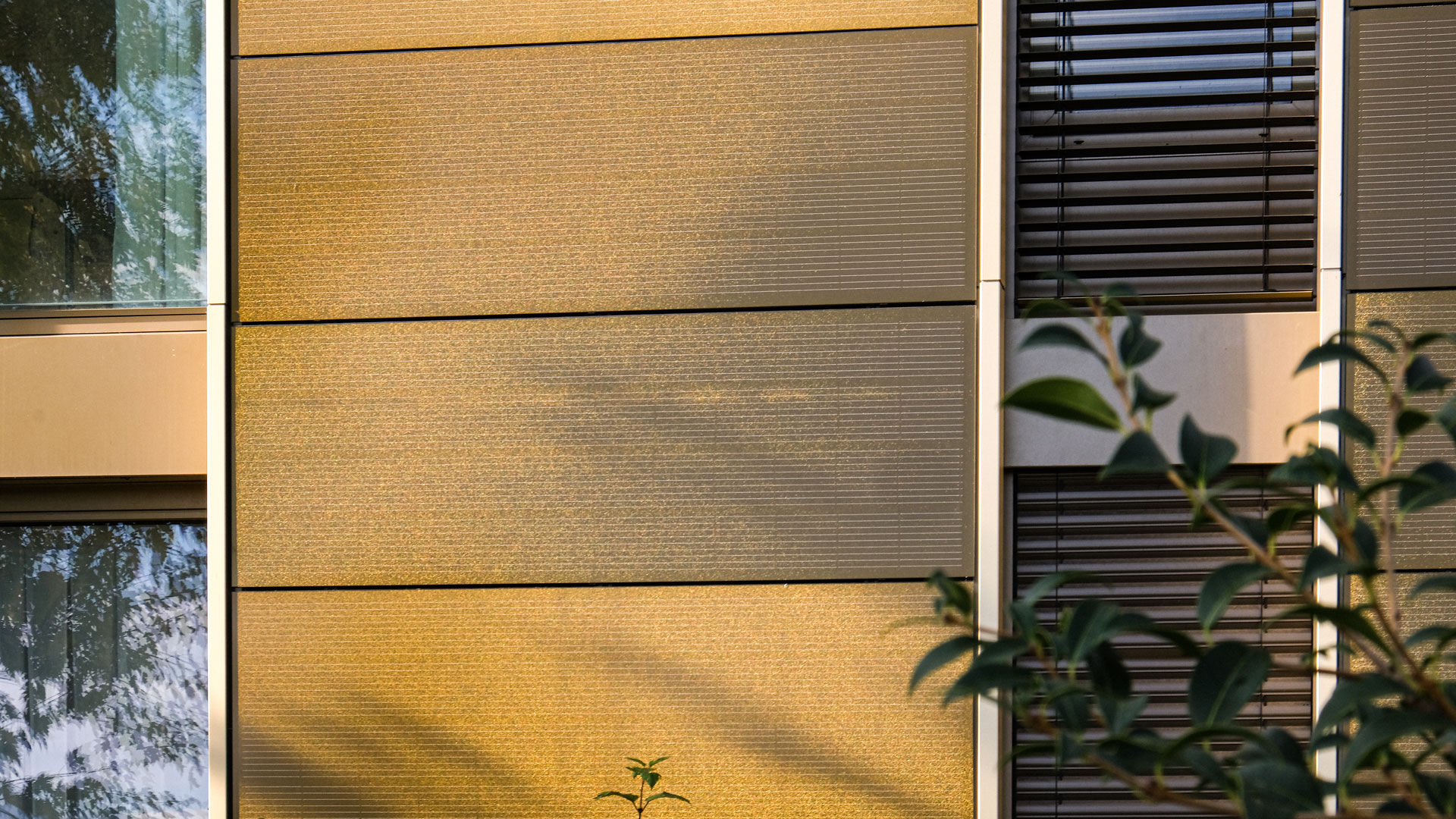
    Gold-coloured façade modules in Schlieren set new solar standards

    Megasol Energie AG, based in Deitingen, has launched a new coloured solar module on the market. According to a press release, the modules with their new colour design achieve around 94 percent of the efficiency of conventional black photovoltaic modules.

    The panels under the name SOLARCOLOR Morpho are manufactured for installation as façade elements. For example, they have been installed on two new buildings in the Lacheren area of Schlieren. Depending on the incidence of light, the gold-coloured modules create a lively play of colours, according to the press release.

    The two buildings in Lacheren comprise 36 flats. The roof is also covered with photovoltaic modules and generates peak values of 68 kilowatts with an annual yield of 59,900 kilowatt hours. The façade elements generate peaks of 17 kilowatts and an annual yield of around 16,200 kilowatt hours.

    Megasol Energie AG is one of the five nominated finalists for the Prix SVC Espace Mittelland 2025 sponsored by the Swiss Venture Club (SVC), which will be awarded in Bern on 12 March 2025.

  • Solar park project completed five months earlier than planned

    Solar park project completed five months earlier than planned

    Nexans Switzerland has commissioned its new solar park at the Cortaillod site five months ahead of schedule. It consists of ten individual systems, each of which was installed on a different roof. These independent units were then connected together to form a higher-level system. According to a statement from the cable manufacturer, this required adaptations to the specific architectural and structural features.

    This approach made it possible to completely avoid interfering with production activities at the site during the installation work. “The result: a 100 per cent successful commissioning, almost five months earlier than planned.”

    Since the summer of 2023, a team of Groupe E Greenwatt specialists from the Boudry NE site has installed over 4,000 solar modules, each with a capacity of 430 watts, “under demanding technical conditions”. The solar park has a total output of 1.7 megawatts. Together with a 700 kilowatt system previously installed by Groupe E, Nexans now achieves a self-consumption rate estimated at over 90 per cent.

    “This strategic partnership supports our goal of continuing to reduce our environmental footprint and develop our business sustainably, and strengthens our energy resilience,” Nexans Switzerland CEO Marco Spinelli is quoted as saying. “Even without these plants, Nexans only consumes electricity that comes 100 per cent from renewable sources, and has done so since the beginning of the year.”

  • Solar energy on rails: new concept

    Solar energy on rails: new concept

    Sun-Ways wants to transform railway tracks into solar power plants. The idea is to install solar modules between tracks in such a way that they can be easily removed again, for example for track repairs. The Federal Office of Transport has now given the green light for the first pilot project, according to the start-up from Ecublens, which was founded in 2023.

    Sun-Ways will now be able to test its systems on a 100-metre stretch of track near Buttes station from spring 2025. The 48 solar modules will be installed by Scheuchzer, a track builder and manufacturer of track construction systems based in Bussigny VD.

    The installation and connection to the grid will be carried out by Viteos, a provider of renewable energies based in Neuchâtel, and DG Rail, a specialist in railroad power supply. The system will be able to generate up to 16,000 kilowatt hours per year over an area of 100 square meters. The partners in the pilot project are bearing the costs of 585,000 Swiss francs.

    Thanks to a special development from Scheuchzer, the solar systems from Sun-Ways can be installed both manually and automatically on the track bed between the tracks and easily removed again. The Scheuchzer machine can now lay up to 1000 square meters of solar modules per day. In Switzerland alone, with its 5000 kilometers of track systems, Sun-Ways expects a potential of 1 terawatt hour of electricity per year, enough to supply 300,000 households.

    The town of Aigle VD has already approved another plant, which is to be built on private tracks over a length of 1500 kilometers. Sun-Ways is also already in talks with the French state railroads SNCF and with partners in Spain, Romania and South Korea about further pilot projects.

  • Energy contract signed for sustainable neighbourhood in Romont

    Energy contract signed for sustainable neighbourhood in Romont

    Granges-Paccot-based energy supplier Groupe E and KAAB have signed an energy contract for the La Maillarde neighbourhood in Romont. According to a press release, the 40-year contract covers the supply and utilisation of internal waste heat, the provision of a microgrid infrastructure and the installation of solar modules. Groupe E will supply energy to the site on behalf of KAAB, which will ensure the operation, maintenance and financing of the systems.

    Heat is supplied via the district heating network of the municipality of Romont. The network managed by Groupe E is mainly fuelled by wood chips from local forestry and waste heat from the roasting systems at the Nespresso plant. A gas-fuelled auxiliary heating system is provided for long periods of cold weather.

    The electrical system is controlled by the neighbourhood’s own microgrid. This is fed by a photovoltaic system with an output of one megawatt. It generates around one gigawatt hour of electricity per year.

    The La Maillarde neighbourhood, which is owned by KAAB, was used by the multinational company Tetra Pak until 2016. From 2025, watch manufacturer Rolex will set up shop there, creating around 250 new jobs in the region. The final La Maillarde project envisages an area of 40,000 square metres. Currently, 19,000 square metres are in use.

  • Meyer Burger Modules honoured as top performer

    Meyer Burger Modules honoured as top performer

    PVEL has included Meyer Burger ‘s high-performance modules in the highest category of its current top performer list. This was announced by the independent North American laboratory for reliability and performance testing of solar modules on 5 June when it published its 10th Annual PV Module Reliability Scorecard.

    According to Meyer Burger, these tests relate to Meyer Burger’s current product portfolio and the utility module that will be manufactured at the Goodyear site in Arizona. These tests are carried out in seven different categories, including temperature and humidity effects, the impact of mechanical stress and hail and all relevant degradation mechanisms.

    Meyer Burger joined only eight other manufacturers on the list of those that received top marks in all seven categories. According to Meyer Burger, PVEL tests far beyond the usual IEC and UL standards.

    “We can be proud to have achieved such a good result in our very first participation in the PVEL test procedure,” Madlen Apel, Head of Product Management, is quoted as saying. “This success impressively reflects our quality awareness and our technological leadership in the industry and independently demonstrates the confidence in our products for all customers and investors.”

  • “Little Marcel” leads Boudry’s road maintenance department into a new era

    “Little Marcel” leads Boudry’s road maintenance department into a new era

    In June last year, the canton of Neuchâtel launched an architectural competition to find innovative solutions for the urgently needed expansion and renovation of the road construction centre in Boudry. The aim of the challenging search was to create a future-proof infrastructure that fulfils the requirements of sustainability and efficiency. The “Little Marcel” project by Julien Dubois Architectes SA from La Chaux-de-Fonds won over the jury out of fourteen entries and took first place.

    The winning project is characterised by its holistic approach, which focuses on both architectural quality and functional excellence. In addition to the refurbishment of the existing building, the planned extension also includes the construction of new buildings that will enable the site to be utilised to the full. The sustainable concept, which emphasises the project’s commitment to the environment through the integration of solar modules and the use of timber constructions, is particularly noteworthy.

    The realisation of “Little Marcel” promises to improve work processes while at the same time enhancing the landscape and architectural quality of the site. The targeted expansion of the workshop buildings and the creation of a spacious inner courtyard will serve to optimise logistics and promote cooperation between employees.

    With a planned budget of CHF 12 million for the overall competition and a further CHF 1.5 million for the relocation of service buildings, the Government Council is laying the foundations for a modern and future-orientated infrastructure. The public exhibition of the competition entries gives the public an insight into the visionary plans for the Boudry depot.

    This project marks an important step in the development of road maintenance in the region and sets new standards in terms of sustainability and efficiency in road maintenance in the Canton of Bern. The further development and refinement of the winning project is eagerly awaited with a view to a future application for a building loan.

  • 3S Swiss Solar Solutions opens second production site in Worb

    3S Swiss Solar Solutions opens second production site in Worb

    The second production site has been opened at 3S Swiss Solar Solutions AG. In Worb, the Thun-based manufacturer of solar modules is focussing on the production of TeraSlate systems. According to a press release, the G12 cells installed in these systems deliver more power, are more efficient and have improved aesthetically. Delivery of the first modules is planned for the end of January 2024.

    The company has invested over 10 million Swiss francs for further growth. At the heart of “Europe’s most modern solar module production” is a 200-tonne laminator in which glass, solar cell strings and special plastic films are pressed into robust modules under heat, according to the press release. This production step is carried out under vacuum and plays a key role in creating a durable, bubble-free encapsulation.

    “The highest quality, the best service, sustainable solutions – that’s what makes the Swiss location possible for us and at the same time we have a very central location in Europe,” owner and CEO Patrick Hofer-Noser is quoted as saying. According to the press release, the new production plant is a further step towards the future generation of 3S solar modules. The plant is geared towards larger quantities and the use of larger cell formats. The nominal capacity is estimated at 250 megawatts per year.

    In future, the new site will also be used for training and education programmes as well as for company representation in order to relieve the pressure on the bursting headquarters. “Due to the enormous growth in recent years, our possibilities in Gwatt are more than exhausted and the premises are no longer sufficient for the current number of employees,” says Patrick Hofer-Noser.

  • Expansion of photovoltaics to increase by 58 percent in 2022

    Expansion of photovoltaics to increase by 58 percent in 2022

    Despite bottlenecks in skilled labor and blocked supply chains, 58 percent more photovoltaics were installed in 2022 compared to the previous year. Swissolar points to the figures now published by the Swiss Federal Office of Energy in a media release. According to the figures, solar modules with an output of 4.74 gigawatts were installed in Switzerland at the end of 2022. This covered almost 7 percent of Switzerland’s electricity demand over the course of the year. This production was equivalent to half of the Gösgen nuclear power plant.

    This amount of solar power must be increased sevenfold in the next twelve years, according to the association: “With the overcoat decree currently being discussed by parliament, it must be possible to create the necessary framework conditions for this.” That is quite realistic, also with the help of the solar express law for the accelerated building of alpine plants. On suitable roofs and facades alone, 70 terawatt hours could be generated annually. That would be twice what the National Council and Council of States have set as a target for renewable energies by 2035.

    Demand for battery storage has also more than doubled compared with the previous year. With the storage capacity of all the battery storage systems installed to date, 35,000 households could be supplied with electricity for a day, according to the data.

    For the current year, Swissolar expects a photovoltaic expansion of 20 to 30 percent. This is expected to pick up further momentum from October 1 with the new vocational apprenticeships of Solar Installer:in EFZ and Solar Assembler:in EBA. “Now,” says Swissolar Managing Director Matthias Egli, “we need a clear signal from politicians that solar energy offers long-term career prospects.”

  • MARNA Beteiligungen wants to buy solar company Flisom

    MARNA Beteiligungen wants to buy solar company Flisom

    According to a press release , MARNA Beteiligungen AG from Heidelberg plans to take over the majority of the Flisom Group based in Niederhasli. MARNA Beteiligungen AG wants to cooperate with FL1 Holding GmbH, which belongs to it, and is also planning a capital increase.

    Flisom, a spin-off from the Swiss Federal Institute of Technology in Zurich ( ETH ), has developed particularly flexible and lightweight thin-film solar cells. They are produced on plastic films using so-called roll-to-roll manufacturing techniques and can be attached to roofs or facades, for example. However, they are also suitable for use in mobility applications, such as in aviation. In 2020, Flisom commissioned a 40-megawatt production plant in Hungary to manufacture the modules.

    "Flisom is ideally positioned to benefit from the megatrends behind the increasing demand for electricity (…)," writes MARNA Beteiligungen AG in the press release. She counts population growth, increasing prosperity, digitization and electromobility among these megatrends.

    According to the information, various requirements still have to be met for the planned transaction.