The software company zevvy AG and Elektrizitätswerk der Stadt Zürich(ewz) are joining forces for electricity billing solutions. In future, ewz will also use the flexible billing platform, which calculates energy flows in multi-party buildings and neighbourhoods, as detailed in a press release. The zevvy software enables the billing of solar power for self-consumption (ZEV), virtual ZEVs (vZEV), tenant electricity and local electricity communities (LEG), as well as heating and water costs and charging stations for electric vehicles. In future, the platform will be used as a white label, i.e. under the ewz logo.
According to the press release, ewz benefits in particular from the software’s integration capability, which can be used with various building technology systems, monitoring platforms, smart home providers and Internet of Things (IoT) solutions. This versatility enables a flexible system architecture for future energy services and reduces lock-in effects. This makes it more difficult to switch to other providers or systems.
“We are delighted that other partners from the zevvy ecosystem are contributing to our success. The software enables work in the client system. For example, dSyde SA supports French-language projects and Prola Services GmbH helps with the initial migration effort,” says Cyrill Burch, CEO of zevvy.
The background to the partnership is the increasing importance of shared solar power and the associated services and technologies. For example, active energy management in solar energy communities and the concept of local energy communities), which will be introduced in January 2026, require new solutions. Ewz wants to use the zevvy software to expand its range of energy billing services for property portfolios.
The city of Zurich is interested in expanding solar power production in the city as quickly as possible. To this end, the city’s own electricity utility(ewz) is launching a new offer via local electricity communities (LEG). In future, owners of large photovoltaic systems (PV systems) will be able to sell their surplus electricity directly to households in the neighbourhood, the city administrationannounced in a press release. Previously, it was only possible to feed surplus electricity into the ewz grid.
With the ewz.solarquartier offer, ewz will take over the networking of interested producers and consumers of solar power as well as administration and billing. The owners receive a stable revenue of 12 centimes per kilowatt hour supplied. “This means that LEG can generate up to 10 per cent more revenue than with the return delivery alone,” explains ewz Director Benedikt Loepfe. Households purchase the electricity at the price of the standard ewz.natur product.
“The installed capacity of PV systems in the city of Zurich has more than quadrupled in the last ten years or so,” explains City Councillor Michael Baumer. The city wants to further strengthen this growth trend wherever possible, explains the head of the Department of Industrial Operations, where ewz is based. “In addition to the various measures already underway, a good offer for LEG helps to make the realisation of solar installations in the city even more attractive.”
The expansion of solar power reached a new record in 2024, according to a statement from Swissolar. According to the industry association, systems with a total output of 1,798 megawatts were installed, an increase of 10 per cent compared to the previous year. In total, 8170 megawatts were installed by the end of 2024. This generated 5961 gigawatt hours of electricity.
Solar power accounted for 10.4 per cent of electricity demand in 2024. In the previous year, it was 8.25 per cent. Swissolar expects a share of 14 per cent by 2025. “Solar power is already a central component of our energy supply today and is well on its way to becoming the second mainstay of our electricity supply alongside hydropower,” said Matthias Egli, Managing Director of Swissolar, in the press release.
Swissolar also emphasises the importance of solar power for the winter months. Around 2,400 gigawatt hours of solar power were generated between the beginning of October 2024 and mid-April 2025, around a third of annual production.
The number of newly installed battery storage systems grew by 4 per cent in 2024. In single-family homes, 47 per cent of all solar installations were already equipped with battery storage systems, compared to just 42 per cent in the previous year. The total installed storage capacity at the end of 2024 was already 896 megawatt hours, enough to cover the consumption of 100,000 households for one day.
Germany produced around 40 terawatt hours of solar power between January and June 2025, an increase of 30 per cent compared to the same period last year. France, Belgium, Denmark and Poland also recorded growth in photovoltaics. The expansion is having an impact, but the parallel lull in wind power weighed on the overall balance. At 60.3 TWh, wind power generation was around 18% down on the previous year. As a result, the share of renewable energies in net public electricity generation in Germany fell slightly to 60.9% (2024: 65.1%).
Europe-wide trend with regional differences Within the EU, combined electricity generation from wind and solar fell slightly to 344.4 TWh in the first half of 2025, compared to 358.1 TWh in the previous year. The figures from Fraunhofer ISE show that while solar expansion is bearing fruit in many countries, meteorological fluctuations such as wind lulls are having a greater impact.
Electricity trading adapts to Germany imported 7.7 TWh of electricity in the first half of the year, primarily from Scandinavia, where wind and hydropower continue to offer favourable prices. These imports were more attractively priced than domestic electricity from fossil-fuelled power plants. Exports went to Austria, the Czech Republic and Poland, among others.
Electricity prices rise slightly – customer prices stable After falling in recent years, the average exchange electricity price rose again to €86.64/MWh in the first half of 2025. The highest prices were recorded in January and February, when there was little wind. At an average of 27 cents per kilowatt hour in June, electricity prices for new customers were back at the 2021 level.
CO2 costs and gas prices on the rise again In parallel with the electricity market, CO₂ certificate prices rose by 11 per cent compared to the previous year, and natural gas was also more expensive than in the first half of 2024. These developments illustrate how sensitively the energy market reacts to fluctuations in supply and political conditions and how important a sustainable, resilient energy infrastructure is.
In a new study by the Swiss Energy Foundation (SES), Switzerland ranks at the bottom of the league table for electricity production from solar and wind energy. It produces 681 kilowatt hours of solar power per capita and 19 kilowatt hours of wind power. In total, the country produces 700 kilowatt hours per capita from solar and wind energy, putting it in 22nd place out of 28 EU member states.
Sweden is the leader in wind power production with 3930 kilowatt hours per capita, followed by Denmark with 3448 kilowatt hours. Even neighbouring Austria comes in at 1004 kilowatt hours. In terms of solar production per capita, the Netherlands leads with 1206 kilowatt hours per capita, followed by Spain and Cyprus. However, even Austria has 941 kilowatt hours and Germany 888 kilowatt hours.
Switzerland was able to increase its production of electricity from wind and solar from 7.2 per cent to 11 per cent within five years. However, other countries in Europe often achieved higher increases of up to 20 percentage points in the same period. In a European comparison, only Malta, Slovenia, Romania, the Czech Republic, Latvia and, bringing up the rear, Slovakia are behind Switzerland in the production of electricity from wind and solar per capita.
In the view of the SES, wind energy in particular must be expanded in Switzerland, according to a press release. A total of 11 per cent of domestic electricity consumption is generated by wind and solar, 7.2 percentage points more than five years ago. European neighbours
The new Electricity Act shows that the Swiss population wants to intensify sustainable electricity production in the future. Political instruments for implementing the law are already active or will be from 2026. Their impact will become apparent in the coming years, according to the SES.
The exchange of electricity with neighbours also holds great potential for Switzerland. Switzerland is already integrated into the European electricity grid with over 40 cross-border transmission grids. European electricity trading is central to Switzerland’s ability to obtain winter electricity from its European neighbours’ wind turbines, according to the press release. The planned EU electricity agreement forms the basis for increased electricity trading.
St.Galler Stadtwerke (SGSW) has expanded its photovoltaic system on the roof of the kybunpark football stadium, home to FC Gallen 1879, as detailed in a press release. A large proportion of the locally generated solar energy – around 440,000 kilowatt hours – will be used for events at the stadium. The symbolic inauguration of the system took place at FC St.Gallen 1879’s home match against FC Lausanne-Sport on 26 January.
The roof is now completely covered with solar modules. The additional capacity of 572 kilowatts of peak power will enable 560,000 kilowatt hours more electricity to be generated. The total output of the system is now 1,205 kilowatts at peak times, increasing annual electricity production to more than 1 million kilowatt hours. This could cover the annual electricity needs of 288 four-person households.
This increase in capacity, which will be implemented jointly by SGSW, Stadion St.Gallen AG and FC St.Gallen Event AG between September 2024 and January 2025, means that the system will retain its status as the “largest solar installation on a roof” in the city. The previous photovoltaic system was considered the largest when it was commissioned in 2015, with a peak output of 633 kilowatts and a production of 520,000 kilowatt hours per year.
In future,Thurplus will produce solar power on the roof of Signer Elektromotoren in Frauenfeld. According to a press release, the Frauenfeld-based energy supplier commissioned a photovoltaic system with 140 modules on an area of 280 square metres at the end of November. With an output of 62 kilowatt hours, it will generate around 62,000 kilowatt hours of electricity per year.
Thurplus financed the system, built it with regional craftsmen and will also operate it. Signer Elektromotoren is providing the roof and will receive the solar power at a heavily discounted rate. “We have been thinking about realising a photovoltaic system for a long time,” junior boss Dominik Signer is quoted as saying in the press release. “The collaboration with Thurplus was very good and we are pleased to be able to contribute to the promotion of solar energy.”
Founded in 1967, the family business repairs electric motors and builds customised motors.
Thurplus is looking for further roof areas for photovoltaics. “Such joint projects contribute to the energy transition and to achieving our urban sustainability goals,” said Fabrizio Hugentobler, city councillor and head of the Thurplus, Leisure and Sport department, in the press release. Frauenfeld aims to install an output of 8,000 kilowatt peak by 2027.
The Basel-based energy supplier IWB has received planning permission for the construction of a solar plant on the former Hinterm Chestel landfill site in Liesberg. The investment decision is expected to be made at the beginning of 2025, according to a press release. Following a swift start to construction, the first solar power, which can supply around 1,000 households, is expected to flow as early as spring 2026.
7,600 solar modules are to be installed on an area of 25,000 square metres. This corresponds to an installed capacity of 3.4 megawatts. The system will be installed at a certain height so that green areas can continue to be cultivated below. This should also benefit local biodiversity.
“It is important to us that the plant is realised in an environmentally friendly way. For this reason, we deliberately integrated existing natural objects during the planning phase in coordination with KELSAG,” Daniel Neuenschwander, Project Manager for large-scale photovoltaic systems at IWB, is quoted as saying in the press release. KELSAG (Kehrichtbeseitigung Laufental-Schwarzbubenland AG) is the owner of the landfill site and will make the area available for up to 50 years.
The habitat of various animal species is also taken care of. “We closely involved nature and environmental organisations in this project right from the start. That was the recipe for success for a balanced project: the concerns of electricity production and biodiversity are given equal consideration,” says Neuenschwander.
Lucerne University of Applied Sciences and Arts and its industrial partner Matica have developed a technology that allows surplus solar power to be stored without loss in a thermochemical process in summer and used for heating in winter. A first pilot plant has now gone into operation at the animal carcass collection centre (TKS) in Frauenfeld, Matica announced in a press release. The Wagenhausen-based company specialises in the construction of special containers such as water heaters and heat and cold storage tanks.
The SeasON demonstration plant in Frauenfeld uses caustic soda as a storage medium. In summer, the caustic solution is concentrated using surplus electricity from the TKS solar system and the separated water is stored in separate tanks at room temperature. In winter, the concentrated lye is diluted again with the separated water. This is vaporised using low-temperature heat from a heat pump. Both this vaporisation energy and the heat generated from the exothermic reaction when the lye is diluted can be used for heating. The storage efficiency of the system is put at up to 95 per cent in the press release.
“SeasON solves several challenges of the energy transition at the same time and promotes sustainable, efficient energy management,” Benjamin Fumey from Lucerne University of Applied Sciences and Arts is quoted as saying in the press release. “In the development of SeasON, we have mutually conditioned each other and at the same time created a win-win situation between research and practice,” says Matica CEO Marc Lüthi. A second demonstration system is currently being installed in the new Swiss Post delivery centre in Kaltenbach TG.
Solar Manager has launched a new version of its gateway for solar power. According to a press release from the energy management specialist based in Muri and Isernhagen in Germany, Solar Manager Connect 2 is easy to integrate into existing systems as a top-hat rail version. The hardware is also being launched with the new Solar Manager software. According to the company, the gateway is compatible with over 500 devices from different manufacturers.
Connect 2 can be used to control a home network (Home Energy Management System, HEMS). The new features include two integrated relay inputs for controlling wallboxes and heat pumps, two digital inputs and an analogue output as well as an RS-485 industry standard for communication with third-party devices, which was already built into the previous model. There is also an integrated EEBUS standard for communication with grid operators as a smart meter gateway.
“Our aim was to make installation as simple as possible, even in increasingly complex energy systems,” said Andreas Kuhn, founder and CEO of Solar Manager AG, in the press release. “The feedback from our partners was crucial. We incorporated their wishes directly into the development of Solar Manager Connect 2 so that installers can continue to do their work quickly and reliably.”
Energy consumption in the canton of Zug amounts to almost 3,000 gigawatt hours per year, with buildings and mobility accounting for the largest share. The cantonal government’s new energy and climate strategy (EKS) aims to reduce energy consumption and rely more heavily on renewable energies. At the same time, the government wants to strengthen security of supply in the canton and reduce greenhouse gas emissions to net zero by 2050. With clear interim targets up to 2030, the government is concretising the path to these ambitious goals.
Investments in solar power and energy storage A central component of the strategy is to increase the production of solar power in the canton. At the same time, investments in innovative energy storage technologies such as hydrogen are planned. “We want to shape the energy infrastructure of the future through close collaboration with industry and science,” explains Construction Director Florian Weber. Buildings in the canton should also increasingly serve as energy producers and thus become an energy hub.
Sustainability in agriculture and negative emission technologies As part of the KERB sustainability project, the canton is focussing on measures in agriculture to reduce CO2 emissions. Forests and moors play a central role in CO2 sequestration. For unavoidable emissions, the canton is focussing on negative emission technologies that are intended to permanently remove CO2 from the atmosphere. A study is to determine the potential of these technologies in the canton.
Adapting to climate change In addition to reducing emissions, the canton of Zug is also preparing for the effects of climate change. A cantonal natural hazard strategy aims to minimise climate-related risks such as heat and invasive pests. At the same time, investments are being made in climate-adapted road surfaces and sustainable forest management to ensure both protection and recreational areas.
According to a press release,Evaarist is launching a grid platform “for the democratisation of energy self-sufficiency”. The Sion-based start-up wants to enable more owners of existing solar installations to consume more of their solar production themselves. In addition to the autarcie.ch platform for controlling solar power from the roof, Evaarist also offers easy-to-install battery packs.
“Energy self-sufficiency is something that is close to our hearts,” says Loïc Viret. He founded Evaarist 2023 with Julien Morard and Stéphane Curchod. The engineering firm specialises in renewable energies and energy self-sufficiency and launched the autarcie.ch platform as part of the Espace Innothèque at the Foire du Valais 2024, according to the press release.
Evaarist’s considerations were based on the observation that almost 98 per cent of the 240,000 or so existing solar installations in Switzerland are not equipped with batteries. Evaarist offers universal battery systems for solar roofs. A battery pack is installed in parallel with the electricity grid, the solar modules and the existing inverters. “This will make it possible to store and work with additional energy. And above all, the degree of self-sufficiency can be increased to 65 to 85 per cent, compared to 20 to 30 per cent without batteries,” Viret is quoted as saying.
Furthermore, Evaarist wants to bring the material directly from the manufacturer to the customer and the installation will largely be carried out as a “do it yourself” project. Thanks to an agreement with a German importer, autarcie.ch offers battery packs from CHF 5800 for 10 kilowatt hours.
Autarcie.ch is not an anti-blackout system. “But our systems can be equipped to work if the grid fails,” Viret is quoted as saying.
The international energy company Eaton and the agrivoltaics specialist Insolight, also based in Lausanne, have agreed on a strategic collaboration to optimise the use of solar power in agriculture. According to a press release, Eaton’s experience in intelligent energy management will be combined with Insolight’s solar technologies. In particular, it will be investigated whether Insolight’s photovoltaic systems can be coupled with Eaton’s battery storage systems (BESS) and charging infrastructure for electric vehicles. Insolight plans to install more than 100 projects with a capacity of 300 megawatt peak by 2026. For its part, Eaton intends to support the projects with technical expertise and product training.
Both companies will also support the farmers involved in the integration, commissioning and ongoing maintenance of new sustainable energy systems. Insolight’s agrivoltaic systems not only generate electricity that can be used on the farms, but also protect plantations against wind, hail and heavy rain.
“This collaboration with Eaton represents an important milestone in our endeavour to bring innovative agrivoltaic solutions to the market,” said Luiggino Torrigiani, Head of Marketing and Partnerships at Insolight, in the press release. “By partnering with Insolight, we can extend our capabilities to the agrivoltaic sector, where energy efficiency can have a real impact alongside agricultural productivity,” added Anne Lillywhite, Senior Vice President and General Manager for Energy Transition, Digital and Services at Eaton.
CKW wants to protect operators of small solar plants from very low market prices, especially in summer, and help them to amortise the plant. To this end, the Axpo subsidiary is already applying the minimum remuneration for solar power planned by the federal government from the billing for the second quarter of 2024, CKW announced in a press release. Operators of solar plants with an output of up to 150 kilowatts are expected to receive a minimum price for their solar power from the beginning of 2025 if the reference market price set by the Swiss Federal Office of Energy is particularly low.
CKW is basing the amount of the minimum remuneration currently paid on the draft ordinance. It provides for different minimum remuneration per kilowatt hour depending on the size of the plant. In addition, the Lucerne-based energy service provider also voluntarily acquires a guarantee of origin for solar power. This amounts to 2 centimes per kilowatt hour for small solar plants and 1 centime per kilowatt hour for plants with an output of 100 kilowatts or more.
In the press release, CKW also advises operators of photovoltaic systems to optimise their own consumption. This is particularly worthwhile in phases with low reimbursements. In addition to its own energy management solutions and battery storage systems, CKW also recommends joining forces with neighbours to optimise self-consumption. The new Electricity Act, which was approved by voters on 9 July, also opens up further options such as the formation of local electricity communities or virtual associations for self-consumption.
Galliker Transport AG now has a charging station of superlatives: as part of the Innovation Day by Galliker, the logistics company from Altishofen has put the first Stationary Battery Backed Mega Charger from Designwerk into operation, Designwerk Technologies AGannounced in a press release. The pilot system of the battery-backed fast charging system has a total capacity of 1 megawatt hour and is powered by solar energy produced by Galliker itself.
“By using the battery-buffered charging station, we can utilise the solar power produced during the day to efficiently charge our electric commercial vehicles around the clock,” said Felix Felder, Head of Fleet Management at Galliker Transport AG, in the press release. “The Mega Charger can contribute to the stability of our site network by smoothing out peak loads.”
The charging station is the size of a standard container. The pilot system at Galliker is equipped with two charging points, each with an output of 420 kilowatts of direct current. The maximum version of the Mega Charger can accommodate a total capacity of up to 2 megawatt hours.
“The commissioning of the Mega Charger at Galliker is an important milestone in the development of future-proof charging infrastructure for heavy commercial vehicles,” explains Thorben Maier, Head of Sales and Customer Service Charging Technology at Designwerk Technologies AG. “Our technology enables logistics companies to cover a wide range of charging scenarios sustainably, with the buffer storage relieving the load on the power grid.”
St.Gallisch-Appenzellische Kraftwerke AG(SAK) from St.Gallen and the textile manufacturer Tisca from Bühler AR have put a large photovoltaic system into operation. According to a press release, SAK has installed solar panels covering an area of 4,250 square metres on the reconstructed roofs of the Tisca production halls at the Urnäsch site. The construction and maintenance of the solar system was free of charge for Tisca, but the company is tied to the refinancing with a photovoltaic contracting agreement. Tisca receives solar power from the electrical energy produced on its own property at a fixed price. Both companies are contributing to the implementation of Energy Strategy 2050.
“With photovoltaic contracting, a commercial or industrial building owner makes their roof available for photovoltaic expansion. SAK finances and is responsible for the planning, construction and maintenance,” Ralph Egeter, Head of Project Development at SAK, is quoted as saying in the press release. “Once the project is completed, the companies can use the solar power produced by the system for their own consumption at a fixed price. As compensation for the use of the roof, the companies receive a defined amount of solar energy at zero cost, depending on the size of the system. With this commitment, we are giving trade and industry a simple and cost-effective opportunity to invest in the energy future of Eastern Switzerland.”
SAK has installed a total of three photovoltaic systems at Tisca. The one now in operation is currently the largest in the canton of Appenzell Ausserrhoden.
Region Energie Solothurn also felt the consequences of the 2022 energy crisis in 2023. According to a press release, the regional supplier posted a loss of CHF 760,374. It blames this on record-high purchase prices, which have a delayed effect until 2024. It has not passed these on to customers in full.
Gas sales to business and small customers fell by 4.6 per cent to 334 gigawatt hours in 2022. Sales to large customers even fell by 19.4 per cent to 394 gigawatt hours. Regio Energie Solothurn refers to the measures taken by the federal government, under which the industry was required to switch from gas to oil.
Electricity sales increased by 11.1 per cent to 130 gigawatt hours. The company points out that it has also been supplying the municipalities of Lommiswil SO and Nennigkofen SO since January 2023. On the other hand, the grid levy has fallen because more solar power is being produced for the company’s own consumption instead of being fed into the grid.
Regio Energie has also completed the biogas pipeline between Utzenstorf BE and Gerlafingen SO. This means that the planned biogas plants in Utzenstorf can be realised.
Integrated energy solutions for sites and complexes generate added value for all stakeholders. They intelligently network all of the energy supply components for an ideal interaction of production, consumption and storage within an overall system. This unleashes efficiency potential, increases the degree of self-sufficiency and secures long-term supply to new and existing properties. The new ewz and Faktor Journalisten white paper entitled ‘Integrated energy solutions for sites and complexes’ offers property owners a knowledge base they can use during the planning process.
Components of integrated energy solutions To exploit synergies, you need to plan the energy solution as a networked system from the beginning.
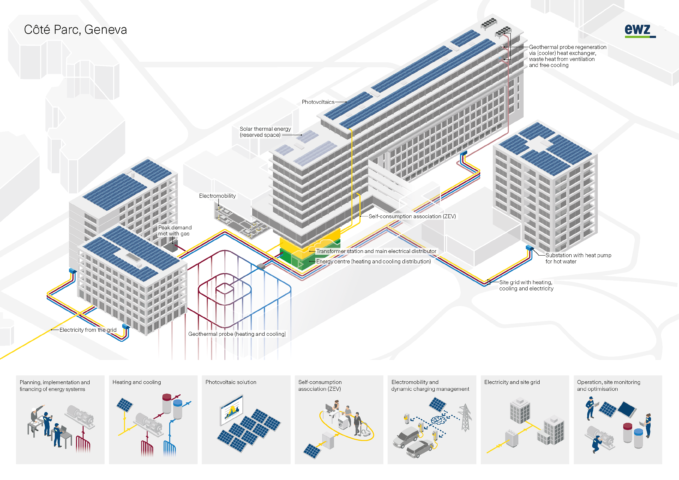
Heating and cooling from local, renewable sources Thermal networks are a good way of supplying sites or complexes with carbon-free or carbon-neutral local heating and cooling. They can be implemented and operated on different scales (for complexes, sites or entire neighbourhoods) and at different temperature levels. The energy for high-temperature networks largely comes from wood or the waste heat generated by waste incineration plants, while networks with low to medium temperature levels often use geothermal heat, lake and river water, ground water and waste heat (from computing centres, for example). The lowest operating temperatures are achieved by anergy networks or low-temperature networks, which also cool buildings in summer with the free cooling method. Various network types can be combined for greater efficiency (see Côté Parc and Greencity).
Harness solar power with a high rate of self-consumption A self-consumption association (ZEV) maximises the amount of energy consumed on site, which means that the photovoltaic installation is paid off quicker. What’s more, solar power is often cheaper than electricity from the public grid for ZEV participants. Local electricity communities (LEG), which are expected to be introduced in 2025 or 2026, enable solar power supply across properties and use the distribution grid.
Microgrids for security in planning and supply Site electricity grids can be used to supply complexes, sites or neighbourhoods with electrical energy. Microgrids, or smart grids fitted with smart components, incorporate both generators and consumers of electricity. They help to ensure grid reliability by selectively switching on consumers, charging storage systems or throttling production.
Charging infrastructure and electromobility – the new standard Electromobility is another important aspect of sustainable sites. To meet the growing demand for electric charging stations, it is a good idea to address construction of the charging infrastructure early on. Load management can help coordinate the electricity requirements of the charging station(s) with that of the other consumers in the building, and to regulate charging.
Storing energy for enhanced efficiency With the share of renewable energies set to increase in the future, energy storage will become increasingly important. For example, electric car batteries configured for bidirectional charging can be used for storage purposes. Stationary battery storage systems are another means of absorbing surplus solar power and making it available again as required. Thermal storage units can be charged with solar power that would otherwise have to be fed into the public grid. This helps prevent peak loads, and also means that heat generators can set up in smaller dimensions. Geothermal probe fields can absorb excess heat (e.g. from solar panels or waste heat) to regenerate the ground and to cool spaces.
Reducing emissions and cutting costs in the long term Continuous energy monitoring is a good way to cut energy costs and reduce greenhouse gas emissions in the long term. Continuous monitoring of the electricity, heating and cooling consumption values in a property, for example, can serve as a basis for adjustment. Energy monitoring is also important for ESG reporting, which is already mandatory for certain companies. By constantly reviewing consumption data and ensuring professional operation, companies have an opportunity to reach their efficiency and environmental targets and to create transparency in their dealings with various stakeholder groups.
‘Energy as a service’ The ‘use, don’t own’ principle is ideally suited to integrated energy solutions for entire complexes or sites. For customers, this not only reduces their investment of time, but also the financial risk, while ensuring a significantly higher security of supply. When a client chooses an‘energy as a service’ model, they outsource the planning, construction, operation and/or financing of the entire energy infrastructure for decades. This also ensures that the systems are operated reliably and efficiently.
Learn more in our new white paperentitled ‘Integrated energy solutions for sites and complexes’.
AEW Energie AG has installed a photovoltaic (PV) system on two pitched roofs of Swisspearl Schweiz AG, formerly Eternit (Schweiz) AG, in Niederurnen. According to a press release, 3144 solar panels have been installed on an area of 6282 square metres. The system is operated under a contracting model: Swisspearl Switzerland receives a preferential price for the electricity produced on site in return for providing the roof area. The contract runs for 30 years.
The plant on the production hall of Swisspearl, a supplier to the construction industry, produces 1270 megawatt hours, which corresponds to the electricity requirements of 290 households. 85 per cent of the electricity produced is consumed on site and the rest is fed into the power grid. This installation at Swisspearl Schweiz AG expands the AEW portfolio to 81 systems with a total peak output of 25.7 megawatts.
“The PV system provides Swisspearl Schweiz AG with ecological, local and cheap electricity without having to worry about the photovoltaic system,” said René Wüst, Project Manager at AEW Energie AG, in the press release. “This allows them to concentrate on their core business. The new hall offers ideal conditions for the construction and thanks to the early involvement of all those involved and the constructive cooperation, the installation went smoothly.”
ARA Thunersee will also generate solar power in future. As decided by the delegates of the municipal association on 1 November, a solar folding roof is to be installed on the roof of the wastewater treatment basin. They decided to invest 12.4 million Swiss francs in the project, according to a press release. This should be amortised within 17 years.
The folding roof from the manufacturer dhp technology, based in Zizers, will have a solar module surface area of 23,000 square metres. This will make it the largest photovoltaic system at a Swiss wastewater treatment plant and one of the largest in the canton of Bern. It will have an output of 3,000 kilowatts peak and generate 3 gigawatt hours of electricity per year.
In addition, ARA Thunersee already produces 13 gigawatt hours of biomethane per year and feeds this into the natural gas grid of Energie Thun AG.
The Umwelt Arena in Spreitenbach is presenting a special exhibition on solar power together with the electricity utility of the city of Zurich(ewz). According to the announcement, the special exhibition, which will be open all day from 3 November to 28 April 2024, will focus on the history of the development of solar power, the function and installation of solar power and the potential of the sun to generate electricity.
The ewz special exhibition shows the huge potential for climate-friendly solar power production that lies dormant on rooftops and how fundamentally uncomplicated it is to take action yourself to have a solar system installed, according to the press release. However, there are still reservations and outdated myths about the construction and utilisation of solar systems. The exhibition therefore sheds light on various aspects, including, for example, how a solar system and flat roof greening can ideally complement each other. On a journey of discovery, visitors are given information about the development of solar energy over the last few decades. They can also take part in a solar quiz.
The Umwelt Arena would like to point out that those particularly interested in the topic of solar power and visitor groups such as companies, clubs or schools can combine a visit to the special exhibition with a guided tour of the SonnenTrail. The possible uses of solar thermal energy and photovoltaics are presented.
According to the Umwelt Arena press release, guided tours must be booked in advance by telephone or online.
Despite bottlenecks in skilled labor and blocked supply chains, 58 percent more photovoltaics were installed in 2022 compared to the previous year. Swissolar points to the figures now published by the Swiss Federal Office of Energy in a media release. According to the figures, solar modules with an output of 4.74 gigawatts were installed in Switzerland at the end of 2022. This covered almost 7 percent of Switzerland’s electricity demand over the course of the year. This production was equivalent to half of the Gösgen nuclear power plant.
This amount of solar power must be increased sevenfold in the next twelve years, according to the association: “With the overcoat decree currently being discussed by parliament, it must be possible to create the necessary framework conditions for this.” That is quite realistic, also with the help of the solar express law for the accelerated building of alpine plants. On suitable roofs and facades alone, 70 terawatt hours could be generated annually. That would be twice what the National Council and Council of States have set as a target for renewable energies by 2035.
Demand for battery storage has also more than doubled compared with the previous year. With the storage capacity of all the battery storage systems installed to date, 35,000 households could be supplied with electricity for a day, according to the data.
For the current year, Swissolar expects a photovoltaic expansion of 20 to 30 percent. This is expected to pick up further momentum from October 1 with the new vocational apprenticeships of Solar Installer:in EFZ and Solar Assembler:in EBA. “Now,” says Swissolar Managing Director Matthias Egli, “we need a clear signal from politicians that solar energy offers long-term career prospects.”
On 5 May, the AMAG Group commissioned a photovoltaic (PVA) plant with an output of 87 kilowatts peak on the roof of the Porsche Centre in Winterthur. The new plant is part of a major offensive in which the Group has already set up a whole series of solar plants on the roofs of AMAG operations. By 2025, around 75,000 square metres of surface area are to be equipped with solar panels, informs the automobile trading group headquartered in Cham in a statement. This would be sufficient to cover over 20 per cent of the Group’s electricity requirements. AMAG also aims to achieve climate neutrality by 2025 at the latest.
The new plant on the roof of the Porsche Centre will contribute around 86 megawatt hours of solar power annually towards this goal. “For us, it is a great pleasure that we now not only stand for Porsche’s great products in the Winterthur region, but also for sustainability and climate protection in accordance with the AMAG Group’s strategy,” Marcel Renz, Managing Director of AMAG First AG’s Porsche Centre Winterthur, is quoted as saying in the statement. “Thanks to PVA, we will be able to cover our own electricity needs to a certain extent.”
According to the statement, the AMAG Group is pursuing the goal of becoming the leading provider of sustainable individual mobility. The acquisition last year of the solar company Helion, which specialises in photovoltaics, heat pumps and e-mobility, should also be seen against this background.
Wallisellen is increasingly relying on LED luminaires for lighting in public spaces. As it says in a media release, the utility company die Werke operates the lighting of public streets and squares with energy-saving LED lamps on behalf of the city of Wallisellen. Already today, 65 percent of the city in the canton of Zurich is equipped with intelligent LED lamps. These can be switched on or off as required and can also be dimmed.
“With LEDs, electricity can be saved and light pollution reduced,” says Philipp Maurer, Head of Civil Engineering + Landscape at the City of Wallisellen, explaining the conversion. The measures taken are part of the project “More Night for Wallisellen”, according to the press release.
Compared to their predecessors, the sodium vapour lamps, the new LED lights only need about half the electrical energy. This large saving is also achieved by the fact that the LED luminaires are equipped with sensors. When vehicles or pedestrians approach, the light is raised via motion sensors. At times of low activity, it is reduced by 50 percent.
By mid-2023, all street lighting should be equipped with the new system. The city buys the electricity required for operation from local solar power producers.
In Switzerland, about 6% of all apartment buildings have a solar hot water system (solar thermal) in operation. These are used to heat hot water in order to reduce the consumption of oil and gas. Most of these systems were installed about 10 years ago, when photovoltaics were much more expensive. However, in recent years they have been forgotten. Many owners and administrators discover the installations only by chance through a view of the property on Google Maps, when they analyse the roof for photovoltaic suitability.
On average, solar hot water systems have 20 years of operation ahead of them, during which they can generate CO2-free heat and also significantly reduce utility costs thanks to fossil energy savings. Because nobody knows about the existence of many installations, one in five is defective. This means valuable solar heat is being wasted and fossil fuel heating systems are having to step in instead.
Several cantons have already recognised the problem and launched awareness campaigns to make owners, caretakers and administrators aware of the issue. The free solartest.ch platform has been created for this purpose in collaboration with Energie Schweiz and Swissolar. This allows users to check whether their system is running correctly by simply entering the temperature values they have read.
To avoid having to read the temperature values every week, Energie Zukunft Schweiz has developed the LORALARM monitoring system, which can be retrofitted.
As part of a project with a large Swiss insurance group, 65 existing solar hot water systems were monitored, of which a total of 15 systems were found to be out of order. Minor repairs enabled systems worth CHF 1.5 million to be put back into operation within a very short time. The good time to find out if your solar thermal system is running is on a sunny winter’s day. This ensures that the defect will be producing sun-warmed water again by the time of the productive spring days from the beginning of March, after any repairs have been carried out.
According to a press release , St.Gallisch-Appenzellische Kraftwerke AG ( SAK ) and Heizplan AG from Gams are founding a joint venture for the training of skilled workers. The background is the increasing order situation for photovoltaic systems, for which additional specialist staff is required.
As a result of the high demand for solar roof systems for single and multi-family houses as well as for commercial properties, customers have to wait longer for the craftsman. SAK and Heizplan want to tackle the growing need for additional skilled workers under a joint company roof. The first positions are to be advertised in the course of the week.
According to the head of the energy solutions and production divisions at SAK, Adriano Tramèr, who was quoted in the media release, the expansion of photovoltaics can be accelerated together. "By founding the company, we are pooling our strengths and supporting the energy transition in Eastern Switzerland – and thus the energy policy efforts of the Eastern Swiss cantons."
The share of solar power in the total electricity consumption in Switzerland has reached almost 6 percent, explains Swissolar in a statement . The association of the Swiss solar energy industry relies on the solar energy statistics published by the Swiss Federal Office of Energy . According to her, the expansion of photovoltaics in 2021 rose by 43 percent year-on-year to 683 megawatts. In total, systems with a total capacity of around 3.65 gigawatts have been installed. They produced a total of 2.84 terawatt hours of solar power in 2021.
However, in order to close the gap created by the planned phase-out of fossil fuels and nuclear power, solar power production would have to be increased to 45 terawatt hours per year, says Swissolar. This goal can be achieved by using almost 40 percent of the currently existing roof areas by 2050. In an 11-point plan , Swissolar sets out how solar production can be increased to 25 terawatt hours by 2035. “This would mean that the water reserves in the reservoirs would be sufficiently large even in late winter and spring, despite the nuclear phase-out,” the statement said.
For 2022, Swissolar is expecting further growth of 25 to 30 percent to 850 to 900 megawatts. Without bottlenecks in personnel and material, the increase could be even higher, believes Swissolar. The association demands reliable framework conditions for this. “Anyone who is now aligning their professional career with solar energy wants to be sure that the politically induced ‘stop-and-go’ of the last decade is a thing of the past,” Swissolar Managing Director David Stickelberger is quoted as saying in the statement.
According to a press release , Younergy Solar wants to democratize solar energy and is issuing a green bond worth CHF 5 million. Younergy’s business model is understood as democratization. The Lausanne-based company installs photovoltaic systems on the roofs of its customers and assumes the entire costs of installation, maintenance and monitoring. As a result, customers – from single-family homes to large companies – produce their own electricity without any upfront investment and instead only pay for the energy produced. When the amortization period has expired, the system becomes the property of the customer. This means that everyone can generate and use solar power regardless of their personal budget.
“We are the only ones in Switzerland that cover single-family homes as well as buildings with larger roofs. That was the key to our rapid growth,” Pedro Miranda, CEO and co-founder of Younergy, is quoted as saying. “The energy transition is mainly taking place at the local level. That’s why we want to expand this solution further,” Miranda continues. The sharp increase in energy prices and the uncertain energy supply in connection with the geopolitical situation required local supply. Electricity prices are likely to rise by more than 20 percent in Switzerland in 2023. With the Younergy solution, on the other hand, significantly lower prices are possible for private individuals and companies. The demand is therefore increasing sharply.
So far, the company, which was founded in 2015 by a group of solar energy experts at the Swiss Federal Institute of Technology in Lausanne ( EPFL ) and is funded by the Swiss Federal Office of Energy ( SFOE ), already operates 480 such photovoltaic systems throughout Switzerland.
Nüssli has put its photovoltaic system into operation. With its 8000 square meters, this is the fourth largest solar system in the canton of Thurgau. It is operated by the electricity company of the canton of Schaffhausen (EKS). According to a media release , this was also the impetus for the construction of this plant. The 1.5 megawatt hours of solar power produced annually by the approximately 4,100 modules are fed into the network of the Hüttwilen power station .
This is two and a half times what the plant needs to be fully self-sufficient. The surplus is available to more than 300 four-person households in the area.
"We realize sustainable or even self-sufficient buildings for our customers," Nüssli CEO Andy Böckli is quoted as saying. “With the new system, we are now taking on even more responsibility on our premises. We are happy to go one step further towards a sustainable future together with EKS and to be able to supply ourselves with electricity.”
Enormous solar potential After a steady increase over the years, photovoltaics recorded a record increase in 2020. According to the “Solar energy statistics” of the Federal Office of Energy (SFOE), around 118,000 photovoltaic systems with an output of almost 3 gigawatts were installed at the end of 2020. The strong market growth continued in 2021, so that according to Swissolar, photovoltaics (PV) today covers more than 6 percent of Switzerland’s electricity requirements. Experts assume that this trend will continue, not least in view of the efforts towards much more energy independence.
Ecological and economic advantages Photovoltaic systems bring a whole range of advantages for owners of real estate portfolios. On the one hand, they can protect themselves against rising electricity prices. On the other hand, they already meet possible future self-production specifications today. Also with regard to subsidies, new rules will make the production of solar power more attractive in the future. In addition, portfolio owners with their own solar systems benefit from a clear reputation advantage.
In most cases, PV power from your own roof is cheaper than power from the grid. The fact that power consumption due to heat pumps and electromobility will continue to rise in the future contributes to the financial attractiveness of PV systems. Improving the ecological balance sheet is also becoming increasingly important, because sustainability aspects are part of the strategy of more and more companies. Furthermore, PV systems are also interesting because they increase the value of real estate. If the photovoltaic systems produce more electricity than can be consumed on site, it is possible to use the solar power in other properties.
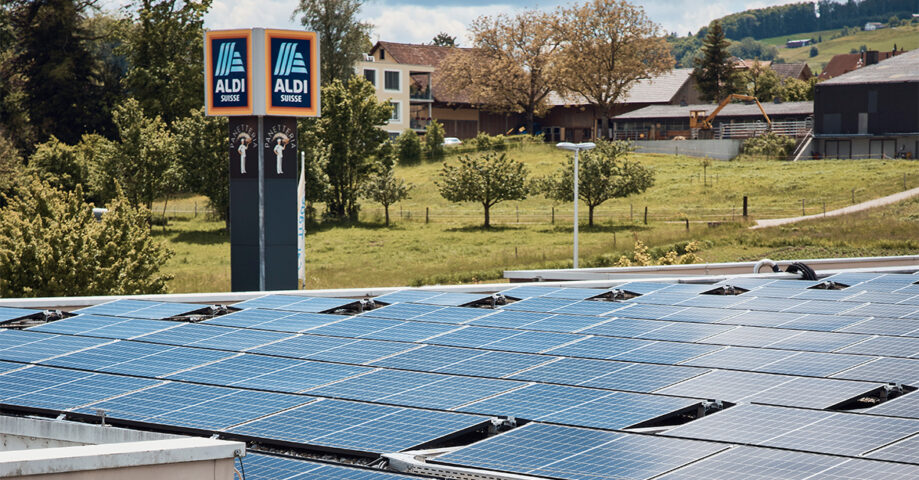
In the ALDI SUISSE solar project , for example, sustainability and cost-effectiveness play a key role. In just over a year, ewz equipped 68 store roofs between Romanshorn and Geneva with photovoltaic systems. ALDI SUISSE uses most of the solar power itself for its own branch operations. Thanks to the large PV systems, the implemented solution enables a high solar yield with an average self-consumption of 55 to 60 percent.
High self-consumption increases profitability There is already a heat pump in around 90 percent of new buildings, and new registrations of electric cars are continuing to rise sharply. However, heat pumps and electric vehicles are only really low in CO 2 if they use renewable electricity. The combination with a photovoltaic system therefore makes sense: Solar power reduces CO 2 emissions and high self-consumption increases the profitability of the PV system. This is because the production costs for solar power are lower than the electricity tariff for households and because the energy suppliers pay a low tariff for the solar power fed into the grid.
A good way of using a large part of the solar power yourself is to organize several end users in a group for self-consumption (ZEV) . These are possible both in rental properties and among property owners. The degree of self-consumption of photovoltaic systems is on average 30 to 40 percent. This value can be significantly increased with self-consumption solutions.
A large part of the electricity is used on site through the targeted control of consumers such as heat pumps or electric vehicles. The advantage for property owners and their tenants: the cost of solar power, at 8 to 16 centimes per kilowatt hour, is lower than the electricity tariff for households, which costs 15 to 25 centimes per kilowatt hour.
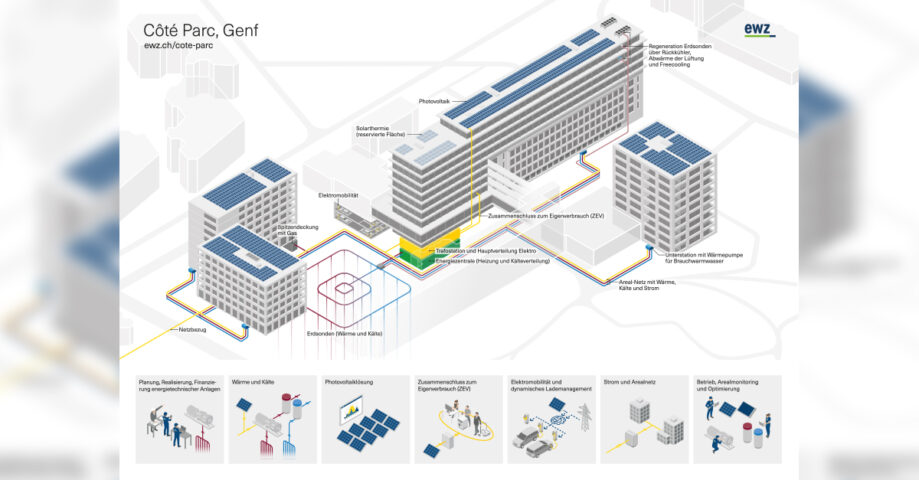
An interesting practical example of this is the “ Côté Parc ” project in Geneva. 776 photovoltaic panels on the roofs of the area form the basis for an integrated solar solution with heat pumps, charging stations for electric cars and the area’s own power grid, including self-consumption for the users.
For real estate owners with large roof areas (from approx. 700 m2), a contracting model is an option worth considering. The provider takes over all services – from planning to financing, implementation to operation over several decades. Including the integration of photovoltaic systems in a holistic energy solution with heat and cold supply, electromobility and self-consumption models.
Business customers of ewz can rely on efficient and tailor-made solutions from competent teams with many years of experience. Investment, maintenance and repair costs are not incurred during the contract period. After the end of the contract period – usually 20 to 30 years – the photovoltaic system becomes the property of the customer.
Further interesting information on the subject of photovoltaics and the white paper “Photovoltaics & ZEV” can be found here .
Wir verwenden Cookies zur Unterstützung und Verbesserung unserer Dienste. Mit der Nutzung dieser Website erklären Sie sich mit der Verwendung von Cookies einverstanden. Weitere Informationen finden Sie in unserer Datenschutzerklärung.