Tag: Spreitenbach

  • From shopping centre to property platform

    From shopping centre to property platform

    Shoppi Tivoli Management AG has changed its name to Tivoli Real Estate Management AG. According to the company, the name change reflects a strategic expansion of its field of activity. In addition to managing the shopping centre in Spreitenbach, the company intends to manage other commercial and residential properties in the Limmat Valley.

    The first project under the new company name is the management of the Tivoli Garten residential park. According to the company, 445 rental flats have been created in the “new lively and colourful district in the heart of the Limmat Valley” with more shopping facilities in the adjacent Shoppi Tivoli as well as extended sports and leisure facilities. The advantages also include the connection to the city centre and short distances to the countryside.

    According to its own information, Shoppi T ivoli is the largest shopping centre in Switzerland in terms of floor space. “With Tivoli Real Estate Management AG, we are retaining our identity and origins in the name, while at the same time making it clear that we are broadening our positioning in order to continue to be there for customers and partners in a reliable, competent and future-oriented manner,” reads a press release.

    Tenants and suppliers will continue to have the same contact persons, and contracts and processes will remain the same. The offices will also remain at Shopping Centre 9 in Spreitenbach.
  • Canton Aargau approves Vinea project in Spreitenbach

    Canton Aargau approves Vinea project in Spreitenbach

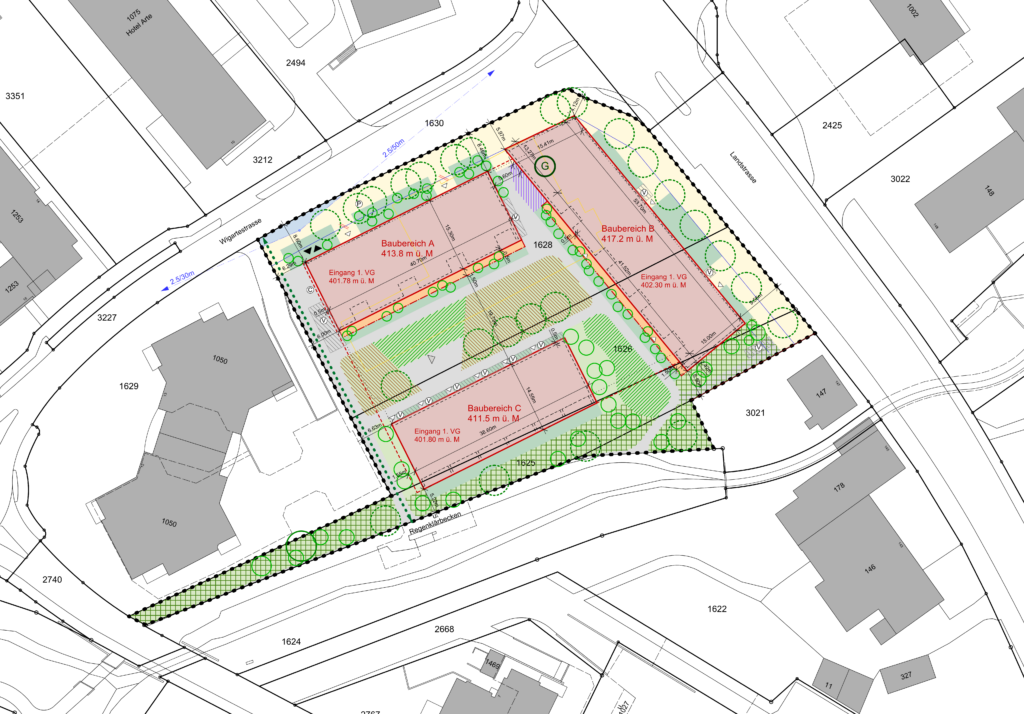
    The municipality of Spreitenbach can realise the Vinea design plan for the construction of flats at the entrance to the village. The Department of Construction, Transport and Environment(BVU) of the Canton of Aargau has approved the design plan, according to a press release. It forms the planning basis for the realisation of a development with around 37 flats on the previously commercially used site south of the Landstrasse and Wigartestrasse junction.

    According to the municipality, the planned development comprises three buildings. A four-storey building is to be constructed along Landstrasse, a three-storey building on Wigartestrasse and a two-storey building directly facing the village stream.

    A traffic-free inner courtyard is to be created between the buildings, which will be available to residents. The underground car park is intended to increase the quality of living and contribute to sustainable development.

    Vinea is based on the indicative project by Hunziker Architekten AG in Baden-Dättwil and SKK Landschaftsarchitekten AG in Wettingen AG. Metron AG in Brugg AG drew up the design plan together with the client and the municipality of Spreitenbach. The Vinea site is currently built on with a commercial development. A development study was prepared by Hunziker Architekten back in 2018. After weighing up various options, the municipality decided in favour of a longitudinally oriented development along the road in order to “create optimal urban planning conditions”.

  • Renewable energy on contaminated soil

    Renewable energy on contaminated soil

    Energy supplier AEW has built a ground-mounted photovoltaic system in Spreitenbach. According to a press release, the newly built solar plant went into operation in September 2024 and was officially opened on November 26. Its installed capacity is 622 kilowatt peak. According to the press release, this could supply 140 households with solar power per year.

    The project is AEW’s first ground-mounted system. The energy supplier is thus temporarily using a previously contaminated plot of land at the Spreitenbach site, which became an open space when the old open-air switchgear was dismantled. It was previously contaminated by foundations, shafts and cable systems, according to the statement. “Brownfield and previously contaminated areas can be used sensibly on a temporary basis to make a significant contribution to the Energy Strategy 2050,” René Wüst, Project Manager at AEW Energie AG, is quoted as saying.

    The decision was also supported by the fact that the system, which comprises 1414 solar modules, requires less maintenance during operation and is less susceptible to faults. If the grid needs to be expanded in the future, for example to include a storage system, it can also “simply be reused, as the photovoltaic system is very easy to dismantle”.

  • Spreitenbach community centre opens on 12 August

    Spreitenbach community centre opens on 12 August

    The construction of the new community centre in Spreitenbach is on schedule, according to a media release. The new building is to be presented to the population in an opening ceremony on Saturday, 12 August, between 11 a.m. and 4 p.m., according to the latest news from the negotiations of the municipal council. The interior work is currently underway. For this purpose, the floor coverings are currently being laid, the carpentry and metal construction work as well as the painting work are being carried out and the commissioning of the building services is being prepared.

    The handover of the new community centre will take place punctually at the end of June 2023, as planned in the schedule. The administrative departments are scheduled to move in at the end of August 2023.

    The building loan of 13.65 million Swiss francs for the new building was approved at the municipal assembly on 26 November 2019. The ground-breaking ceremony took place in January 2022. fsp Architekten from Spreitenbach, who were responsible for the construction, explained at the time that the new administration building was designed for a population of 15,000. When the old municipal building was built in 1964, Spreitenbach still had around 9,000 inhabitants. Today it has over 12,000.

    The municipality of Spreitenbach has been supporting the Spreitenbach Adult Education Centre with a contribution for years, according to a separate statement. The municipal council, with the participation of the local citizens’ commission, has increased the contribution for the year 2023 to 7500 Swiss francs. Within the framework of the 2024 budget, the annual contribution is to increase to 10,000 francs.

  • Umwelt Arena presents "Building 2050 Urdorf".

    Umwelt Arena presents "Building 2050 Urdorf".

    The Swiss environmental arena has presented its latest future energy policy project, “ Building 2050 ”. According to the press release , the pioneering project in Urdorf shows how, thanks to the use of the latest building technology, residential developments can already become a CO2-neutral power plant in which tenants can live within their own energy budgets without electricity and heating costs.

    The Umwelt Arena is presenting all of these innovations in the new exhibition “Bauen 2050” in Spreitbach from mid-July 2022 with a construction documentary and interactive elements relating to modern construction.

    The pilot project in Urdorf is referred to as a “power house”. The building by René Schmid Architekten AG Zurich shows that surplus solar energy from the summer can be used to produce renewable, non-fossil gas for the winter using photovoltaic systems on the roof and facade. There is also a wind-solar small power station. The facade and roof insulation protects the house against cold and heat. In midsummer, excess heat can be withdrawn from the apartments and used to heat the water. The rest is stored in the ground via the geothermal probes.

    The excess electricity from the summer is used to produce hydrogen in a power-to-gas plant. It is temporarily stored in the existing gas network for the winter.

    The house in Urdorf shows the residents their daily current consumption level in order to control their personal energy budget. There are sun blinds that can be controlled depending on the weather, energy-efficient, networked household appliances of the highest efficiency class and showers with heat recovery as well as CO2-controlled comfort ventilation. Even when using the lift, the braking energy produces electricity.

  • Nanux brokers real estate digitally and anonymously

    Nanux brokers real estate digitally and anonymously

    Nanux AG designs real estate transactions fully digitally and therefore anonymously. According to a press release, the young company based in Spreitbach, founded in June 2021, offers a new digital platform and anonymously brings investment properties to real estate investors or private buyers. So far, such objects in Switzerland have only been sold via the owner’s networks. Buyers found the offers almost exclusively in this way. Nanux is now digitizing the entire process from the advertisement to the appointment with the notary. According to Nanux, this off-market area for real estate is a niche with a future.

    Viviana Gujer, CEO and founder of Nanux, even speaks of the beginning of a new trading era in the Swiss economy. “Despite the exclusivity of this form of trading, thanks to digitization we are reaching more owners and are thus giving a new boost to the almost dried-up real estate market,” Gujer is quoted as saying. “Our trading partners are particularly impressed by the fact that they enjoy complete anonymity. We only show properties to pre-vetted buyers and therefore do not scatter the offers on the market.”

    Nanux gives owners and investors access to a closed platform. According to the notification, your data will not be published. They also have no direct contact with buyers or sellers.

  • Hächler rebuilds Spreitenbacher Waldhütte

    Hächler rebuilds Spreitenbacher Waldhütte

    Hächler AG from Wettingen has rebuilt the forest hut belonging to the municipality of Spreitenbach, which had become dilapidated due to subsidence. From spring onwards, the forest hut will again be available to citizens for festive occasions with 40 seats, according to the press release . There is a new hall with a fitted kitchen and an open fireplace both inside and outside.

    The new building in the middle of the forest on Heitersberg became necessary because of subsidence. The forest hut was built in 1968 and renovated in 1990. According to the Hächler Group, the municipality of Spreitenbach decided to rebuild the popular forest hut due to the subsidence of the ground by around 20 centimeters. In May 2020, the timber construction department at Hächler AG was awarded the contract to build the new forest hut.

    According to a report submitted by Günter Ebner, Head of Timber Construction at Hächler, the replacement building in timber element construction in the Neuenhof workshop was prefabricated in the same dimensions as the old hut. The finished wall elements with built-in electrical preparation and cutting of the roof components were produced in just three weeks. The shell assembly in the forest on the Heitersberg was carried out with millimeter precision using the company's own truck crane. The inner wall surfaces made of multi-layer panels in spruce and fir were protected from moisture during assembly. According to the Hächler report, only ecological and sustainable building materials were used.

    The materials are technically state-of-the-art and enable a comfortable room climate as well as heat, cold and noise protection. The combination of vapor-permeable and multi-layer materials with good soundproofing properties would have made this concept of the forest hut a really great project, construction manager Ebner is quoted as saying.

    21 cubic meters of domestic spruce wood, 45 cubic meters of mineral insulation and 450 square meters of multilayer wood panels were used for the supporting structure.

  • “Tivoli Garden”: An identity-defining project

    “Tivoli Garden”: An identity-defining project

    A look back: The major project in Spreitenbach is marked by years of delays. For example, VCS Aargau defended the project in 2012 and submitted an objection. He demanded an expansion of the environmental impact assessment, which covers the entire area, including the shopping center.
    rums “Shoppi Tivoli”, the Limmatpark and the parking spaces available to the “Shoppi Tivoli” in the environmental arena. After the revised design plan, the VCS filed another complaint, this time because of the parking space management, which did not go far enough for the traffic club. Those involved were finally able to agree on a compromise solution in January 2019 – and nothing stood in the way of the project.

    Identifying feature
    With the “Tivoli Garten” development, five houses with a total of 445 rental apartments, a double kindergarten, an Obi hardware store and a stop for the Limmattalbahn are now being built in the immediate vicinity of the “Shoppi Tivoli” shopping center. The proposed mix of apartments consists of 1½ to 5½ room apartments. The generous private outdoor spaces are intended to meet the needs of the various tenant groups, i.e. families, singles and pensioners, for example.

    Base construction with two towers
    The superstructure consists of a base building with the Obi hardware store and the Limmattalbahn stop, from which two high-rise buildings and three up to seven-storey long buildings extend. The project managers emphasize that the two high-rise buildings act as an identity-defining feature of the development. They also interact with the two existing high-rise apartment buildings in the “Shoppi Tivoli” area from the 1960s. The spacious outdoor areas are located in the private courtyard of the "Tivoli Garden". Eiffage Suisse, Zurich office, was entrusted with the implementation of the major project. Solid construction strives for the Minergie / greenproperty standard.

    Direct access to the "Shoppi Tivoli"
    A public pedestrian level with direct access to the “Shoppi Tivoli” is planned on the base building. The passerelle concept of the municipality of Spreitenbach allows further connections to the surrounding parcels at this level, and at street level a new transfer hub for public transport with the Limmattalbahn and various bus routes is designed.

    The major project was developed jointly by the Migros Aare cooperative and Credit Suisse Asset Management. The owner is MEG Tivoli Garten, which consists of two real estate funds from Credit Suisse Asset Management. ■