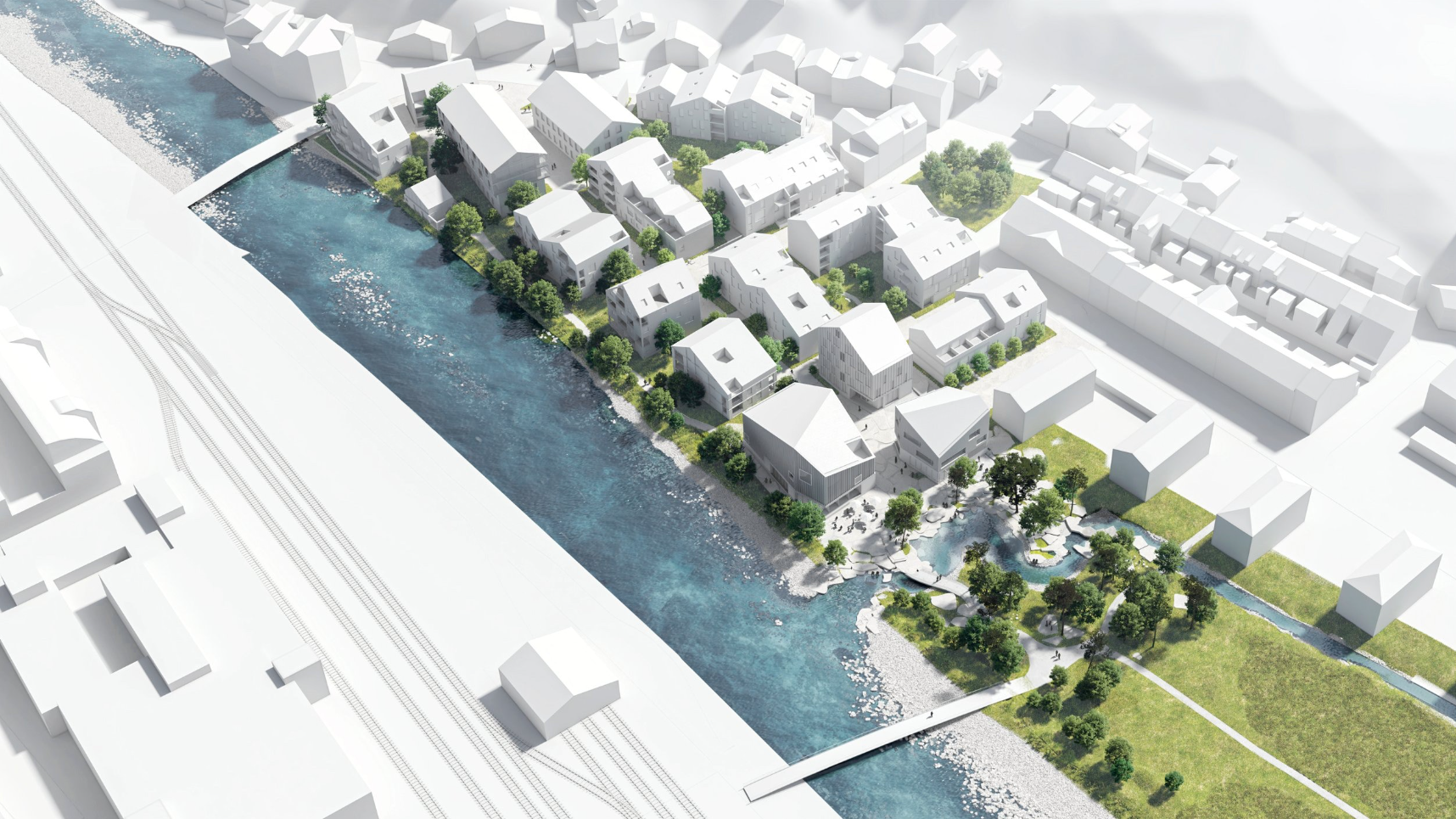
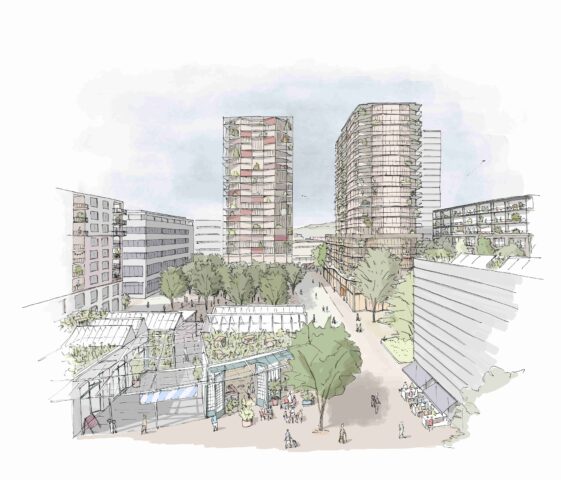
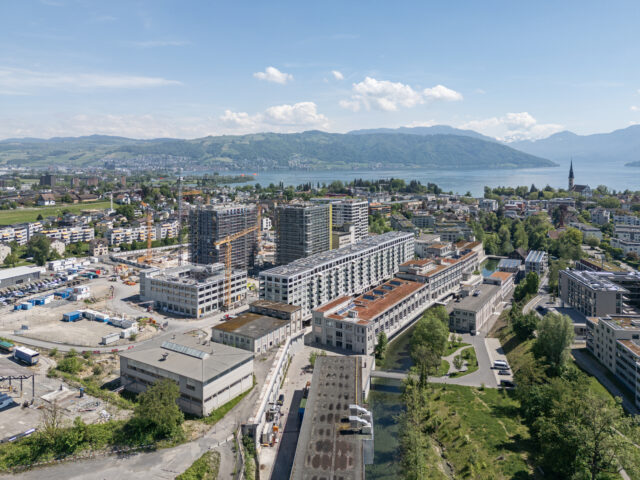
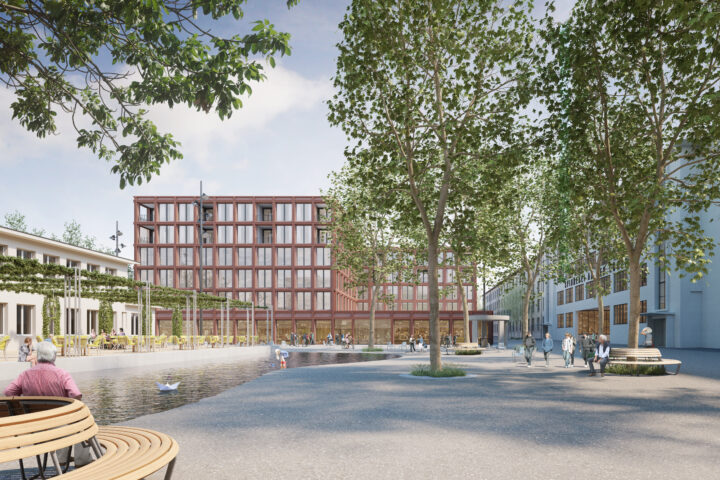
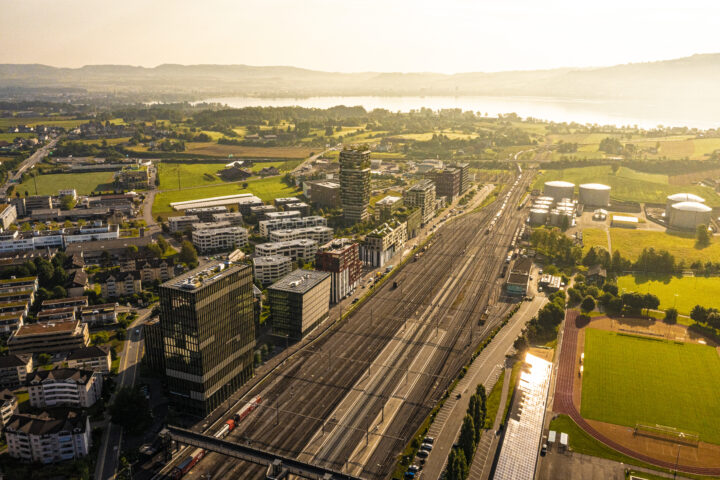
The Kartoni neighbourhood shows how visionary urban development can succeed. On a former industrial site, a green residential neighbourhood with around 150 flats is being created, complemented by service and cultural facilities. What still exists as a planning sketch today will develop in several stages into a diverse living space that is open to all generations and lifestyles. The historical backdrop of Glarus will not only form the framework, but will also be further developed through modern architecture and sustainable construction methods.
Town and country reconnected Glarus is more than just the canton’s capital, it is a way of life. Only an hour away from Zurich or St. Gallen, Glarus offers urban density and natural recreation at the same time. The Kartoni neighbourhood reinforces this quality. It builds a bridge between the district of Ennenda and the town centre, creating new paths and meeting places both spatially and socially. The municipal merger that took place in 2011 thus takes on a tangible architectural dimension.
Water as a connecting element In future, the Linth will become the lifeline of the neighbourhood. Where previously sealed surfaces dominated, a public riverside space with direct access to the water is being created. The renaturalised canal interweaves with the river landscape and creates a playful counterpart to the structured design of the nearby Volksgarten. The area becomes a meeting place for walks, relaxation and shared experiences.
Car-free garden neighbourhood The Kartoni neighbourhood relies on an underground solution for mobility. Directly after the Linth Bridge, an access road leads to a spacious underground car park, which means that the entire neighbourhood remains car-free above ground. The result is a garden neighbourhood that is open, green and criss-crossed by paths. The car-free design not only promotes peace and safety, but also sends out a strong signal in favour of a new way of living together in densely populated areas.
The courage to take stages and a plan with a vision The development of the neighbourhood does not follow a rigid timetable, but reacts flexibly to political, economic and social conditions. Several planning strands are currently running in parallel: from the Hängg Tower to residential areas and the integration of a music school. The already approved development plan is being adapted to new requirements, particularly in relation to the neighbouring Dorfbach project in Ennenda.
The new service agreement between the city of Winterthur and the House of Winterthur provides for an adjustment of the organisation’s tasks. The House of Winterthur should focus on strengthening the Winterthur Switzerland brand and on the strategic marketing of the location for business, education, culture and tourism, according to a statement from the city.
This includes making the hidden champions among the companies and the diversity of the local business landscape visible. Innovation and knowledge transfer are to be strengthened through targeted networking and new event formats, among other things. The House of Winterthur will also actively support start-ups.
Operational location promotion, on the other hand, will once again be the responsibility of the city. This includes company relocations, portfolio management and space brokerage.
The city intends to support the House of Winterthur with CHF 760,000 per year between 2026 and 2029, CHF 100,000 per year less than before. The final say lies with the city parliament.
In a statement, the House of Winterthur recalls that the city’s contribution was CHF 960,000 per year when the organisation was founded in 2017. Beat Schwab, President of the House of Winterthur, which is organised as an association, refers to the new management and other changes in personnel. “There is a spirit of optimism at House of Winterthur,” he is quoted as saying in the press release. “It would be a shame if excessive pressure to save money were to jeopardise this development and seriously impair the sustainable promotion of the location as well as the management of company relocations.”
The association is supported by the city, the neighbouring municipalities and over 400 members.
While space is still available in the countryside and construction processes are often less complicated, the urban reality is characterised by density requirements, regulations and lengthy approval procedures. Communication channels are shorter in the countryside and processes are more direct. In cities, on the other hand, complex projects such as “The Circle” at Zurich Airport require sophisticated coordination and patience.
Skills shortage knows no boundaries Whether rural or urban, the struggle for qualified apprentices is noticeable throughout Switzerland. It is worth noting that young people from rural regions are often more adept at manual labour. Not least because they come into contact with practical work at an early age. Nevertheless, recruitment remains a challenge, especially in urban areas where academic or commercial careers dominate.
Regional roots as a success factor Whether traditional family businesses in Schwyz or locally anchored construction companies in Thurgau, the construction industry remains a strong pillar of the regional economy in both cantons. In the countryside in particular, master builders are not only economically active, but also socially active, as members of associations, presidents of event organisers and promoters of local life.
Objections slow down progress everywhere Rural idyll does not protect against legal hurdles: Even outside the cities, construction projects are regularly delayed by objections. The call for a clearer, faster and legally secure procedure is growing louder. Long overdue from a practical point of view.
Different starting points for the order situation While the canton of Schwyz is currently recording a solid order volume with growing construction activity and large projects, the situation in Thurgau is tense. Non-essential investments are being postponed there to save money, with a direct impact on local construction companies.
Focus on sustainability and quality The requirements for new buildings are changing rapidly. Energy efficiency, sustainability and climate-friendly construction dominate project requirements. At the same time, time pressure on construction sites is increasing, while legal complexity is growing. The industry’s desire for more quality instead of price dumping and a return to long-term, sustainable values.
The cantonal structure plan regulates the main features of the desired spatial developments. It sets out in text and on maps how the cantons and municipalities should develop.
The need for more affordable living space is recognised by politicians and the canton: In addition to “conventional” flats, flats for families, affordable flats and flats for the elderly are also being built in the various areas.
A wide variety of site developments are taking place across almost the entire perimeter of the “valley communities”. In addition to the sites, the traffic situation is also being further developed and adapted to the increased utilisation: Examples range from the conversion of bus stops to bypasses to relieve the burden on Cham town centre. This also includes car-sharing concepts, such as at the Papieri site in cooperation with AMAG.
A lot is also happening in public transport. In future, the Papieri site in Cham is to receive an express bus via the bypass motorway and the Unterfeld Süd site will have a bus stop in the neighbourhood.
Sustainability plays a decisive role in new projects in particular. The Zug area plays a pioneering role in this respect. The Papieri site in Cham was honoured with the prestigious Watt d’Or award from the Swiss Federal Office of Energy. This emphasises the site’s initiative in the field of renewable energies. A climate-neutral district is being created here that relies entirely on renewable energy sources and covers 75% of its energy requirements on site. The innovative technologies contributing to the high level of energy self-sufficiency include hydroelectric power plants and photovoltaic systems. Geothermal energy is used for heating and cooling.
The sustainability certificate, awarded by the Swiss Sustainable Building Council to Suurstoffi in Rotkreuz, recognises the sustainable construction methods and holistic planning of the project. The award proves that the highest standards in terms of energy efficiency, mobility and biodiversity have been met. The projects show that Zug not only assumes ecological responsibility, but also serves as a model for forward-looking urban development in Switzerland. By utilising innovative concepts and technologies, the canton of Zug is positioning itself as a pioneer in the sustainable design of urban living spaces.
The other sites are also impressive. The construction of a high-rise building in timber construction is planned on the Tech Cluster site. The “lighthouse project” called “Project Pi” envisages the construction of an innovative residential tower block. With a height of 80 metres, the plan is to build one of the tallest timber high-rises in Switzerland with affordable flats.
Baar – Unterfeld Süd A mixed-use neighbourhood with around 400 residential units and around 1,000 workplaces is planned for the Unterfeld Süd area. The basic structures were defined by representatives of the population of Baar together with experts under the leadership of the municipality. The development plan for the first of three construction phases was put to the people of Baar for a vote on 22 September 2024. The plan was approved with 74 per cent of votes in favour.
The realisation of the first stage includes the high-rise building at the Baar Lindenpark light rail station and the neighbouring commercial building. These will be transferred to a joint development plan. The earliest possible start of construction of the first stage is planned for 2025. The remaining building plots will be developed in parallel and realised in subsequent construction phases. According to current planning, Implenia’s project will be completed in 2029, provided the subsequent plans are approved by the relevant authorities and construction proceeds according to plan.
Hinterberg South (Städtler Allmend) The Hinterberg Süd site in the Städtler Allmend employment area in Cham will become a new, lively and easily accessible working and shopping centre for the local population. It offers attractive space for new companies to set up shop and ground-floor uses for the neighbourhood. The upper floors of the office buildings offer flexible spaces that can be customised to the individual needs of future companies.
Publicly accessible uses such as a restaurant, café or bakery are located on the ground floors. They offer workers, shoppers, visitors and passers-by various consumption options and contribute to the revitalisation of the area and the entire neighbourhood. The four buildings surround a public square – the actual centrepiece of the site, which is open to the general public as a place to meet and spend time.
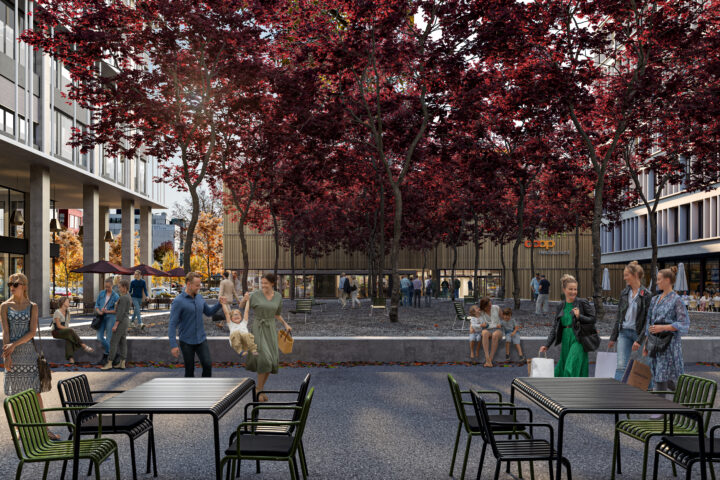
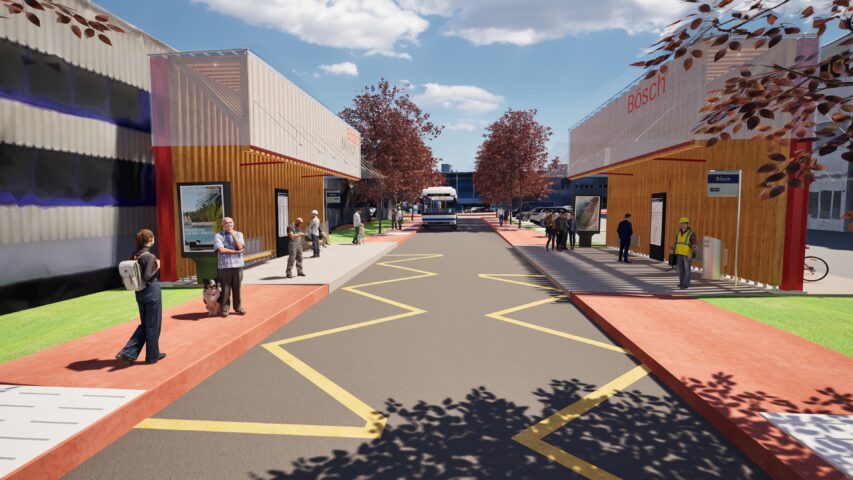
Bösch Hünenberg In order to meet the requirements of a growing service and commercial area, the infrastructure needs to be adapted. The Bösch area should become more attractive for workers and companies and offer space for 6,000 jobs in future. This densification is provided for in the cantonal structure plan. It is binding for the municipality of Hünenberg. The vision is for the Bösch area to develop into a modern and urban place of work that is attractive to investors. To this end, space is to be created through structural densification, which can also lead to an increase in jobs. A holistic landscape design and well-organised mobility will ensure a better quality of life in Bösch. New leisure, supply and catering facilities ideally complement everyday working life in Bösch. On 9 December 2024, the municipal assembly will decide on the road credit of CHF 2.9 million to finance the first stage of the implementation of the operating and design concept in Bösch.
LG Zug Due to its size and prominent location, the LG site is of central importance for the urban perception and urban character of Zug. A lively urban district with a convincing architectural design is to be created on the site of the former industrial area. With the necessary development plan, the planning and building law of the Canton of Zug ensures high-quality development and realisation.
Papieri Cham The Cham Group is developing a new residential and working neighbourhood with industrial charm on the Papieri site. Directly on the River Lorze, the distinctive existing buildings of the former paper factory are being supplemented with striking new buildings and realised in a sustainable way. A new meeting place with supra-regional appeal is being created here, where past and present go hand in hand. A new urban district with around 1,000 flats and 1,000 jobs is being built in several stages over eleven hectares on the site of the former paper factory. It is not being built on a greenfield site, but in the midst of buildings steeped in history: The conversion of characteristic existing buildings preserves the connection to the past – the industrial roots of the neighbourhood remain tangible.
They are complemented by striking new buildings, including five tower blocks with impressive views. The new neighbourhood directly on the Lorze offers an attractive mix of commercial space, flats, lofts, workplaces, studios, open spaces and public-oriented uses. All of this on a sustainable and well-balanced site that maintains – and continues to write – its own history.
The Papieri site creates new foundations for an energy-efficient, climate-neutral and sustainable society. It is a pioneering project throughout Switzerland.
Spinning mill on the Lorze Many threads once ran together in the largest spinning mill in Switzerland. The construction of the spinning mill on the River Lorze shaped the development of Baar in the middle of the 19th century. A new, lively neighbourhood with shops, cafés and other local businesses is being created around the historic spinning mill building, which characterises the public pedestrian zone. In addition to family flats and affordable flats, there will also be flats for the elderly. These will be complemented by vegetable gardens, green façades and shady trees.
Suurstoffi The Suurstoffi site was the first site in Switzerland to be awarded the DGNB platinum certificate for sustainable neighbourhoods in planning and construction by the Swiss Sustainable Building Council (SGNI). The DGNB certification confirms that Zug Estates has realised a prime example of sustainable site development with the Suurstoffi site in Rotkreuz. It meets the comprehensive quality requirements of the DGNB certification system, which includes criteria such as energy efficiency, CO2 emissions, life cycle assessment, grey energy, flexibility of use and recyclability of the materials used. The Suurstoffi site is one of the first lighthouse projects of the last 10 years. This also includes the “XUND” health education centre, for which one of the last buildings is currently being completed.
Tech Cluster From June 2018 to May 2019, five renowned Swiss and one Austrian team took part in an overall performance study to explore how affordable living in a high-rise building can be made possible using state-of-the-art construction methods and sustainable materials. At the same time, a study contract was drawn up for an overall urban development concept for the surrounding area of the city of Zug between Baarerstrasse, Göblistrasse, Industriestrasse and Mattenstrasse.
The Tech Cluster Zug builds on the preliminary investments made by V-Zug and other companies in the Metall Zug Group. Its potential lies in the diverse relationships and synergies between the future users. These will transform the current factory site into an innovative and exciting part of the city of Zug.
Located within the Greater Zurich Area (GZA), Zug is one of the world’s leading economic regions. The location boasts an excellent infrastructure, great potential for young talent and political and economic stability.
Both the municipalities and the canton of Zug are constantly evolving and adapting to the requirements. With innovative projects, such as a bypass to relieve congestion in the centre of Cham, lake water that will regulate the temperature in the houses in residential areas in the future and exciting projects, such as the Association for Decarbonisation or the Climate Charter Zug, the canton is shaping a modern image with ambition.
Numerous areas of historical significance are being renovated and converted to create attractive mixed-use developments comprising residential, work and commercial space.
As a result, Zug remains a canton worth living in, which is also reflected in a high level of life satisfaction.
Zug is not only appreciated by its 133,000 residents, numerous independent ratings and studies also confirm Zug’s outstanding position. For example, Zug has been ranked first among the Swiss cantons in the Credit Suisse and UBS rankings for 24 years. The basic principles of business friendliness, service orientation and a culture of innovation make the canton of Zug an ideal partner for companies, educational institutions and research institutes.
Testimonials
Andreas Klopp General Manager Roche Diagnostics International AG
“Rotkreuz is located in the Zurich-Zug life sciences cluster and offers ideal conditions for driving innovation thanks to its excellent infrastructure and high quality of life. For over 50 years, Roche in Rotkreuz has been contributing to the health of patients worldwide with diagnostic solutions.”
Dr Katja Buller Vice President, Head of Corporate Affairs International, Biogen
“Local and international specialists, “Local and international specialists, a multi-layered infrastructure and professional cooperation with the authorities have made the canton of Zug the ideal location for our international headquarters for more than 20 years”
Katharina Gasser President of the Zug Chamber of Commerce
“Our members appreciate the business-friendly conditions in the dynamic and innovative Canton of Zug. The authorities are service-orientated, make decisions quickly and work efficiently; the unique “spirit of Zug” is palpable.”
Hanspeter Rhyner Chairman of the Executive Board, Zuger Kantonalbank
“Zuger Kantonalbank combines tradition and modernity. This is precisely the DNA of the attractive location of the Canton of Zug. Digital AND personal – this is how we meet the needs of our customers in line with this DNA. And we can fulfil all needs and accompany you through life.”
The city council is pursuing the goal of freeing the banks of the Rhine from motorised traffic and transforming it into a lively centre for leisure, living and business. This redevelopment offers Schaffhausen a unique opportunity to sustainably improve the quality of life in the city and promote tourism at the same time. The focus is on the expansion of green and open spaces as well as new housing and jobs.
The development strategy includes concrete steps to realise this vision, building on the results of an urban planning study and public consultations.
Step-by-step implementation in sub-projects The implementation will be realised in several sub-projects over a period of twelve years until 2036. The sub-projects include the new connecting road, the development of the Gaswerk site and the upgrading of the Rhine embankment promenade. This division allows for gradual realisation and creates planning security for all parties involved. Interim utilisation is planned for the Gaswerk site until construction begins.
High added value with manageable investment The project requires public sector investment totalling around CHF 35 million, of which the city will bear around CHF 22 million. The remaining costs will be co-financed by the federal government and the canton. Private investment in residential and commercial space significantly increases the economic benefits of the project and promotes urban development.
Fundamental decision and framework conditions In order to implement the project efficiently, a fundamental vote is proposed. At the same time, all operational decisions will be delegated to the City Council in order to minimise the implementation risk and increase planning certainty.
The City Council has defined clear framework conditions, including an amicable solution for the water sports clubs, the promotion of biodiversity and the urban climate and the creation of a balanced mix of charitable and non-charitable housing on the Gaswerk site. In addition, potential studies are being carried out to clarify the economic feasibility of catering and commercial uses.
With the redesign of the banks of the Rhine, Schaffhausen is opening a new chapter in its urban development – towards a more sustainable, liveable and economically stronger future.
The circular economy is an important lever for achieving the political net-zero targets. Like many other cities around the world, Zurich is also committed to the circular economy: in 2022, a strategy for the circular economy was adopted with “Circular Zurich”. in 2023, Zurich became the first Swiss city to sign the “Circular Cities Declaration”.
The intelligent use of resources is particularly important in construction. With the “Charter for Circular Construction”, politicians and businesses set an example in 2023 and made a joint commitment to conserving primary resources and landfill space and reducing CO2 emissions from their own construction activities.
Initial findings from two pilot projects But how do the political commitments affect specific construction projects? What challenges does circular construction pose? And how are the planning and construction processes changing? The City of Zurich’s Office for Buildings is gaining answers to these questions through two pilot projects.
The city gained initial experience with the procurement, storage and processing of reused building components during the renovation of the Mööslistrasse 2023 kindergarten (Bischof Föhn Architekten, Zurich). Washbasins and toilets were dismantled, cleaned and refurbished on site. Plant troughs from the balconies were reused as outdoor space boundaries. Where possible, the built-in furniture was sourced from the city’s own stock. Thanks to component screening, steel beams, wooden pergolas, fire doors and kitchen elements from other buildings were identified, dismantled and reinstalled. So-called “component hunters” were deployed for everything that was not found in the city’s used parts warehouse.
The second pilot project, the new “Juch-Areal” recycling centre, is much more comprehensive. The Office for Buildings launched an architectural competition with re-use requirements for the project in 2022. The competition participants were able to use a digital catalogue of components or use other available components from non-urban sources for their designs. The buildings also had to be designed in such a way that they could later be used as a component mine themselves (design for disassembly).
The projects submitted show that it is possible: Yes, it is possible. The jury was particularly impressed by the high quality of the competition entries, which were created despite – or perhaps thanks to – the new specifications. The building material of the winning project by Graber Pulver Architekten AG (Zurich) dismantles the hall of the previous recycling centre and rebuilds it at the new location with only minor adjustments. Disposed books, magazines and clothes are used as insulation material. Sheets of recycled glass and aluminium, old kitchen covers, doors and table tops protect the façade from the weather. Discarded scaffolding is turned into storage shelves.
It is in the nature of things that pilot projects precede a standardised introduction on a broad scale. This is also the case with circular construction. The realisation of the two projects in Zurich shows that many questions still need to be clarified: How can components be catalogued? How can availability be checked? Where will they be stored? Who assumes legal liability?
The planning and construction processes will change as a result of cycle-orientated construction, because the component mines must be known as early as possible, preferably at the beginning of the planning phase. Building Information Modelling (BIM) facilitates the reuse of components, the planning of their dismantlability and the development of future component mines.
Significant savings in indirect greenhouse gas emissions in the pilot projects The pilot projects show that this approach is worthwhile. According to a subsequent calculation, the consistent reuse of building components saved a good 30% of greenhouse gas emissions during the renovation of the Mööslistrasse kindergarten. Current calculations even predict a 40% saving in greenhouse gas emissions for the Juch-Areal recycling centre compared to a conventional new building.
Night-time thermographic flights are used to analyse the entire urban area from the air in order to create a 3D thermal imaging model of the urban infrastructure. This model is intended to provide valuable insights into the energy efficiency of the buildings and provide property owners with exclusive data about their buildings. The aim is to precisely determine the need for refurbishment by recognising insulation weaknesses.
The flights are part of the CATCH4D research project, which focusses on climate adaptation through thermography and heat mapping. This research initiative, led by the Institute for Regional and Urban Development Research in cooperation with the City of Dortmund, uses aerial thermography to assess the condition of urban building insulation and identify acute renovation needs.
The images not only provide a basis for effective climate protection measures, but also open up the possibility of extensive applications. The spectrum of possible uses ranges from monitoring forest fires to estimating the yield of solar installations. Data protection is a top priority: Personal data cannot be captured due to the image resolution.
The project, financially supported by Google.org, demonstrates the importance of interdisciplinary collaboration for urban development and climate protection. The combined 3D thermographic aerial images, which were developed in collaboration with Anhalt University of Applied Sciences, enable a new dimension of data collection and analysis for the property sector and urban planning.
The STEK 2035 identifies the core themes of urban development and organises them into five strategic areas: Living, working, mixed-use areas and centres, landscape and open spaces as well as urban space and mobility. Specific measures and fields of action are identified for the implementation of these strategies.
The strategy is designed as a steering instrument for urban development. It serves as a basis for future neighbourhood, area and landscape developments, for the coordination of settlements and transport and for the careful and attractive design of public spaces and open spaces. It also forms the basis for the revision of the basic building and planning regulations (revision of the building regulations and the zoning plan).
The “Housing” strategy shows Thun a clear way to make the future housing supply attractive, diverse and contemporary and to revitalise neighbourhoods so that a good social mix can be promoted. This involves identifying areas with particularly high development potential and others where the focus is on preserving historical and particularly valuable qualities.
As the eleventh largest city in Switzerland with a population of around 45,000, Thun is enjoying growing popularity. This is not least due to the many green spaces and the special character of the city. The different atmospheres of the neighbourhoods create a unique cityscape that harmoniously combines urban, suburban and rural elements.
The “Working” strategy creates the framework conditions for the further development of trade, industry and work. With a view to stronger development in the service sector, the city places particular emphasis on mixed areas that offer space for both housing and jobs. Certain areas are explicitly earmarked for labour-intensive uses or even the military. The city of Thun plays an important role as a regionally significant employment location for both the surrounding municipalities and the entire Oberland region.
Another building block of Thun’s urban development is the “Mixed areas and centres” strategy. The focus here is on making the city centre more attractive. Mixed-use areas that combine living, working and leisure are of central importance. Thun’s city centre, with its good accessibility and concentration of services, forms the heart of the city and is a model for other diverse and lively mixed-use areas. To complement the city centre, attractive secondary centres are being promoted and existing supply locations developed in a targeted manner. At the same time, Thun attaches great importance to strengthening the neighbourhood centres, which are indispensable for providing the population with basic services.
The “Landscape and open spaces” strategy underlines the desire to strike a balance between settlement development and the protection of ecologically valuable areas. The preservation of cultivated land, the protection of habitats and access to green spaces take centre stage. Particular attention is paid to the networking of green spaces in order to preserve nature and protect special landscapes such as Strättlighügel or Haslimoos.
To summarise, it can be said that the importance of public green and open spaces in the midst of high-quality inner-city development is steadily increasing. The STEK 2035 emphasises this and considers open spaces to be indispensable for high-quality urban development. This supports Thun’s aspiration to be a sustainable and liveable city with a comprehensive quality of life.
Among other things, Sevcik proposes so-called neo-areas. These should close gaps between settlement areas. For example, a campus on part of the marshalling yard could offer space for a Hochschule Limmat, a computer centre, but also a congress and entertainment centre. A new residential quarter could be built between Neuenhof and Killwangen, and a future-oriented quarter for new forms of living and working in the Tägerhard to the east of Wettingen. In the Hard in Siggenthal, too, a new district could combine work, living and leisure.
Sevcik points out that the Limmat has so far had little presence in the region. He suggests upgrading the river landscape in Dietikon to a riviera.
Economically, the future Limmat Valley city should rely on its strengths in applied technology and design, logistics and trade, as well as medtech and biotech. Mobility in the region should be facilitated by the extension of the Limmattalbahn, the use of the railway line between Dättwil and Wettingen, cable cars and the bicycle network. Sevcik also proposes a take-off site for vertical take-off electric helicopters at the Würenlos motorway service station.
Sevcik developed the strategy ideas on the initiative of the Limmatstadt Location Promotion Agency and presented them at the general meeting of Limmatstadt AG on 15 August. 20 companies, mainly from the region, supported the project. The publication can be ordered digitally.
But the Schlierefäscht has even more to offer – it is not only a festival of fun and celebration, but also an exciting platform for business and industry. A special highlight is the newly launched real estate meeting “Immobilien meets Limmattal” on Thursday, 7 September 2023 with exciting keynotes, panel discussions and exchange of experiences.
The half-day event will focus on the topic of “Limmattal site development”. It offers a unique opportunity to delve deeper into the development of the region and gain insights into the challenging interplay of architecture, urban planning and social aspects.
Be inspired by the latest trends, analyses and innovative solutions. You can expect exciting keynotes from renowned speakers such as Michael Hermann, Managing Director of sotomo, Fabienne Hoelzel, Professor of Urban Design at the State Academy of Fine Arts Stuttgart or Thomas Sevcik, CEO of arthesia, interesting insights into the areas of Dietikon, Schlieren and Spreitenbach as well as a lot of interesting information about electromobility, the property market and sustainability for areas.
Take the opportunity to make valuable contacts and get to know the Limmattal real estate industry. Register now and secure your ticket at the exclusive price of CHF 80 (instead of CHF 150) with the note “reader offer immo-invest”.
Real Estate meets Limmattal Thursday, 7 September 2023, from 2 p.m. Event tent, Pischte 52, Schlieren
The Lucerne through station is intended to eliminate bottlenecks in the Lucerne rail hub with new, underground approaches and an underground station. The project, which is currently in the planning phase, is intended to create capacity in today’s fully utilised railway system and thus enable new, more direct and faster rail connections in the future. “The underground station and the new, underground access routes will improve the accessibility and attractiveness of Central Switzerland,” says Massimo Guglielmetti, SBB overall project manager for Lucerne through station. “Without infrastructure expansion, further development of rail services in Lucerne is no longer possible.”
In the preliminary project, SBB presents the technical feasibility of the large-scale project, which consists of the sub-projects underground station, three-lane tunnel and Neustadt tunnel:
With the underground station, a total of 44 metres wide platform hall for four tracks will be built below the existing station. This will create more space at Lucerne station, which is currently used by around 100,000 passengers every day
The 3.8-kilometre-long three-lane tunnel will create an underground, direct line from Ebikon to Lucerne, crossing under the lake basin over a length of 400 metres. This second access removes the bottleneck situation in the railway network and enables more frequent and faster train connections
The 2.1-kilometre-long Neustadt Tunnel connects the underground station to the existing access road. This will enable through connections and eliminate the need for a majority of trains to turn around in the Lucerne terminus station
In order for the planned improved service to be of benefit to the whole of Central Switzerland, the railway infrastructure in the catchment area must also be expanded at certain points. In addition, parking facilities are needed outside Lucerne station to be able to park trains overnight and outside peak times
Lowering tunnel under the lake basin Compared to previous plans, a lowering tunnel is now planned for the subway of the lake basin. Five prefabricated elements of the tunnel tube will be lowered into the bottom of Lake Lucerne. This means that it is not necessary to drain the lake basin in sections. The environment and landscape are less affected. This construction method has never been used in Switzerland before.
The costs for the three project parts, the underground station, the Dreilinden tunnel and the Neustadt tunnel, are estimated at 3.3 billion Swiss francs. For the realisation, SBB expects a construction period of 11 to 13 years
Additional studies on howto proceed SBB is now clarifying possible implementation sequences for the major project on behalf of the Federal Office of Transport (FOT). The results should be available by the end of 2023. A decision will then be made on the next steps in the project. “All the work is going according to plan. I am convinced that the Federal Council will be able to present a well-studied and advanced project to parliament in 2026,” Anna Barbara Remund, FOT Vice Director and Head of the Infrastructure Division, told the media in Lucerne. The federal parliament will ultimately decide on the implementation
Great importance for Lucerne and Central Switzerland The expansion of the Lucerne railway junction is one of the most important infrastructure projects in the region. “Central Switzerland has been waiting for the urgently needed infrastructure upgrades at the Lucerne hub and in the direction of Zurich for 50 years,” held Cantonal Councillor Fabian Peter, Director of Construction, Environment and Economic Affairs and President of the Central Switzerland Public Transport Directors. “An attractive public transport offer is crucial if we are to be able to cope with mobility growth at all and handle it sustainably,” said Fabian Peter. “In order for the through station to unfold its full benefits, Central Switzerland expects it to be realised and financed from a single source.”
For the city of Lucerne, there will be the opportunity to make the space around the station attractive, to make the station more accessible and to increase the quality of stay. “The city will also work to ensure that the construction period of over ten years is as compatible with the city as possible,” said City Councillor Manuela Jost, Director of Construction. “Even during this time, open spaces must be preserved and the city centre must remain accessible.”sBB is planning the through station on behalf of the Federal Office of Transport. It is working with the canton and city of Lucerne, Zentralbahn, the Lucerne transport association and the cantons of Obwalden and Nidwalden, and is involving the LuzernPlus association of municipalities.
In 2023, the city of Winterthur will support a total of five innovative projects that can contribute to sustainable development and to increasing the quality of life in the city. For this purpose, the city is providing a total of 200,000 Swiss francs from the Smart City Winterthur innovation credit, informs the city administration in a corresponding statement. Since the launch of this credit, Winterthur has supported a total of 18 Smart City pilot projects.
This year, WinEnerGIS is one of the projects that can look forward to receiving funding. In this project, a prototype for a public information platform in the energy sector is being developed. Here, building-specific information on available energy sources will be made available. The project Together on the Trail of the City Climate integrates the population into Winterthur’s temperature measurement network.
In the Digital Mobility Lab API project, Stadtbus Winterthur and the Digital Mobility Lab of the Zurich University of Applied Sciences are working together. The aim is to develop an interface with which questions from practice can be solved with real data in the future. The first step is to optimise connections when changing trains.
The Winterthur@Metaverse project is looking into the question of beneficial applications for Winterthur in the Metaverse. If necessary, a first prototype will be developed in the metaverse. Finally, the RPA@DigiWin project is about digitising repetitive tasks of the city administration.
The Dietiker construction company Walo Bertschinger has completed the work on the landscaping of the new Westfeld neighbourhood in Basel. According to a media release on LinkedIn, this environmental project includes the entire outdoor space, plus a narrow Allmend area along Hegenheimerstrasse and part of the area surrounding the Felix Platter Hospital.
The surrounding project realised by Walo consists largely of publicly accessible areas. Beyond the site, the works complement the open space and footpath offer to connect and revitalise the neighbourhood. The work includes 23,000 square metres of terrain modelling, 8,000 square metres of paving, a fountain and seven tree troughs made of natural stone, the furnishing and all the work on the 2900-metre-long utility lines.
The forum now stretches between the newly built Felix Platter Hospital and the new Westfeld building and flows into the neighbourhood square in front of the converted hospital building. There is a “carpet” of natural stone slabs there. In contrast to the stone forum and the neighbourhood square, the neighbourhood garden, which has also been laid out, is mainly green and covered with trees.
Since 2015, a showcase project for a trend-setting residential building culture has been created around the old hospital, which has now been converted into residential space, according to Walo’s statement. More than 500 cooperative flats have been built on the approximately 35,000-square-metre plot, of which around 400 are on the part of the site earmarked for new buildings and around 130 in the converted hospital building. There is also space for neighbourhood uses, services and small businesses. The building cooperative wohnen&mehr has published a video clip on the project.
The Lucerne City Council is requesting a special credit of 5.05 million Swiss francs from the City Council for the conversion of the heating supply to 100 per cent renewable energy. In addition, a supplementary credit of 194,000 francs was requested for the 2023 budget. According to a press release, this is to finance the increase in staffing in the real estate department that is needed until 2034.
Additional staff percentages had become necessary because the voters of Lucerne had approved the city’s climate and energy strategy in September 2022. It stipulates that the city’s own buildings and facilities of the administrative assets, such as schools and administrative buildings, must be supplied with 100 per cent renewable energy by 2030.
Thanks to the increase in personnel in the real estate department, the conversion to renewable heat supply should be implemented by 2035 and the upcoming renovations of the properties in the financial assets can be managed. This is planned for a total of 39 properties.
With the conversion of the properties of the financial assets to 100 per cent renewable energy, the city council wants to set a good example for its own properties, according to the statement. The city will help with any interim solutions for tenants.
Alexander Carisch will be the new head of the Dietikon location promotion as of December 1st. According to a media release , Carisch convinced the city council at the September 5 meeting. His innovative spirit, his professional competence and his integrative communication were decisive.
As a former head of urban development and location marketing in the city of Baden and also as head of the location development department in the Canton of Schwyz Economic Office, Carisch has the right experience for the position, according to the statement from the city of Dietikon . Through his previous activities, the newly appointed head of Dietiker Location Promotion is also connected to the Limmattal.
The head of the Dietikon location promotion, Adrian Ebenberger, is retiring after four and a half years in office for reasons of age at the end of 2022.
The Dietikon location promotion submits semi-annual interim reports on activities in the areas of location promotion, economic development and city marketing. The most recently published report from June covering the period from November 2021 to April 2022 highlights the progress made in the Cleantech Hub Dietikon project, which started last autumn 2021, and in the Smart City Dietikon project as particular highlights of this work. Demand for commercial space remains high. There are regularly more rental requests than offers. The number of start-ups and liquidations is said to be relatively constant.
Construction work on Hamburg's district heating tunnel began on August 5, Implenia announced in a statement . The construction and real estate company from Opfikon is realizing the project on behalf of Wärme Hamburg . The 1.16 kilometer long tunnel will cross the Elbe about 2 kilometers west of the Elbe tunnel for the autobahn.
From the winter of 2024/25, this will be used to transport waste heat from industrial processes in the south to the north of the Hanseatic city. This is a requirement so that the coal-fired power plant in Wedel can be replaced by energy from the future Hafen Energy Park of Hamburger Energiewerke GmbH . "We are pleased that we can plan and implement this large and complex infrastructure project for the Hamburger Energiewerke and thus contribute to a sustainable energy supply in Hamburg," said Thomas Fiest, Head of Tunneling Germany at Implenia.
In the first construction phase, Implenia is constructing the start and target shaft with diaphragm walls 1.5 meters thick and 30 meters deep. Then a tunnel boring machine will bore the actual tunnel with a diameter of 4.55 meters. Access and operating equipment for the operation should be accommodated in the shafts.
Schritt für Schritt wird Urdorf-Nord zu einem dichten, lebendigen und bezahlbaren Raum für innovative, nachhaltige und lokale Lebens- und Arbeitsformen. Momentan ist Urdorf-Nord in einer Phase der baulichen Verdichtung und wird mit der Limmattalbahn verkehrstechnisch noch besser an Zürich und den Kanton Aargau angeschlossen. Die Stadt im Dorf ist bereits heute eines der wichtigsten Arbeitsplatzgebiete im Limmattal und hat mit der Kantonsschule und dem angrenzenden Limmattalspital eine starke Verankerung in der Bildung und Gesundheit.
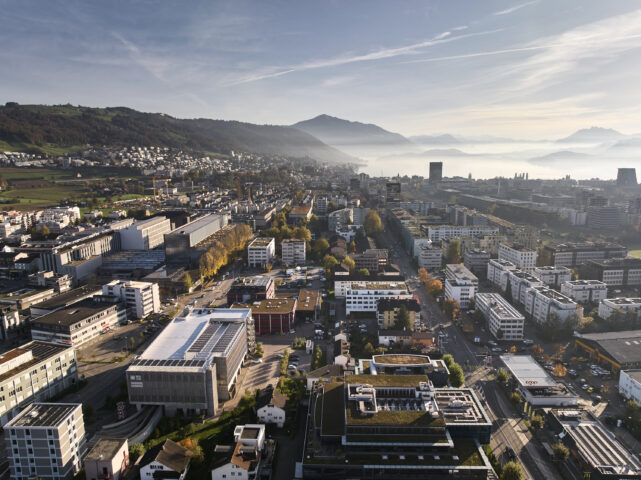
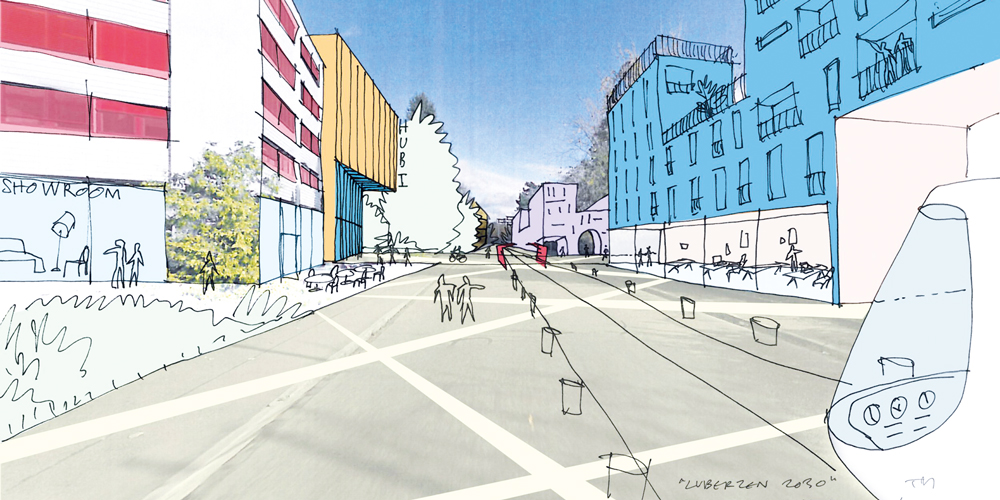
An die Kantonsschule angrenzend ist eine Zone vorgesehen, die neben innovativem Arbeiten auch urbanes Wohnen möglich macht. Die Strasse «In der Luberzen» soll zur Flaniermeile werden, und an einer der beiden Limmattalbahn-Haltestellen ist ein Platz vorgesehen, der Urdorf-Nord mit den umliegenden Quartieren verbindet. Die Nord-Süd-Verbindung schliesst an den zentralen Platz an, der die Achse weiter zur S-Bahn-Station Glanzenberg leitet. Von der Maisonette über das Loft bis zur WG-Wohnung, in Urdorf-Nord soll eine vielschichtige Wohnwelt entstehen, die ein urbanes Flair hat und gleichzeitig den Dorf-Charme nicht verliert. Urdorf-Nord gehört zu den wirtschaftlich interessantesten Gebieten im Limmattal und birgt ein hohes Potenzial bezüglich Arbeits- und Wohnqualität. Die Stadt im Dorf ist topografisch wie auch verkehrstechnisch das Entrée Urdorfs im Limmattal und kann damit eine Leuchtturm-Funktion einnehmen, um innovative und zukunftsorientierte Unternehmen anzusiedeln.
In Urdorf-Nord (www.urdorfnord.ch) soll aber nicht nur gearbeitet, sondern auch gelebt werden. Die Entwicklungsstrategie sieht vor, eine gute Balance zwischen innovativer Unternehmenskultur und urbanem Wohnen zu ermöglichen. Das Ziel ist klar: In einer umsichtigen Struktur werden sich Wohnen und Arbeiten attraktiv ergänzen, und so ergeben sich befruchtende Synergien. Darüber hinaus wird Urdorf-Nord ein optimiertes Verkehrskonzept erhalten, das den Ausbau des öffentlichen Verkehrs sowie des Langsamverkehrs gleichermassen berücksichtigt.
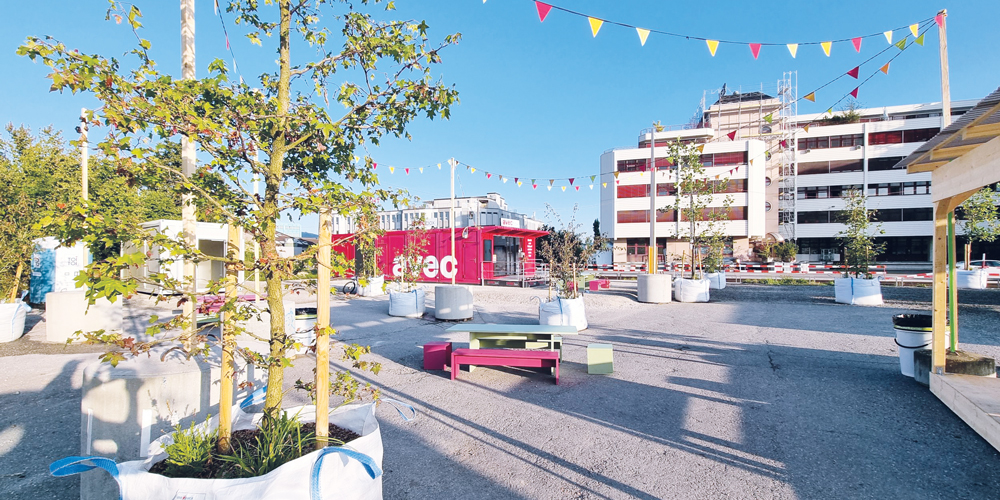
Bereits heute ist die Stadt im Dorf erlebbar, etwa mit der Zwischennutzung #luberzenareal: Seit Mitte August 2021 bieten unterschiedliche Foodtrucks, die avec box – der modernste Convenience Store der Schweiz – und unkomplizierte Aufenthaltsmöglichkeiten erhöhte Aufenthalts- und Verpflegungsqualität.
Die Zwischennutzung #luberzenareal lädt bereits heute zu Verpflegung und Aufenthalt ein.Willkommen im geplanten Urdorf-Nord.
Raiffeisen considers the “often rumored thesis of the great Corona city flight” to be insubstantial. “The city remains an extremely attractive residential area. But that literally has its price, ”Raiffeisen chief economist Martin Neff is quoted in a press release on his bank’s current transaction price index. “People are turning their backs on her only because of the high housing costs.”
As the figures for the third quarter of 2021 show, every minute of commuting time around Zurich costs 21,000 francs for a single-family home and 15,500 francs for a condominium. On average, condominiums were traded 2.0 percent more expensive than in the previous year. According to the information, the prices for single-family houses rose by 4.4 percent, the faster than ever since the launch of the Raiffeisen transaction price index.
Compared to agglomeration communities, urban locations have lost their attractiveness. But despite the recent increase in the vacancy rate in the cities, the vacancy rates in the centers are still very low. Overall, Raiffeisen sees a “soft landing” for the rental housing market.
Scarce land is being built on more and more densely. While in 2000 43 percent of new residential units were built in single-family houses, in 2020 it was only just under 11 percent. The proportion of apartments that have been newly created through additions, extensions and other renovations has almost doubled within ten years from 7 to 13 percent.
In the countryside and in tourist regions, AirBnB remains good business despite the pandemic. “Compared to the regular rental housing market, some extremely attractive returns could be achieved there,” says Neff. “In the big centers, however, the business is usually not worthwhile after deducting all costs.”
The Oberhauserriet – today's Glattpark – has a long and eventful history behind it. The planning of the development of the former swamp and agricultural area took more than forty years. After the approval of the neighborhood plan in 2001, however, the development picked up speed: A new district of Opfikon was built on what was once a green field at a rapid pace, with currently around 5780 residents and 3100 jobs in the neighborhood plan area. Today the Glattpark has a model character in its uniqueness. A new book, which appeared in mid-September, shows challenges and solutions on the way from the meadow to the urban district and traces the individual development steps. **
Breathe life into a vision The founding of an organization that was unique in Switzerland at that time contributed significantly to the success of the Glattpark: a merger of several landowners to form a superordinate area marketing department, which was responsible for the overall marketing of the Oberhauserriet. The aim was to create a common brand from which all individual projects would in turn benefit. The new organization – the Glattpark area marketing – was supposed to act as an information hub for landowners, the media and the general public on the one hand, and to provide marketing services to the individual landowners on the other. But first and foremost, it should breathe life into a vision, because offices and apartments should not simply be built in Oberhauserriet – an urban vision would be realized here. Communication with the development area therefore required a way of thinking that went beyond the mere application of individual projects.
Marketing offensive for a meadow In view of the rather difficult economic environment at the time, the establishment of joint area marketing must be described as courageous. The developments at the airport and in terms of aircraft noise, the uncertain realization of the Glattalbahn – a location advantage that should not be underestimated for the new district – but also the generally difficult economic situation made "big hits" appear difficult. The area marketing Glattpark was aware of this fact from the beginning, but saw the overall quality of the area as an opportunity. The success soon proved the area marketing right: Thanks to extensive marketing and communication measures, the organization quickly developed into the central information and contact point for the new district. When marketing the area, it was initially about making the vision visible. For this purpose, the Glattpark area marketing relied on the one hand on visualizations and on the other hand on a large model that was constantly updated. In the specially set up showroom, interested parties and investors were able to get an idea of the future district. In addition, a comprehensive website offered a lot of information. Events, trade fair appearances and classic media work complemented the marketing measures. And finally the former Riet even became a town: in 2005 the Glattpark officially became a separate district with the postal address “8152 Glattpark (Opfikon)”. The process was initiated by the landowners: They were rightly convinced that the «Glattpark» postal address would contribute a lot to branding.
Coordination between landowners and the city Another important success factor for the development of the Glattpark was the close cooperation between the city of Opfikon and the landowners. The complexity of the development of a new district also made it necessary for the city of Opfikon to create new forms of organization: the Glattpark area management. The new organization was commissioned by the Opfikon City Council to take over the strategic and operational management of the new district. The area management should include the needs of all administrative departments in the city that affected Glattpark in the development process. The main task of the committee, however, was the overall coordination and the exchange of information between those involved. Representatives of the authorities, administrative employees, landowners' representatives and external specialists from the areas of spatial planning, marketing, business administration and social science had a seat in the area management.
What the urban heart desires With the rapid construction progress in Glattpark, the new district quickly revived – and thanks to the establishment of an active neighborhood association, the initiative of committed residents and external organizers, it developed its own neighborhood identity. The "Glattpark-Barometer" showed the concerns of the residents – and initiated various measures to improve the quality of life. So Glattpark became more and more popular with families; and the demand for a school building of their own grew correspondingly louder. After several referendums, nothing stands in the way of its realization. And so the new district will soon really offer everything that the urban heart desires: a comprehensive district supply with shops and services, optimal connections to public transport, a spacious park landscape with its own lake, crèches, kindergarten and soon a primary school. ■
* Alexandra Vogel is the head of the office of the Swiss Association for Location Management SVSM
** The book “Glattpark – a city is created”, published by IGG Glattpark, can be ordered by e-mail to info@glattpark.ch or by phone on 043 211 50 10 for CHF 50 plus shipping costs. The book with high-quality hardcover binding in the format 24 x 34 cm traces the eventful history of the development area on 128 pages with texts, pictures, quotations and newspaper articles. The book has been available since mid-September.
The Barcelona-based architectural firm Guallart Architects has won the tender for the planning of the new Chinese city of Xiong'an. It should be resilient and 100 percent self-sufficient. According to the will of the Chinese President, it should become the “new standard for the post-COVID era”.
According to an article by the Thomson Reuters Foundation , Xiong'an is being conceived as a self-sufficient city that produces its own energy, food and other resources. It will have rooftop farms and greenhouses, drone-friendly terraces and shared 3-D printers. In addition, apartments are planned with space for home offices so that their residents can work from home in the event of future pandemics. The city's eco-friendly design includes blocks of flats made from cross-laminated timber, renewable energy and streets reserved exclusively for pedestrians and cyclists.
"We can no longer design cities and buildings as if nothing had happened," Vincent Guallart, founder of Guallart Architects and former chief architect of the city of Barcelona, is quoted in the article. “Our proposal arises from the need to find solutions to the different crises that are playing out on our planet at the same time. They are supposed to create a new kind of urban life based on a biological circular economy. That will make cities and municipalities stronger. "
The present draft was strongly influenced by the experiences of the team of architects during the lockdown in Spain. “We wanted to make a case for the things that we think are important during a lockdown and in the future. If apartments enable teleworking and tele-teaching, have flexible rooms on large terraces, cities can grow food on their roofs and residents can print things in the neighborhood, we will be better prepared for the crises of the future. "
Xiong'an is being built in Hebei Province, around 130 kilometers southwest of Beijing. According to the article, China's President Xi Jinping has described it as the "new standard for the post-COVID era". He marked Xiong'an as an urban innovation zone back in 2017.
Wir verwenden Cookies zur Unterstützung und Verbesserung unserer Dienste. Mit der Nutzung dieser Website erklären Sie sich mit der Verwendung von Cookies einverstanden. Weitere Informationen finden Sie in unserer Datenschutzerklärung.