Tag: Stadtpräsident

  • “A big city with small-town charm”

    “A big city with small-town charm”

    Where do you currently see the biggest challenges for the city?
    Winterthur is experiencing strong growth. This brings opportunities, but also challenges. More and more people want to move to Winterthur. This requires a greater number of available jobs, because short commutes mean quality of life. In addition, we have to provide more transport and educational infrastructure. This entails costs – even if we generate more tax revenue due to the growing number of residents. Nevertheless, larger investments are necessary to absorb the growth. With “Winterthur 2040” we have defined where densification is to take place. We expect around 135,000 residents by 2040.


    You have already mentioned it: the city of Winterthur currently has over 120,000 inhabitants. Last year you recorded the strongest population growth in decades. Why is that?

    Winterthur is simply a great city! We are excellently located. We offer a lot of green spaces, a high quality of life and a wide range of cultural activities. Our educational institutions also attract young people in particular. This brings well-trained professionals to the regional labour market. Of course, we also benefit from our affiliation with the Zurich economic region.
    And we are a modern technology city, which is interesting for companies. In short: Winterthur is a big city that offers everything, but still retains its small-town charm.

    How is the city’s housing market doing in view of the sharp rise in the number of inhabitants?
    Like all cities, we are struggling with a very low vacancy rate. But we still have a few municipal and some private building reserves to fall back on. The current building and zoning regulations still allow for a lot. There is a lot of building going on, as we can see from the number of building permits. Basically, we are striving for a well-mixed city. That’s why we try to offer both affordable housing and housing for higher incomes. In my opinion, however, the housing market should not be regulated by the city, it should function as independently as possible.


    You have set up the Smart City office. What does it deal with and how does it work?

    We were the first city in Switzerland to have a Smart City strategy at the city council level. The Smart City uses social and technological innovations in a targeted way to ensure quality of life, conserve resources and promote sustainable development. In other words, it is about using modern technologies to simplify everyday life for the population and to make the city well connected. For this purpose, we have founded the Smart City Winterthur office. In addition, the city of Winterthur is positioning itself as a Living Lab (WinLab), a real laboratory or test city, in which social and technological innovations for the benefit of sustainable urban development can be tried out, systematically tested and, if successful, scaled up. Partners from research and development, business and civil society are invited to actively participate.


    Sustainability is an important keyword in this context.
    True. Researchers from a wide range of disciplines agree that the city of the future must be a sustainable city. This means that the city must be designed in such a way that it can adapt to changing conditions. This concerns not only the “hardware” such as infrastructure, buildings and open spaces, but also the “software”, i.e. the social and economic structures. A sustainable city is therefore economically successful, ecologically compatible, socially stable and thus: resilient. The sustainable Winterthur should therefore also be an ecological city, in the sense of quality of life for its inhabitants. This includes as few emissions as possible, sufficient green spaces, open space and flexible and diverse mobility. With regard to social resilience, it is important for us to strengthen networks and address existing disadvantages.


    What has been done specifically in the area of digital transformation of the city administration and what is still planned?
    In order to be able to approach the digital transformation in a targeted and holistic manner, the city is currently developing a digitalisation strategy. This is geared to the needs of the various stakeholders and is based on the available means and resources. Our goal is to create a faster and as low-threshold contact to the population as possible. Currently, the city offers over 90 e-services that can be accessed via a central portal. We also want to make our internal work processes even more efficient. The highest priority is not only ease of use, but also data protection and data security. The greatest challenge, however, is and remains the speed at which digitalisation is advancing. It is important to keep pace here. We have not yet reached our goal, but we are well on our way.


    In 2017 you initiated the merger of the associations Winterthur Tourism and Location Promotion Winterthur Region. The result is the new organisation House of Winterthur. What is your conclusion some six years later?
    With House of Winterthur we have founded an association that allows us to conduct integrated location marketing. At the time, we were the first city to try this. We want to do marketing for the city and the region of Winterthur from a single source, so to speak, and generate a higher added value. We got off to a good start with a very broad sponsorship. The sponsorship is very broad with the canton, municipalities, companies, hotels, restaurants, cultural institutions and the city; meeting the different demands was a very big challenge. We certainly haven’t done everything optimally here. We have had a new director for a year and a half and are in the process of reorganising the board. I am still convinced of the idea, but we still have to optimise and adjust it.

  • Carmen Walker Späh speaks of a "moving moment"

    Carmen Walker Späh speaks of a "moving moment"

    Schlieren gets a new cluster. After the Bio-Technopark, the shopping and the start-up cluster, the new Healthtechpark was opened on Tuesday. The project is based on the work of the Health Tech Park Zurich-Schlieren association, which was founded last year and on whose board the city of Schlieren and the canton are also represented.

    The goal: Even more companies and start-ups from the health tech sector should move into the property of the city of Schlieren. It is hoped that if the companies work together from a central location, they can network better – and thus provide decisive impetus in the industry.

    The new park is located in the properties at Rütistrasse 12 to 18 at the Innovation and Young Entrepreneur Center (IJZ). 82 percent of the buildings belong to the city. According to location promoter Albert Schweizer, it is currently renting a quarter of its 17,000 square meters to health-tech companies. According to the canton, 12 companies have currently joined the Healthtechpark. The city of Schlieren has gradually renovated its property in recent years and made it suitable for laboratories.

    Zurich Economics Director Carmen Walker-Späh (FDP) officially inaugurated the park together with Schlierem City President Markus Bärtschiger (SP). For her, this is "a moving moment," said Walker Späh.

    The pandemic has shown society how important the healthtech sector is. For example by producing diagnostic devices or hygiene masks. Walker Späh is certain that further innovative diagnostic methods will be developed in the new park, for example for the treatment of cancer.

    Canton pays 200,000 francs over four years
    The Healthtechpark not only serves the well-being of the population, but is also important for Zurich as a business location. The canton is already the largest healthtech location in Switzerland. The sector is currently experiencing a boost. The industry is responsible for added value of CHF 5.3 million and 19,000 jobs throughout Switzerland. One in seven of these is in the canton of Zurich – and the trend is rising.

    In order for this trend to continue, the new park is needed. Because: “Innovation is increasingly being created in networks. » Finally, Walker Späh emphasized that important partners for the project had been found in the Zurich University Hospital and the Limmattal Hospital. On request, government councilor Walker Späh also said that the canton would support the Healthtechpark with an allocation of CHF 200,000 spread over the next four years. According to this, the park, which is currently financed by sponsors and patrons, should be self-supporting.

    The Mayor of Schlieren, Bärtschiger, explained why he didn't consider the Schlieren location to be coincidental. For example, because the Biotechnopark is already located here. The city therefore already knows what laboratories would require – and what permits are required for them. In addition, Schlieren is an important location for start-ups. And the healthcare system is represented on the one hand by the Spital Limmattal and the University Hospital Zurich, on the other hand by the Cantonal Pharmacy Zurich.

    Not only the place, but also the time was chosen correctly, as Bärtschiger emphasized. The healthcare system experienced a drive during the corona crisis. "Now people want to show what they can do." Bärtschiger therefore believes that this tailwind should be used.

    Location promoter Albert Schweizer receives a lot of praise
    The Schlierem location promoter Albert Schweizer was in the spotlight. He received praise from the speakers for initiating the project and working on it for eight years. Councilor Walker-Späh specifically mentioned Schweizer and Mayor Bärtschiger said about him: "He always finds pearls." The park's CEO, Stefan Leuthold, praised Schweizer's vision. And as a thank you for his work, he gave him a special box to remind him to drink enough every day. In line with the health promotion of the new park.

    But what good is this park for the Schlieremer population? Markus Bärtschiger replies: "One quickly forgets that Schlieren not only has 20,000 inhabitants, but also 19,000 jobs." And around 50 percent of the tax base comes from the companies based in Schlieren that are subsidized by such parks.

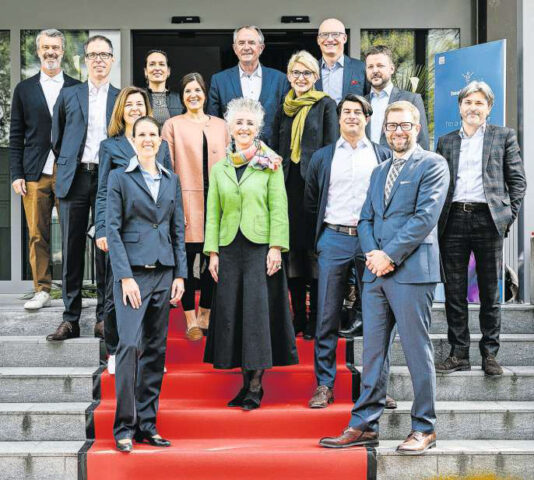
    Left: The board of the Healthtechpark association with the government councilor and mayor from left to right: Bruno Schefer, Stefan Leuthold, Danielle Spichiger (centre), Melanie Aregger (below), Karina Candrian (top, not on the board), Regina Grossmann, Carmen Walker Späh, Albert Schweizer, Gabriela Senti, Carlo Centonze, Matthias Herrmann, Michael Tschudin, Alain Rudiger, Markus Bärtschiger. Right: The Healthtechpark logo.
  • Hofer municipal management expands board of directors

    Hofer municipal management expands board of directors

    Hofer Kommunalmanagement AG in Riniken presents three new board members. According to a press release , Otto Müller, mayor of Dietikon until 2018, the former CVP National Councilor Melchior Ehrler and the Limmattal network manager Jürg Hässig are new members of the board of directors. Bruno Hofer, founder of the agency for location promotion, which has also been active in the Limmattal since 2007, becomes Chairman of the Board of Directors.

    Hofer is setting a new focus in location development advice, according to the press release. For this purpose, the newly developed method for community management, the systemic community management SysKom, which is now under trademark protection, is being marketed throughout Switzerland. A market analysis has shown that the need for location promotion in Swiss municipalities exists and is growing, Hofer is quoted as saying: "The competition between locations virtually forces us to carry out impact-oriented location promotion."

    The methodological approach created by Hofer and his employees in Riniken is described in the media release as a handy method that is intended to help cities, municipalities and regions to experience an upgrade for their location in a simple process, which can also be reflected in rankings. According to Hofer municipal management, the method comprises eight steps from determining the location to spatial planning and location communication. According to the announcement, the end point is location marketing.

  • 3S Solar Plus inaugurates a new production line

    3S Solar Plus inaugurates a new production line

    3S Solar Plus AG opened a new production line at its location in Thun on August 20th. Several guests from business and politics attended the celebration – among them the Mayor of Thun, Raphael Lanz.

    "With the ultra-modern line we are increasing our capacity and flexibility many times over", Patrick Hofer-Noser, owner and managing director of 3S Solar Plus, is quoted in a media release. The expansion is intended in particular to increase the delivery capability of various products for building-integrated photovoltaics. These are delivered to customers in Switzerland and other European countries.

    3S Solar Plus specializes in the manufacture of building products that generate energy thanks to integrated solar technology. The company separated from the solar company Meyer Burger in 2018. Since then it has more than doubled the number of its employees.