Tag: Stadtquartier

  • La Rasude Lausanne

    La Rasude Lausanne

    La Rasude is one of Lausanne’s six urban transformation poles and is located directly next to the train station and one of the most important public transport hubs in French-speaking Switzerland. From the city’s point of view, this is the ideal location for densification that combines short distances, high density of use and a better quality of life. The plan d’affectation defines the permitted uses, building volumes and requirements for the environment, mobility and monument protection

    Building on existing buildings instead of tabula rasa
    Around 70 percent of the existing buildings will be preserved, including the striking building on Avenue de la Gare designed by Alphonse Laverrière, whose protection was explicitly secured in a revised project following criticism from the federal government and experts. Individual buildings such as “Gare 45” and “Horizon” may be raised by two storeys, and two new structures will be added. One along the tracks and one in the district center, the heights of which are defined in such a way that the existing skyline and visual references are respected and the Edipresse tower is not towered over

    Living, working and social mix
    Around 30 percent of the floor space is earmarked for housing, at least 20 percent of which will be logements d’utilité publique, i.e. non-profit apartments. In total, almost 500 people will be able to live in a district that is currently uninhabited. At the same time, a diverse mix of uses will be created, including offices, a hotel, stores, early childhood care, cultural and leisure spaces and neighborhood services. Around 500 square meters will be reserved for cultural professionals and public uses at controlled, affordable rents

    Public space, greenery and mobility
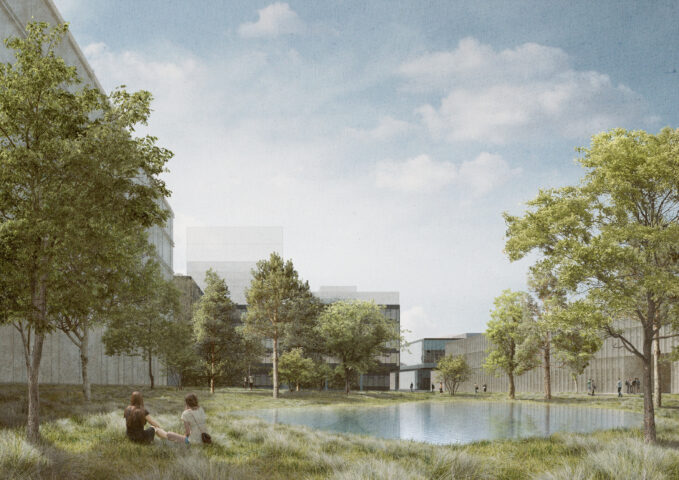
    The currently closed, heavily sealed complex will be transformed into an open, pedestrian-oriented quarter. Around half of the site will be available as public space in future, much of it with trees and green areas, supplemented by green roofs, photovoltaic systems and a connection to renewable heat sources to significantly improve the carbon footprint. Access on the surface is primarily on foot and by bicycle, while an underground garage with around 275 car parking spaces and around 1,200 bicycle parking spaces bundles the necessary mobility options underground

    Political process and outlook
    The plan is available for public inspection until December 18. Objections and objections will be incorporated into the further revision before the decision is taken by the municipal council to the canton. In parallel, competitions for architecture and public spaces with participatory formats are planned to ensure the quality of implementation. Construction is currently scheduled to begin around 2029, with the new district coming into operation in stages between 2031 and 2033, provided that any political referendums do not change the timetable.
  • MFO-West becomes an urban neighbourhood

    MFO-West becomes an urban neighbourhood

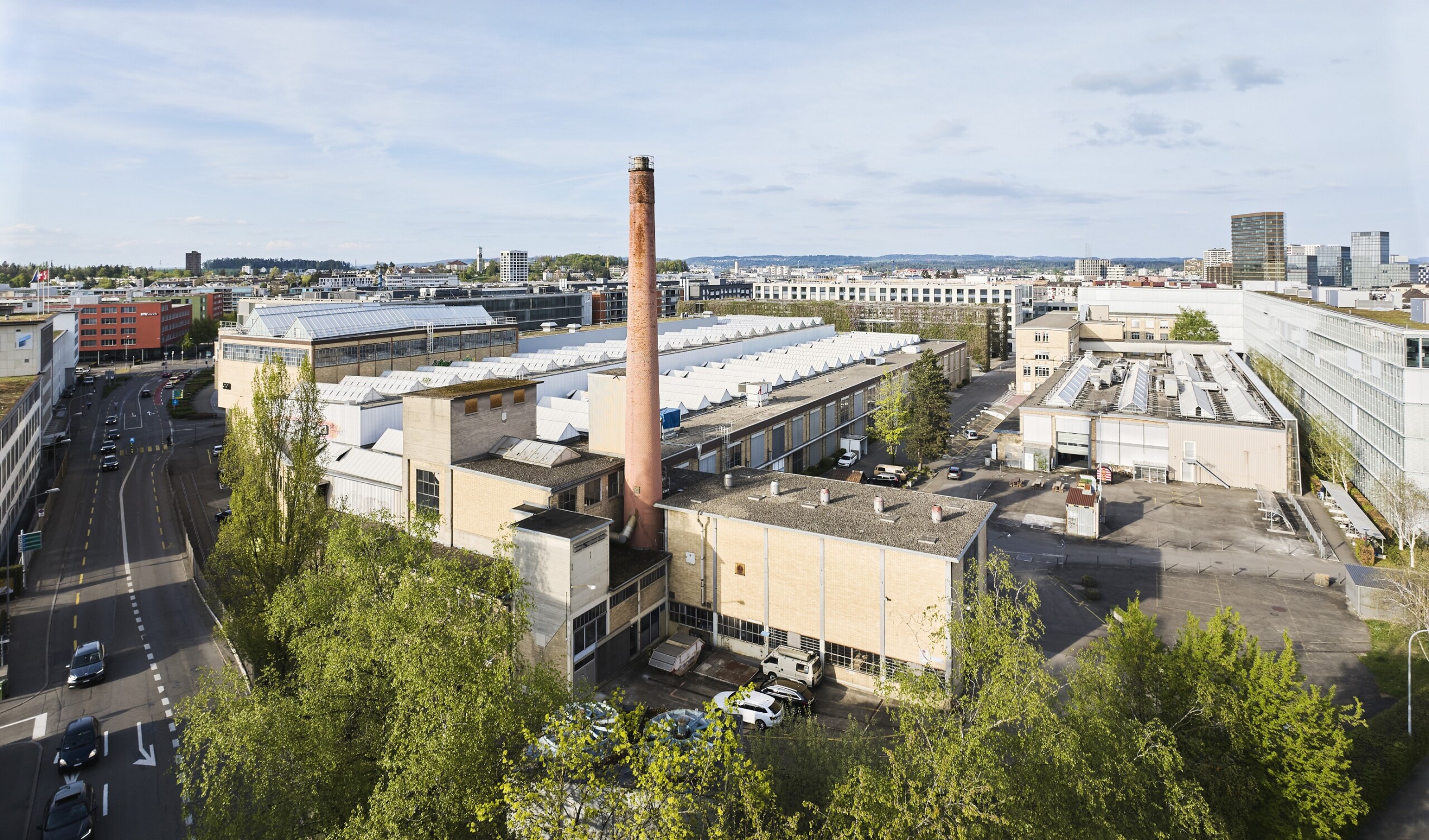
    The purchase of the 25,500 m² ABB site by the City of Zurich for a net CHF 106 million is more than just a land purchase. It is a strategic decision with a long-term impact. Thanks to the urban development contract concluded in 2021 and the special building regulations that come into force in 2025, Zurich can shape the future on a centrally located piece of the city. With high density, mixed uses and consistent citizen participation.

    Transformation through participation
    A key success factor is the early and transparent involvement of residents, associations and neighbourhood organisations. The needs of the neighbourhood were directly incorporated into the participatory strategy process. This turned an industrial site into an urban development concept with a high level of social acceptance. Urban planning thus not only gains space, but also trust.

    Mix of uses as a driver of innovation
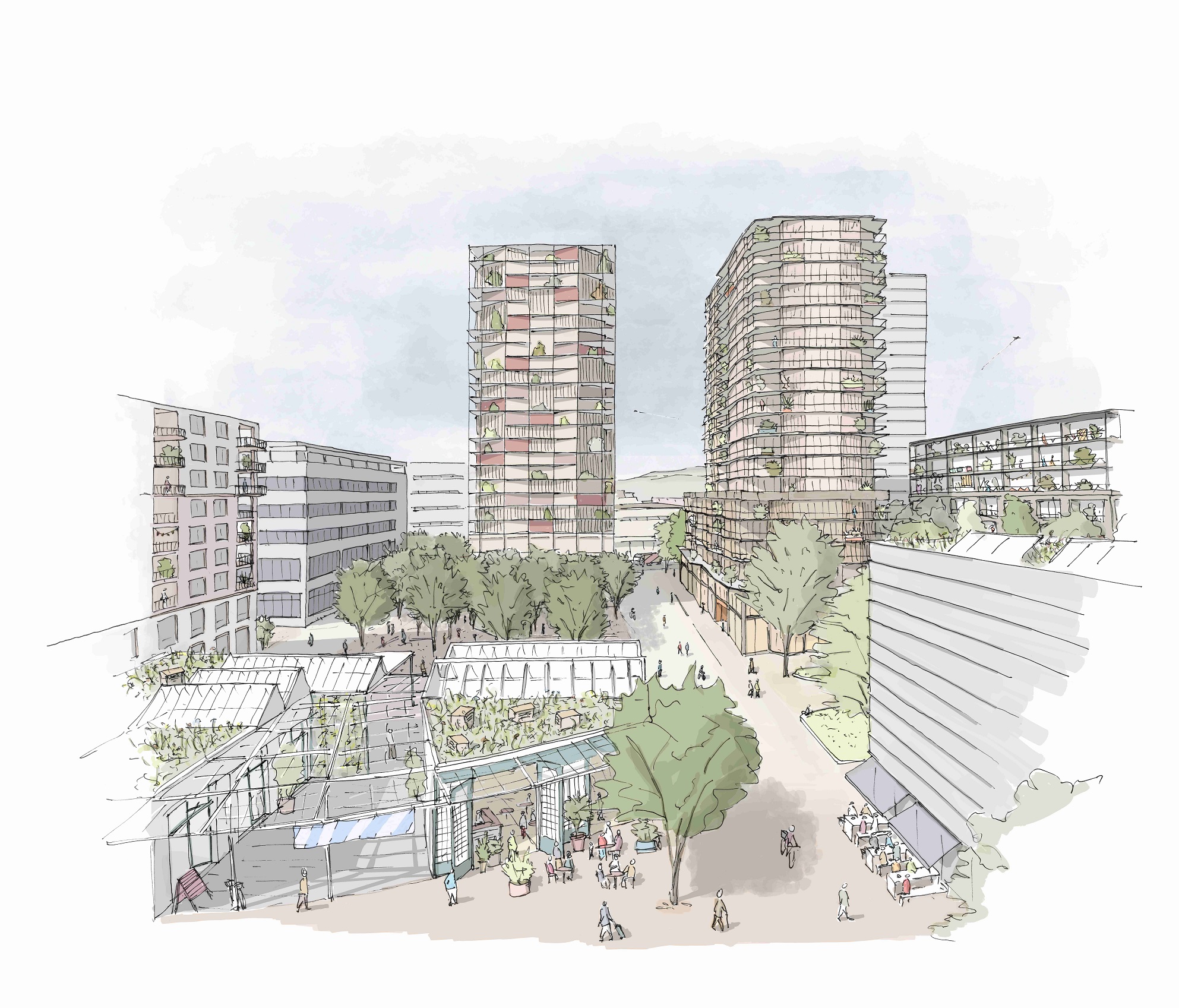
    The utilisation concept envisages three new construction zones and three existing areas. A mix of non-profit housing, neighbourhood supply, creative commercial use and publicly accessible open spaces is planned. The House for Culture and Circular Economy is a flagship project for innovative urban utilisation. The combination of culture, sustainability and economic activity makes the site a catalyst for new value creation models in urban areas.

    Temporary use as an impetus for location quality
    Before construction work begins, halls and open spaces are used temporarily in a targeted manner. A strategy that brings life to the neighbourhood, promotes social contacts and creates identity even before construction begins. Interim uses are increasingly recognised as a success factor for the attractiveness of locations and resilience in transformation areas.

    Public-private partnership with a role model function
    ABB remains anchored in Oerlikon with 500 jobs and supports the development. The project shows how forward-looking urban development can work constructively with private owners. A model that can be transferred to other urban conversion sites. The combination of urban management and entrepreneurial willingness to co-operate points the way forward.

    MFO-West is not an isolated case, but an exemplary model for the urban transformation of former industrial sites. Those who invest in such development areas can help shape new urban qualities. From social integration and innovative utilisation concepts to sustainable value creation. In times of housing shortages, climate targets and new forms of mobility, sites like MFO-West are the key to the city of tomorrow.

  • LG site becomes an urban neighbourhood

    LG site becomes an urban neighbourhood

    The transformation of the LG site aims to create a lively, open district characterised by architectural quality and urban flair. The project is based on a development plan that ensures that urban development and architectural standards as well as social and ecological aspects are incorporated into the planning. In a study process, the team Salewski Nater Kretz, pool Architekten, Studio Vulkan Landschaftsarchitektur and mrs partner were selected as the winners, whose concept forms the basis for the neighbourhood development.

    Purchase of land by the city of Zug
    In order to influence the urban use and price development on the LG site in the long term, the city of Zug is planning to purchase a central plot of land on Theilerplatz. The cost of the plot amounts to CHF 65 million. This transaction will soon be dealt with by the Grand Municipal Council. This acquisition will enable the city of Zug to influence the design of the neighbourhood and ensure that affordable living space is created in the heart of Zug in the near future, as demanded by the people of Zug in June 2023 when they approved the 2000-apartment initiative.

    Remodelling work on the LG site
    While the long-term development plans for the upgrading of the LG site are in the political planning process, two existing buildings on the UBS Fund Management (Switzerland) AG site are currently being renovated. These are Gartenstadt 2a and the brick building at Zählerweg 3-9, both of which are adjacent to the Shedhalle with the “Freiruum”. This renovation is being carried out by property developer and total contractor Losinger Marazzi AG outside of the ordinary development plan procedure on the LGAreal and is being implemented in stages.

    Occupation by 2027
    The building at Gartenstadt 2a should be completed by mid-2026 and provide space for new commercial tenants. The 60 or so flats at Zählerweg 3-9, on the other hand, are expected to be ready for occupation in early 2027. If everything goes according to plan, the “Freiruum” will move into the ground floor of the 200-metre-long building at this time. Once the LG-Areal development plan comes into force, the Shedhalle can be renovated in a further stage in order to offer the “Freiruum” its long-term premises from 2029.
    New urban neighbourhood
    By 2032, the once “forbidden city” will become an open and mixed neighbourhood with an industrial character and urban flair. Around 1,200 flats and 2,300 jobs will one day be on offer. Theilerplatz, the heart of the new urban quarter, will be transformed into a central meeting place for neighbourhood residents and the city’s population with inviting places to spend time and green open spaces.

  • Aarau barracks site to become a new city quarter from 2031

    Aarau barracks site to become a new city quarter from 2031

    The barracks area in Aarau is facing a major transformation. From 2031, a new urban neighbourhood is to be created and military use will be shifted to a reduced area. To support this process, the canton of Aargau has decided to extend the lease agreement with armasuisse, which expires in 2030. This decision provides all parties involved with the necessary planning security until the army’s relocation is completed in 2035. It is planned to conclude a new contract for civilian use from 2036 and to develop a concept for military use at the same time in order to safeguard the interests of all parties.

    The barracks site, which currently belongs mainly to the Canton of Aargau and the federal government, is to be made more accessible to the public in future. The urban development project allows for civilian use from 2031, and the agreement to restrict military use to the northern part of the site means that the civilian development of the site can take place gradually without jeopardising the overall urban development vision.

    The planning security created by the extension of the lease agreement enables all partners involved to plan the necessary steps to realise the construction projects from 2031. This chronological sequence should ensure that the landowners can realise the construction projects efficiently from 2031 and that the army can move into its new facilities by the end of 2035.

  • Participatory planning as the basis for sustainable development

    Participatory planning as the basis for sustainable development

    The key area for urban development, the Thun railway station district, is at an important turning point. The vision of a dynamic mobility hub and a lively urban neighbourhood is making progress with the findings now available from the participatory charrette process. Mayor Raphael Lanz emphasises the importance of the open-ended and participatory process, which creates a solid basis for future planning steps.

    The charrette process, in which visions and viable solutions were developed by three interdisciplinary teams, demonstrates the importance of involving various interest groups in the planning process. The broad participation enabled a comprehensive dialogue and the development of shared visions for the Thun railway station district.


    One of the key findings is the need to make spatial and operational optimisations in order to create a future-oriented mobility hub that is suitable for the disabled. This also includes relieving Seestrasse and the Maulbeer roundabout of motorised individual traffic and incorporating the south side of the station for a new bus solution. In order to develop the area in a timely and sustainable manner, major upfront investments and interdependencies should be avoided as far as possible.

    In addition, the development should take into account the existing identities and structures and build on optimised access and open spaces. The promotion of a location-appropriate and balanced mixed-use urban neighbourhood with a high degree of flexibility and the strengthening of public spaces are further key objectives. For example, Bahnhofplatz, the Schifflände and the riverside promenade are to be upgraded and further developed as important public spaces. Improved pedestrian and cycle connections, including new links such as a “panoramic bridge” crossing the Aare and a railway overpass, are also under discussion. Seestrasse is to become an attractive backbone for the neighbouring development area. This extends between the railway tracks and shipping canal as well as the River Aare. Over the next few years, the entire neighbourhood is to develop into a well-located, well-balanced area with a variety of focal points and space for innovative residential and working uses.

    In parallel with the further planning, the city is tackling initial measures to make the area more attractive. One example of this is the temporary greening of Aarefeldplatz with “climate trees”, which has already been completed and not only helped to improve the quality of life over the summer months, but also emphasised the importance of green spaces in urban areas. With this “LeiStbild” and the final report from the charrette process, the city of Thun has a clear idea of how the area should be developed in the coming years. The synthesis of these findings is currently being incorporated into a masterplan and is expected to be finalised by the end of 2023. The masterplan will serve as a further guideline for the implementation of the project. Thanks to these coordinated efforts, the city of Thun is well on the way to realising its vision of a liveable and mobility-friendly urban district at Thun railway station.

  • The new Lokstadt: urban, versatile, steeped in history

    The new Lokstadt: urban, versatile, steeped in history

    With Lokstadt, Implenia is developing a new, urban and versatile quarter with 750 flats for around 1500 people. Lokstadt is located to the south-east of Winterthur railway station. The area used to be home to the workshops of the Swiss Locomotive and Machine Factory (SLM) – the most important locomotive forge in Switzerland. The neighbouring Sulzer factory took over SLM in the 1960s.

    Some of the locomotives produced by SLM serve as namesakes for the various construction fields. For example, the “Tender”: condominiums were built here, which are ready for occupancy since the beginning of 2023, as well as commercial space. The flats of the 17 “townhouses” were also for sale: these are four- to five-storey maisonettes that have already been completed. In a second construction phase, six four-storey “townhouses” were built: these comprise a total of 24 flats and will be ready for occupancy in spring 2023. The “Elefant” office building, which is located directly on Zürcherstrasse, will also be ready for occupancy soon.

    The central dialogue square will be framed by three buildings in the future. The first is the “Krokodil”, a wooden building. Here, 254 flats have been created to meet the diverse living needs of three cooperatives as well as individual homeowners. Vertical window bands are reminiscent of the former industrial halls and give the building a clear structure. BIGBOY” is located at the front of Dialogplatz:

    BIGBOY offers 125 flats and a roof terrace for the residents…

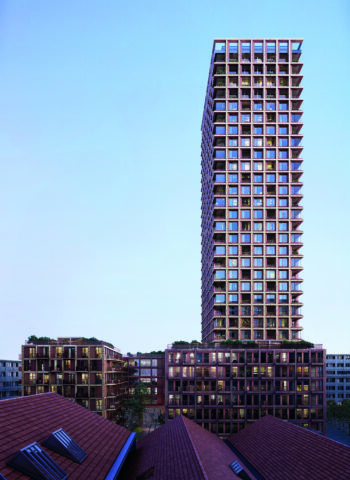
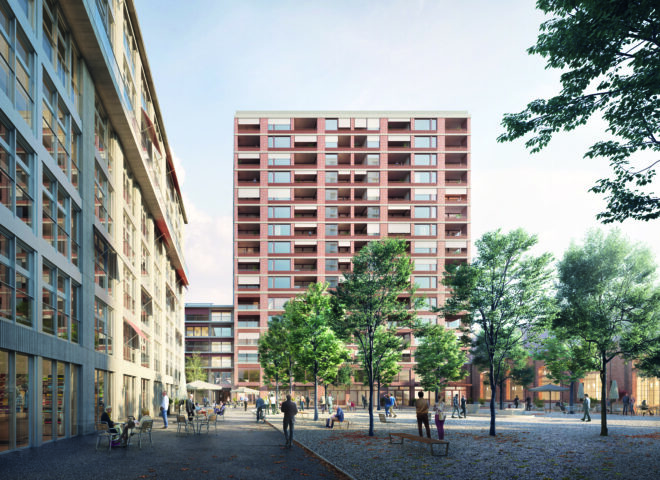
    The building, which is over 50 metres high and 16 storeys high, is home to 125 rental flats as well as five office and commercial spaces between 55 and 370 square metres. The roof terrace offers a unique view over Lokstadt and the whole of Winterthur. The industrial past of the site is reflected in the brick façade. Bigboy will be ready for occupancy in summer 2023. The third building is still under development and is currently the tallest planned wooden high-rise in the world: “Rocket”, developed and realised on behalf of Ina Invest, will be 100 metres high and with 32 storeys will be the landmark of the new district and the Winterthur skyline. The plan is for 255 flats. In addition, non-profit flats are planned in the “Tigerli” base building. A hotel is also planned. The occupancy date is planned for 2027.

    Lokstadt offers a unique residential atmosphere.

    Lokstadt stands for the sustainable use of resources, a prudently planned variety of uses and the innovative revitalisation of listed buildings. These include the former factory buildings. Under Implenia’s leadership, these are being transformed into spaces for experience that reflect local history and modern city life. The quarter is being developed step by step in accordance with the requirements of the 2000-watt society. Despite the dense construction, importance is attached to sufficient open spaces and a high quality of stay. The area will be made accessible to motorised traffic by means of an underground car park spanning all the buildings. Above ground, pedestrians and cyclists have priority thanks to a generously designed pedestrian zone.

    Despite the dense construction, Lokstadt attaches importance to sufficient open spaces and a high quality of stay.

    With Lokstadt, Winterthur links the 19th century with the 21st century: Here, the city’s industrial history is brought together with Winterthur’s future as a residential, educational and service city. The quarter is being built for people who love city life and who care about sustainability. A Lokstadt app will serve as a communication and interaction channel for all tenants, owners and employees in the future.

  • The new Lokstadt: urban, versatile, steeped in history

    The new Lokstadt: urban, versatile, steeped in history

    With Lokstadt, Implenia is developing a new, urban and diverse neighbourhood with 750 flats for around 1500 people. Lokstadt is located south-east of Winterthur railway station. In the past, this area was home to the workshops of the Swiss Locomotive and Machine Factory (SLM) – the most important locomotive forge in Switzerland. The neighbouring Sulzer factory took over SLM in the 1960s.

    The Rocket skyscraper is the tallest wooden residential building in the world being planned at
    .

    Some of the locomotives produced by SLM serve as namesakes for the various building plots. For example, the “Tender”: condominiums were realised here, which have been ready for occupancy since the beginning of 2023, as well as commercial space. The flats in the 17 “townhouses” were also for sale: these are four- to five-storey maisonette flats that have already been completed. In a second construction phase, six four-storey “townhouses” were built: these comprise a total of 24 flats and have been ready for occupancy since spring 2023. The “Elefant” office building, which is located directly on Zürcherstrasse, will also soon be ready for occupation.

    The central dialogue square will be framed by three buildings in future. The first is the “Krokodil” in timber construction. Here, 254 flats have been created to fulfil the diverse housing needs of three cooperatives and individual homeowners. Vertical bands of windows are reminiscent of the former industrial halls and give the building a clear structure. BIGBOY” is located at the front of Dialogplatz: the building, which is over 50 metres high and has 16 floors, is home to 125 rental flats and five office and commercial spaces of between 55 and 370 square metres. The roof terrace offers a unique view over Lokstadt and the whole of Winterthur. The industrial past of the site is honoured by the brick façade. Bigboy will be ready for occupancy in summer 2023. The third building is still under development and is currently the tallest planned timber high-rise in the world: “Rocket”, developed and realised on behalf of Ina Invest, will be 100 metres high and, with 32 storeys, will become the landmark of the new district and the Winterthur skyline. There are plans for 255 flats. Charitable flats are also planned in the “Tigerli” plinth building. A hotel is also planned. The move-in date is planned for 2027.

    BIGBOY offers 125 flats and a roof terrace for residents.

    Lokstadt stands for the sustainable use of resources, a carefully planned variety of uses and the innovative revitalisation of listed buildings. These include the former factory buildings. Under the leadership of Implenia, these are being transformed into experience spaces that reflect local history and modern city life. The neighbourhood is being developed step by step in accordance with the requirements of the 2000-watt society. Despite the dense construction, emphasis is placed on sufficient open spaces and a high quality of stay. The site will be developed with an underground car park for motorised traffic across all building plots. Above ground, pedestrians and cyclists have priority thanks to a generously designed pedestrian zone.

    With Lokstadt, Winterthur connects the 19th century with the 21st century: Here, the city’s industrial history is brought together with Winterthur’s future as a residential, educational and service city. The neighbourhood is being built for people who love city life and care about sustainability. In future, a Lokstadt app will serve as a communication and interaction channel for all tenants, owners and employees.

  • Everything will be new on the Rösslimatt site by 2040

    Everything will be new on the Rösslimatt site by 2040

    The Rösslimatt site in the middle of Lucerne borders railway tracks on both sides. It is to be completely redesigned by 2040.

    The area is divided into different construction sites and will be realised in three stages. In the first stage between 2018 and 2025, construction sites A to C will be developed and Güterstrasse 7 will be gently redeveloped. In the second stage, from 2025 to 2040, an interim use is planned for the exposed areas. In the third stage and after the realisation of the Lucerne through station from around 2040, the development of new uses with a focus on housing is planned on construction sites D to F. The development of a new residential building is planned on construction site A.

    A 180-metre-long, sustainable building designed by architect Rolf Mühlethaler is being built on construction site A. It will be realised on the site of an old goods shed that was demolished in 2020. The façade of the new building is characterised by surrounding verandas as well as a two-storey arcade on the side of the new Walter-von-Moos-Promenade with a weather-protected wood and glass façade made of local wood.

    The new building has around 21,600 square metres of lettable space. At the end of 2019, the Lucerne University of Applied Sciences and Arts was secured as the main tenant. It intends to start its university operations on around 16,000 square metres from the autumn semester of 2025. The ground floor will be characterised by public-oriented uses such as a cafeteria, a café, meeting zones and a large lecture hall. In particular, the track loggia, a striking two-storey opening in the long building, and the newly designed Bürgenplatz, together with the planned catering uses, will form new urban meeting places.

    A mixed-use building is to be constructed on construction sites B and C. After the architectural competition concluded in February 2020, the winning project by the consortium Demuth Hagenmüller Lamprecht Architekten with Alessandra Villa Architektur was recommended for further work by the monitoring committee and is currently under construction.

    In September 2020, the pharmaceutical company MSD committed itself to the Lucerne site. It will move into around 15,000 square metres of office space on construction sites B and C. Site preparation began in the second quarter of 2021, and occupation is planned for 2025.

    Both new buildings have space that has not yet been let.

    The building at Güterstrasse 7 was erected in 1905 and is listed as an object worthy of preservation in the building inventory of the city of Lucerne. This building with its historic façade design is a 7-storey masonry structure consisting of a basement, five upper floors and an attic. It includes commercial and residential space. The building was refurbished in 2020 and the space occupied in 2021. The gentle refurbishment made it possible to make the flats available again at moderate rents.

    The Rösslimatt site is being developed in a sustainable, demand-oriented and high-quality manner. The connection of the site to the district heating and cooling network of Energie Wasser Luzern guarantees 100 percent sustainable generation of heat and cooling. The central location allows optimal use of the existing public transport services as well as several offers for car and bike sharing.

    In addition to the criteria of the 2000-watt society, the goals of the Swiss Society for Sustainable Real Estate at the silver level are met. In September 2019, the Rösslimatt was awarded for its demonstrable and exemplary results according to the 2000-watt site criteria in the development phase and recertified in 2021.

  • ETH Campus Hönggerberg continues to develop

    ETH Campus Hönggerberg continues to develop

    The core mission of ETH Zurich is teaching and research as well as the transfer of knowledge to the economy and society. A modern infrastructure is a key factor in this. In order to cope with the increasing number of students and researchers and to create the necessary space for new research areas and innovative teaching methods, ETH Zurich is working on the further development of its main locations Zurich Centre and Zurich Hönggerberg. With regard to future space requirements, the Hönggerberg campus plays a central role. As a basis for its further development, ETH Zurich, together with the City and Canton of Zurich, has drawn up the master plan “Campus Hönggerberg 2040”. It describes the long-term spatial development goal. The structural densification and further development of the campus should preserve the current conditions of the site, such as the sensitive embedding in the local recreation area as well as listed buildings and gardens, and only take place in accordance with the emerging demand. In the next few years, a new building for quantum physics, a computer centre and a centre for student and entrepreneurial initiatives will be built, among other things. The central Wolfgang-Pauli-Strasse will also be renovated and upgraded as an important master plan element. Until the campus is fully developed, a conversion, new construction, extension or renovation of around a dozen buildings is planned, including four new high points. Various green areas are to be expanded. With the new master plan, ETH is building on the previous “Science City” master plan from 2005. ETH Zurich wants to develop its campus sustainably on various levels: ecologically, economically and socially. Among other things, it wants to take a big step towards climate neutrality and is focusing on energy supply without fossil fuels. A central element of this is the expansion of the current energy grid. Projects are also planned with regard to sustainable building, local climate, biodiversity as well as retention and drainage. For the further development of the campus, ETH Zurich is in dialogue with internal and external interest groups and involves selected people in a participatory manner on a selective basis.

    Attractive open spaces should ensure a high quality of stay and support biodiversity on the campus.

    In order to protect the surrounding landscape, the campus will be developed inwards and densified within the existing area. A green ring road around the campus symbolises this development and serves as a transition from the campus to the landscape. Attractive open spaces will ensure a high quality of stay and further promote biodiversity on the campus. The campus should be easily accessible by environmentally friendly means of transport such as public transport or bicycle. To relieve the local public transport system, a direct electrically powered bus, the so-called eLink, already runs between the Hönggerberg Campus and the Campus Zentrum for ETH members. Other local services such as bike sharing are available and are being continuously expanded. The current urban district character of the Campus is to be further strengthened. The central Wolfgang-Pauli-Strasse will become a lively and green promenade with versatile ground floor uses for the public. The central “piazza” will also gain in importance in the future and will invite people to meet and exchange ideas.

  • Ina Invest takes over the implementation of Bredella in Pratteln

    Ina Invest takes over the implementation of Bredella in Pratteln

    Ina Invest will take over the majority of the CERES Group Holding AG, informs the real estate company based in Opfikon in a message . Further shares in the company of the Lucerne investor Hermann Alexander Beyeler go to Ina Invest investment partners not named in the communication.

    The Bredella development area in Pratteln is named as the heart of the new acquisition. The industrial and commercial park located here is to be replaced in the next 20 years by a city quarter with 70 percent living space and 30 percent commercial space.

    Ina Invest writes that the market value of the properties on the 82,600 square meter area at Pratteln train station will increase from around CHF 300 million today to over CHF 1 billion. The commercial space in Bredella currently generates around 8.6 million Swiss francs in rental income. HRS Real Estate AG and Implenia as general contractors are to take on the implementation of the project in equal parts.

    Ina Invest intends to pay part of the purchase price in the form of shares. Specifically, 10 percent of Ina Invest's share capital is to be transferred to Hermann Alexander Beyeler. Ina Invest intends to offer the current tenants on the site "in the course of the site development further suitable areas on the site".

    In the same communication, Ina Invest communicates the appointment of Daniel Baumann as CFO. The business economist who works at Implenia has "supported Ina Invest in all business matters" since the company was spun off from Implenia and the subsequent IPO in summer 2020. Baumann will take up his new office at the beginning of 2022.

  • A city quarter including the Limmattalbahn

    A city quarter including the Limmattalbahn

    “Where Zurich has a future” is Schlieren's slogan. This also applies to the new Reitmen district, where 177 rental apartments for different generations and needs will be built in five buildings. All apartments would offer sophisticated floor plans, carefully selected materials and spacious balconies. Each of the five houses has its own character and its own color concept can be read on the homepage on which the project is presented. The urban development stands for the modern Schlieren, emphasize those responsible for the project. The settlement is to become a place with a high quality of life that offers contemporary living and commercial space for a wide audience. In addition, there is 1,500 square meters of commercial space, a spacious park and, from 2022, the stop of the new Limmattalbahn directly in front of the door. ■