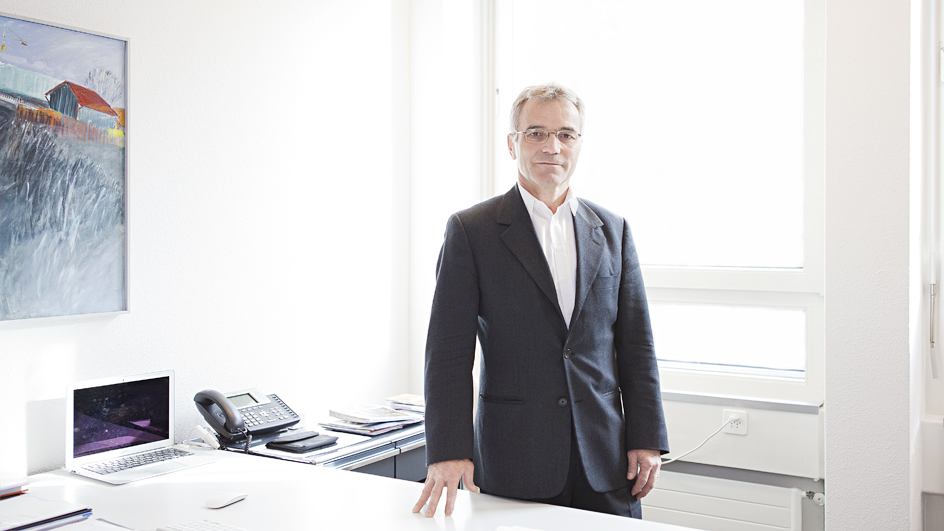
Mr Binkert, you have been working in property development for decades. What drives you personally and what is your vision for the future of architecture and property development?property development is also spatial development. With every building, we change our environment, the space around us. This change should be an improvement, not a deterioration. I am concerned with the question of the rules that we must observe to ensure that our built environment remains sustainable, liveable and fit for the future. I see the future of property development in creative, holistic planning that combines social needs with technological possibilities and puts people and the environment at the centre.
Which project has had a particular impact on you?
Every project broadens the horizon of experience – but Greencity Zurich was a turning point for me. It was the first time we developed concrete rules for Losinger Marazzi on how a neighbourhood has to be planned, built and operated in order to be considered truly sustainable. This project showed me how profound an impact sustainability can have when it is systematically thought through and implemented. The fact that Losinger Marazzi emerged as Switzerland’s first “green general contractor” was a strong sign that sustainability can also be a model for economic success.
As President of the 2000-Watt Smart Cities Association, you are committed to sustainable and energy-efficient cities. How do you specifically integrate sustainability aspects into your projects?
In Greencity Zurich, we developed comprehensive rules for the planning, construction and operation of a sustainable urban district for the first time. This resulted in the “2000-Watt-Areal” label, which has certified over 50 urban neighbourhoods throughout Switzerland. Today, we are developing it further under the authorisation of the Swiss Federal Office of Energy – with a view to the smart city. We were recently able to certify the first project in India.
The biggest challenge remains the balance between ecological, social and economic sustainability – especially internationally. In China, social demands are difficult to realise, in Brazil there is often a lack of environmental understanding, in the Emirates economic efficiency is not an issue. In Switzerland, too, it takes empathy, understanding and perseverance to implement viable, sustainable solutions.
You have international experience, including in the USA and India. What differences and similarities do you see in urban development between Switzerland and these countries?
The main difference lies in the pace of growth: emerging countries with rapidly growing populations need a lot of new space quickly and cheaply – often at the expense of quality. There, sustainability is a promise for the future that is often met with scepticism. Sustainability costs a lot in the short term, but only yields returns in the long term, but then, according to our assumptions, it covers the costs many times over.
In the western world – where growth is stagnating or declining – other values take centre stage: social justice, the circular economy, biodiversity. Here, sustainable development is increasingly seen as a prerequisite for quality of life. However, the demand that the West must also pay for sustainable development in emerging countries is also pushing wealthy countries like Switzerland to their limits.
What trends do you see in future urban and area development and how do you envisage the forms of housing of the future, particularly with regard to demographic change, increasing urbanisation and densification?
We are at a turning point. The construction industry urgently needs to catch up in areas such as digitalisation, automation and artificial intelligence. We are still building “brick and mortar” – as in Roman times. While basic human needs have hardly changed, the technical possibilities certainly have. The megatrends – demographic change, health, the future of work, the climate crisis – require new answers to the question of how we live. We must have the courage to question the status quo, break new ground and try out solutions that did not exist in the past.
The “housingisation of Switzerland” cannot continue. What used to work in a Switzerland with 6 million inhabitants and limited mobility is now leading to collapse. We need to see ourselves more as part of the universe again, in which we are just one of many species – not as dominators. Every day we see the consequences of our short-sighted use of finite resources, diminishing biodiversity and the waste of energy.
In future, we will move closer together, make space for others, live more efficiently and with greater sufficiency. To ensure that this does not diminish our quality of life, we need to make better use of the technological opportunities that are already available to us today and those that we will develop in the future. We will live more urbanised lives than we do today, we will meet our daily needs within walking distance and we will be better connected.
We have now reached 9 million inhabitants in Switzerland. The property industry has been talking about a Switzerland of 10 million for some time now. In your opinion, are we sufficiently prepared for this and where do you still see a need to catch up?
The idea of a Switzerland of 10 million is already outdated. If we want to enable our ageing society to live comfortably, we need an additional young and well-educated workforce – we need a 12-million-strong Switzerland! We must offer sustainable solutions to the expected migration flows of climate refugees and war refugees without jeopardising our culture and history. The faster and better we prepare for this, the more we will be able to benefit from it.
We are ill-prepared for the exogenous paradigm shifts. Although we are aware of the pull of the big cities, we do not offer any alternatives. We still work with zoning plans, even though these are no longer able to reflect our production and our way of life. We stare spellbound at the successful crowd-pullers of Zurich, Basel and Geneva instead of recognising and exploiting the dormant qualities of small towns such as Lenzburg, Brugg, Wetzikon or Glarus. There is an urgent need to catch up here.
Our vision of Smart City Switzerland is not a megacity with a sprawling agglomeration – quite the opposite: we are proposing to become more compartmentalised again. It is not the large Swiss cities that should grow, but the medium-sized and well-connected smaller cities that should become denser and more urbanised – with plenty of green space in between. Urbanisation includes the improvement of amenities, cultural enhancement and, in particular, the creation of new jobs. And where research on settlement development identifies gaps in the urban network, we must also have the courage to build new cities.
What roles and long-term vision do you see for the Glarus economic region and which key projects will characterise the coming years?
Glarus North is the economic backbone of the canton – with its location, infrastructure and proximity to the Zurich economic area, it offers enormous potential for production and services. Glarus South, on the other hand, scores highly in terms of nature, recreational value and quality of life. These two areas should be considered much more in terms of a functional symbiosis. The Glarus 2030 vision shows clear prospects for this, but it needs to be supported more broadly. Key projects in Näfels-Mollis and Niederurnen-Oberurnen would be ideal catalysts, but have so far been underutilised – not even in the recently adopted municipal structure planning. Narrow cantonal and federal regulations on building zone dimensions are slowing down development – there needs to be room for manoeuvre for future-oriented solutions.
One of your students’ Master’s theses analyses Glarus North as a potential sub-centre in the Zurich economic region. How do you assess the development potential of this region, particularly with regard to infrastructure, industries, jobs
and housing?
The potential of Glarus North is impressive. Our studies on Smart City Switzerland show that there is space for a medium-sized city on both sides of Lake Walen – but whether this is created in Glarus North, Ausserschwyz or Sarganserland ultimately depends on the political will of the residents.
The aforementioned HSLU master’s thesis examines the relationship between the large city of Zurich and the surrounding sub-centres (nodes of second centrality). The current situation of the brain drain and the salary mercenaries who commute back and forth between rural Glarus and urban Zurich is contrasted with the vision of the 15-minute town of Glarus Nord. The master’s thesis confirms the interdependence of spatial planning and economic development, of densification and diversity of use, of jobs and living space.
What needs to happen from a planning and political perspective so that Glarus not only grows, but also helps to shape the future?
From the perspective of Smart City Switzerland, the Federal Office for Spatial Development ARE must revise spatial planning throughout Switzerland and create new open spaces for densified settlement development. On this basis, existing cities can be densified or even new regional cities (nodes of second centrality) and small towns (nodes of third centrality) can be developed.
For Glarus, this specifically means active lobbying in Bern to position Glarus North as a business location. This is the only way for the canton to free itself from the role of passive follower in financial equalisation. A clear decision needs to be made between a wait-and-see approach and active participation. If you want to help shape the future, you have to invest – in planning and development, infrastructure, location marketing and political persuasion.
What role does the cantonal structure plan play in this and what influence can be exerted at communal level?
The cantonal structure plan reflects the current situation and takes a linear approach. It does not reflect the paradigm shifts that we will be facing in the coming years. The structure plan also offers insufficient flexibility to be able to react to the new exogenous and endogenous challenges.
The scope for influencing the overarching structure plan is limited. The municipality is dependent on the canton, and the canton in turn is dependent on the federal government. In addition, the requirement for planning consistency makes any innovation difficult. The reaction times are too long. Nevertheless, there are levers: pilot projects and development centres (ESP) make it possible to test innovative ideas and try out new urban models.
Today’s 105th immoTable in Glarus makes an important contribution to the urgently needed discussion on whether Glarus wants to become a location for the future.