Tag: Städtebau

  • Canton Aargau approves Vinea project in Spreitenbach

    Canton Aargau approves Vinea project in Spreitenbach

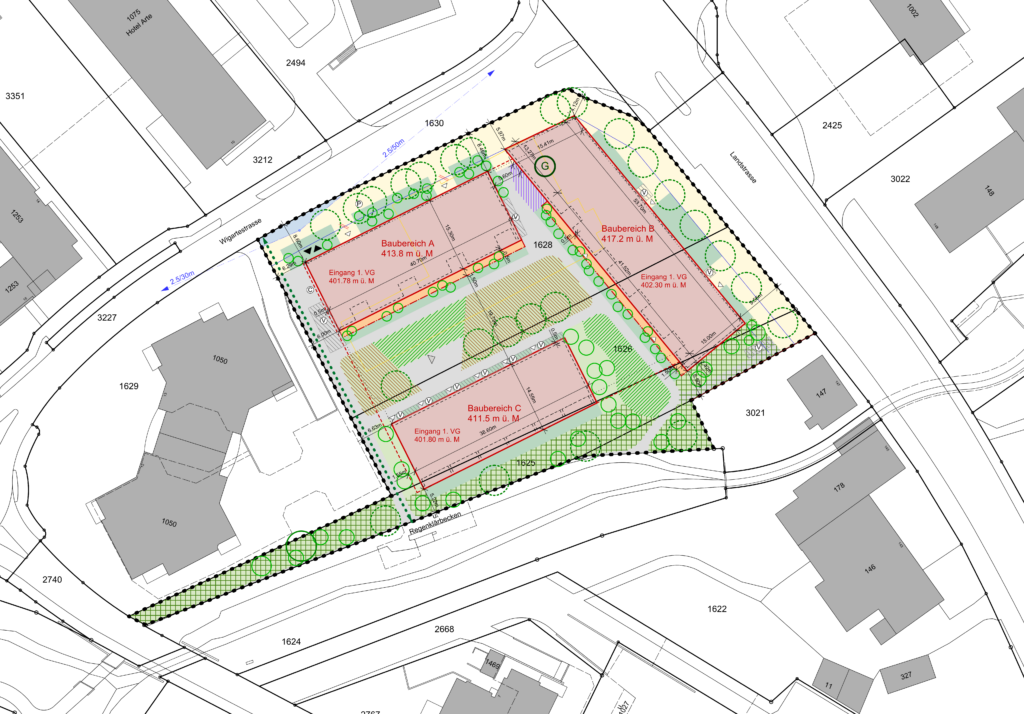
    The municipality of Spreitenbach can realise the Vinea design plan for the construction of flats at the entrance to the village. The Department of Construction, Transport and Environment(BVU) of the Canton of Aargau has approved the design plan, according to a press release. It forms the planning basis for the realisation of a development with around 37 flats on the previously commercially used site south of the Landstrasse and Wigartestrasse junction.

    According to the municipality, the planned development comprises three buildings. A four-storey building is to be constructed along Landstrasse, a three-storey building on Wigartestrasse and a two-storey building directly facing the village stream.

    A traffic-free inner courtyard is to be created between the buildings, which will be available to residents. The underground car park is intended to increase the quality of living and contribute to sustainable development.

    Vinea is based on the indicative project by Hunziker Architekten AG in Baden-Dättwil and SKK Landschaftsarchitekten AG in Wettingen AG. Metron AG in Brugg AG drew up the design plan together with the client and the municipality of Spreitenbach. The Vinea site is currently built on with a commercial development. A development study was prepared by Hunziker Architekten back in 2018. After weighing up various options, the municipality decided in favour of a longitudinally oriented development along the road in order to “create optimal urban planning conditions”.

  • A historical heritage in new splendour

    A historical heritage in new splendour

    in 1896, Richard Theiler laid the foundation stone for the Electrotechnical Institute, which later became world-famous as Landis Gyr, with the construction of the Theilerhaus. The importance of the Theilerhaus for the people of Zug cannot be denied and its preservation became a priority in 1989 when the Canton of Zug acquired the site in order to preserve it for future generations.

    Preservation of historical substance
    The Canton of Zug has developed a comprehensive concept entitled “The Theilerhaus and its spirit”. This outline of ideas aims to preserve the “spirit” of the buildings and to bring together aspects of economy, technology, architecture and culture in a holistic framework.

    Refurbishment in keeping with the heritage
    The maintenance measures extend to all existing old buildings, focussing on earthquake safety, fire protection and accessibility. The renewal of windows, sun protection and roof cladding as well as the insulation of the Shedhalle are important steps towards meeting the requirements. The new building in the eastern area respects the historical substance and creates an appealing overall urban structure.

    A new urban accent
    The planned new building complements the urban ensemble and consists of a five-storey head building and a four-storey intermediate building. This design, which is connected to the high-rise building by a modern stair tower, blends harmoniously into the existing surroundings and strengthens the identity of the site.

    The Shedhalle as a cultural, creative space
    Once the renovation work has been completed, the Shedhalle will not only function as a place of remembrance of the past, but also as a lively space for cultural and artistic events. This use offers added value for the people of Zug and emphasises the versatility of the site and its relevance in today’s world.

    Forward-looking project
    Overall, this project represents a significant step in the urban development of the Canton of Zug and should benefit future generations. The planned measures emphasise how important it is to view historical heritage as part of a living, constantly evolving society and to shape it accordingly.

  • Halter establishes competence centre for urban development and architecture

    Halter establishes competence centre for urban development and architecture

    Schlieren-based real estate developer Halter is creating a new centre of excellence for urban planning and architecture. According to a press release, it will be set up within the company under the responsibility of Christof Glaus, former Senior Partner at Stücheli Architekten in Zurich. The centre will support the areas of developments, overall services and renovations, particularly in the early strategic phases of project development. The establishment of the competence centre is scheduled to begin in April.

    As a Halter Group company, Halter AG shares the vision of establishing a circular economy in order to achieve the net-zero sustainability target for all projects. This requires a structural change in the property and construction industry that promotes and demands integrated collaboration models, the company continues.

    The new team for urban development and architecture is directly affiliated to the CEO of Halter AG and supports the areas of development, overall services and renovations in the early strategic phases of project development with urban development and architectural feasibility studies. The close and cooperative partnership with external, recognised urban planners, architects and open space planners remains of central importance.

    “In Christof Glaus, we have gained a renowned urban planner and architect who has been responsible for many outstanding designs and their realisation during his successful career,” says Maik Neuhaus, CEO of Halter AG. Glaus’ skills as a jury member or chairman of numerous competitions are also undisputed.

  • A new chapter is being opened on the former Comadur site

    A new chapter is being opened on the former Comadur site

    High-quality and identity-creating development
    The project vision for the development /
    reuse of the former Comadur site is to develop an urban, mixed-use, identity-creating neighbourhood component with high-quality buildings and open spaces in the short to medium term. Accordingly, the city of Thun and the client (Pension Fund of the Swiss Bar Association (PKSAV)) carried out a multi-stage planning process. The aim was to sound out the potential of the site in a study of design variants, to secure the urban planning qualities as part of a project competition in accordance with SIA Ordinance 142 and to define these under planning law in a zone with planning obligation (ZPP).

    The winning project “Capybara
    The winning project “Capybara” forms the basis for the development of the Comadur site at Bernstrasse 11. It sets new accents in a heterogeneous environment with innovative urban planning and architectural measures. The three characterful buildings – the “Stadthaus”, the “Gartenhaus” and the “Anbau” – merge creatively with the existing structure of the neighbourhood. They form a coherent ensemble that impresses with its density, diversity and clear identities. A central element of the design is the connecting inner courtyard. It not only creates a seamless integration of the new buildings, but also promotes dialogue with the surrounding neighbourhood. The skilful combination of materials, colours and textures creates an interplay between the history of Comadur and the contemporary elements of the project.

    Sustainable design
    The project is of a very high quality in various aspects. In addition to the visible and appealing design, sustainability considerations and the consideration of grey energy as well as a conscious and careful use of materials play an important role. The project offers a balanced mix of aesthetics, sustainability and integration into the existing neighbourhood.

    Diverse and lively “neighbourhood piece
    The focus of the site development is on the realisation of contemporary forms of housing. Around 60 new flats are planned. The residential units are diverse and specifically designed to meet the diverse needs of potential residents. This residential use will be supplemented by additional uses that are adapted to the location and orientated towards the public. In this way, a lively and identity-creating neighbourhood component is being created.

    Conclusion
    The site development at Bernstrasse 11 presents itself as a visionary project that honours the past and at the same time provides forward-looking impetus. The winning project “Capybara” shows how history and the present can be combined in a densely populated area, always focussing on quality and care.

  • Using climate simulation to combat heat islands

    Using climate simulation to combat heat islands

    The heating of asphalted city centres – so-called heat islands – is a well-known problem in urban development. However, it can be noticeably improved with smart measures. This is demonstrated by the city of Winterthur in cooperation with the spatial planning office Berchtoldkrass Space & Options and the office GEO-NET Umweltconsulting GmbH, which specialises in climate analyses, by means of a computer-assisted climate modelling for the Lokstadt. The current planning status was compared with two climate-optimised scenarios. Thanks to the simulation, it is possible to see how the design of the buildings and open spaces affect the outside temperatures and thus influence the quality of stay in the area. At the same time, it was tested which measures are particularly feasible and effective. The pilot study is part of the Smart City Winterthur programme and was made possible by its innovation loan. It was commissioned by the Office of Urban Development.

    Numerous residential units and workplaces will be built on the Lokstadt planning perimeter. In order for the neighbourhood to have a high quality of life later on, planning based on climate aspects makes sense. A climate-adapted and thus heat-tolerant design is possible despite dense construction: bioclimatically effective compensatory measures in Lokstadt include trees, unsealed, light-coloured and greened surfaces and shaded areas. Large green roofs – ideally in combination with shady photovoltaic systems – have a positive effect on the urban climate. In addition to façade greening, water areas and drinking fountains improve the quality of stay.

    The evaluation shows: The Lokstadt was already well positioned in terms of urban climate in the original planning in the design of the public space. In order to further optimise the climate, additional tree locations as well as light-coloured, infiltration-capable surfaces are being examined. The technology offers all the prerequisites for optimising the urban design of the future in terms of climate.