Tag: Stahlbeton

  • Innovative measurement technology facilitates structural inspection of reinforced concrete

    Innovative measurement technology facilitates structural inspection of reinforced concrete

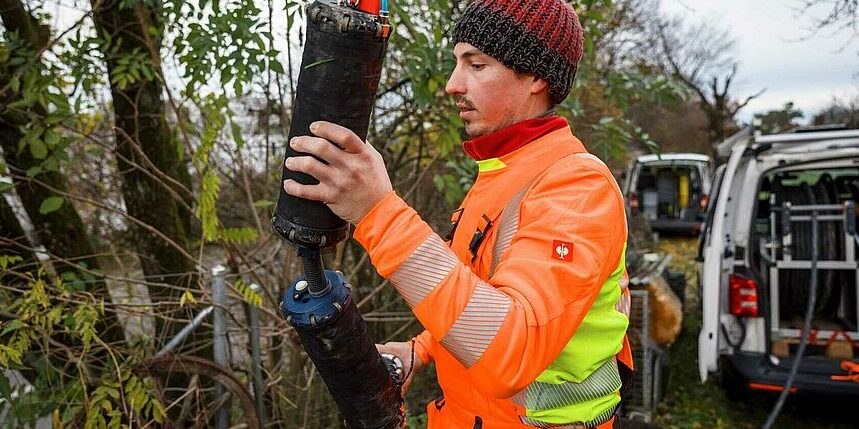
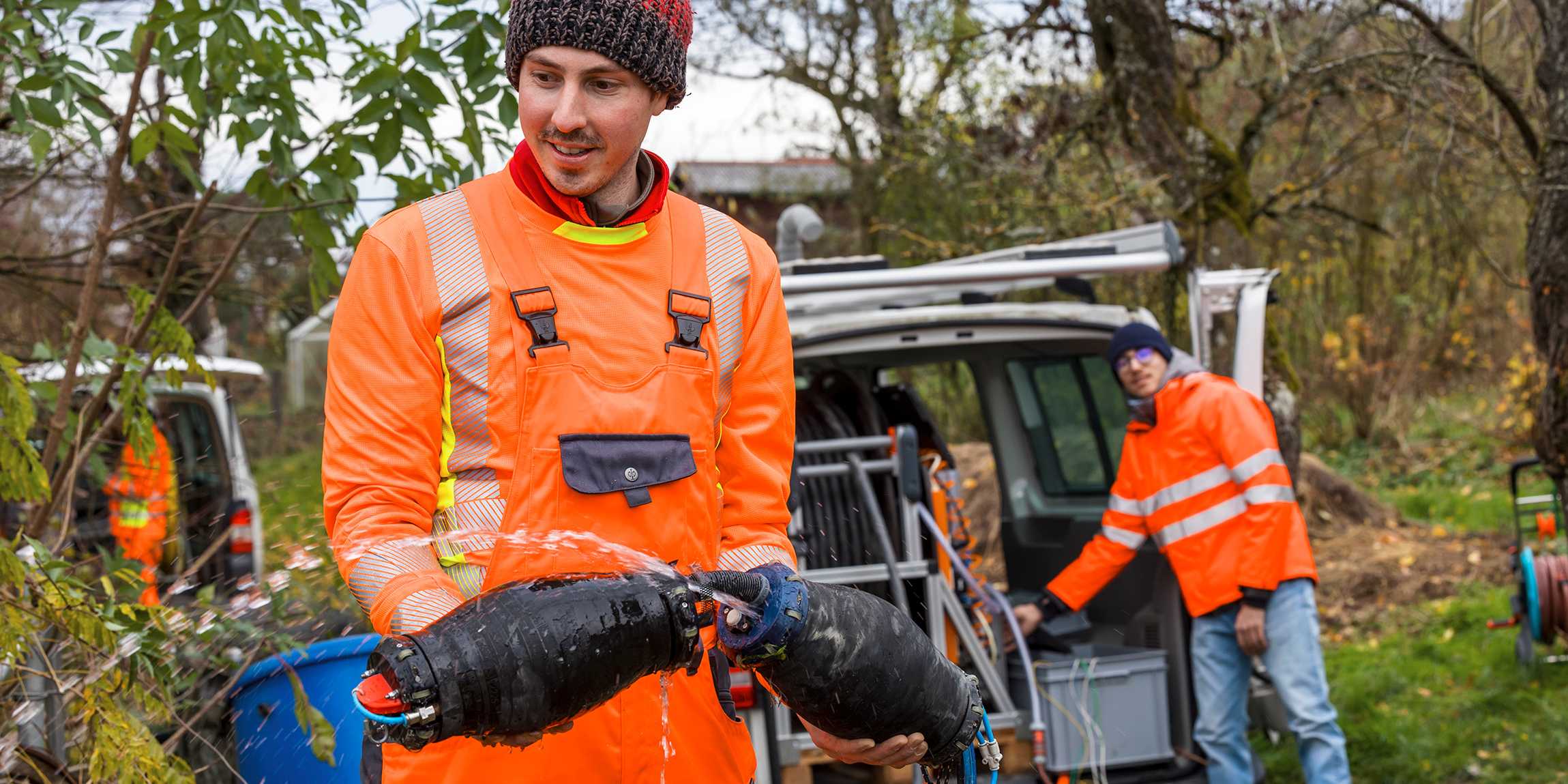
    Researchers at the Swiss Federal Institute of Technology in Zurich(ETH) have developed a method for detecting corrosion in the reinforcing steel of reinforced concrete structures without having to break open the concrete. The method developed by mechanical engineer Lukas Bircher and his team is based on electrochemical measurements, the ETH reported in a press release. Specifically, the researchers have invented a probe consisting of two inflatable seals with electrodes in the centre. A water pipe is built into the associated cable.

    The probe is inserted into the drainage pipes, the seals are inflated and water is then fed into the sealed area. The water creates a connection between the electrodes in the probe and the soil through the holes in the drainage pipe. This creates an electrolytically conductive connection to the steel in the structure, which forms a localised electrochemical measuring point. “We use the measuring cell to record electrical signals, which vary depending on whether the reinforcing steel is corroded or not,” Bircher is quoted as saying in the press release.

    At present, the probe still has to be passed manually through the drainage pipes one by one to enable a comprehensive assessment of the condition of the steel. In the next step, the team wants to “automate the measurement more and make the inspection probe more robust”, explains Bircher. As the concept has already proved its worth, he will found a start-up called Talpa Inspection together with materials engineer Federico Martinelli-Orlando and civil engineer Patrick Pfändler.

  • New measurement technology detects corrosion in reinforced concrete without intervention

    New measurement technology detects corrosion in reinforced concrete without intervention

    Retaining walls, tunnels and bridges made of reinforced concrete characterise the Swiss cityscape and infrastructure. However, many of these structures are already several decades old – and chemical changes in the concrete affect the steel used. If the reinforcing steel begins to rust, the structure loses stability. The damage is particularly problematic in inaccessible places where conventional testing methods fail.

    Electrochemical measurements as a new solution
    Until now, engineers have had to break open parts of the concrete to check for corrosion damage. A time-consuming and often inadequate procedure. Talpa has developed a new method that works via drainage pipes. A special probe is inserted into the pipe and uses electrochemical signals to measure the likelihood of corrosion in the surrounding reinforced concrete.

    “This has never been done before,” explains Lukas Bircher, one of the developers. “Previously, you had to remove entire concrete surfaces to find damage and could still easily miss a critical area.” With the new technology, entire sections of wall can now be systematically tested without destruction or costly construction work.

    Measurements during operation – without a construction site
    The method has already been successfully tested, including on a 200 metre-long retaining wall in Zurich-Höngg. The principle is a probe that is inserted into the drainage pipe and fixed in place with inflatable seals. The system then directs water into the measuring area, creating a conductive connection between the electrodes of the probe and the steel in the concrete. Based on the recorded electrical signals, the team can recognise whether and to what extent corrosion is present.

    A new measurement is taken every 25 centimetres to record the condition of the entire section of wall. “This allows us to specifically identify those areas that actually pose a risk,” says Bircher. “This not only saves time, but also high costs for unnecessary interventions.”

    50 years after the construction boom – the need for renovation is growing
    Many of the reinforced concrete structures affected today date from the boom period between 1960 and 1980. Retaining walls from the 1970s in particular often contain cavities that favour corrosion. Previously, damage had to be identified by means of time-consuming spot checks, with a high risk of overlooking critical areas. The new method offers a comprehensive and reliable analysis for the first time.

    From research to start-up Talpa-Inspection
    The technology has such great potential that Bircher founds the start-up Talpa-Inspection together with two colleagues. The name “Talpa”, Latin for “mole”, symbolises the innovative way of making deeply hidden damage visible. Supported by an ETH Pioneer Fellowship, the team is further developing the technology and preparing to enter the market.

    Future prospects, automation and scaling
    The measurement is currently still partly manual, but the team is already working on an automated version. The aim is to make the probe more robust and further accelerate the measurement process. Demand is high. In Switzerland alone, there are over 1,000 kilometres of potentially affected reinforced concrete structures.

    “Our method offers a real opportunity to extend the service life of existing structures,” says Bircher. “We hope that it will soon establish itself as a standard procedure for structural diagnostics.”
  • Will this environmentally friendly composite material make reinforced concrete superfluous?

    Will this environmentally friendly composite material make reinforced concrete superfluous?

    The production of cement is considered to be particularly harmful to the climate, which is why the construction industry is looking for alternatives to reduce CO2 emissions. Researchers at the German Institute of Textile and Fibre Research (DITF) in Denkendorf have developed such an alternative. The new composite material made of natural stone, carbon fibres and biochar could be an environmentally friendly alternative to reinforced concrete and has an excellent CO2 balance.

    Joint project DACCUSS-Pre
    The use of plant materials such as wood, straw or other plant fibres as building materials enables efficient carbon sequestration. But for the team in the DACCUSS-Pre project, short-term storage is not enough. They are working on a new building material called CFS (CarbonFibreStone), which consists of plant-based carbon fibres, biochar and hard rock. This building material should not only fulfil all technical requirements, but also remove more carbon dioxide from the atmosphere in the long term than is released during its production.

    CFS achieves this carbon sequestration in three different ways
    The conversion of carbon-rich biomass such as algae into carbon fibres makes it possible to store carbon in the building material in the long term. The hard stone in the CFS also contributes to the binding of CO₂. Stone dust is produced during the manufacturing process, which accelerates the weathering of the stone and thus binds carbon dioxide from the air in the stone through chemical reactions. Biochar, another durable and carbon-rich material obtained from plant parts, is used as an insulating layer between the stone slabs.

    Building façade realised
    In close cooperation with the company TechnoCarbon Technologies, the project has already made considerable progress – a first prototype in the form of a building element for house walls has been successfully realised. This consists of the aforementioned components carbon fibres, hard rock and biochar. Two natural stone slabs serve as the outer walls of the building element. The carbon fibres reinforce the side walls with the help of technical fabrics and take on the tensile load, similar to reinforcing steel in reinforced concrete. The biochar in turn serves as filling material and acts as effective insulation.

    BIO-carbon fibres from raw materials
    The carbon fibres developed at DITF Denkendorf consist of lignin, which is obtained from biomass. These fibres are characterised by their cost-effectiveness due to low raw material costs and their efficiency in binding carbon. Compared to conventional reinforcing steel, they do not rust, which extends their service life. Although their production requires more energy than that of steel, the amount used in construction is so small that the overall balance of energy and CO2 emissions is more positive than that of reinforced concrete. The use of solar energy and biomass during production and the natural weathering of the stone powder mean that the CO2 balance of the new building material is actually negative. This means that buildings can be constructed that actively contribute to CO2 reduction.

    Environmental impact of the building façade
    The researchers from Denkendorf report enthusiastically about the new demonstrator for a wall element in building construction. This is made of gabbro, a natural stone from India, which is not only visually appealing but also has a high load-bearing capacity, as load tests confirm. The top layer of the stone panels is made from bio-based carbon fibres, with the biochar coming from the renowned Convoris GmbH, which is known for its excellent thermal insulation values.