Tag: Start-up

  • PropTech start-up develops AI solution for property

    PropTech start-up develops AI solution for property

    The start-up Nestermind, which specialises in AI-supported automation solutions in the real estate sector, has successfully completed a substantially oversubscribed pre-seed financing round, according to a press release.

    The fresh capital will be used to further develop the technology and boost the company’s national and international market presence. The Agentic AI software developed by Nestermind enables easier management of property listings, better customer communication and faster sales processes.

    “We are proud to have such experienced and strategically valuable partners at our side who share our vision of taking property marketing to a new level,” said co-founder and CEO Lucas Pelloni.

    The platform opens up new ways for players in the property industry to network in a data-driven ecosystem. “We are thus creating enormous efficiency potential and paving the way for a new way of working in the property industry,” co-founder and CTO Severin Wullschleger is quoted as saying.

    According to the company, the software is particularly tailored to the needs of smaller SMEs in the property sector. By automating tasks such as lead generation and CRM management, they can increase efficiency and save time without having to invest in complex systems.

    According to the press release, the financing was concluded with the participation of a round of investors comprising “well-known personalities from the property sector, renowned family offices and leading property companies”. The amount was not disclosed.

  • New measurement technology detects corrosion in reinforced concrete without intervention

    New measurement technology detects corrosion in reinforced concrete without intervention

    Retaining walls, tunnels and bridges made of reinforced concrete characterise the Swiss cityscape and infrastructure. However, many of these structures are already several decades old – and chemical changes in the concrete affect the steel used. If the reinforcing steel begins to rust, the structure loses stability. The damage is particularly problematic in inaccessible places where conventional testing methods fail.

    Electrochemical measurements as a new solution
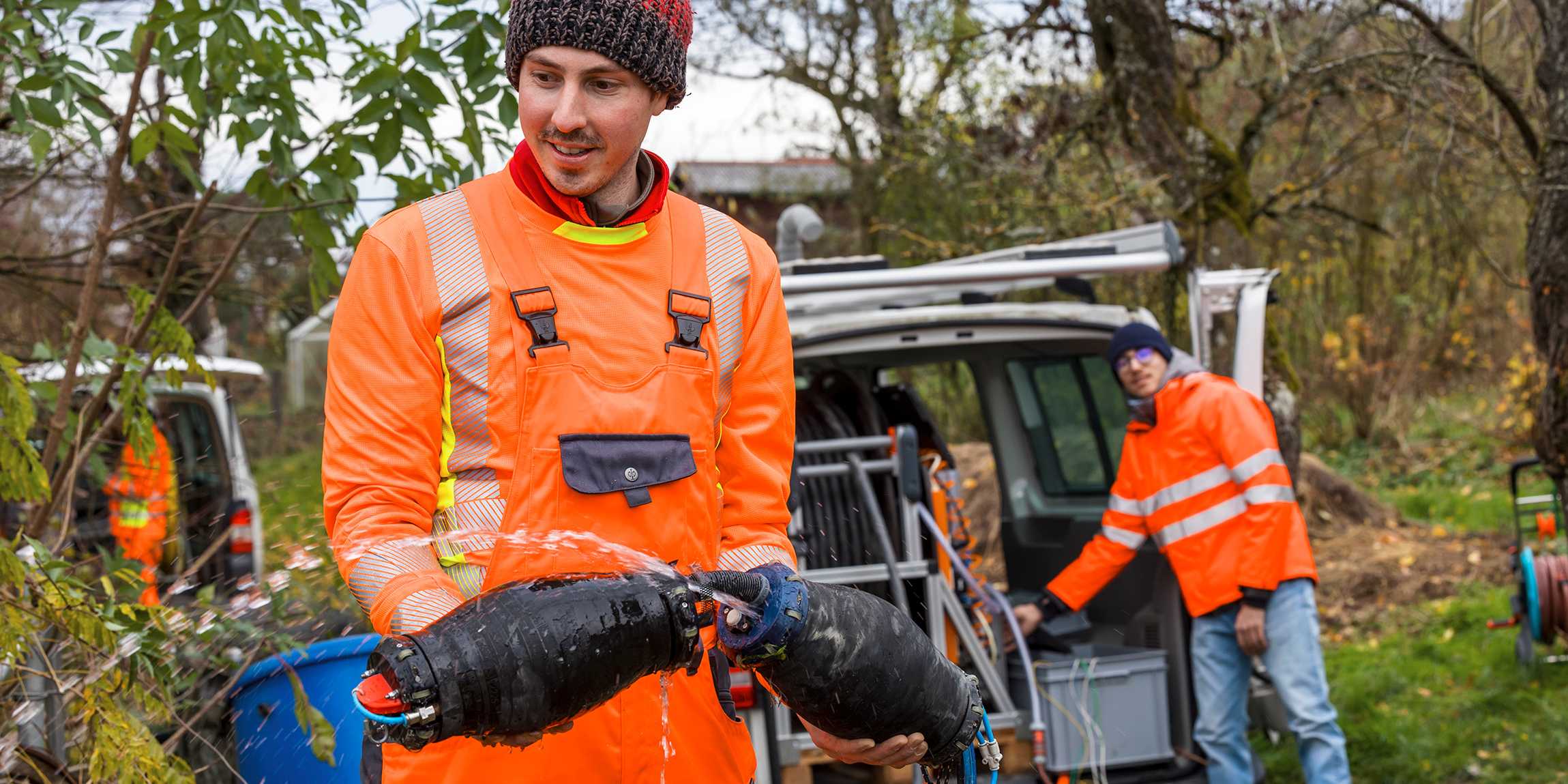
    Until now, engineers have had to break open parts of the concrete to check for corrosion damage. A time-consuming and often inadequate procedure. Talpa has developed a new method that works via drainage pipes. A special probe is inserted into the pipe and uses electrochemical signals to measure the likelihood of corrosion in the surrounding reinforced concrete.

    “This has never been done before,” explains Lukas Bircher, one of the developers. “Previously, you had to remove entire concrete surfaces to find damage and could still easily miss a critical area.” With the new technology, entire sections of wall can now be systematically tested without destruction or costly construction work.

    Measurements during operation – without a construction site
    The method has already been successfully tested, including on a 200 metre-long retaining wall in Zurich-Höngg. The principle is a probe that is inserted into the drainage pipe and fixed in place with inflatable seals. The system then directs water into the measuring area, creating a conductive connection between the electrodes of the probe and the steel in the concrete. Based on the recorded electrical signals, the team can recognise whether and to what extent corrosion is present.

    A new measurement is taken every 25 centimetres to record the condition of the entire section of wall. “This allows us to specifically identify those areas that actually pose a risk,” says Bircher. “This not only saves time, but also high costs for unnecessary interventions.”

    50 years after the construction boom – the need for renovation is growing
    Many of the reinforced concrete structures affected today date from the boom period between 1960 and 1980. Retaining walls from the 1970s in particular often contain cavities that favour corrosion. Previously, damage had to be identified by means of time-consuming spot checks, with a high risk of overlooking critical areas. The new method offers a comprehensive and reliable analysis for the first time.

    From research to start-up Talpa-Inspection
    The technology has such great potential that Bircher founds the start-up Talpa-Inspection together with two colleagues. The name “Talpa”, Latin for “mole”, symbolises the innovative way of making deeply hidden damage visible. Supported by an ETH Pioneer Fellowship, the team is further developing the technology and preparing to enter the market.

    Future prospects, automation and scaling
    The measurement is currently still partly manual, but the team is already working on an automated version. The aim is to make the probe more robust and further accelerate the measurement process. Demand is high. In Switzerland alone, there are over 1,000 kilometres of potentially affected reinforced concrete structures.

    “Our method offers a real opportunity to extend the service life of existing structures,” says Bircher. “We hope that it will soon establish itself as a standard procedure for structural diagnostics.”

  • Der Switzerland Innovation Park Central

    Der Switzerland Innovation Park Central

    At Suurstoffi in Rotkreuz, the SIPC offers an inspiring environment that promotes dialogue and collaboration between over 120 partners from business, science and society. A vibrant innovation ecosystem is created here that efficiently translates new ideas into marketable solutions in the construction sector.

    Diverse formats to promote innovation
    In order to drive innovation, the SIPC works in five thematically focussed Future Labs, which specifically address current challenges such as the transformation to a circular economy in construction or new processing models
    in construction or new processing models. These labs are hybrid working environments with structured processes and formats that promote collaborative innovation. A variety of event and workshop formats as well as the digital community platform Jointcreate – a kind of “LinkedIn for innovation” – provide inspiration, empower participants and support the innovation process. The focus is always on implementation to achieve real impact. Financing and start-up advice as well as office and project space are available for this purpose.
    The SIPC also manages various programmes, such as the Circular Building Charter, an association of major real estate investors who are increasingly focusing on circular procurement and construction methods. The SIPC imparts knowledge in regular experience workshops. The open sharing of experiences in pioneering projects promotes dialogue within the industry.

    A contribution to the construction industry of tomorrow
    With its clear values – openness, fairness and professionalism – the SIPC makes a decisive contribution to the transformation of the construction industry. As a non-profit organisation, it pursues the motto “Building Excellence” and invites all interested parties to become part of this movement. Switzerland Innovation Park Central shows how innovation in the construction industry can promote not only technological progress but also social responsibility. By combining vision and practice, the SIPC is shaping a sustainable future and is an indispensable partner for anyone who wants to contribute to the construction industry of tomorrow.

  • The Ark and CleantechAlps are looking for start-ups for smart energy utilisation

    The Ark and CleantechAlps are looking for start-ups for smart energy utilisation

    CleantechAlps, the cluster of cleantech companies in Western Switzerland, and The Ark, a foundation for innovation in Valais, are organising the second pitch contest for smart energy start-ups. The competition will take place on 30 August as part of the Smart Energy Events on the Energypolis Campus in Sion, the organisers announced in a press release. Interested start-ups have until 7 June to apply online to take part.

    We are looking for start-ups that were founded after 2014 and are active in the energy sector. A jury is responsible for pre-selecting the young companies that will ultimately take part in the competition. At the pitch contest itself, the start-ups compete for the best idea, the best short presentation and the audience award. All three awards come with prize money of CHF 5,000 each. In addition, the competition offers participants “a unique opportunity to present their company in the best possible light and meet important players in the industry”, write the organisers.

  • Enshift automates path from large buildings to net zero

    Enshift automates path from large buildings to net zero

    The young Baar-based cleantech company enshift offers owners of large commercial properties a complete digital solution for the path to net zero. According to a media release, it is designed to automate and simplify the entire transformation process towards local and renewable energies.

    Its toolset reportedly includes everything needed for design, contracting, financing, implementation and performance optimisation. It spans the life cycle of all currently available renewable energy technologies.

    “We have set our 2050 net-zero targets, but the path to get there is completely unclear for the construction and real estate sector,” founder and CEO Pierre Bi is quoted as saying. “We believe our solution can accelerate the transformation and increase energy retrofits in Europe by a factor of 3.” As a sign of its “strong will” to make a positive contribution to change, enshift offers free property and potential analyses to commercial building owners in Switzerland.

    Bi had already launched Aeris Cleantech. The company, which focuses on air purification, was acquired by iRobot, a North American specialist in cleaning robots, in November 2021.

    In the first stage of a seed financing round, Bis new company enshift raised 3.5 million Swiss francs. International investors such as Israel’s Sarona Ventures, Vevey VD-based OneCreation and, via Berlin-based Global Founders Capital, the founder of start-up accelerator Rocket Internet, Oliver Samwer, participated. Meanwhile, 20 engineers and developers reportedly work at enshift, while the first green energy projects are already entering the implementation phase.

  • Hoyou wins at the Start-up Weekend Uri 2023

    Hoyou wins at the Start-up Weekend Uri 2023

    The Canton of Uri held the second edition of its Start-up Weekend Uri from 1 to 4 September. The canton “once again presented itself as an attractive location for start-ups”, writes the cantonal Department of Economic Affairs in a statement. Four young companies were given the opportunity to further develop their business idea “in an inspiring environment between co-working space, canoe tours and culinary delights together with expert coaches”, it continues.

    “We have only known the canton of Uri in passing,” Miro Mandelz and Philip Zollinger of appreci8 are quoted as saying. Their start-up from Zollikon ZH uses artificial intelligence to mediate between job seekers and employers. “During the three days, we were able to get to know the versatile business and living location of Uri better and further develop our business idea.”

    At the final presentation on 4 September, Christine Hegglin was able to convince the jury of experts from companies and the cantonal administration with her platform for real estate exchange. She received the *zünder wildcard for this and is allowed to participate in the *zünder accelerator funding programme with her start-up Hoyou without going through the selection process.

  • Migros invests single-digit million sum in solar start-up Rayo

    Migros invests single-digit million sum in solar start-up Rayo

    Zurich-based Migros is investing in the Zurich start-up Rayo. To this end, the retail group is pouring capital in the single-digit millions into the start-up via Sparrow Ventures, a Migros subsidiary and growth capital provider, and Migrol AG, also part of the Migros Group, according to a media release.

    Rayo wants to make solar energy more accessible by renting out solar systems in a subscription model. This way, owners have no initial costs. Instead, owners pay “a fixed monthly amount for 20 years for their individual solar solution”. The price includes the photovoltaic system as well as all services from clarifications, planning, installation, maintenance and repairs to insurance and a smart home app.

    There is interest in sustainable, individual solar solutions and energy self-sufficiency. Nevertheless, according to the data, only about one in ten single-family homes in Switzerland has solar panels on the roof. This is low by European standards. According to a media release, Lorenz Lüchinger, CEO of Sparrow Ventures, believes that the reason for the reluctance to install solar panels on one’s own house is the initial costs and the administrative effort.

    It is precisely this gap that Rayo wants to close “and offer a solar solution with which the Swiss population can reduce their electricity costs and at the same time improve their ecological footprint”, Andreas Flütsch, CEO of Migrol, is quoted as saying.

    Rayo subscribers can also order a battery storage system for surplus solar power in addition to their solar package. Rayo also provides charging stations for electric vehicles, using synergies with Migrol and the Migros Group. Migrol, headquartered in Adliswil ZH, operates filling stations, charging stations and car repair shops, among other things.

  • ImmoTrack digitises home maintenance with artificial intelligence

    ImmoTrack digitises home maintenance with artificial intelligence

    The start-up ImmoTrack is launching an automated scheduling system for home maintenance. The Baar-based start-up is thus adding a module to its web-based software, according to an article by startupticker.ch.

    ImmoTrack has been developing a software-as-a-service solution for the digitalisation of caretaking processes since 2019. This is because, according to the information, work in this area is still often done manually. “Scheduling is done by hand with pen and paper, and property reports for clients recorded on the computer are printed out and sent by post.”

    As a result, there is no overview of the results and services provided. This leads to dissatisfied clients and tenants as well as high maintenance costs. Founder Ofer Becker, himself a former manager of a caretaker company, wanted to change this and developed a solution based on artificial intelligence with his team. Through self-learning algorithms, work scheduling can be constantly improved.

    “Over the past three and a half years, we have steadily developed the web-based solution and will be offering our latest achievement – automated work scheduling – from June,” founder Becker is quoted as saying in the article.

    A financing round is currently underway. So far, the company has been able to collect 2.5 million Swiss francs in investments. 20 customers are using the software. another 60 want to test it. ImmoTrack expects an increasing demand for a digital solution in the field of facility management.

  • Bernese wood technicians want to increase demand for beech wood

    Bernese wood technicians want to increase demand for beech wood

    The start-up Fagusnoir has been founded at the Department of Architecture, Wood and Construction(BFH-AHB) at the Bern University of Applied Sciences. The Biel-based wood engineers are striving for “new perspectives and a significantly higher status in the value-added process” for the native beech, according to a statement. At the Berlin Design Week, which runs until 17 May, they presented a process developed at the BFH’s wood technology laboratory that can be used to change the colour of beech wood. A new look could make beech, which is hardly used, more attractive for the construction industry. The aim is to colour solid beech wood over its entire cross-section. The basis is the substances tannin and iron contained in the wood. They set in motion a chemical reaction that produces a dark, greyish colour in the wood.

    In Switzerland, every fifth tree is a beech. For aesthetic reasons, darker and “expressive wood species such as oak, walnut and cherry” are in demand. The wood-processing industry prefers rare or non-native tree species for interior finishing and furniture production. They have to be bought in large quantities abroad.

    According to Fagusnoir, due to low demand, many beech trees are not felled, are sold abroad at cheap prices or end up as firewood on the domestic market. The increasing spread of beech trees has a negative impact on the ecosystem.

  • Start-up Beyoul sells holiday homes to several owners

    Start-up Beyoul sells holiday homes to several owners

    The Zurich-based proptech start-up Beyoul makes holiday homes and flats available to several parties via a platform. In this way, two to eight owners can buy a property together, according to a media release.

    This so-called co-ownership model reduces the costs for the purchase as well as for the maintenance. In addition, the maintenance costs and expenses associated with a second home are included in the price at Beyoul. Another advantage is that the properties are less likely to be vacant. This benefits the local economy.

    According to the press release, every tenth household in this country owns at least one holiday home. However, it is only used for an average of ten weeks a year. With the co-ownership approach, Beyoul wants to “adapt the ownership relationship to its own use”.

    A property at Beyoul is acquired by “two to eight parties with as complementary a use as possible”. The owners can dispose of the property according to their share. They reserve stays via an app. According to Beyoul, a fair distribution is ensured by a credit system in connection with a smart algorithm.

    Like an administration, Beyoul also takes care of the cleaning after each stay, the maintenance as well as the upkeep of the furnishings and the house.

    Beyoul is a concept of the Zurich-based Aquilas Company Builder AG. The consultancy company launches and scales innovative concepts in the field of global urban trends.

  • Venture Kick supports irmos technologies with 150,000 Swiss francs

    Venture Kick supports irmos technologies with 150,000 Swiss francs

    Irmos technologies receives financial support of 150,000 Swiss francs from Venture Kick. The start-up, which emerged from research centres at the Swiss Federal Institute of Technology Zurich, has developed a platform that uses sensors and intelligent algorithms to convert vibrations from traffic, wind, construction work and seismic events, for example, into structural condition data. In this way, the structural integrity of buildings is to be monitored in real time.

    According to a Venture Kick media release, greater monitoring of buildings and bridges is needed because 50 per cent of Switzerland’s 1.1 million buildings have exceeded their planned lifespan. Irmos technologies has reportedly already used the platform in several pilot projects, such as the Swiss Confederation’s official guest house, the Bellevue Palace in Bern, and the Glarus Cantonal Hospital. A long-term monitoring project has been agreed with the Federal Roads Office.

    The young company plans to invest the Venture Kick funds in expanding its market presence in Switzerland and developing the business plan for its international growth in 2024. In view of the severe damage caused by the earthquake in Turkey in February, with over 30,000 human victims and 10,000 buildings destroyed, irmos says an early warning system is urgently needed in Switzerland. The market volume for its use here is estimated at 100 million Swiss francs annually.

    “If our start-up is a sailboat, Venture Kick was literally the wind and the compass for our entrepreneurial journey,” Panagiotis Martakis, managing director of irmos technologies, is quoted as saying in the statement. “In addition to the massive financial support, the coaching kicks and the network of investors and industry experts turned our research idea into a valuable commercial proposition.”

  • Swiss AI is in the final of the Elevator Pitch Competition

    Swiss AI is in the final of the Elevator Pitch Competition

    Swiss AI has been nominated for the Elevator Pitch Competition(EPiC) 2023 in Hong Kong. The Zug-based start-up is one of 24 finalists in the Proptechs category, according to a statement from the organiser, the Hong Kong Science and Technology Parks Corporation(HKSTP). Another 26 finalists were named in the Fintechs category. The 50 young companies were selected from 618 applications from 55 countries.

    Swiss AI uses optimisation algorithms to help multinational companies and other clientele from around the world plan their investment decisions. A digital twin combines the financial, technical, environmental and quality of life impacts of planning to enable informed decision-making. Swiss AI is about “promoting sustainable societal change in terms of energy, mobility and urbanisation while creating investment opportunities around the world”. The company is based in Zug and the development department is in Zurich.

    The EPiC finale will take place on 28 April at Hong Kong’s tallest building, the International Commerce Centre. The centrepiece of the event is a 60-second lift ride during which participants present their business model.

    According to the announcement, EpiC, with the Science Park’s network of more than 1,000 investors and 300 corporate partners, offers “the best platform available for start-ups” to achieve “real business success”. All 50 finalists would have the chance to be considered for direct investments of up to $5 million from the HKSOP Venture Fund and receive support for market expansion across Asia. In addition, the overall winner will receive $90,000.

  • The shell of the QUBO think tank is complete

    The shell of the QUBO think tank is complete

    The shell of the two interconnected buildings of QUBO in Sarnen North is complete. Sixteen months have passed since the groundbreaking ceremony. According to a media release from Obwaldner Kantonalbank(OKB), this think tank will offer established companies, innovative start-ups and co-workers space for meetings and interactive inspiration.

    OKB is constructing a new building there that will provide a new home for innovative companies in Obwalden. The bank will make most of the premises in the new building available to the Startup Pilatus association for the promotion of start-ups as early as October 2023. OKB itself will set up an Innovation Lab there for itself and others. Eberli AG is modernising and expanding its existing headquarters there. Its two conversion and expansion partners, werkunion ag and Orfida Treuhand + Revisions AG, will each occupy one floor as future co-owners of the building.

    The QUBO will have the QULT bistro on the ground floor and the QLUB room for events with up to 100 people. The OKB describes the official opening, planned for March 2024, as an “important milestone for Sarnen as a business location and for entrepreneurs in the region”.

  • On course for expansion – Woonig takes over Scantick

    On course for expansion – Woonig takes over Scantick

    "We are pleased to be able to provide our customers and interested parties with an expanded range of products and services with the acquisition of Scantick" – Erich Linus Birchler, founder and CEO of Woonig AG

    In addition to the smart ticketing module, the communication module will also be expanded to include an innovative component. In the future, for example, pinboard messages from the Woonig Infocenter can be displayed directly at the properties via a “low-power display”.

    About Scantick
    Scantick, based in Zweidlen Zurich, is a ticket system with which messages can be recorded quickly and easily via a QR code and faults and problems can be eliminated. Scantick is active in the real estate management, sanitary and commercial/manufacturing sectors.

    About Woonig
    The IT company Woonig, based in Bottighofen on Lake Constance, offers a "Software as a Service" (SaaS) communication and interaction platform for real estate management (RE Edition) and for service providers (DL Edition), for digitizing and automating the processes between real estate managers , tenants/owners and service providers.

    The Woonig software is easy to integrate, configure and can be used productively in just a few steps. Woonig also offers standard interfaces to common real estate management systems.

  • Swiss Prime Site selects four start-up ideas

    Swiss Prime Site selects four start-up ideas

    Swiss Prime Site , a listed real estate company based in Zug, has identified and promoted four start-ups in its accelerator program that are rethinking existing business models in the industry: DuraMon from Zurich, Novalytica with offices in Bern and Zurich, Proximi from Helsinki and Spotr from Den Hague.

    The participants had to develop relevant use cases for the real estate company and its subsidiaries, which lead to sustainable processes , improved efficiency and sustainable growth. Finally, the jury selected these four start-ups that were able to present themselves to the board of directors. The aim is a sustainable cooperation.

    DuraMon believes in safer, more affordable and sustainable construction and repair solutions that reduce concrete infrastructure maintenance costs and carbon emissions. Novalytica supports companies in the development of clearly defined data strategies in order to generate business-relevant insights and tools.

    Capable of relating any application to a specific location, Proximi’s platform provides tools for geofencing, delivers mobile content, automates IoT devices and integrates third-party interfaces. The start-up Spotr uses numerous image sources from people to satellites to analyze entire building portfolios in minutes.

    “The Swiss Prime Site Accelerator is very well designed,” Yurena Seguí Femenias is quoted as saying by DuraMon. The experts asked the right questions and gave “informative and tailor-made advice”.

  • Start-up MOOST wins ABB Electrification Challenge

    Start-up MOOST wins ABB Electrification Challenge

    MOOST has won ABB ‘sSmart Buildings Challenge . The Rapperswil start-up was honored by the technology company as part of the ABB Electrification Startup Challenge 2022 .

    According to MOOST, it has transformed the not always intelligent home (smart home) into a learning home (learning home). The start-up company has “created a great concept and a plan including a proof of concept,” said Aldo Sciaccia, Global Head of Product Management and R&D, ABB Electrification , Smart Buildings, in thejury’s statement . “With the proposed solution, we are able to connect different data sources, add context and provide users with actionable insights.” It bridges the gap to advanced technology and helps even untrained end users to make “billions of better decisions”.

    According to an ABB press release , more than 100 teams from 34 countries applied for the awards. Victory in the Smart Power category went to Italian start-up i-EM . The North American start -up Pratexo won in the Distribution Solutions category.

    The winners take part in a collaborative project with ABB worth $30,000. The goal is to launch a joint solution for customers on the ABB Ability Marketplace later this year, reaching an audience in over 100 countries. They also receive mentoring support from ABB’s startup accelerator SynerLeap and from Microsoft ‘s startup advisors. Because, according to Anton Kotov, Head of Digital and Strategy at ABB Electrification, “only with some of the brightest minds in the world can we develop solutions to the world’s energy and climate problems”.

  • Holcim concrete is supposed to charge electric vehicles

    Holcim concrete is supposed to charge electric vehicles

    Holcim has entered into a strategic partnership with the start-up Magment . The young company based in Oberhaching near Munich is working on a wireless inductive charging infrastructure for electric vehicles. According to Magment's understanding, they should be charged where they go instead of having to go where they are charged. This reduces the need for charging stations and at the same time saves time, according to a message from the Zug-based building materials manufacturer.

    Together, the development departments of both companies have created a "unique concrete with high magnetic permeability" for road surfaces. The technology is currently being tested at Purdue University in the US state of Indiana. Applications for industrial floors to charge robots and forklifts while driving are also in preparation.

    Magment CEO and co-founder Mauricio Esguerra believes that both companies will be an “important companion for the sustainable electric transport of the future” “by developing superior qualities” of magnetizable concrete technology. Holcim is also pleased to “develop concrete solutions with Magment to advance electromobility,” said Edelio Bermejo, Head of Holcim's Global Innovation Center. The Zug-based company is shifting "the limits of innovation by working with start-ups all over the world in order to take on a pioneering role in terms of sustainability".

  • Digitalswitzerland shows start-ups the Swiss market

    Digitalswitzerland shows start-ups the Swiss market

    The Digitalswitzerland initiative aims to attract promising young companies to Switzerland. To this end, it launched the Swiss Market Entry Program, which was carried out for the fourth time this year in cooperation with the European innovation platform Kickstart .

    As part of the program, start-ups that are already successful abroad receive an insight into the Swiss ecosystem. Meetings with leading companies, public institutions and innovation programs are organized. The aim is to motivate companies to enter the Swiss market and to support them in doing so.

    According to an announcement , 25 start-ups from 16 countries took part in the Swiss Market Entry Program this year. They come not only from European countries, but also from the USA and Israel. A company from New Zealand also took part with CarbonClick . It supports companies in climate protection by giving them carbon offsets.

    The 25 start-ups were received in Switzerland on December 6th. The program took place in the Kraftwerk, a former power station that has been converted into a space for innovation in Zurich.

  • open2work is looking for investors

    open2work is looking for investors

    Many companies have too much space all the time or even temporarily. Moving to smaller premises would be too time-consuming. Conversely, other companies or sole proprietorships often need more space temporarily. Open2work GmbH wants to mediate between the two groups.

    The start-up founded in 2020 by Alexandre Roque and Lionel Ebener from western Switzerland handles the bookkeeping and payment transactions. New providers can activate their offices themselves on the open2work portal, and interested parties can book their workplaces there. There are currently a total of 22 offices around Zurich and Zug, two in Bern and one in Sion.

    "We are the solution for those who have too much space," says co-founder and CEO Lionel Ebener. Conversely, users of the offer can choose offices from companies that correspond to their own interests. "This cultural aspect is important to us."

    Open2work is currently in talks with investors. The company wants to grow faster with fresh capital. After the end of the Corona crisis, the two founders see a growing need for flexible solutions, both on the part of the providers of office space and among the users.

  • Intelligent lighting convinces investors

    Intelligent lighting convinces investors

    LEDCity has secured 2 million francs in fresh capital as part of a financing round. A customer of the start-up and a group of business angels have invested, according to a media release. In addition to the financing by the investors, the company has also received a guarantee from the technology fund of the Federal Office for the Environment .

    LEDCity has developed a lighting solution that aims to reduce electricity consumption by up to 80 percent. The development is intended to replace classic motion detectors in commercial buildings. It uses up to 50 times more sensors on the same area. Algorithms also ensure that the lighting intensity is controlled automatically.

    With the fresh funds, LEDCity wants to enlarge its sales team in western Switzerland and at the same time expand to Germany. The start-up also wants to further develop its algorithms.

  • Imomi lanciert Plattform für privaten Immobilienverkauf

    Imomi lanciert Plattform für privaten Immobilienverkauf

    Ab sofort offeriert die digitale Plattform imomi.ch Immobilienbesitzerinnen und -besitzern die Möglichkeit, ihr Objekt selbständig und ohne Makler zu verkaufen. „Die Digitalisierung hat bereits viele Bereiche unseres Lebens vereinfacht. Nun wird es Zeit, die generell träge Immobilienbranche zu revolutionieren“, wird CEO und Mitgründer Nicholas J. Arthur in einer Medienmitteilung des Basler Start-ups Imomi zitiert.

    Oft fehle es an Erfahrung und Zeit, sich selbst um den Verkauf zu kümmern. So sähen sich Verkaufswillige häufig gezwungen, Maklerkommissionen bis 3 Prozent in Kauf zu nehmen, heisst es dort weiter. Bei der Eigenvermarktung über imomi.ch zahle der Kunde erst bei erfolgreichem Abschluss 0,9 Prozent des Verkaufspreises.

    Für die sichere und effiziente Abwicklung des Verkaufsprozesses bietet Imomi eine unabhängige und kostenlose Schätzung des Werts einer Immobilie und eine professionelle Dokumentation. Diese beinhaltet das Erstellen eines virtuellen Hauses mit 3D-Rundgängen sowie professionelle Fotos und Drohnenaufnahmen. Eine entsprechende Annonce wird schweizweit in die relevantesten Immobilienplattformen eingestellt. Die Sicherheit eines professionellen Vertragswerks sei durch fachkundige Notare gewährt.

  • Algorithm provides information on building applications

    Algorithm provides information on building applications

    In Switzerland, the publication of planning applications is mandatory. According to smartconext , around 50,000 building applications are published every year. Many construction companies do their own research in order to win new customers. Due to the many different sources, the expenditure of time and money is disproportionately large.

    The Zug-based start-up makes building applications easily accessible to small construction companies with its platform that was launched in June. With technologies such as Robotic Process Automation, existing information on building applications can be automatically recorded from all possible sources. Thanks to the use of artificial intelligence and machine learning, the data is processed.

    Smartconext is now expanding its platform with a new interface solution. According to a media release , this enables a cross-platform exchange of information. For example, a heat pump manufacturer who is interested in new builds and conversions is only shown building applications that are suitable for him. What is unique is that all information is available in real time.

    "Our mission is to drive the digitization of the construction industry forward," says Dominik Mahn, CEO and founder of smartconext. “We develop solutions that simplify processes, save costs and increase success,” he adds. According to Mahn, the company passes the resulting cost advantage on to customers.

  • Wolkenkratzer sollen Solarstrom produzieren

    Wolkenkratzer sollen Solarstrom produzieren

    Gebäude gehören zu den grössten Energieverbrauchen. In Europa sind sie für ungefähr 40 Prozent des Stromverbrauchs und für 36 Prozent des CO2-Ausstosses verantwortlich, wie Venture Kick in einer Mitteilung schreibt. Insbesondere hohe verglaste Gebäude verbrauchen viel Energie. Im Sommer müssen sie aufgrund der grossen Fenster stark gekühlt und im Winter stark beheizt werden. Das Tessiner Jungunternehmen iWin will diesem Problem entgegenwirken.

    Die Firma arbeitet an einer Lösung, mit der vor allem grosse Gebäude mit Glasfassaden selbst erneuerbare Energie produzieren können. Konkret entwickelt sie spezielle Jalousien, welche als Photovoltaikanlage fungieren. Die zugrundeliegende Technologie wurde bereits an der Fachhochschule der italienischen Schweiz (SUPSI) validiert und zum Patent angemeldet.

    Die Jalousien von iWin sind den Angaben zufolge in einer Isolierglaseinheit versiegelt. Ein Vorteil der Lösung ist, dass sie nicht nur zur Energieproduktion dient, sondern gleichzeitig auch einen Licht- und Sonnenschutz bietet. Ausserdem stört sie die optische Erscheinung des Gebäudes nicht und kann auf einer grossen Fläche installiert werden.

    Mit seiner Entwicklung konnte das Start-up nun die Jury von Venture Kick überzeugen. Es gewinnt einen Förderbeitrag in der Höhe von 150’000 Franken. Damit will es die Entwicklung eines anwendungsfähigen Produkts vollenden, sodass es mit dem Verkauf starten kann.

  • Houzy gewinnt die Baloise als Investorin

    Houzy gewinnt die Baloise als Investorin

    Die Baloise investiert laut einer Medienmitteilung in das Zürcher Proptech-Start-up Houzy. Damit will der Basler Versicherer sein Portfolio an innovativen Technologien rund um das Wohnen erweitern.

    Houzy betreibt eine digitale Plattform, die Daten intelligent verknüpft und daraus Empfehlungen für Wohneigentümer ableitet. Sie kann beispielsweise errechnen, wann die Heizung saniert und wie viel Geld dafür auf die Seite gelegt werden soll. Sie kann Eigentümer aber auch mit passenden Partnern für den Unterhalt oder andere Aufgaben verknüpfen. Dabei zahlen die Anbieter eine Fixgebühr pro Jahr, um auf der Plattform gezeigt zu werden. Für die Nutzer ist die Plattform kostenlos.

    Mit der Investition von Baloise schliesst Houzy eigenen Angaben zufolge seine Serie-A-Finanzierungsrunde ab. Im Rahmen der Runde habe das Start-up „mehrere Millionen“ Franken für das weitere Wachstum in der Schweiz gesammelt. Neben der Baloise konnte sich Houzy im Sommer auch eine Investition von der Zürcher Grossbank UBS sichern. Die Aktienmehrheit halten nach wie vor die Gründer.

    „Wir haben gezielt Partner gesucht, die nicht nur in Houzy investieren, sondern als strategische Partner zu uns passen. Mit der Baloise und ihrem Home-Ökosystem werden zahlreiche Synergien entstehen, die unsere Entwicklung schneller vorantreiben, worauf wir uns alle sehr freuen“, sagt Stefan Schärer, CEO von Houzy.