Tag: Steiner AG

  • Steiner enters into partnership with House of Lab Science

    Steiner enters into partnership with House of Lab Science

    «Wir freuen uns sehr über die Partnerschaft mit Steiner, um unser bestehendes Flächenangebot für Life Sciences–Firmen um weitere Standorte erweitern zu können. Mit dem Standbein in Basel leisten wir einen Beitrag zu einem der beiden wichtigsten Life Science-Clustern der Schweiz, wodurch wir von bedeutenden Synergieeffekten dieser Ökosysteme profitieren. In Winterthur hingegen demonstrieren wir unsere Kernkompetenz, ein neues Zentrum auch bei vergleichsweise geringen Netzwerkeffekten erfolgreich aufbauen zu können», so Dr. Christian Hugo Hoffmann, CEO von House of Lab Science. 

    Bei der Entwicklung von Immobilienprojekten berücksichtigt Steiner stets gesellschaftliche Trends und antwortet mit innovativen Lösungen auf die Herausforderungen der Zukunft. Im Büro- und Gewerbebereich hat das Unternehmen bereits vor längerer Zeit das nachhaltige und mehrdimensionale Konzept «Manufakt» entwickelt, das nebst modular nutzbaren Räumlichkeiten ein Angebot an geteilten und nach Bedarf benötigten Flächen bietet. Das erste Manufakt-Gebäude konnte im Sommer 2021 nach knapp anderthalbjähriger Bauzeit feierlich eröffnet werden. 

    Steiner und das House of Lab Science verfügen zusammen über das notwendige Know-how, um mit innovativen Gebäudekonzepten auf den wachsenden Flächenbedarf im Bereich Life Sciences, einer Schlüsselindustrie der Schweiz, zu antworten. Während das House of Lab Science unter anderem seine innovative Community-Plattform sowie die exzellenten Kontakte in die Branche und Startup-Welt beisteuert, liefert die Steiner AG das erforderliche Know-How in der Immobilienentwicklung und die dazugehörigen Ressourcen. 

  • The foundation stone for the Gupfengarten housing estate is laid

    The foundation stone for the Gupfengarten housing estate is laid

    According to a press release , real estate service provider Steiner celebrated the laying of the foundation stone for the Gupfengarten residential area. With the official starting signal, the construction project for a “family-friendly development in the Zurich Unterland” will be initiated. Steiner took over development, consulting and sales. The general contractor Eiffage Suisse AG , headquartered in Glattbrugg ZH, the architects Graf Biscioni based in Winterthur and the client Evostate Immobilien AG from Zurich are involved in the implementation.

    By the end of 2023, 36 terraced single-family houses and three multi-family houses with 21 condominiums are to be built on the Gupfengarten site south of the center of Niederweningen. The housing estate meets a contemporary living and development standard and covers the strong demand for high-quality living space.

    The planning meets the criteria for sustainable construction. The heat is generated almost entirely by means of a heat pump, geothermal probes and photovoltaic system. An energy management system enables “efficient and intelligent” use of energy. According to the announcement, the wooden building envelope has optimal thermal insulation.

  • Steiner and House of Lab Science are planning new innovation parks

    Steiner and House of Lab Science are planning new innovation parks

    Steiner is collaborating with the young company House of Lab Science , which specializes in offering and operating innovation parks for life sciences companies. As a first step, the two partners have planned the establishment of two new innovation parks in Basel and Winterthur. Steiner AG contributes its expertise in real estate development and its corresponding resources. House of Lab Science contributes its community platform and its contacts in the life sciences industry and start-up scene.

    “With the base in Basel, we are making a contribution to one of the two most important life science clusters in Switzerland, which means that we benefit from significant synergy effects of these ecosystems,” Christian Hugo Hoffmann, CEO of House of Lab Science, is quoted in the press release. “In Winterthur, on the other hand, we are demonstrating our core competence of being able to successfully set up a new center even with comparatively few network effects.”

    The Manufakt concept developed by Steiner is to be used in the construction of the innovation park. These are modular rooms with which areas can be divided as required. The first manufactory building was opened last summer after almost a year and a half of construction, explains Steiner in the press release.

  • Werkarena Basel: NOMEN EST OMEN

    Werkarena Basel: NOMEN EST OMEN

    [smartslider3 slider=”10″]

    In spring 2022, the commercial area on Neudorfstrasse in Basel’s St. Johann district came to life with the first companies moving in. Before that, in November 2021, a public kick-off event took place in the premises, which were still in the basic construction at the time: around 60 representatives from politics and business took part in the event and were enthusiastic. However, it took a while for that to happen. After the government council granted the building permit in 2013, the architecture team led by Markus Kägi and Thomas Schnabel won the 2014 competition put out by the municipality. The municipal trade association was involved as a partner in the processes right from the start, and the relevant companies were supposed to appear together as investors. But this plan didn’t work out. Invited project developers were able to present their ideas. Steiner AG prevailed against well-known competitors. Construction work on the factory arena began in 2019, and the shell was completed in March 2021.

    An appeal to the future
    The triangular, 4316 square meter lot of the business park is located in the north of Basel and directly on the French-Swiss border with St. Louis. The Rhine flows further to the east. The port of St. Johann existed there until 2009, which was then transformed into a waterfront promenade. It showed that industry has a long tradition in the district of the same name. Today, however, ship traffic no longer dominates and the newly settled sectors are more colourful: in the immediate vicinity of Neudorfstrasse there is sometimes the gambling industry or a hotel, but also the premises of a meat and poultry producer or the customs office. The location is ideal for high-emission traders. They have increasingly left the city in recent years because their noisy productions were no longer tolerated in many places. Now they are benefiting again, also in other areas: In addition to the connections to Basel-Mulhouse-Freiburg Airport and the St. Johann through station, the motorway makes trinational long-distance traffic possible. Finally, a fast connection to Basel city center is guaranteed from the Werkarena by car, bus and soon also by tram. The building has a total of 244 parking spaces for employees and visitors.

    Architecture with silent references
    The architectural appearance of the Werkarena is reminiscent of Erich Mendelsohn’s (1887–1953) department store Schocken in Chemnitz, which was completed in 1930. This example of new building caused a sensation at the time as a kind of horizontally layered composition with careful materialization. The structure of the façade of the Werkarena is only broken up towards Neudorfstrasse on the first three floors. The ground floor and first floor have 10 meter wide galleries that can be driven on. These floors are particularly suitable for commercial companies with a large logistics or production share. The connection to the outside space, i.e. to the street, is provided here intelligently and across floors by the element of the ramp. With a room height of 3.47 to 4.37 meters, they stand out visually from the other four floors, which are 2.95 and 3 meters high. At the same time, they give the building volume a visually refreshing depth. There, the pillars, which are arranged at regular intervals, also set a vertical counterpoint to the horizontal rows of windows from the third floor upwards.

    No marketplace of vanities
    With a usable area of 19,300 square meters, the business park is intended to appeal to small and medium-sized companies. Various tenants are already on board and will move into the complex with their offices after completion. They should benefit from each other through the direct proximity and thus also from the vision of the Werkarena – the focus is on a so-called ecosystem, i.e. close (technical) cooperation between the various companies, the use of synergies and a transfer of know-how. Nathalia Szydlowski, Managing Director of Tandemworks GmbH, was enthusiastic at the kick-off event in November 2021: Her company started as a start-up and has now established itself in the construction industry. This rise also has something to do with co-working spaces, because the existing infrastructure and all the accompanying programs have always allowed her to concentrate on her core business. Now Nathalia Szydlowski wants to continue her success story in the Werkarena – this also offers services such as telephone and postal services and various shared facilities, such as office, meeting and conference rooms or catering areas that can be used collectively. Stefan Gabriel, who heads the development team at Steiner AG in Basel, adds: “Right from the start, our concept was aimed at developing a flexible and site-specific product for the highly competitive Basel commercial and office market.”

  • At home close to nature

    At home close to nature

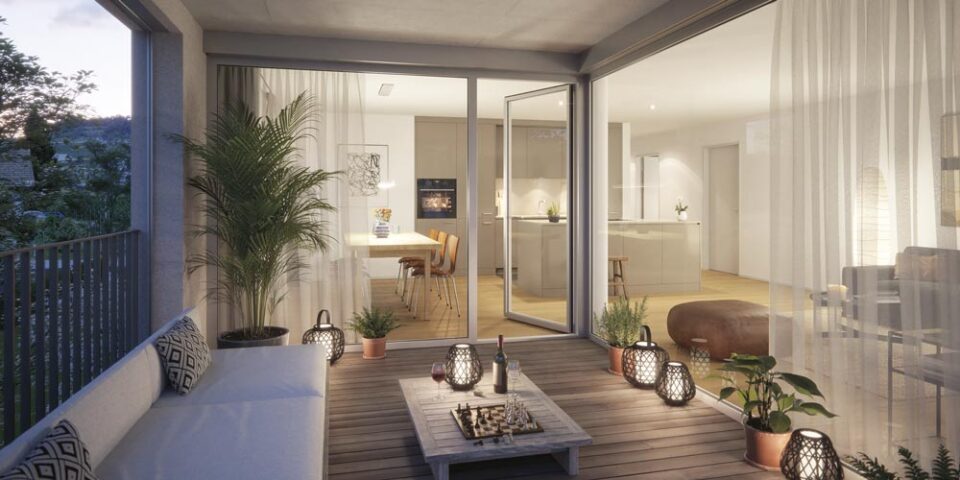
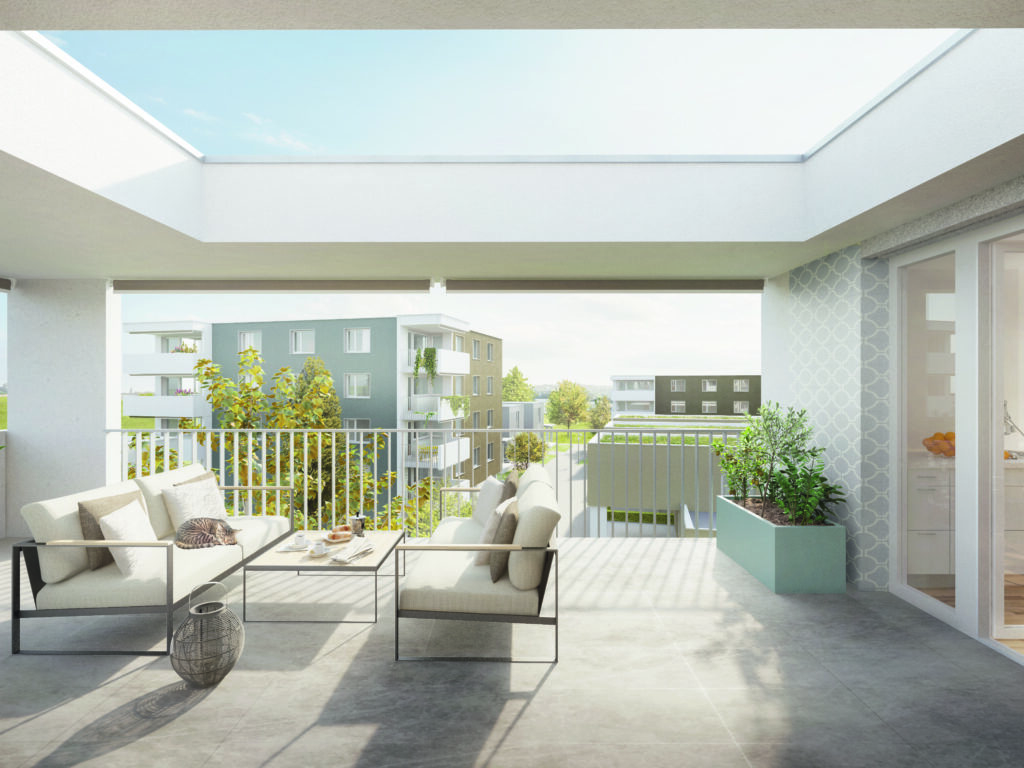
    Attention: In Niederweningen, 36 child-friendly terraced single-family houses with 4.5 and 5.5 rooms are being built on a plot of around 11,000 m². You have your own private garden, and the 21 spacious apartments in condominium ownership with 1.5, 3.5 and 4.5 rooms have a covered outdoor area or garden. The settlement is traffic-free and may only be entered in exceptional cases. An underground car park with direct access to the corresponding residential units and above-ground visitor parking spaces complete the unique living experience: “The sweet life moves into the Gupfengarten and a relaxing and carefree retreat is offered,” says Alexandra Schlegel, who is responsible for marketing this project at Steiner AG responsible for. “In terms of size and price, the project is perfectly tailored to young families and couples who want to fulfill their dream of owning their own home and prefer the charming village life to the big city.”

    The Gupfengarten is located in a quiet residential area on a slight slope in the southern part of Niederweningen. The colorful and local architecture characterizes the likeable character of this project and radiates a relaxed homeliness: “The project impresses with its individuality and personality, because here you can help determine the expansion and interior with the online configurator. From our carefully coordinated and harmonious range of materials and colors you can put together your very own combination according to your individual wishes. We have already selected four well-balanced and characterful designs for you as a suggestion – let yourself be inspired and simply use the configurator on our website www.gupfengarten.ch.»

    Sustainability is a top priority in the Gupfengarten: the heat generation is almost entirely covered by renewable energy using a heat pump and geothermal probes as well as a photovoltaic system. In addition, an integral energy management system ensures an efficient and intelligent energy solution. The building shell is made of wood and achieves optimal thermal insulation values. The idea of sustainability is further implemented through the use of wood as a CO2-neutral and naturally renewable raw material. Living with a feel-good factor of 100, so to speak.

  • «The real estate industry still has the best years of digitization ahead of it»

    «The real estate industry still has the best years of digitization ahead of it»

    About the person
    As Chief Digital Officer at Steiner AG, Giuseppe Giglio is responsible for digital transformation and the development of new digital products. Previously, he was responsible for the digitization of sales channels and the development of support platforms for private customers at Swisscom.

    Mr. Giglio, what is your job at Steiner AG?
    Together with my team of around 25 people, I am responsible for digital corporate development. Our goal: to keep the company technologically fit and to successfully establish it in new digital markets. A year ago, Steiner AG bundled the competencies for the digital area and gave me responsibility.

    You previously worked outside of the real estate industry. From your point of view, where is digitization in the real estate sector compared to other sectors?
    Other industries were able to benefit from the advantages of digitization earlier. Real estate is still at the beginning of this journey. However, in the many discussions I have had with various companies in our industry, I sense a great willingness to change. There is a kind of spirit of optimism. The real estate sector still has the best years of digitization ahead of it. It was also this circumstance that made me personally decide to switch.

    Was this spirit of optimism stimulated by the corona pandemic?
    The pandemic has certainly put some pressure on pushing digital issues. But I believe that the real estate industry would be at this point even without Corona. Companies don’t want to be left behind and remain competitive.

    Where is Steiner AG ahead in terms of digitization?
    Not least because of its modern IT infrastructure, the company was able to adapt very quickly to the new market conditions of the last two years. For example, we were able to immediately send the staff from the offices to the home office without any problems and ensure operations at all times. We came out of the pandemic more successful and stronger. Steiner AG also consistently relied on BIM for its own developments very early on. Today we can draw on more than ten years of experience in this technology and know all the tricks and pitfalls.

    Which digitization topics are currently particularly in demand?
    The energy and climate targets for 2030 challenge the industry along the entire value chain. In this respect, there is a great deal of demand for topics relating to transparency with regard to environmental indicators. In addition, online collaboration platforms – which are already standard in other sectors – are gradually gaining a foothold in the real estate industry.

    To what extent has BIM already established itself today?
    We find that BIM or parts of BIM are very often used in larger projects. We have also registered high demand for renovations and existing buildings in recent months. We have some catching up to do when it comes to smaller projects or explicitly in the area of building operations. Digitization is always associated with process changes and investments – many companies are still cautious here. We need to show decision makers the benefits of BIM and provide evidence.

    What are the advantages of BIM?
    BIM creates the basis for real networking of real estate projects. If applied consistently and consistently, planning errors can be avoided in an early phase – and it is possible to react faster and therefore more cheaply to new general conditions. Digital planning also enables efficient operation. The benefits for building operations are exponentially greater.

    « Artificial intelligence is already indispensable today »

    Can you give an example of Smart Home?
    The best-known examples are the intelligent control of building technology such as lighting, heating and security solutions, such as door locks or alarm systems. Such solutions are now widespread.

    What are the advantages of Smart Home?
    One speaks today of “Ambient Assisted Living”. Smart technology in the living area, for example, allows older people to stay longer in their own apartment or house and lead a self-determined life, even if they have health restrictions. For example, with the help of sensors that register when someone falls over and immediately trigger an alarm. There is also the option of controlling lights/blinds, etc. barrier-free via speech and not via complicated control elements. Last but not least, this topic also harbors a lot of potential on the investor side.

    Which one exactly?
    A smart home can measure and control the consumption of household technology such as heating or cooling, which leads to a reduction in electricity consumption. This results in lower operating costs.

    How and where are future technologies such as Augmented Reality (AR), Virtual Reality (VR), Artificial Intelligence (AI) already being used today?
    AR and VR are currently still niche topics that are often used as marketing tools. They are excellent for visualizing visions and are breeding ground for inspiration.

    AI, on the other hand, is already a reality more often than you think: For example, when determining costs or detecting anomalies in building operation. Since these processes are usually carried out in the background, the user often does not notice that artificial intelligence or an algorithm is involved. If you plan and build digitally today, artificial intelligence has become indispensable.

    What is necessary for AR and VR to also become suitable for everyday use?
    We have to tackle projects with a «digital first mindset». The earlier a project is tackled digitally, the more profitable it becomes overall. We need more practical examples that show that projects with this way of thinking become more successful. VR in particular is helpful in an early phase to improve cooperation and to quickly make critical decisions. I am convinced that AR and VR will prevail in the real estate sector in the next five years.

    Which digitization solutions are most in demand from partners and subcontractors of Steiner AG?
    Many companies are still at the beginning of their digitization journey. That is why training courses, BIM management and real estate inventories for the digital inventory of the real estate portfolio are currently in particularly high demand.

    In your opinion, how will digitization change the industry in the next five years?
    I believe that digitization is bringing us all closer together. Clients, the public and companies work and exchange information on the same platform and actively shape the project. This leads to a democratization of real estate projects, which in turn leads to more successful and sustainable results.

  • Steiner AG enters into a strategic partnership with HEGIAS

    Steiner AG enters into a strategic partnership with HEGIAS

    The dynamic startup HEGIAS offers the world’s first automated and browser-based solution for visualization and communication with Virtual Reality (VR) for the planning, construction and real estate industries. The rapidly growing company was founded in 2017 and currently employs around 20 people at the two locations in Zurich and Lugano. “With Steiner AG, we have a strong partner at our side who supports us in realizing our growth ambitions,” says Patrik Marty, CEO of HEGIAS. Giuseppe Giglio, Chief Digital Officer at Steiner AG, adds: “The new virtual collaboration environment will enable everyone involved in the project to work on the same model at the same time and from any location.” This simplifies and accelerates previous processes and contributes to a significant reduction in errors.

    Ajay Sirohi, CEO of the Steiner Group, is convinced that the cooperation will contribute to the long-term success of both companies: “The combination of HEGIAS’ digital expertise and our proven experience in the BIM and construction sectors enables us to jointly create tailor-made innovations for the market develop. With the first strategic partnership in the digital sector, we can expand our expertise in this area and actively help shape the future of the real estate industry. In the future, we are planning further collaborations with innovative start-ups in order to continue the digital transformation of our company and to grow sustainably in the field of future technologies.»

  • Steiner Group: Pleasing annual result for 2021/2022

    Steiner Group: Pleasing annual result for 2021/2022

    At the beginning of 2020, Steiner AG announced the transformation of the business model with a focus on real estate development. The company was able to complete the first year of transformation on March 31, 2022 with very good results. In the year under review, the Steiner Group achieved consolidated sales according to Swiss GAAP FER of CHF 763.6 million. The business activities resulted in an extraordinary operating result of CHF 49.7 million before taxes and interest.

    In the fiscal year from April 1, 2021 to March 31, 2022, Steiner AG was able to record solid growth in all key areas of its core business. In addition to the strong real estate development business, the high level of construction activity at the TU/GU in western Switzerland also delivered a robust result. Profits from the sale of condominiums and developed projects to investors with a total market value on completion of CHF 880 million also contributed to the pleasing result. At the same time, new development projects with a projected market value upon completion of around CHF 1.5 billion were acquired. The development portfolio of ongoing real estate developments at Steiner AG has thus continued to grow and now amounts to CHF 6.4 billion.

  • Steiner Office Barometer 2022: Hybrid working is the trend

    Steiner Office Barometer 2022: Hybrid working is the trend

    Working from home has established itself as a form of work for many after the home office obligation has been lifted. Where home office is possible (for 60% of those surveyed), around three quarters currently work at least partially in the home office. This proportion is significantly lower for women than for men (66% vs. 81%), although more women would like to work more in the home office. One reason for the lower proportion is that women are more likely to do jobs that do not allow them to work from home.

    This development is reflected in changed living situations: a good quarter of those surveyed for whom home office would theoretically be possible moved in the past year or is planning to move. Of these, 42 percent state that the work situation influences this decision. The data suggests that with a higher desired home office workload, a longer commute and higher housing costs are accepted.

    Around a quarter (27%) expect adjustments in workplace design. 66 percent would like separate rooms for concentrated work. Individual offices that can be used when needed are very popular with 64 percent of those surveyed. The central location of the workplace with good connections to public transport remains very important for 74 percent of those surveyed.

    Three work types
    33 percent of those surveyed (the «office types») prefer working in an office. They would be willing to do a maximum of 20 percent of their workload in the home office. They are often at the beginning or end of their professional careers and often work for medium-sized SMEs. Most of them work in companies that have their own office space. “Office types” see disadvantages when working from home, especially in the difficult communication on an interpersonal and professional level.

    Hybrid working models are very popular with 42 percent (the “hybrid types”). They are mostly in the middle of their professional careers and work more often than average in public administration or with financial service providers and insurance companies. For them, the more difficult communication is the biggest disadvantage of working from home. 30 percent fear the loss of corporate culture for their company. Because they lack the interpersonal and professional exchange in the office, most do not want to spend more than 50 percent of their working hours in the home office.

    The majority of people working from home are well received by 25 percent (the “home office types”). They work more often than average in the information/communications sector with jobs that are mostly in open-plan offices. Supervisor functions are rarer in this group and they see no disadvantages for themselves or for the company when working from home.

    Steiner and the working world of the future
    Steiner AG has been dealing intensively with the “working world of the future” for several years. Last autumn, the company held an internal competition on this subject, in which around 50 of its own real estate specialists took part. The innovative concepts received were evaluated by a specialist jury and are now being incorporated into the development of innovative products and solutions for the office sector. Michael Schiltknecht, Co-CEO of Steiner AG, praises the great diversity of the contributions: “At Steiner, employees can get actively involved when it comes to developing their own workplace environment. We not only want to develop innovative concepts for our customers, but also implement them in our company». According to Michael Schiltknecht, Steiner AG will introduce a new, inspiring working environment on its premises this year, which will offer space for concentrated work as well as for collaborative exchange between employees.

    Representative study with 1000 respondents
    The study was carried out by Marketagent.com Schweiz AG on behalf of Steiner AG from February 16 to 20, 2022. It is based on more than 1000 online interviews with web-active and working people from Switzerland between the ages of 18 and 75 and included more than 40 questions.

  • Majority stick to working from home

    Majority stick to working from home

    Hybrid work remains trendy, writes Steiner AG in a statement on the Office Barometer 2022 from the Zurich-based real estate service provider, which specializes in project development and implementation. According to the study carried out by Marketagent.com Schweiz AG on behalf of Steiner, 42 percent of those surveyed would like to split their working hours between the office and at home. A quarter would like to continue working from home even after the home office obligation has been lifted. A full return to the office is the aim of 33 percent.

    The so-called office types reject the home office mainly because of the more difficult communication there on an interpersonal and professional level, explains Steiner. The same reason is given by the Hyprid types as why they only want to do part of their work at home. On the other hand, the home office types, who mostly have workplaces in open-plan offices, see no disadvantages in working from home either for themselves or for the company.

    Steiner has been “intensively dealing with the working world of the future for several years,” the company explains in the press release. Among other things, Steiner held an internal competition on the subject. The company intends to use the ideas submitted there to develop offers in the office sector. The company’s own employees should also benefit from this, explains Michael Schiltknecht in the press release. “At Steiner, employees can get actively involved when it comes to developing their own workplace environment,” says the Steiner CEO.

  • Steiner AG sells commercial building in the Glasi district

    Steiner AG sells commercial building in the Glasi district

    The investment company Edmond de Rothschild Real Estate SICAV from Geneva has bought the Angelo house in the new Glasi district in Bülach from the Zurich general contractor Steiner , who is developing the quarter. Nothing was known about the purchase price. According to a press release , the first expansion work began in November 2021.

    The Wisli Foundation will move in as a long-term tenant. The non-profit social institution wants to run a cafeteria and a bakery on the ground floor. Furthermore, the digital health center , a center for digital innovation in healthcare, occupies rooms. Overall, more than 80 percent of the 6,576 square meter commercial space is rented.

    From the summer, the new district with its 21 new buildings on a 42,000 square meter site of the former Bülach glassworks should gradually come to life. After completion of all work, the quarter will offer 1,500 people 560 apartments and more than 20,000 square meters of commercial space to live and work.

  • Steiner AG sells housing project in Suhr to Corpora

    Steiner AG sells housing project in Suhr to Corpora

    13 apartment buildings with a total of 146 apartments are to be built on Neumattweg Ost in Suhr. The superstructure is designed for use by different age groups and family sizes, Steiner AG informed in a press release . The real estate developer from Zurich has decided to sell the project to Corpora Immobilien AG from Aarau before it is actually implemented.

    "With Corpora Immobilien AG, Aarau, we were able to sell this extensive project to an investor with development expertise and local roots, who will ensure the successful further development and realization of this attractive residential development," project manager Daniel F. Hauri is quoted as saying in the press release. No information is given there on the purchase price for the approximately 1.6 hectare area. Steiner cites an adjustment to the portfolio that was initiated last year as the reason for the sale.

  • Steiner AG can realize the residential building project Haus Weiler

    Steiner AG can realize the residential building project Haus Weiler

    The building permit for the new building project Haus Weiler in Winterthur's Neuhegi district is legally binding. As Steiner AG , which was commissioned with the planning, informed in a press release , the first apartments should be ready for occupancy in spring 2025. Residents will find peace and quiet and close to nature, but at the same time can reach the city in around 15 minutes by bike or bus, according to the message.

    The new residential development will close another gap in the KIM area. A modern building with 80 modern apartments with two and a half to five and a half rooms is to be built on 3328 square meters. The extraordinary room heights are a special feature. "While the apartments on the ground floor are equipped with private garden seating, the residential units on the top floors will impress with their large, private terraces," the company reports. The plans also provide for “a cozy inner courtyard”, which offers space for “cozy get-togethers, lingering, relaxing and playing”.

    The KIM quarter, launched in 2018 in the Oberwinterthur district , sees itself as “a lively and multi-layered quarter with commercial and residential buildings of various sizes”. The new district combines the advantages of urban structures with high recreational value at the same time. Green areas, playgrounds and car-free zones as well as attractive shopping opportunities in the area are named as strengths.

  • Steiner AG is redeveloping the industrial area in Breitenbach

    Steiner AG is redeveloping the industrial area in Breitenbach

    The Steiner Investment Foundation wants to convert the Isola area not far from the center of Breitenbach into a residential and commercial area. The owner of the eleven hectare site has commissioned the construction service provider Steiner AG with this, according to a media release . The residents of Breitenbach are to be included in the development process from next year.

    The project developer also wants to open up the Isola area, which is located directly on the Lüssel, to the public. “This can look forward to new, attractive meeting and green areas, which will be created in place of the existing company roads and storage areas”, Stefan Gabriel, team leader for real estate development at Steiner AG, is quoted in the media release.

    The new quarter is not intended to compete with the village center, but rather to complement it. An intensive exchange is currently taking place with the Breitenbach municipal administration about the respective ideas and expectations. As a basis for a common understanding of the spatial development of the area, an urban development and open space planning test planning process will also be carried out, according to the media release. Renowned architectural offices and landscape architects would be invited to come up with suggestions.

    Construction on the first stage is expected to start in 2029. During the planning phase, however, the company wants to enable interim uses and, if necessary, bring forward individual conversion projects in existing buildings.

    The Steiner Invest Foundation, a Zurich-based asset management company for Swiss pension funds and an investment foundation of Steiner AG, acquired the 114,280 square meter area with its largely empty industrial and warehouse buildings in spring 2021.

  • From A for Altstetten to W for Wädenswil

    From A for Altstetten to W for Wädenswil

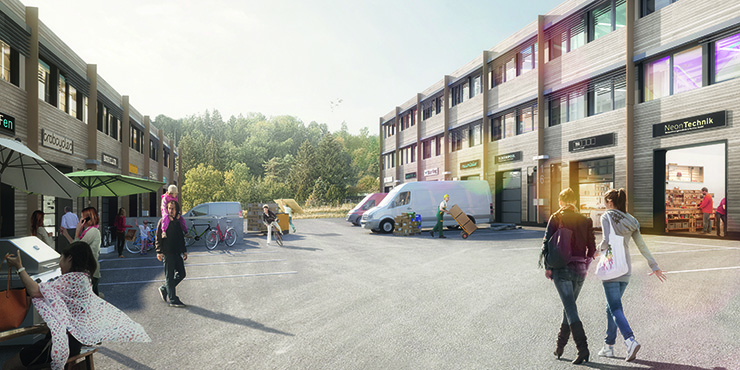
    Manufakt creates a brand that stands for modular building complexes with flexible use by high-value, manufacturing industries. Manufakt is characterized by its local roots as well as regional and national networking. The powerful and clear structures radiate the greatest possible physical presence. In addition to a concise external effect, Manufakt always focuses on the corresponding internal effect and specifically focuses on modular and networked open spaces and atmosphere. On July 1, 2021, the imposing Manufakt8048 commercial property, which was built on one of the last vacant industrial sites in the city of Zurich, was officially opened after around one and a half years of construction. The building, which is located directly on the track field at Zurich Altstetten station and was built for the client Swisscanto Investment Foundation, is exemplary. Because with the innovative concept and the Manufakt brand, Steiner AG is bringing commercial and service companies back to the city.

    The Manufakt concept can be applied to several locations.

    Curated networking
    “For us, Manufakt stands for quality craftsmanship of the future, for Industry 4.0, the digitization of industrial production,” says Peter Herzog, Head of Real Estate Development for Zurich at Steiner. The “curated networking” of the Manufakt buildings is to be understood in a double sense: in addition to the digital, the analogue networking in the building, which takes place in particular via the open courtyard, is to be promoted. And Othmar Ulrich, Head of Real Estate Development Region East, adds: “We offer industry and commerce an environment that gives tenants the opportunity to further expand their network. We imagine that the buildings will be played with a choreography. ” The manufacturing concept is currently also being used in Wädenswil and Winterthur. In Wädenswil (Appital area), a development for trade, research and offices will be built by 2024. The name was chosen based on the postcode of Wädenswil Au: Manufakt8804. More information: www.manufakt8804.ch.

  • No density stress in Bülach

    No density stress in Bülach

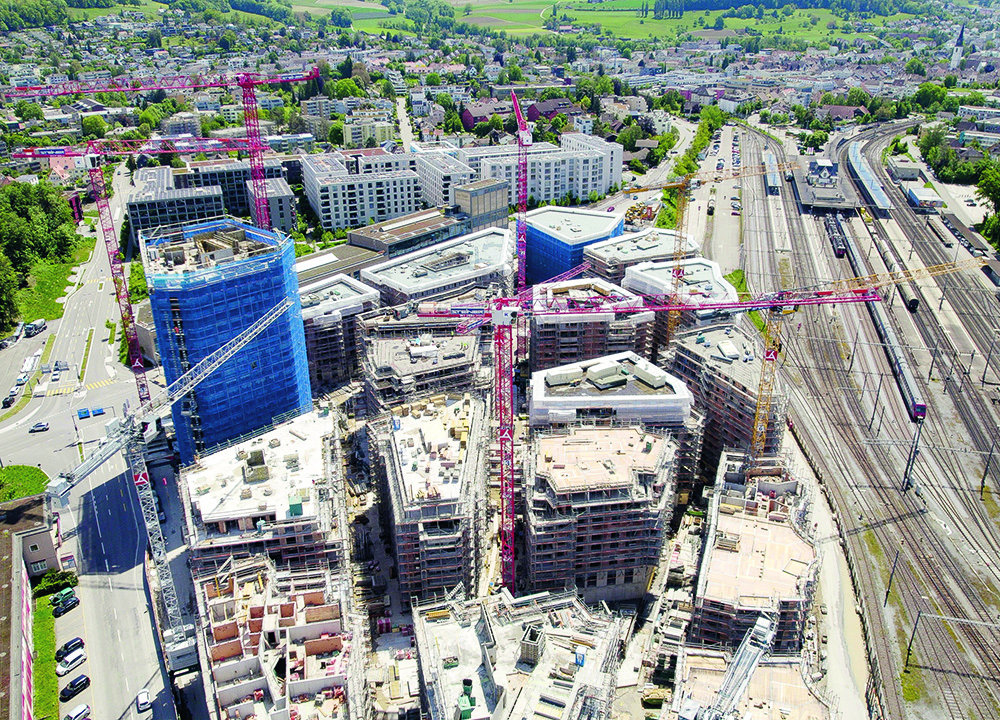
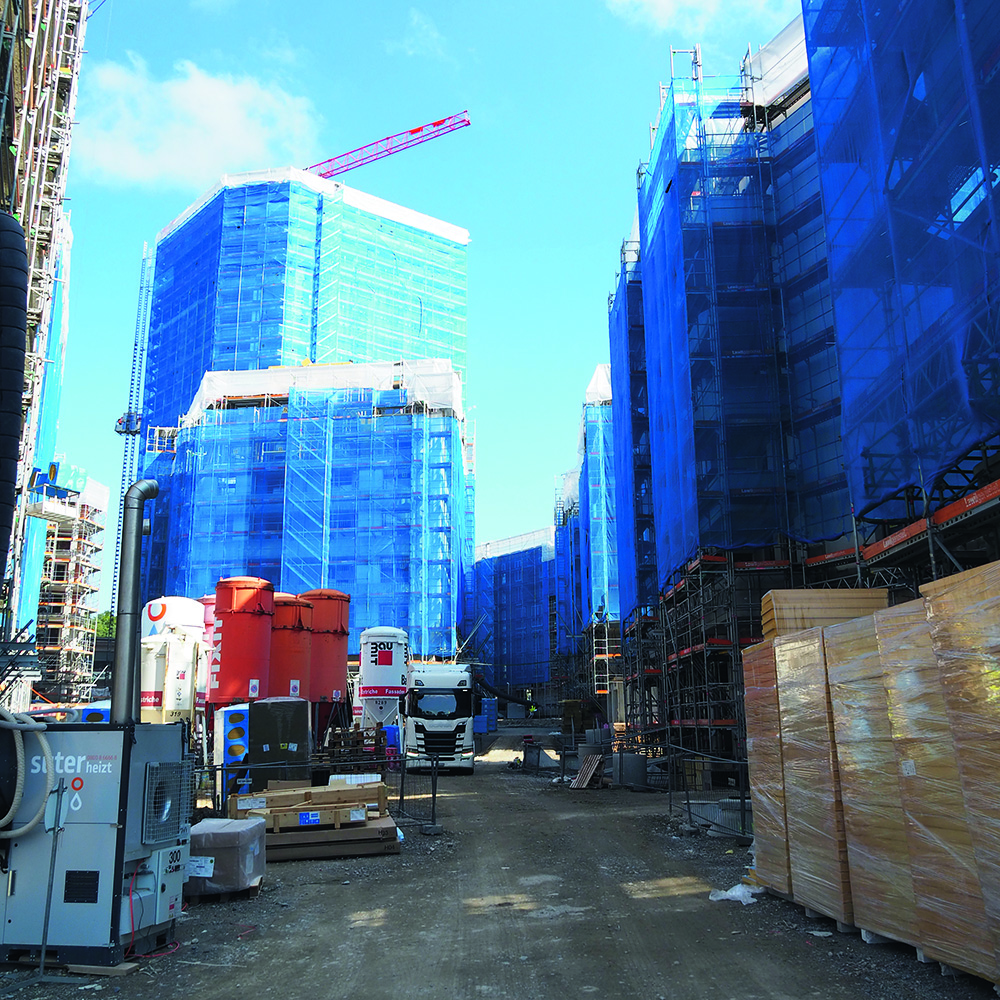
    The bird’s eye view shows the size of the construction project.

    The new city quarter should be attractive for future residents as well as for the Bülach residents who are already living there. “An exciting quarter has been developed,” says Mark Eberli, Mayor of Bülach, “and it will work well with the good mix of residential and commercial.”

    Lots of space to live.

    Urban density
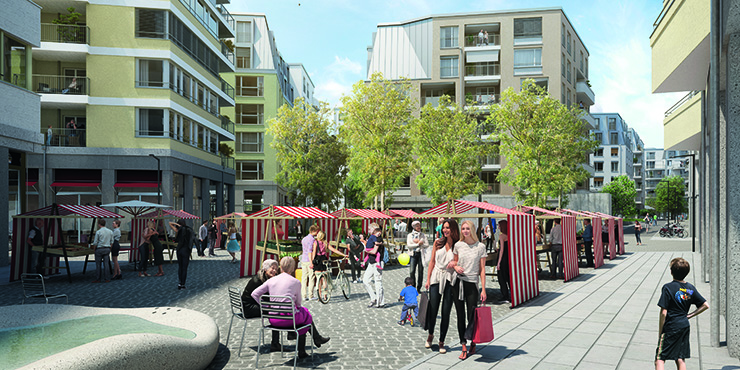
    The former glassworks area impresses with its excellent geographical location, right next to the train station and in close proximity to the feeder to the cantonal highway A51. A major challenge was to structure the high structural density with an appropriate urban and architectural concept so that an interesting and versatile living and working space is created in this urban location. Thanks to an alley-like development concept as well as an attractive and varied outdoor space with green areas and well thought-out neighborhood squares, the people in the Glasi Quarter will receive a valuable compensation for the structural density.

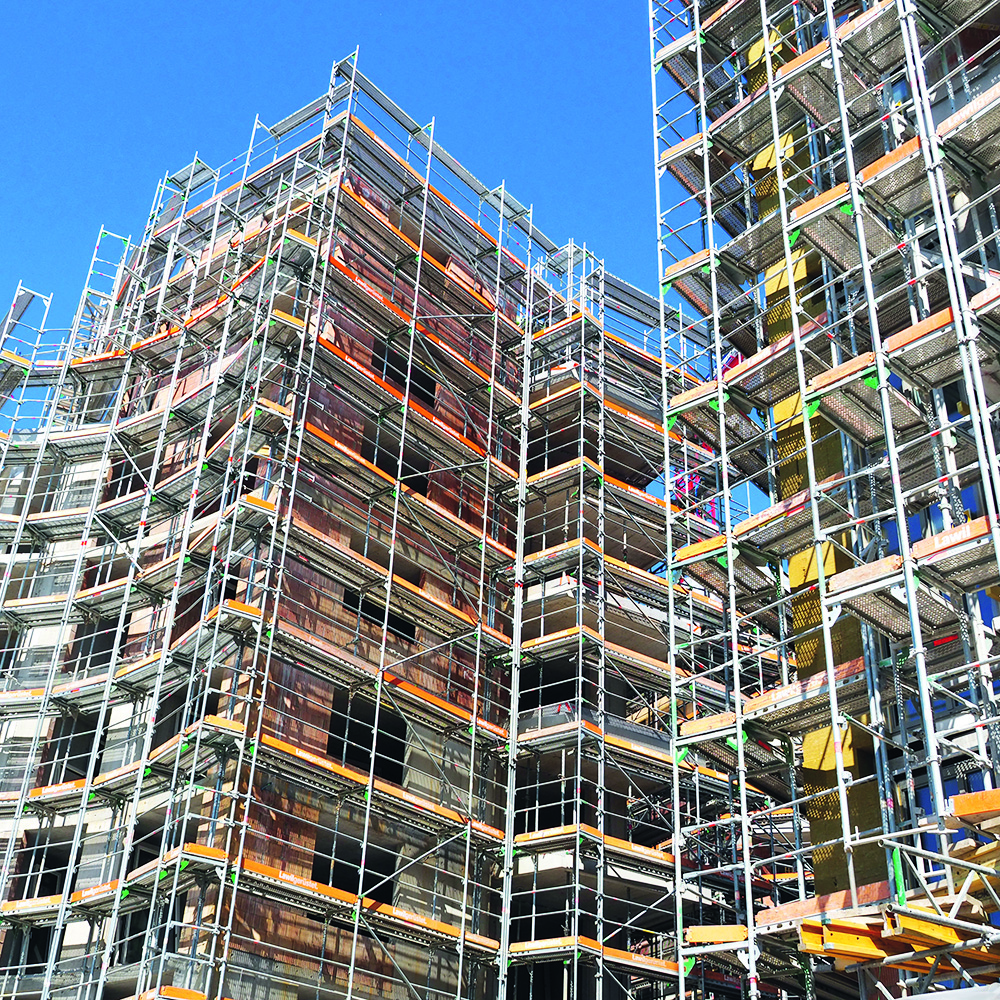
    Construction is currently being carried out at the highest heights.

    Move in from 2023
    A broad mix of apartments is being created in the Glasi Quarter, including inexpensive cooperative apartments as well
    Includes condominiums. These can be inhabited by singles, couples, families and shared apartments. Areas for retail and trade, a care center with apartments for the elderly, a charitable social institution and a day nursery are already let. A substantial proportion of commercial space offers space for shops, craft businesses, offices and restaurants. There are some impressions around.

  • Karsten Hell is leaving the Steiner Group

    Karsten Hell is leaving the Steiner Group

    Steiner AG initiated a company transformation in spring 2021, the Zurich-based general and general contractor explains in a press release . The business model was geared towards the further expansion of the company's own project portfolio and the addition of participation models and investment vehicles such as the Steiner Investment Foundation. In addition, Steiner wants to launch digital products for the real estate market in the future.

    As part of the company's transformation, Karsten Hell offered the board of directors his resignation as CEO, Steiner informs. Hell joined Steiner in 2013 as Chief Operating Officer (COO) and has headed the company as CEO since July 2018. The outgoing CEO will remain with the company as an advisor to the board of directors, writes Steiner.

    Hell's successor will be Ajay Sirohi with immediate effect. The graduate economist and mathematician joined the Steiner Group in 2011 as Chief Financial Officer. Sirohi previously held the same position for various multinational companies.

    With Michael Schiltknecht , Sirohi will also join Steiner AG's previous Head of Real Estate Development as Co-CEO. Schiltknecht joined Steiner in 2007 as head of real estate development. The two new company directors should “continue to pursue the specified strategy and ensure the sustainable development of the company”, says the announcement.

  • A residential area to feel good

    A residential area to feel good

    With this project, Steiner AG is creating living space for young people, singles, couples, families and senior citizens. In the new quarter there will be attractive housing offers, private retreats and communal meeting areas. Numerous green areas with playgrounds and playgrounds invite you to spend a lot of time outside. At first glance, the many green and recreational areas as well as the bright apartments catch the eye: "We have placed great emphasis on open, well-lit interiors with a beautiful view, which ensure a pleasant, feel-good climate, peace and relaxation," says Stefan Gabriel, Team Leader Real Estate Development at Steiner AG. «The apartments are barrier-free, functional and can be flexibly furnished. Private gardens and community gardens invite you to linger and round off the multi-generational living in the quarter. "

    Here, a fallow industrial area is being transformed into a new place to live in the countryside. Existing listed buildings such as the barn and the Alte Post are carefully integrated and revitalized for living and common areas. This project aims to create a comfortable living area that will enrich Fischbach-Göslikon.

    Contemporary renovation
    Steiner AG sees its project as a symbol of the connection between the past and the future of Fischbach-Göslikon. “The listed barn is an important cultural and historical witness in the community and in the neighborhood – a building that needs to be preserved. The barn is being gently but modernly renovated and used for new purposes. A day-care center with 16 places and a workshop are to be built on the ground floor. A common room for various occasions, such as birthdays or family celebrations, is planned on the upper floor. The room can also be rented by the public, ”says Gabriel.

    Start of construction in 2022
    The start of construction on the first stage is scheduled for 2022. The overall project, which consists of three stages and should be completed by 2032, will one day include 165 residential units in 10 apartment buildings and 46 row single-family houses. Due to the current design plan, there must be an interval of four years between building applications. Gabriel concludes: “We are now expecting the building permit for the first stage to become legally binding. We are pleased about the excellent cooperation with the authorities and everyone involved. This is an important prerequisite for such a project to be implemented successfully. "

    The 165 residential units are all very bright.
  • Zurich's Manufakt8048 business park is open

    Zurich's Manufakt8048 business park is open

    The Manufakt8048 business park has been completed. On Thursday, the building owner Swisscanto , the developer and general contractor Steiner AG , architects, project partners and future tenants celebrated the opening of the new modular building complex in Zurich-Altstetten. In a media release , Steiner AG also announced that in the coming years, with Manufakt8820 and Manufakt8409, two more industrial parks will be built in Wädenswil ZH and Winterthur based on the same concept.

    Steiner AG describes its special manufacturing concept as sustainable and multidimensional. It offers shared meeting rooms that can be used as required, as well as so-called flex offices and meeting areas. In order to make commercial rents affordable, especially for young companies, Steiner AG has improved space efficiency with areas that can be used jointly, for example. This can be "implemented well in reception areas, meeting rooms or lounges", says her Head Real Estate, Michael Schiltknecht. This is particularly interesting for start-ups, "who don't have to rent everything right away".

    As it is said, the Manufakt8048 commercial property benefits from the attractive environment in the “up-and-coming urban quarter” in the west of Zurich in the immediate vicinity of the Zurich-Altstetten train station. It thus offers "ideal conditions for companies from a wide variety of industries".

  • Steiner AG builds new quarters in Fischbach-Göslikon

    Steiner AG builds new quarters in Fischbach-Göslikon

    When the building permit becomes legally binding, construction work for the Widacher project in Fischbach-Göslikon can begin in summer. The shares the project developer Steiner AG with now.

    As part of this construction project, a fallow industrial area will be converted into "a new place to live in the countryside". Listed buildings such as the barn and the Alte Post would be carefully integrated and revitalized for living and common areas.

    The start of construction on the first of three stages is scheduled for summer 2022. Initially, 16 terraced houses and 42 apartments will be built to the Minergie standard. A total of 165 residential units are to be built there in ten multi-family houses and 46 single-family houses.

  • "Gupfengarten" in Niederweningen receives building permit

    "Gupfengarten" in Niederweningen receives building permit

    The building permit for the Gupfengarten residential development in Niederweningen is now legally binding. According to a media release, construction on a well-developed area south of the 3,000-inhabitant village should begin in late summer. The project is being implemented by the Zurich project developer Steiner AG on behalf of Evostate Immobilien AG.

    The Gupfengarten project comprises 36 single-family houses and three multi-family houses with 21 condominiums. It should be completed by the 3rd quarter of 2023. Graf Biscioni Architekten AG is responsible for the architecture.

    Othmar Ulrich, Head of Real Estate Development in the Eastern Region at Steiner AG, points out in the press release that the marketing of the apartments began last year. "With the legally binding building permit, another important milestone has now been reached," said Ulrich. The 36 row single-family houses with 4.5 and 5.5 rooms have their own private garden and are child-friendly. The 21 condominium apartments with 2.5 to 4.5 rooms have a covered outdoor area. The traffic-free settlement has an underground car park with direct access to the residential units.

    The Gupfengarten project focuses on sustainability with heat generation using a heat pump and photovoltaic system. The building envelope is made of wood for optimal thermal insulation values. The Gupfengarten development is within walking distance of the train station. From there it is 35 minutes by train to the center of Zurich.

  • Steiner plans a new residential complex in Winterthur

    Steiner plans a new residential complex in Winterthur

    The real estate developer Steiner AG is planning to build a new residential complex in Winterthur, according to a media release . It is to be built on the KIM site at Winterthur Neuhegi train station. The so-called Haus Weiler is to be built on a plot of 3328 square meters and comprises 80 condominiums. Twelve of these will be built as studio apartments on the ground floor with private garden terraces. A further twelve are being built as attic apartments with private roof terraces.

    The design plan for the KIM area already became legally effective in September 2013. The newly emerging quarter combines living and working. It includes green areas, playgrounds and car-free zones. Grocery stores, cafes and restaurants are within walking distance. In addition, Zurich Airport can be reached in 25 minutes by car or train.

    According to the announcement, the building application was submitted to the city of Winterthur on March 25th. Steiner AG expects construction work to start in summer 2022. Completion is planned for spring 2025.

  • Beginning of a new era of shopping

    Beginning of a new era of shopping

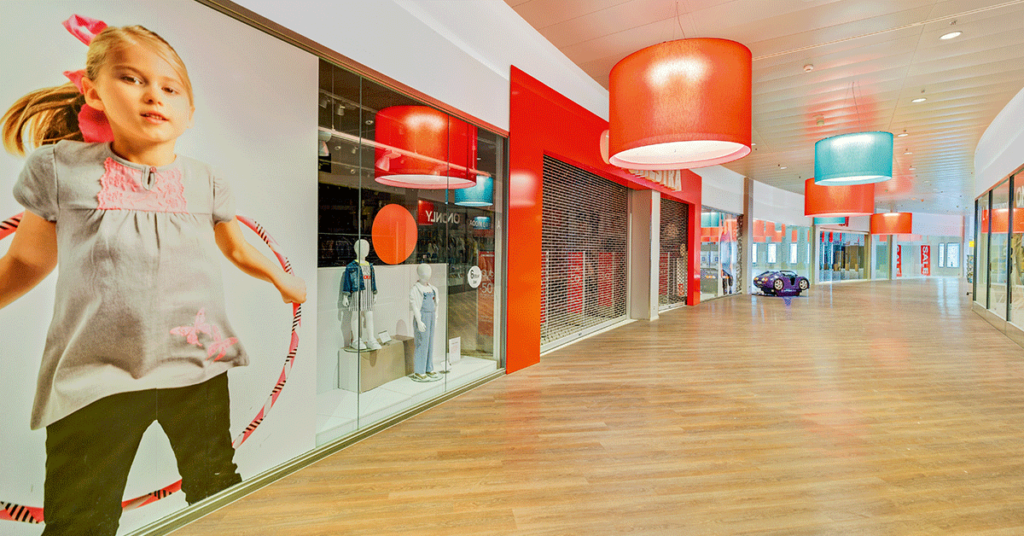
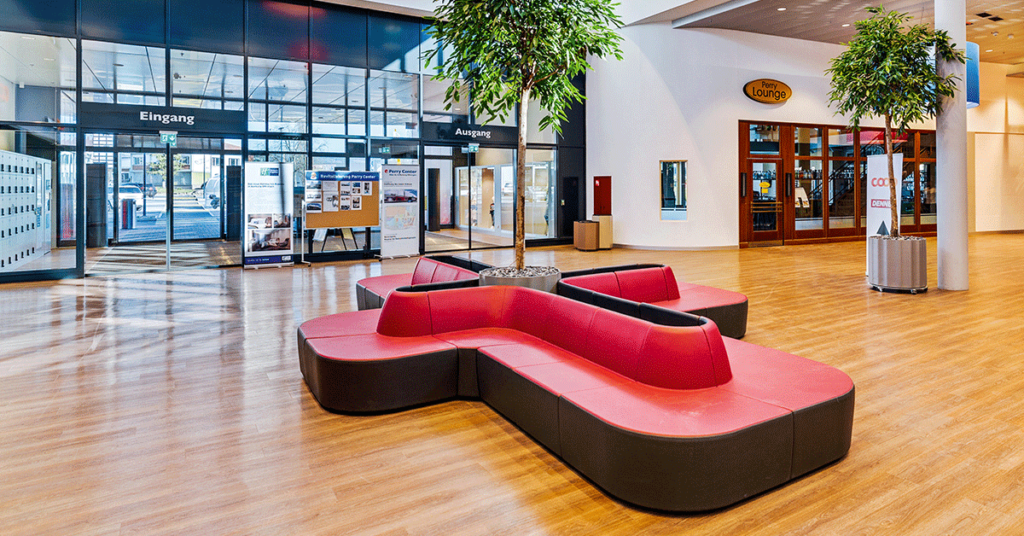
    The project included not only adjustments to the sales and service areas as well as the catering offer, but also the construction of a modern hotel with 80 rooms. Today the Perry Center represents a new urban shopping experience.

    Pure shopping pleasure
    Not only the bright and spacious areas, the expanded range of products and services in over 40 shops and a children's paradise ensure that visitors to the modernized Perry Center feel completely at ease. In order to ensure the most stress-free journey possible, a new parking system has also been introduced for the around 800 parking spaces. From the outside, the Perry Center will of course also have a new look after the work has been completed: a unique, 15-meter-high, illuminated lamellar facade makes the shopping center appear as high as the newly opened Holiday Inn Express Hotel. At night, the slender panels of the Perry Center are particularly noticeable when they shine in different colors. A total of 2600 running meters of LED strips are integrated into these slats. By the way, guests of the new hotel can access the shopping center directly via a walkway, where they can shop and eat.

    Logistic masterpiece
    The client has commissioned Steiner AG as the executing total contractor. As a leading real estate developer as well as total and general contractor, it has already implemented numerous visionary projects throughout Switzerland. Since the entire revitalization of the Perry Center was carried out during ongoing operations, Steiner and all the subcontractors involved were faced with high requirements in terms of planning, implementation and logistics right from the start. Not only did the flow of visitors have to be optimally controlled during the construction phase, but existing tenants also had to move within the center. ■