Tag: Steuern

  • Zurich convinces as a business location

    Zurich convinces as a business location

    According to a survey of over 400 companies in the canton of Zurich conducted by the Office of Economic Affairs, 82% rate the location positively, with 22% rating it as “very satisfied” and 60% as “fairly satisfied”. This high level of approval is primarily based on three factors: the excellent transport infrastructure, the high quality of life and the availability of well-trained specialists. Economic stability and political reliability were also cited as locational advantages.

    Infrastructure impresses
    Of the 24 location factors assessed, infrastructure (71%) and quality of life (55%) were mentioned most frequently as plus points. The labor market followed with 43%. On the other hand, 90% of companies consider the cost environment, in particular rents, wages and regulations, to be a clear disadvantage. Similarly, 64% criticize the tax environment. Zurich ranks last in Switzerland in terms of corporate tax burden.

    One in four companies planning to relocate
    A quarter of the companies surveyed have thought about moving out of the canton of Zurich in the last five years or have concrete plans to do so. The main driver is the high tax burden. According to statistics, over one percent of Zurich companies relocate to other cantons every year. This trend is in line with the assessment of many companies.

    Well positioned in European comparison
    The results are also reflected in a comparative European study by the Office of Economic Affairs. In comparison with other European economic regions, Zurich is particularly impressive due to its educational landscape, economic performance and quality of life. The study sees a need for action in areas such as labor market dynamics, innovation promotion and regulatory density.

    Location with strengths – but under pressure
    The canton of Zurich remains a leading business location with excellent infrastructure, a high quality of life and a competent labor market. At the same time, feedback from companies clearly indicates that the cost and tax environment needs to be adjusted in order to stop migration trends and ensure long-term competitiveness. For decision-makers, this means actively developing location policy before the strengths are overshadowed by structural weaknesses.

  • Swiss tax landscape in transition

    Swiss tax landscape in transition

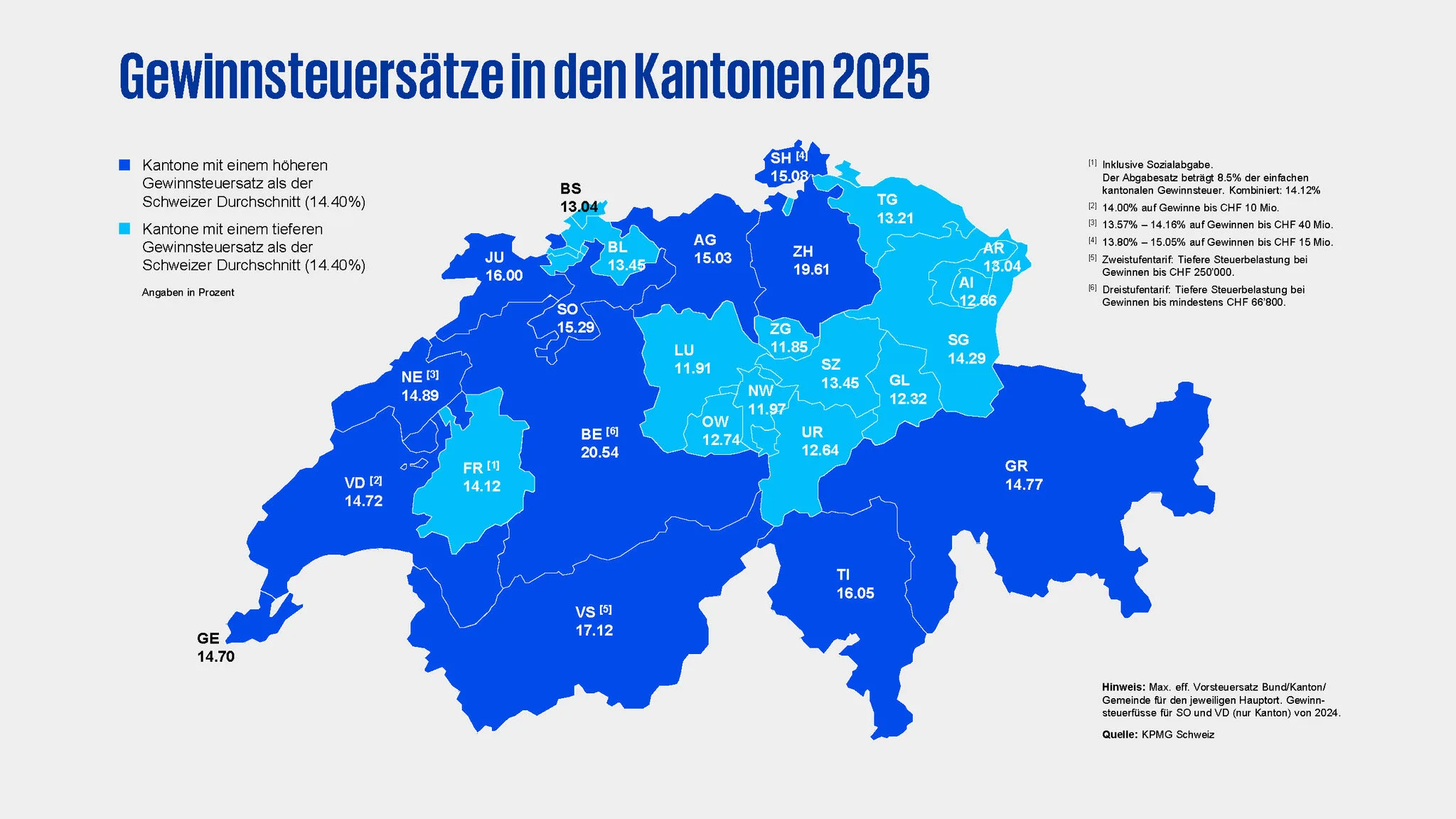
    In 2025, the average corporate income tax rate in Switzerland fell from 14.6% to 14.4%. The canton of Zug remains the front-runner with just 11.85%, while Bern (20.54%), Zurich (19.61%) and Valais (17.12%) occupy the upper ranks in the tax ranking. At first glance, this is a sign of the attractiveness of the business location, but the dynamics are more nuanced.

    In fact, some cantons have even increased their tax rates slightly. Geneva, for example, rose from 14 to 14.7 percent, while Basel-Stadt will increase its rate to 14.53 percent in 2026. This is due to the introduction of the global minimum tax rate of 15% for companies with high profits. Cantons that were previously regarded as low-tax locations are adapting in order to cushion the threat of the additional tax and retain revenue themselves. For investors, this means that while the tax advantage remains, flexibility is required in order to be able to react to cantonal differences and future adjustments.

    Location remains competitive
    There has also been a slight decrease in the top tax rates for private individuals. From an average of 32.7 percent to 32.5 percent. Geneva (-1.7 percentage points) and Schwyz (-0.61) in particular have lowered their rates. However, the ranking remains stable. Schwyz (21.98%), Zug (22.68%) and Nidwalden (24.1%) remain at the top. Geneva, Vaud and Bern remain the most expensive cantons for top earners. For real estate developers and highly skilled workers, these locational differences in income tax remain a decisive factor, especially for international projects.

    Global minimum tax Stability in Switzerland, uncertainties internationally
    Over 50 countries worldwide have already implemented the minimum tax of 15 percent for large companies. However, the USA, the original driving force behind the initiative, has not yet adopted the OECD guidelines into national law. On the contrary, the new US administration is increasingly questioning the project. Experts such as Stefan Kuhn from KPMG Switzerland emphasize that, in the worst-case scenario, these uncertainties could lead to a return of tax competition or special digital taxes. For Switzerland, however, the signal is clear: the global minimum tax is becoming a reality here too. The stability of implementation and the ability to plan remain a locational advantage over uncertain international developments.

    Cantons boost location attractiveness with targeted projects
    In parallel to the tax adjustments, many cantons are investing in location promotion projects. Lucerne, Basel-Stadt, Zug and others have already adopted programs to support local companies and new relocations. For real estate developers, this means opportunities for new projects, incentives for investment in commercial and residential space and a solid basis for long-term viable business models.

    At the same time, it is clear that it is not tax policy that determines the attractiveness of a location, but also the accompanying measures such as infrastructure, securing skilled workers and digitalization. This is where new spaces for innovative projects are created for developers and investors,

    especially in a market environment that is characterized by growing demands for sustainability and resource efficiency.

    Industrial policy and tariffs
    In addition to taxes, international trade issues are once again gaining in importance. Discussions about US tariffs, bilateral trade agreements and strategic industrial policy are driving reindustrialization worldwide. For Swiss locations, this means that the demand for suitable production and logistics space could increase. At the same time, the protection of strategic industries is once again receiving greater political support, which could open up new areas for investment in high-tech and industrial production.

    Switzerland remains strong – eyes on Ireland and Asia
    In an international comparison, Switzerland remains on a par with other top European locations. Ireland taxes corporate profits at 12.5 percent, Hungary at 9 percent. Guernsey, the Bahamas and the Cayman Islands remain low-tax havens with zero percent, but this is no comparison for Switzerland. Instead, the location competes with attractive metropolises such as Hong Kong (16.5%) or Singapore (17%), which entice with additional incentive programs. China, India and Brazil also continue to rely on other tax strategies with high rates (25-34%), but selectively offer low effective burdens for strategic industries. Switzerland remains competitive and complements this advantage with a stable political and legal framework.
  • Lucerne responds to tax pressure with a billion-euro package

    Lucerne responds to tax pressure with a billion-euro package

    International tax competition is being readjusted by the OECD minimum taxation and is hitting Lucerne hard. The previous advantage of low corporate taxes for internationally active groups will no longer apply. This could result in companies moving away, a drop in investment and a massive loss of tax revenue. Over a billion francs are at stake for the federal government, canton and municipalities – a scenario that Lucerne is not prepared to accept without taking action.

    Strengthening the business location, ensuring quality of life
    The cantonal government is responding with a far-reaching location promotion programme, which comprises around CHF 300 million per year. Around two thirds of this is to flow directly into measures to promote innovation, digitalisation, economic areas and a business-friendly administration. This will also create new opportunities for property developers and investors. In particular in the planning and realisation of forward-looking commercial and infrastructure projects.

    The remaining third is dedicated to quality of life. The measures range from tax relief and family friendliness to the promotion of culture and digital participation, key location factors when it comes to retaining talent and attracting new workers.

    Participatory and forward-looking
    The programme was developed in close consultation with the business community, municipalities and social partners. The public consultation will run until 9 June 2025 via the “e-participation” tool. The final decision lies with the people. The package will be put to the vote in September 2026 and is scheduled to come into force on 1 October 2026.

    Lucerne is sending a strong signal with this proposal. Location promotion is no longer an optional extra, but a strategic duty – and it requires clear, long-term investment.

  • Standstill in the owner-occupied rental value debate

    Standstill in the owner-occupied rental value debate

    The abolition of the imputed rental value, a tax that is unique in Europe, is in danger of failing once again. There is broad agreement in both councils that the system needs to be reformed. However, its implementation remains highly controversial. The issues of property tax for second homes and the debt interest deduction in particular are causing conflict.

    In its third deliberation on Thursday, the Council of States maintained the abolition of the imputed rental value for primary residences only. It also maintained its position on the debt interest deduction. In future, deductions of up to 70 per cent of taxable property income should remain permitted. The National Council, on the other hand, is calling for a complete system change and also wants to exempt second homes from tax.

    Tourism cantons put the brakes on
    The majority rejection in the Council of States is primarily due to the concerns of the tourism cantons. They fear a considerable loss of revenue due to the abolition of the imputed rental value for second homes. The proposal of a property tax to compensate for this has met with resistance there. “We need to focus on primary residences,” emphasised Martin Schmid (FDP/GR). The introduction of a property tax would present “extremely high hurdles”, as it would require a constitutional amendment with a double majority.

    Realistic collapse of the bill
    The collapse of the bill seems increasingly likely. Even the abolition of the imputed rental value for primary residences is facing headwinds. The tenants’ association has already announced a referendum. Its president, Carlo Sommaruga (SP/GE), criticised the bill as a “tax giveaway for rich homeowners” that does not solve the inequality between tenants and owners.

    Doubts are also growing within the centre-right parties. Pascal Broulis (FDP/VD) warned that the bill would unnecessarily complicate the tax system. The National Council must first decide on the bill again before a possible conciliation conference could follow. However, there is currently no majority solution in sight.

  • Aargau and Thurgau gain in importance for Zurich companies

    Aargau and Thurgau gain in importance for Zurich companies

    Every year, more companies move out of the canton of Zurich to other cantons than move in from there. On average over the decade from 2012 to 2021, the negative balance was 116 companies. This corresponds to around one per mille of the Zurich population. Although the balance is also negative in terms of the number of full-time positions, it is marginal in relation to the 1.1 million jobs offered by the Zurich economy in 2021. This is the result of an analysis by political scientist Peter Moser published by the Zurich Chamber of Commerce.

    If a company relocates, it is often to or from a neighbouring canton. Aargau is clearly in the lead with 18 per cent of the total number of company relocations between 2012 and 2021. According to Moser, this could also be due to the fact that “its economic area, for example in the Limmat Valley, has grown together with that of the canton of Zurich”. This is followed by the low-tax cantons of Zug (16 per cent) and Schwyz (13 per cent), followed by St.Gallen (10 per cent) and Thurgau (9 per cent), which is also low-tax. Financial service providers, on the other hand, prefer the cantons of Zug (40 per cent) and Schwyz (25 per cent).

    Aargau is a popular destination for industrial, construction and logistics companies relocating from Zurich. “They benefit from network effects and the land there is also likely to be somewhat cheaper for these industries, which tend to be land-intensive, than in the expensive centre of the Zurich metropolitan area,” says Moser. He believes that the fact that the production factors of land and labour are comparatively inexpensive there, as in Thurgau, is the main reason why these two cantons in particular have gained in importance as target cantons for migrating companies.

  • How a Switzerland of 10 million can succeed

    How a Switzerland of 10 million can succeed

    Lardi emphasised the need for better framework conditions to counteract the housing shortage. He presented four key demands. Energy-efficient refurbishments and adding storeys can create additional floor space without taking up new space. It is not about skyscrapers, but about moderate increases in the height of existing buildings. Conversion of office space into residential space, as the strict separation between residential and work zones is outdated. Mixed zones could reduce traffic congestion and create living space. Misregulations in rental housing law and tax privileges lead to an unfair distribution of living space. Liberalisation could free up older living space and stabilise prices. Objections and lengthy authorisation procedures are the biggest obstacles. These would have to be streamlined in order to create new living space more quickly.

    Important referendum
    The construction of new living space also requires the continuous renewal of the transport infrastructure. The strategic development programme for motorways is of central importance here. This proposal, which includes six major projects to eliminate bottlenecks, will be put to the vote in November 2024. The Swiss Association of Master Builders is in favour of voting yes to the proposal and is calling for an efficient mobility offering that combines all modes of transport. Lardi also emphasised the importance of the new environmental protection law, which adapts noise protection criteria and enables the construction of flats that were previously blocked for noise protection reasons.

    Illustrious guest appearances
    One of the highlights of the event was the presentation by Bertrand Piccard, who emphasised the role of the construction industry in the fight against climate change. Economist Martin Neff explained how a growing population influences a country’s prosperity and how more living space can be created by reducing regulations. Civil engineer Pirmin Muff presented practical implementation approaches for the construction industry. Cantonal Councillor Martin Neukom delivered the welcoming address from the host Canton of Zurich.

    HGC anniversary and construction party
    The major event, moderated by Mascha Santschi, concluded with a networking aperitif, dinner and the legendary construction party. Musical entertainment was provided by 21-year-old singer Joya Marleen from St. Gallen, one of the rising stars of the Swiss music scene.

  • Tax deductions for eco-investments in new buildings should take effect more quickly

    Tax deductions for eco-investments in new buildings should take effect more quickly

    There is currently a waiting period for environmentally friendly investments in real estate. Such investments are only tax-deductible five years after the property has been built. Last December, Councilor of States Roberto Zanetti (SP / SO) submitted a motion calling for this waiting period to be shortened.

    In view of the high construction costs, the financial limits of especially younger builders for ecological measures in new buildings are understandable, writes Zanetti in his motion. If, after completion of the building, it turns out “that the corresponding ecologically desirable additional investments would be financially viable”, the owners will, however, in view of the five-year waiting period “be careful not to take these investments by hand immediately”. This is “regrettable from an ecological point of view,” says Zanetti.

    The shortening of the waiting period called for by the SP Council of States can now be implemented. After support from the Federal Council and the adoption of the motion by the Council of States, the National Council has now “accepted the proposal without discussion”, the parliamentary services inform in a message . Now it is the Federal Council’s turn. He must create the legal basis for shortening the waiting period. In addition, different procedures between the cantons are to be harmonized so far.

  • Discounts for research strengthen locations

    Discounts for research strengthen locations

    "With the Swiss tax reform and AHV financing (TRAF), instruments for tax relief for research and development activities were introduced at the beginning of 2020," explains BAK Economics in a press release . The economic research institute has examined the effects of these concessions on the tax burden of companies in the individual cantons.

    According to the results, they reduce the effective average tax burden of a company on the Swiss average from 13.5 to 12.2 percent, explains BAK Economics. Very research-intensive companies could even reduce their exposure by an average of 4.3 percentage points to 9.2 percent. For the cantons, the benefits for spending on research and development (R&D) represented an internationally accepted substitute for the tax privileges abolished by the TRAF in addition to promoting innovation.

    With the flexible implementation of the requirements by the cantons, the ranking of the cantons in the tax burden for very research-intensive companies has shifted, explains BAK Economics. The low-tax cantons of Nidwalden and Obwalden continued to occupy the top positions here. "However, some high-tax cantons with a generous design of the R&D instruments can significantly reduce their burden," writes BAK Economics.

    Specifically, “the bottom three in ordinary taxation”, Bern, Zurich and Aargau, “for companies with very high R&D intensity towards the middle of the ranking”. The canton of Geneva has the highest average tax burden for companies with high R&D expenditure.