Tag: Strassenbau

  • Infrastructure works tackle challenging terrain on Lake Zurich

    Infrastructure works tackle challenging terrain on Lake Zurich

    Walo Bertschinger AG, a family-run construction firm based in Dietikon, is carrying out the roadworks and civil engineering works as part of an infrastructure project in the Lake Zurich region. According to a press release, over a stretch of 1.1 kilometres between Tägerst and Buchenegg, “roads, drainage systems and numerous engineering structures are being newly constructed, reinforced or repaired.” The project is scheduled for completion by 2027.

    A central element of the project is the construction of two new Lehnen viaducts, measuring 90 and 130 metres in length. A total of 21 piers and around 240 micropiles will provide a solid foundation on the landslide-prone slope.

    “Limited space, steep terrain and a tight schedule make this project particularly challenging,” explains Walo Bertschinger AG in the press release. “We are therefore all the more pleased that the work is progressing according to plan and that the team is delivering a strong performance in their daily work.”

  • Graubünden builds bigger, more expensive, longer

    Graubünden builds bigger, more expensive, longer

    128 construction sites do not mean relief, but concentration. Instead of many small interventions, the focus in 2026 will be on complex infrastructure projects that require more manpower, longer construction times and higher budgets. Traffic light systems will be used at 67 of the 128 construction sites to guide traffic through in an orderly fashion. The Graubünden Civil Engineering Office has set clear priorities.

    La Punt freed from through traffic
    The largest project is the La Punt bypass in the Engadin. In future, a 584-metre-long tunnel will run under the village center and a 55-metre-long bridge will cross the Inn. The total costs amount to 80 million Swiss francs and the construction period is eight years until 2033. After the ground-breaking ceremony in September 2025, the preliminary cuts in the Arvins area will be made in 2026. It is a relief for La Punt and a leap in quality for the Engadin.

    New tunnel for the Surselva
    Between Disentis and Curaglia, a new 500-metre-long tunnel will replace the dilapidated Las Ruinas tunnel and its two galleries. The work will take three years and traffic will remain in operation throughout the construction period. As the new tunnel runs directly next to the existing one in some places, night-time closures are unavoidable. An intervention that requires consideration, but is necessary.

    malix five years of work before completion
    On the Julierstrasse between Chur and Malix, the signs are pointing to the finale. The section lies in a landslide area and has been stabilized, widened and straightened over five years. The final work should be completed by July. As a visible sign of the new start, the section will be given a cycle lane. A project that was born out of necessity and ends up as a modern stretch of road.

    infrastructure as an investment
    Graubünden’s 2026 construction season shows that infrastructure is not a matter of course. Operating 1360 kilometers of cantonal roads through alpine terrain, landslide areas and flood zones requires continuous investment. Fewer construction sites, larger projects – this is not a cost-cutting exercise, but a strategic decision for sustainable quality.

  • Lukmanierstrasse receives new bridge at Stgegia

    Lukmanierstrasse receives new bridge at Stgegia

    The Civil Engineering Office of the Canton of Graubünden is carrying out extensive roadworks on the Stgegia section of the Lukmanierstrasse. The Stgegia bridge on the Lukmanier Pass has also been renewed. The project was carried out by the construction company STRABAG from Schlieren under the direction of site manager Carina Bessel.

    For the extensive renovation of the bridge, which is located directly next to the Santa Maria arch dam at an altitude of 1900 metres, the carriageway had to be completely closed for a total of three nights, STRABAG reported in a press release on the project. The team from the Schlieren-based construction company first removed one side of the bridge and set up a temporary temporary bridge. Specialists from the three STRABAG divisions of Specialised Civil Engineering, Timber Construction and Civil Engineering worked together on the construction site.

    The location of the construction site is described in the press release as a particular challenge. In addition to confined spaces and steep slopes, high temperature fluctuations of up to 20 degrees Celsius within one shift are mentioned. However, the construction site offered “a fantastic backdrop”, writes STRABAG. In addition, the team was regularly visited by a curious herd of goats.

    “I am very proud of the team,” construction manager Carina Bessel is quoted as saying in the press release. “The colleagues have achieved remarkable things under challenging conditions and have driven the project forward with great commitment, creating a structure that will last for many years to come.”

  • Renovation of the Pérolles Bridge near Fribourg underway

    Renovation of the Pérolles Bridge near Fribourg underway

    Walo Bertschinger AG is involved in the ongoing renovation of the Pérolles Bridge between Fribourg and Marly FR. The 550 metre long and up to 70 metre high road bridge over the Saane is being repaired following damage to the road surface. Walo Bertschinger’s team is currently taking on a range of the work involved, as the fourth-generation construction company from Dietikon explains in a post on Facebook.

    Specifically, Walo is replacing the carriageway joints and renewing around 10,000 square metres of asphalt. The Walo team is also repairing damaged concrete and providing the bridge with modern waterproofing. The Pérolles Bridge will remain open to cars, buses, bicycles and pedestrians throughout the construction work.

  • Netherlands tests recycling train for sustainable road construction

    Netherlands tests recycling train for sustainable road construction

    Crushed stone, sand, gravel and petroleum-based bitumen in asphalt roads are the same materials that make up new roads. The only difference is that the asphalt has already been heated and laid.

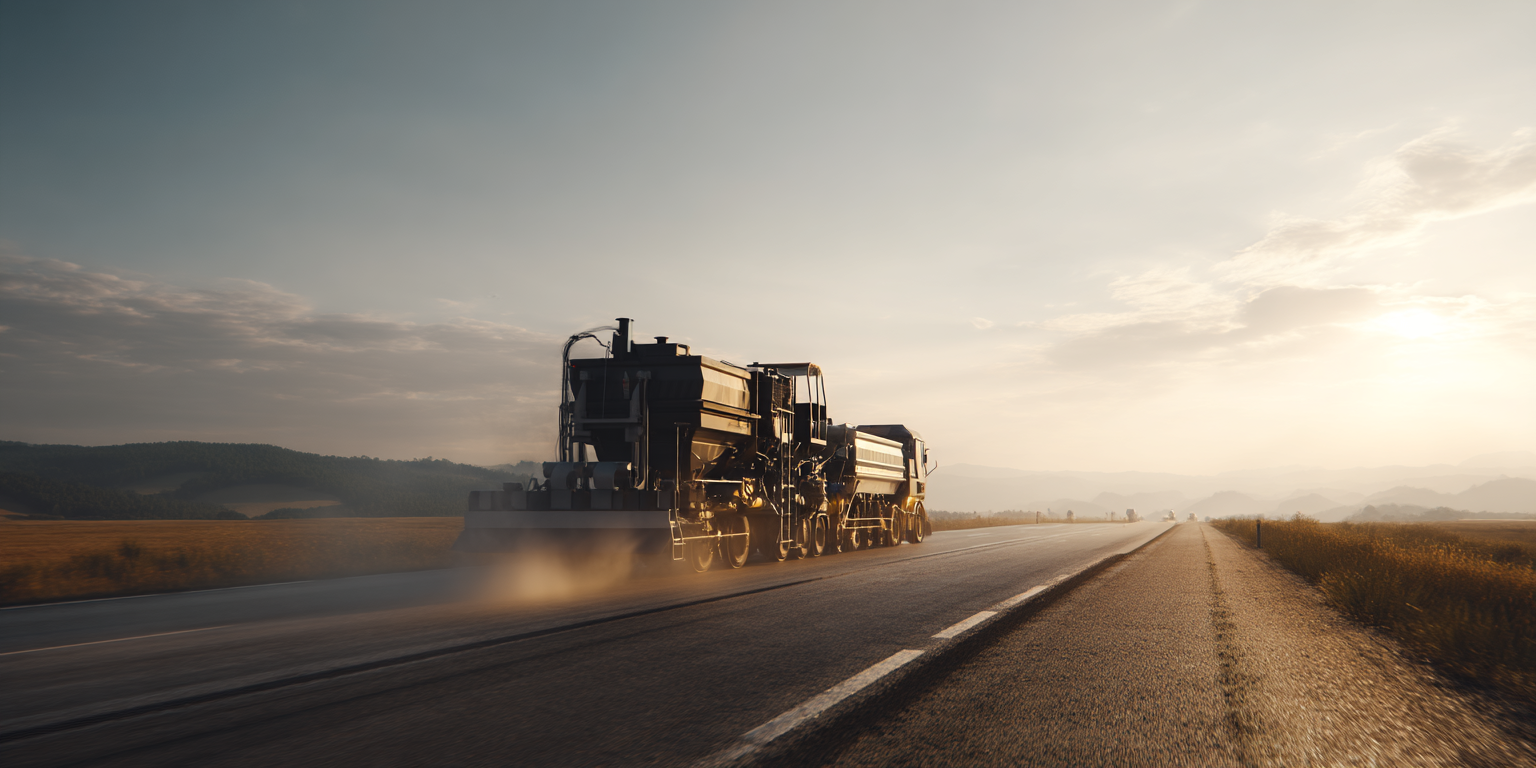
    For this reason, Dutch officials from the Rijkswaterstaat infrastructure agency in Utrecht, part of the Ministry of Infrastructure and Water Management, have invested in the Asphalt Recycling Train (ART or Asphalt Recycling Train). This is a vehicle-like machine that reuses old roads on site instead of tearing them up and disposing of them and then using new materials and thus emitting more carbon. This allows new asphalt to be laid in the same place.

    “With the ART, we can renew roads in a far more sustainable way,” Fredy Sierra-Fernandez, who is developing the ART at the ministry, is quoted as saying in a press release. “At the moment, we are testing a single machine to see how it performs in practice.”

    ART loosens the worn surface layer of roads, heats the old asphalt, picks up the melted material, stirs and mixes it and then applies the renewed asphalt back onto the road. The machine also compacts the road to create a smooth surface.

    Fernandez is now investigating how the roads behave after this process. Since June and from October last year, a provincial road in Gelderland in the east of the Netherlands and a section of the A2 highway have been monitored after the ART was used there.

    The road in Gelderland is in good condition. The section of the A2 highway is somewhat more worn, but still adequate. “We will continue until we are 100 percent satisfied,” says Fernandez. Tests in other regions are planned for April and May 2025.

    The Dutch government hopes to have three or four ARTs in operation across the country by 2030 to create a circular economy for asphalt.

    The ART was awarded the InfraTech Innovatieprijs 2025.

  • Resource-conserving use of demolition materials in road construction

    Resource-conserving use of demolition materials in road construction

    Strabag has been using crushing technology from the manufacturer Gipo to process mineral demolition materials since July. The mobile stone crushing plant Gipo-P100 GIGA produces high-quality aggregates from mineral demolition materials for road construction and concrete production at the Bürglen gravel plant, the construction company writes in a press release.

    The Bürglen gravel plant has a mixed gravel deposit consisting of processed gravel as well as primary and secondary gravel material. Storage and landfill require space. Recycling, on the other hand, means that excavation materials can be reused for future construction projects while conserving resources.

    An excavator fills the hopper of the 74-tonne crushing plant with unsorted demolition material. The material passes through several crushing stages on a conveyor belt, is screened and separated from construction waste until the end product has the required grain size. This is then supplied to the concrete plants, which use the recovered concrete for road construction.

    The technical manager of the Bürglen gravel plant, Franco Martinelli, quoted in the press release, describes the performance of the new crusher using the example of a construction site in Flawil SG. There was an urgent and short-term need for 3000 cubic metres of crushed, unbound 0/45 mixture. “With the crusher, we processed the required material within three days and transported it directly to the construction site. Without our Gipo-P100 GIGA, we would have had no chance of supplying our operatives,” they say.

    Strabag is also planning to use the crusher directly on construction sites for major demolition and dismantling work in the long term.

  • 69 million dollars secured for CO2 storage technology

    69 million dollars secured for CO2 storage technology

    Neustark has secured financing totalling 69 million dollars. According to a press release, the ClimateTech company from Bern was supported by the Decarbonisation Partners financing fund, a partnership between BlackRock and Temasek, with the backing of Blume Equity. UBS initiated debt financing. Existing financiers Siemens Financial Services, Verve Ventures, ACE Ventures and Holcim also participated in the new capital round.

    Neustark intends to use the acquired funds to strengthen its position in Europe and gain new markets in America and Asia.

    Neustark, a spin-off from the Swiss Federal Institute of Technology in Zurich(ETH), has developed a process in which CO2 is converted into limestone, which is bound to the pores and surface of the concrete granulate. The carbonated granulate can then be used in road construction or for the production of recycled concrete. According to the company, Neustark currently operates 19 plants with this technology in Germany, Liechtenstein, Austria and Switzerland. The company aims to store 1 million tonnes of carbon dioxide from the air by 2030.

  • DETEC approves road construction projects

    DETEC approves road construction projects

    This year the federal government will spend a total of around CHF 2.8 billion on new or continued work on the Swiss road network. The Federal Department of the Environment, Transport, Energy and Communications(DETEC) has now approved the corresponding construction programmes.

    According to this, by far the largest part of 1.6 billion Swiss francs will be spent on the maintenance and improvement of the existing national road network. A total of 482 million Swiss francs will be available in 2023 for projects within the framework of the Strategic Development Programme for National Roads and for larger projects. According to a press release from the Federal Roads Office, these funds will be invested mainly in the second tube of the Gotthard road tunnel, the six-lane expansion of the Zurich northern bypass (A1), the Lucerne bypass (A2) and the Le Locle bypass (A20).

    In addition, around 453 million Swiss francs are earmarked for the maintenance, the so-called operational maintenance, of the national road network. This includes, among other things, winter services, greenery maintenance, removal of accident damage and cleaning.

    This year, 264 million Swiss francs are available for new constructions within the framework of the network completion, a joint task between the federal government and the cantons, which was decided in 1960. The largest credit, 111 million, was allocated to the canton of Valais. Obwalden receives 18 million, Schwyz 12 million and Uri 7 million.

  • "We anticipate a trend towards urban living"

    "We anticipate a trend towards urban living"

    To person
    Stephan Attiger (FDP) has headed the Construction, Transport and Environment Department of the Canton of Aargau since 2013. At the national level, the 54-year-old represents the concerns of the canton as President of the Conference of Construction and Environment Directors (BPUK) and as a board member of the Conference of Energy Directors (ENDK). Born in Baden, he worked for a long time in the management of various Swiss companies before moving into politics. Among other things, he was Mayor of the City of Baden from 2006 to 2013 and Grand Councilor of the Canton of Aargau from 2009 to 2013.

    You are in charge of the Construction, Transport and Environment Department of the Canton of Aargau. How do you have to imagine a typical working day for you?
    In the last few months, my working days have been rather untypical due to covid: I was often in the home office, physical meetings were rare, and official events hardly took place at all. But not every day is the same, and the process depends heavily on the schedule. Basically, early in the morning I discuss the short-term issues and what is to come in the medium and long term with my closest employees. This is followed by meetings at various levels: government council, department, departments, bilateral discussions and meetings with external parties. In between I study files.

    What milestones have you reached in terms of construction so far?
    On the one hand, there are numerous larger and smaller buildings that I was allowed to inaugurate – not only in road construction, but also in the environmental sector, such as flood protection and renaturation projects. The latter also have a direct and positive effect on the residential and location attractiveness. In addition, we have created important foundations for the planning and subsequent implementation of mobility projects. With the last revision of the structure plan and the new cantonal mobility strategy mobilitätAARGAU, we want to coordinate settlement and traffic development. It therefore sets specific spatial accents and differentiated goals per room type for the individual means of transport. This in turn affects civil engineering and building construction. As a canton, we also act as a role model.

    In what way?
    For example, we are promoting more biodiversity and quality of stay in the outdoor spaces of our properties. We are looking for good solutions for how biodiversity issues can be taken into account in new buildings and in the maintenance of existing properties. Climate adaptation measures on buildings and in their surroundings make a contribution to achieving our climate policy goals. Another good example is the new building for the Office for Consumer Protection, in which we want to use wood from the Aargau forests as a sustainable building material.

    What are currently the most important construction projects in building construction?
    A major project currently underway in the area of cantonal real estate is the new construction of the police building in Telliquartier in Aarau. The units of the cantonal police, which are distributed across numerous locations, are to be brought together here. The building permit is already available. At the end of March, the canton also started the consultation process for the new location of a canton school in Fricktal. The hearings on the aforementioned new building for the Office for Consumer Protection and the project to merge the Aargau IT department into one building in Unterentfelden were concluded. All construction measures are implemented according to the principle of sustainability. During planning, special attention is paid to the gray energy bound in the building, and the time for new user requirements is coordinated with the time of repair.

    Aargau has a large number of development areas that could offer space for additional residents. What are the plans here?
    The cantonal structure plan designates 21 residential areas with areas that are predestined for high-quality settlement development. These should make a significant contribution to absorbing the expected population growth over the next 10 to 20 years in suitable, easily accessible locations. The areas should not only support the economical use of the soil with an appropriate density, but also become high-quality and attractive residential locations in the interests of sustainable development. This is the task of the municipalities, which determine the appropriate framework conditions and requirements in the land use planning. The canton supports them in this.

    Area developments often stumble over traffic problems. Are you actively helping to find a solution?
    It is effectively the case that high demands are placed on traffic planning, especially when it comes to site developments. This is because there are many unknowns about future claims. Here, traffic planning must provide a flexible framework in order to be able to react to the various requirements of investors. As far as the canton is concerned, it takes an active part or sets the framework conditions at the interfaces.

    The project to extend the Limmattalbahn from Killwangen-Spreitenbach to Baden is currently making waves. What are your arguments to try to change your mind against the opponents of extra time?
    The reporting in the media unfortunately gives a distorted picture of the general level of acceptance for this project. In the public hearing, the regional planning associations and all municipalities in the perimeter of the new tram route as well as most associations of the Limmattalbahn approved. The specifically proposed lines also received broad approval. We take the public's reservations that emerged from the hearing very seriously. For example, we have added additional variants for the lines. We will examine these and other objected points in more detail until they are determined in the structure plan and weigh them against the other cantonal interests and with the reservations mentioned.

    Urban sprawl is also a problem in Aargau. Did the municipalities make mistakes in spatial development?
    It is important to look to the future. In today's inventory, the potential that can be better used for sustainable development should be recognized. The revision of the Spatial Planning Act of 2013 has shown that the development needs of the next 20 years can be covered with the internal development of the settlement, i.e. the use of the existing reserves. We take the containment of urban sprawl very seriously. The 2015 structure plan finally defines the settlement area. The consumption of crop rotation areas has already fallen sharply.

    How well or badly does the cross-community cooperation in spatial development work?
    The regional planning associations play an important role in this cooperation. You also have to coordinate the municipal land use planning regionally in accordance with the building law. The coordination along the municipal boundaries works.

    What does an optimal use of land resources look like for you?
    The economical use of the soil is a central concern. Building upwards cannot, however, be unrestricted. The quality of the settlement and the townscape must always be taken into account. And in the case of underground structures, care must be taken to ensure that there is enough space left where large trees can be planted and water can seep away. This is crucial for avoiding heat islands in the settlement area and for the groundwater. Climate change poses great challenges for us. Optimal use of soil as a resource, sustainable settlement development and high-quality residential and workplace areas are not mutually exclusive.

    The canton of Aargau is already well positioned when it comes to digitization. What are the future plans in the construction sector?
    The digitization of construction projects with Building Information Modeling (BIM) is a big topic for us. We are currently working on around 20 BIM pilot projects. At the beginning of the year, the first master builder submission was put out to tender as part of a pilot project in the invitation process. Our goal is for BIM to be used as standard for project management in all new projects in the civil engineering department from 2025. Astra and SBB have the same “timetable”.

    Pandemics have had an impact on urban planning before. Will Corona present urban planners with new challenges in the future?
    Our villages and small towns are ideally suited for walking and cycling as places with short distances. This is a very good starting position, even in times of pandemic. In more and more places there is the possibility to work in co-working spaces. In this way, long travel times can be avoided, even if there is little space for home office. Attractive public spaces and easily accessible recreational opportunities are important. These are in great demand, and not just since Corona. I do not believe that this pandemic will completely turn city planning upside down.

    According to an analysis by Wüest & Partner, the canton of Aargau has the highest potential for new living space and development areas alongside Geneva, Vaud and Zurich. What will have changed in Aargau in 10 years?
    According to our forecast, we will get more attractive living space, especially in easily accessible locations, near train stations, in the centers of our villages and cities. Existing buildings are being converted, some of them are being built. We anticipate a trend towards urban living, not least because of the demographic development. More older people are drawn to central locations where they can benefit from services, short distances and cultural offerings. But living in the country will also remain attractive. Many of the around 100,000 single-family houses in Aargau are being renovated and brought up to date in terms of energy or even replaced by new buildings.

  • Switzerland needs 87 million tons of material a year

    Switzerland needs 87 million tons of material a year

    Researchers at the Federal Materials Testing and Research Institute ( Empa ) investigated the question: How much does Switzerland consume? The basis was the mass and energy flows for the year 2018. According to the press release , this means that domestic material consumption is 87 million tonnes net per year. That is the mass of material needed to keep the Swiss economy running. This includes, for example, buildings, streets, cars and electricity.

    As an example of outflowing masses, the announcement mentions that 12 million tons end up in the final disposal. The export in the research year 2018 amounted to 18 million tons. A large part of the incoming material remains in the system and allows the "warehouse" to grow by 52 million tons per year (as of 2018). The total weight of the “material warehouse” in Switzerland is around 3.2 billion tons.

    The study is the fourth part of the MatCH project. The abbreviation stands for "Material and energy resources and associated environmental impacts in Switzerland". The project was launched in 2013 on behalf of the Federal Office for the Environment (FOEN) and extended over several stages. The first part recorded all material and energy flows in the construction sector; the second covered mobility. And part three was devoted to the production and consumption of the other goods that are imported, obtained domestically and exported.

    The work now presented is part four, which brings a synthesis of the findings from the three previous ones. The team also analyzed how the behavior of the population affects greenhouse gas emissions. In addition to per capita consumption data, the researchers also analyzed personal behavior. The message states that if all residents behaved like the fifth of the population with the most exemplary lifestyle, Switzerland's total greenhouse gas emissions could be reduced by 16 percent. If, on the other hand, everyone behaved like the fifth with the least ecological lifestyle, emissions would rise by 17 percent.

  • Implenia is renovating the St.Gallen city motorway

    Implenia is renovating the St.Gallen city motorway

    The Federal Roads Office has commissioned ARGE Stadtautobahn with the renovation of the St.Gallen urban motorway between the St.Gallen West and St.Gallen East connections, Implenia explains in a press release . The construction and real estate company from Dietlikon has a 30 percent stake in ARGE Stadtautobahn. In addition to construction work, Implenia will take over the commercial management of the project for the renovation of the St.Gallen city motorway.

    The repair work should start at the end of May and be completed by the end of 2024, Implenia further explains in the communication. During this period, coverings, drainage, edge closures and noise barriers will be renewed and some bridges, galleries, support structures and the Stephanshorn tunnel will be renovated. In addition, the construction of a new passerelle is planned.

    "The renovation of the St.Gallen city motorway is a complex, large-scale project," Christian Späth is quoted as saying in the communication. The Head Civil Engineering Division Implenia is looking forward to being able to “combine Implenia's accumulated expertise in bridge, tunnel and road construction with our extensive experience in managing large infrastructure projects”.

  • Empa is replacing bitumen in road construction with string

    Empa is replacing bitumen in road construction with string

    Researchers at the Eidgenössische Materialprüfungs- und Forschungsanstalt ( Empa ) are currently examining a new method for stabilizing the amount of stone in road construction. Specifically, according to the press release, it is about replacing the bitumen binding agent in the production of the driving surface. Asphalt consists of stones of different shapes and sizes and only becomes a surface that can be used for roads when it is stabilized with the help of bitumen.

    Bitumen causes environmental problems. Air pollutants are released during production from crude oil and later during use. Asphalt is also prone to cracks and deformations and impermeable to rainwater, which pollutes the environment.

    The two Empa researchers Martin Arraigada and Saeed Abbasion from the concrete and asphalt department at Empa are currently implementing a method known from art for the production of road surfaces in a test arrangement. In such art objects, stone steles have been used, which are stabilized by a weave of twine and withstand loads of up to 20 tons at a height of 80 centimeters.

    In the experiment, an electronically controlled robot arm applies a string to a stone layer in a specific pattern. By “interweaving” the stones are fixed in five layers in their position in the “road bed”. In tests, these were already as strong as conventional bitumen asphalt under loads of half a ton. Inexpensive twine was used, such as are conventionally used for tying up packages.

    The trials have not yet led to a ready-to-use product that could be used in road construction. The basic work, however, provides a lot of innovation potential in order to get closer to a recyclable and perhaps rollable road surface using simple means, according to the Empa announcement. A video of the procedure can also be viewed on the website.