Tag: Stromerzeugung

  • Energy provider reports declining results alongside rising investments

    Energy provider reports declining results alongside rising investments

    According to a press release,Repower achieved a total operating performance of CHF 1986 million in 2025. This was 20 per cent less than in the previous year. The operating result before interest and taxes fell by 24 per cent to CHF 133 million, while Group profit fell by 27 per cent to CHF 101 million. According to the press release, the international energy trading business made the largest contribution to earnings. At the same time, the Graubünden-based energy supplier increased its investments by 80 per cent to 142 million. The equity ratio rose from 53 to 59 per cent.

    The low rainfall in spring 2025 in particular had a negative impact on Repower’s result. The wind farms in Italy and Germany also recorded a slight decline. The Teverola gas-fired combined-cycle power plant was out of operation for an extended period. Only solar production increased significantly in 2025. According to the press release, Repower produced a total of 2147 gigawatt hours of electricity in 2025. In the previous year, this figure was 2639 gigawatt hours.

    Repower achieved a very strong result of CHF 371 million and a profit of CHF 300 million in 2023. However, the company also reported a very good annual result for 2025. This was above the long-term average. The company also expects a good result for 2026.

  • Property funds and solar contracting: a response to the specific needs of property owners

    Property funds and solar contracting: a response to the specific needs of property owners

    How does solar contracting work?
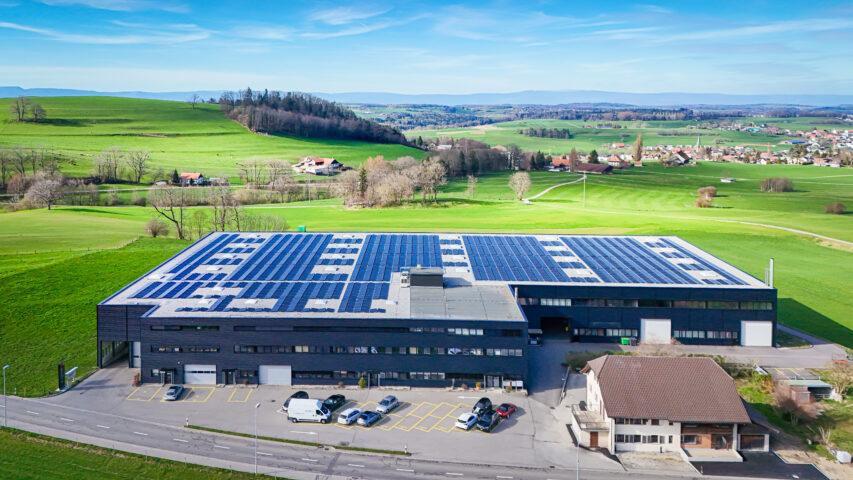
    Solar contracting is based on a simple principle: we install our own photovoltaic panels at your company’s site. Within this framework, we take over the complete planning and project realisation, as well as the financing and management of the system.

    This offer not only enables you to upgrade your property, but also fulfils the legal requirements and the expectations of your investors and tenants. It also enables the creation of new rental space.

    Your unused space as a capital investment
    As a property owner, you probably have areas that are suitable for the installation of photovoltaic panels. At Romande Energie, we offer installation on the following surfaces:

    • On a roof
      Turn unused space into a power plant – from 500m2.
    • On a car park
      Use your car park to generate electricity with a solar carport – from 2,000m2.
    • On a greenfield site
      Set up a ground-mounted solar power system on an unused plot of land – from 2,000m2.

    Stoneweg: a concrete example

    The Stoneweg Group, which specialises in real estate investment, turned to Romande Energie to equip several buildings with solar panels.

    We have realised several projects with Romande Energie and have always greatly appreciated their reliability and their solutions to specific challenges.” Diana Oblak, Managing Director at Stoneweg

    Click here for the interview

    What are the advantages of contracting?
    Contracting makes it possible

    • the creation of new rental stock and therefore an increase in your returns.
    • guarantee the conformity of your properties.
    • increase the value of your property.
    • reduce theCO2 emissions of your property portfolio.
    • Providing your tenants with clean and locally generated electricity at a competitive price.
    • participate in reducing the risk of electricity shortages at a national level.
    • participate in the fight against climate change.

    To make an appointment or for further information, please contact us at

    www.romande-energie.ch/solar

    0800 233 825 | solar@romande-energie.ch

  • Zurich power generators jointly train grid electricians

    Zurich power generators jointly train grid electricians

    According to a press release, Zurich’s two electricity suppliers are launching a joint training and communication campaign. Together, they want to train more grid electricians. The focus is on lateral entrants, according to a joint press release from EKZ and ewz.

    Instead of poaching skilled workers from each other, the electricity suppliers have now developed a joint training concept that is specifically tailored to lateral entrants. The programme is aimed at professionals who have already completed training in electrical engineering or another trade. The two energy companies are organising an information evening on this topic on 13 November.

    The programme is being run jointly by the two companies. During the internal training period, employees already receive a full salary. They are employed by either EKZ or ewz and receive their practical training on the job, supplemented by courses at the ewz training centre in Zurich-Schwamendingen. After around a year of further training, graduates receive an internal training certificate.

    In order to reach candidates for the lateral entry programme, the electricity suppliers are launching the Komm ins Team Power campaign. It addresses the target group with short videos on various online channels and directs them to a special website. Advertising campaigns at sporting events, activation via employees of the two energy companies and cooperation with the netzelektriker-forum association are also planned.

  • Rhenus Switzerland puts solar roof into operation in Schaffhausen

    Rhenus Switzerland puts solar roof into operation in Schaffhausen

    Rhenus Switzerland is putting a total of 2511 photovoltaic modules into operation on the roof of the logistics building in Schaffhausen, which has been fitted with a special film. This system is expected to generate around 1,100,000 kilowatt hours of electricity. According to a press release, this is roughly equivalent to the consumption of 220 households.

    The building was renovated in just under four months. The solar power generated on 6700 square metres will be fed directly into the Rhenus grid. Rhenus intends to use this to operate three buildings with office, warehouse and rental space. This will ensure that the logistics areas with a total of 23 loading bays and over 15,000 pallet spaces as well as block storage and picking areas are supplied with energy.

    “When it comes to sustainable logistics, we at the Rhenus Group prefer to be two steps ahead,” said Andreas Stöckli, CEO of Rhenus Alpina. “We are laying the foundations for more efficient and climate-friendly goods handling with the latest addition to our photovoltaic system in Schaffhausen and also at logistics centres in Basel and Spreitenbach. We need innovative solutions that not only benefit the environment and society, but also our customers.”

    The German Rhenus Group is one of the world’s leading logistics service providers with 39,000 employees at 1120 sites and an annual turnover of EUR 8.6 billion. The company has 15 sites in Switzerland.

  • Solar plant investment attracts a lot of interest

    Solar plant investment attracts a lot of interest

    The population of Frauenfeld is showing great interest in participating in large solar power plants. According to the municipal energy supplier Thurplus , it was able to sell all shares in a new photovoltaic plant planned for the roof of Keller-Stahl AG within just over a month.

    The plant consists of 300 modules on an area of 700 square metres. It has a capacity of 140 kilowatts/peak and is expected to generate 140,000 kilowatt hours of electricity per year. Two years ago, a similar plant was built on the roof of Keller-Stahl, which was also financed by private investors.

    The new plant is Thurplus‘ seventh investment plant. These have a total area of 3500 square metres and a capacity of 690 kilowatt/peak. Thurplus customers can participate in solar power plants for as little as 300 Swiss francs. In return, they receive 100 kilowatt hours of electricity per square metre of solar area per year for 20 years.

    Thurplus CEO Reto Lüthy sees the active participation of the city’s residents as confirmation of the company’s strategy. “For them, we are the key player in achieving the local energy turnaround,” he is quoted as saying in the press release. Thurplus is now looking for other solar projects that can be realised through the participation model.

  • Armasuisse builds alpine small wind solar plant in Surselva

    Armasuisse builds alpine small wind solar plant in Surselva

    Armasuisse Immobilien, part of the Federal Department of Defence, Civil Protection and Sport(DDPS), is testing with partners from Swiss industry and research how wind and sun can be used in the Alpine region to generate electricity locally. According to a media release, the construction permit for a test facility at the La Stadera site in the Surselva region in the canton of Graubünden has been granted. Construction work will begin in August and the test plant is scheduled to go into operation in autumn 2024.

    The plant combines the generation of electricity through the use of wind energy and the use of solar radiation through photovoltaics. The test facility consists of a small wind turbine and bifacial (double-sided) photovoltaic modules that will be combined. The project was approved as part of the military plan approval procedure, the Federal Council‘s statement said. The wind turbine will be installed from August 2023. The photovoltaic modules arranged around the wind turbine will follow by autumn 2024 and complete the test facility.

    By the end of 2025, the test facility should provide data so that the efficiency of the new type of construction can be estimated more precisely. The expected energy yield is around 60 megawatt hours per year. According to the statement, this corresponds to the electricity consumption of around 15 Swiss households. The evaluation of the data by the end of 2025 will form the basis for the decision on whether to implement a final expansion with a total of nine small wind solar plants at the site.

    A solar prototype already installed in La Stadera by the Swiss system supplier Turn2Sun from La Sagne NE has already been successfully supplying electricity since winter. The solar prototype is also equipped with double-sided photovoltaic modules.

  • IWB tests alpine solar plant on Melchsee-Frutt

    IWB tests alpine solar plant on Melchsee-Frutt

    IWB has concluded a cooperation agreement with the Kerns Alpine Cooperative outside the stone bridge. According to a press release, the agreement provides for the feasibility of a solar plant on the Melchsee-Frutt plateau to be examined. In addition to the technical details, the effects of a photovoltaic system on the existing management and the environment will also be analysed.

    The good accessibility, the high altitude and the snow favour the production of electricity, especially in winter, according to the statement. The plant would be connected to the Obwalden electricity company.

    The two contract partners have already begun talks with the municipality of Kerns and the canton of Obwalden. Other stakeholders and environmental organisations are also to be included in the talks.

    Markus Ettlin-Niederberger, president of the Kerns Alpine Cooperative, welcomes the expansion of the project. “We can make an active contribution to a renewable and secure energy supply and even increase local added value,” he is quoted as saying in the press release. Pascal Semlitsch also sees great potential in the project. “Melchsee-Frutt offers very good conditions for an alpine solar plant,” the head of investments at IWB is quoted as saying. “We have the goal that more renewable, domestic solar power can be produced very locally and in an environmentally friendly way.”

    IWB has already built an alpine solar plant at the Muttsee dam in the canton of Glarus together with Axpo.

  • Comprehensive energy systems by EKZ

    Comprehensive energy systems by EKZ

    The pressure on holistic ecosystems around real estate and their energy solutions is growing. EKZ simplifies this task with clever solutions.

    The combination and central management of electricity generation and storage, heat and cooling generation and electromobility in an integrated energy system leads to the simplification of property management, maximum living and working comfort and optimal energy efficiency in production. In addition, ecological sustainability is ensured.

    The goals of the Energy Strategy 2050 are being built here. Most of the Verdeblu development has been completed and inhabited since autumn 2019. It is noteworthy that this development covers a large proportion of its energy needs itself, and that exclusively from renewable sources.

    "The specifications of the Energy Strategy 2050 are also an opportunity for the real estate industry," explains Dieter Stutz from Atlantis AG, which is active in the areas of environmental consulting, settlement planning and architecture and who developed the project. The heat supply via groundwater was the best and most convincing solution for the area. Atlantis planned and implemented this complex construction project together with EKZ.

    On-site energy production
    The “Grand Chemin” development was built in Epalinges in western Switzerland, with some of the electricity required being produced on site by a photovoltaic system (PV). A new multi-family house is being built in Emmen (LU), which will be characterized by four heat pump systems with groundwater as an energy source and a photovoltaic system with ZEV. Seen in this way, the future of energy has long since begun in this country as well.

    Text: Mohan Mani, Image: zVg.