Tag: Synergien

  • City council plans reorganisation of heat supply

    City council plans reorganisation of heat supply

    So far, there are three municipal providers of heating networks on city territory: Elektrizitätswerk ewz, Entsorgung + Recycling Zürich (ERZ) and Energie 360° AG. All large-scale heating networks are now to be united under the umbrella of ewz. Through their joint efforts to achieve the city’s net zero targets, the three providers of district heating networks have intensified their cooperation in recent years. Then, about two years ago, the city council formalised this cooperation by establishing the Wärme Zürich office. Since then, Wärme Zürich has been coordinating the expansion of the networks of the three providers. Currently, it is being examined whether the existing heating networks can also be physically connected to each other, so that an overall network is gradually created on city territory, which further increases the security of supply. The planned reorganisation takes these changes into account and represents the next integration stage in the area of heat supply.

    Implementation plan in progress
    A project headed by City Council members Michael Baumer (Head of the Department of Industrial Operations), Simone Brander (Head of the Department of Civil Engineering and Waste Disposal) and Andreas Hauri (Head of the Department of Health and Environment) will show in an implementation plan by the end of the year how and in what timeframe such a reorganisation can take place. The consultation with the staff associations will also take place during this period.

    Integration of ERZ’s district heating activities
    ERZ’s district heating activities will be integrated into ewz. The implementation plan will show how the integration of the district heating activities is to be structured and how and when the employees concerned are to transfer from ERZ to ewz. The experts from ERZ will play a decisive role in shaping the new organisation with their knowledge and many years of experience in the heating sector.

    New prospects for Energie 360°
    Energie 360° will also transfer part of its heating networks in the city of Zurich to ewz, with the employees remaining with Energie 360°. Ownership and operation of the gas grid and all other activities will remain with Energie 360°. Energie 360° is a joint-stock company owned by the public sector. The main owner is the city of Zurich. The company’s strategy of driving forward the transformation throughout Switzerland and supplying exclusively renewable energy by 2040 will be maintained. As the focus of Energie 360°’s activities will shift even more to activities outside the city in the future, the city council wants to offer the company new perspectives and open up the field for cooperation. In order to gain more freedom of action, the city council’s authority to sell shares in this company is to be extended.

  • Photovoltaics: Economic and ecological benefits for real estate owners

    Photovoltaics: Economic and ecological benefits for real estate owners

    Enormous solar potential
    After a steady increase over the years, photovoltaics recorded a record increase in 2020. According to the "Solar energy statistics" of the Federal Office of Energy (SFOE), around 118,000 photovoltaic systems with an output of almost 3 gigawatts were installed at the end of 2020. The strong market growth continued in 2021, so that according to Swissolar, photovoltaics (PV) today covers more than 6 percent of Switzerland's electricity requirements. Experts assume that this trend will continue, not least in view of the efforts towards much more energy independence.

    Ecological and economic advantages
    Photovoltaic systems bring a whole range of advantages for owners of real estate portfolios. On the one hand, they can protect themselves against rising electricity prices. On the other hand, they already meet possible future self-production specifications today. Also with regard to subsidies, new rules will make the production of solar power more attractive in the future. In addition, portfolio owners with their own solar systems benefit from a clear reputation advantage.

    In most cases, PV power from your own roof is cheaper than power from the grid. The fact that power consumption due to heat pumps and electromobility will continue to rise in the future contributes to the financial attractiveness of PV systems. Improving the ecological balance sheet is also becoming increasingly important, because sustainability aspects are part of the strategy of more and more companies. Furthermore, PV systems are also interesting because they increase the value of real estate. If the photovoltaic systems produce more electricity than can be consumed on site, it is possible to use the solar power in other properties.

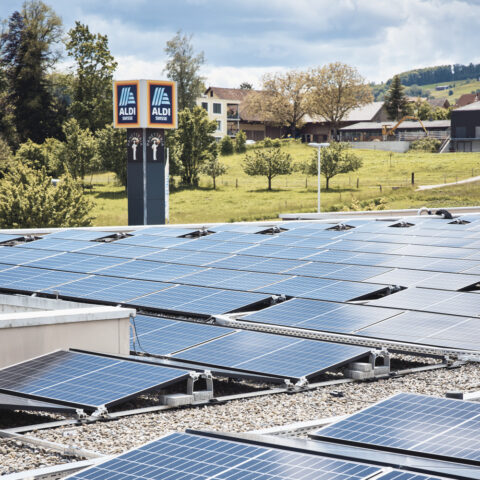
    In the ALDI SUISSE solar project, for example, sustainability and cost-effectiveness play a key role. In just over a year, ewz equipped 68 store roofs between Romanshorn and Geneva with photovoltaic systems. ALDI SUISSE uses most of the solar power itself for its own branch operations. Thanks to the large PV systems, the implemented solution enables a high solar yield with an average self-consumption of 55 to 60 percent.

    High self-consumption increases profitability
    There is already a heat pump in around 90 percent of new buildings, and new registrations of electric cars are continuing to rise sharply. However, heat pumps and electric vehicles are only really low in CO2 if they use renewable electricity. The combination with a photovoltaic system therefore makes sense: Solar power reduces CO2 emissions, and high self-consumption increases the profitability of the PV system. This is because the production costs for solar power are lower than the electricity tariff for households and because the energy suppliers pay a low tariff for the solar power fed into the grid.

    A good way of using a large part of the solar power yourself is to organize several end users in a group for self-consumption (ZEV). These are possible both in rental properties and among property owners. The degree of self-consumption of photovoltaic systems is on average 30 to 40 percent. This value can be significantly increased with self-consumption solutions.

    A large part of the electricity is used on site through the targeted control of consumers such as heat pumps or electric vehicles. The advantage for property owners and their tenants: the cost of solar power, at 8 to 16 centimes per kilowatt hour, is lower than the electricity tariff for households, which costs 15 to 25 centimes per kilowatt hour.

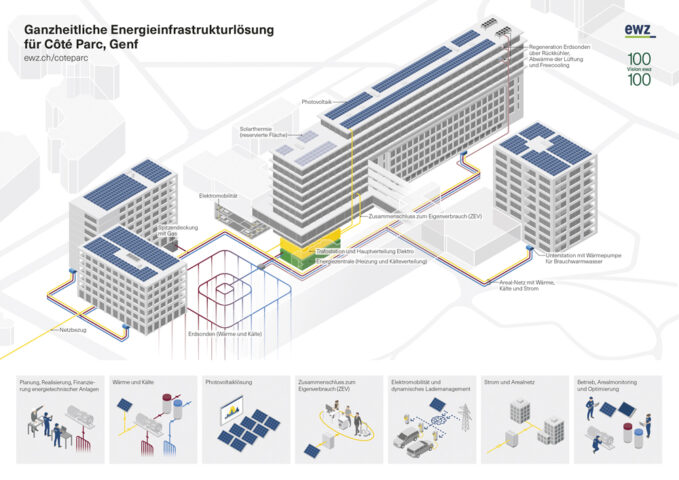
    An interesting practical example of this is the "Côté Parc" project in Geneva. 776 photovoltaic panels on the roofs of the area form the basis for an integrated solar solution with heat pumps, charging stations for electric cars and the area's own power grid, including self-consumption for the users.

    For property owners with large roof areas (from approx. 700 m2), a contracting model is an option worth considering. The provider takes over all services – from planning to financing, implementation to operation over several decades. Including the integration of photovoltaic systems, it is a holistic energy solution with heating, cooling, electromobility and self-consumption models.

    Business customers of ewz can rely on efficient and tailor-made solutions from competent teams with many years of experience. Investment, maintenance and repair costs are not incurred during the contract period. After the end of the contract period – usually 20 to 30 years – the photovoltaic system becomes the property of the customer.

  • Four Aargau energy suppliers are working together

    Four Aargau energy suppliers are working together

    The utility companies in southwestern Aargau are moving closer together. tba energie ag , EW Oftringen AG , EW Rothrist AG and StWZ Energie AG want to found the energy supplier Regionale Energie AG (REAG) and the water supplier Regionale Wasser AG (RWAG) together. The city of Zofingen is said to hold just over 50 percent of REAG. The shares of Oftringen, Rothrist and Zofingen in RWAG are said to be between 27 and 33 percent. Among other things, the merger is intended to increase regional added value and secure jobs.

    The four companies expect synergies of CHF 2 million per year, they write in a statement . About half of this is to be returned to customers via the tariffs. The harmonization of tariffs will take up to ten years.

    The ball is now in the hands of the boards of directors of the four companies, the five municipalities involved and ultimately the voters. The two new companies are scheduled to start operations on January 1, 2023.

  • Apleona bundles businesses in Switzerland

    Apleona bundles businesses in Switzerland

    The new company will be managed by Michael Rohner (CEO), Markus Faber (COO, Facility Management), Thomas Scheiber (COO, Facility Management) and Sabrina Hauser (COO, Real Estate Management). The legal merger will be completed in the spring of 2022.

    According to CEO Michael Rohner, the merger strengthens Apleona’s market position in Switzerland: “By bundling the synergies of resources and know-how, we combine the best of facility management and real estate management, increase the depth of our own services and can thus offer our customers even more added value Offer.”

    In the future, more than 1,400 employees will work for Apleona Schweiz AG at 13 locations in Switzerland.