Tag: Tiefbau

  • STRABAG builds utility lines in Arbon

    STRABAG builds utility lines in Arbon

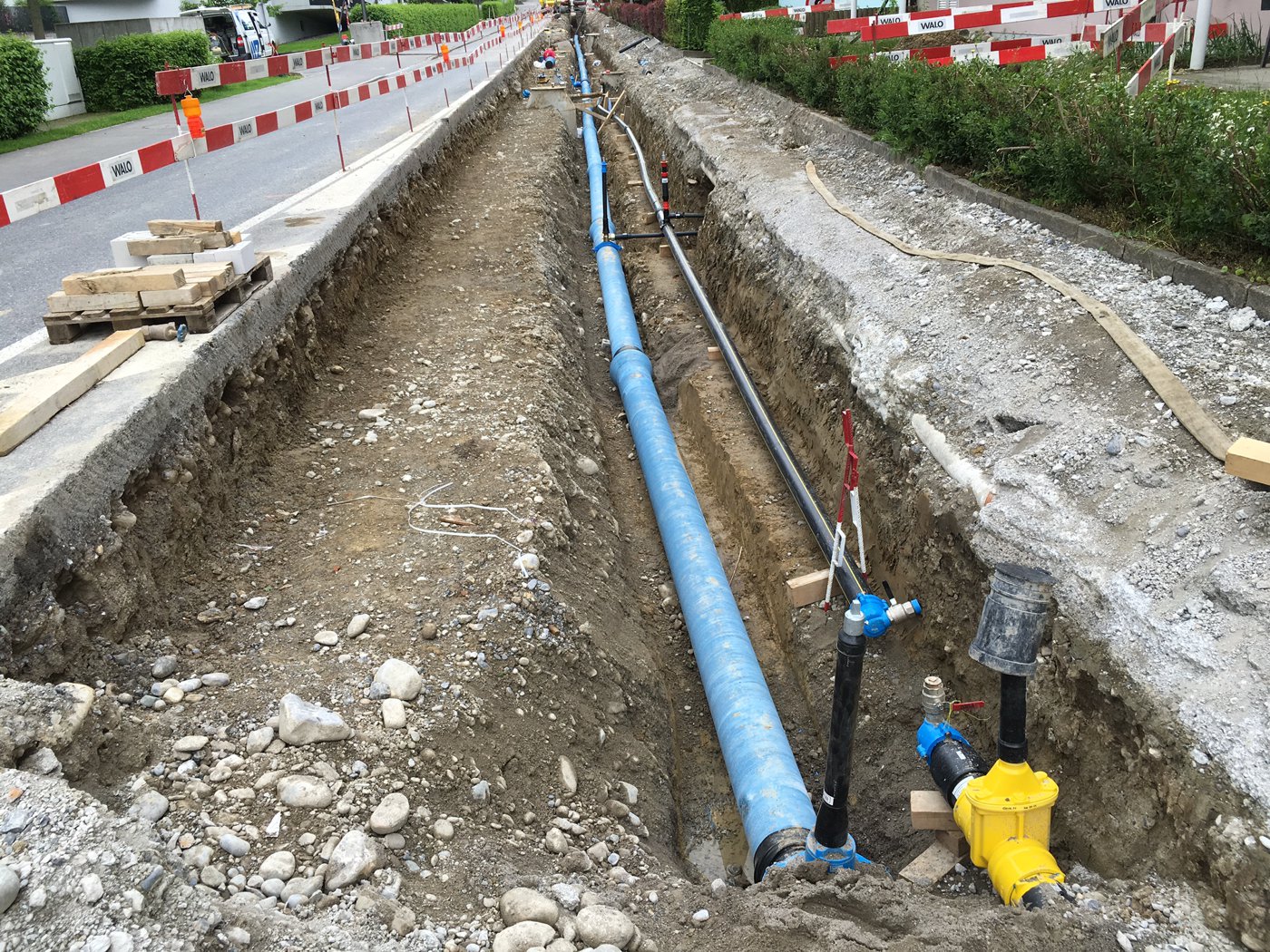
    The Schlieren-based construction company STRABAG AG is building new underground pipes in Arbon, according to a press release. According to the company’s press release, the service lines in Amriswilerstrasse and Egnacherstrasse in Arbon were in a state of serious disrepair. These service lines for water, electricity, gas and the Swisscom data cables are being completely renewed. A new rainwater drain will also be created as part of the work.

    According to STRABAG, the project is characterised by the cooperation between the municipality and the utility company. The construction costs will be borne jointly.

    According to STRABAG, the last renovation of the utility lines was decades ago. Surprises were therefore inevitable during the work. For example, the employees had to uncover power lines by hand. During the process, a mistake would have led to the power being switched off in the entire neighbourhood.

    At the same time, the traffic flow and the interests of neighbours had to be kept in mind. One junction leading to an agricultural machinery park was particularly tricky because there was no way to divert traffic there. However, Ivo Schlappritzi’s team found a solution and a complete closure was avoided without delaying the construction work.

    “Thanks to careful planning and close collaboration with Innoplan Bauingenieure AG, we were able to successfully overcome the challenges on this construction site. Together as a team, we ensured that the new utility lines could be handed over to the municipality of Arbon on schedule in autumn 2025,” said Schlappritzi, STRABAG construction manager for civil engineering and road construction in the Mittelland region.

    Innoplan Bauingenieure AG is an engineering office for structural and civil engineering based in Arbon.

  • Civil engineering work for power grid at Stadelhofen railway station started

    Civil engineering work for power grid at Stadelhofen railway station started

    According to a press release, the Dietikon-based construction company Walo Bertschinger is starting civil engineering work on the cable systems of the Elektrizitätswerk der Stadt Zürich(ewz) directly at Zurich-Stadelhofen railway station. Walo has been awarded an annual contract by ewz from 2024 to 2028. This makes Walo one of four companies involved in important infrastructure projects. Walo Bertschinger will start civil engineering work on ewz’s cable systems directly at Stadelhofen station in February.

    ewz is responsible for the secure and efficient operation of the distribution grid in the city of Zurich and parts of the canton of Graubünden, ewz says. ewz’s modern and intelligent metering and grid infrastructure ensures security of supply in the city of Zurich. In the long term, this infrastructure supports Zurich’s net-zero target for 2040 and the preservation of quality of life in the city. At the same time, it is a prerequisite for further networking and digitalisation.

  • Stagnation characterises the construction industry

    Stagnation characterises the construction industry

    From January to September 2024, the construction industry generated nominal sales of CHF 17.5 billion, an increase of 0.6 per cent compared to the previous year. Adjusted for inflation, however, there was a decline of 0.5 per cent. While civil engineering increased by 2.6 per cent in real terms, building construction recorded a decline of 3.4 per cent.

    Declining incoming orders
    Incoming orders fell by 2.5 per cent in real terms to CHF 17.3 billion. In building construction in particular, rising interest rates, higher construction costs and a shortage of public funds led to a noticeable decline. Only civil engineering was able to achieve an increase in orders in both the public and private sectors.

    Falling order backlog
    The order backlog in the main construction sector shrank by 3.7 per cent to CHF 14.9 billion by the end of September 2024. This corresponds to an order backlog of around 7.7 months. The entire industry is facing a gloomy outlook: While civil engineering is expected to remain stable, residential construction is not expected to grow again until the third quarter of 2025.

    Noticeable decline in employment
    The uncertainties are having an impact on employment. The number of full-time positions in the sector fell by 4.0 per cent to 89,000 employees. Despite the Swiss National Bank’s key interest rate cut from 1.75 to 1.0 per cent in 2024, the effect will be delayed.

    Construction activity in Switzerland is stable, but characterised by stagnation and challenges. Developments in residential construction in particular will be decisive in providing the urgently needed impetus for renewed growth.

  • New localisation solutions improve safety in civil engineering

    New localisation solutions improve safety in civil engineering

    Leica Geosystems, the precision equipment manufacturer based in the St.GallenBodenseeArea, has presented new localisation solutions for the civil engineering sector. According to a press release, employees of civil engineering companies will be able to use the new devices to better locate existing infrastructure supply lines and thus prevent accidents. This new solution from Leica Geosystems consists of the Leica DD300 CONNECT intelligent locating device and the Leica DA300 signalling device. The user-friendly solution enables professionals to carry out accurate, reliable and in-depth underground surveys and gain on-site insights into the underground network, according to the press release. The devices offer a frequency bandwidth for object detection in the spectrum from 33 to 131 kilohertz. The frequency of 83 kilohertz is particularly suitable for detecting objects at greater distances. The system can be integrated into the Leica DX Shield software.

    “Our product range extends from simple entry-level devices to sophisticated, fully equipped high-end locating devices,” said Federico Bertolucci, Product Manager for Locating Systems in the Geosystems division at Leica parent company Hexagon, in the press release. “The new Leica DD300 is characterised by unrivalled versatility, enabling a wide range of users to safely locate and bypass underground utilities. This adaptability significantly increases both productivity and safety at different levels of user expertise.”

  • Private conversion projects boost construction investments in 2022

    Private conversion projects boost construction investments in 2022

    Total construction expenditure is made up of construction investments and public maintenance work. They increased by 1.5% in 2022. However, since construction prices have risen sharply, this results in a real minus of 5.9%. Construction investments showed a nominal increase of 1.8% year-on-year. On the other hand, expenditure on public maintenance work recorded a decline of 1.4% compared to the previous year.

    Private clients invested heavily in conversion projects
    Investments in new buildings (+0.3%) and conversions (+4.2%) increased in 2022 compared to the previous year. This positive result is due to private clients, who invested significantly more in conversions (+7.2%). In the same period they also spent more on new construction projects (+0.3%). The public clients – i.e. the Confederation, cantons and municipalities – increased their investments in new buildings within the year (+0.3%). On the other hand, they spent less on renovation projects (-0.1%).

    Positive development of building construction investments
    Switzerland-wide, more was invested in building construction (+2.3%) compared to 2021. Both private clients (+2.4%) and the public sector (+1.3%) contributed to this positive result. In contrast, investments in civil engineering (-0.1%) declined within a year. Public clients spent less on infrastructure construction (-0.9%). Private clients, on the other hand, invested more in civil engineering (+3.2%).

    Outlook for 2023
    The work in progress (expenditure) for the following year 2023 for construction projects under construction (incl. public maintenance work) increased by 1.6% as of the reporting date 31.12.2022 compared to the previous year’s reporting date.

    Source: bfs.admin.ch

  • Holcim buys Belgian building materials specialist Cantillana

    Holcim buys Belgian building materials specialist Cantillana

    Building materials producer Holcim has announced the takeover of Belgian building materials dealer Cantillana . With Cantillana’s presence and portfolio, Holcim can advance the expansion of the solutions and products division, which is expected to account for 30 percent of Group net sales by 2025, according to a press release .

    For Holcim, the decision in favor of the provider of special solutions means a further optimization of its market position in facade construction systems and thermal insulation composite systems. “This expansion further strengthens our presence in Europe, particularly in the area of building renovation and energy efficiency,” said Miljan Gutovic, head of Holcim’s Europe, Middle East and Africa region.

    The investment ties in with the adopted strategy of “green growth”. Both companies announce that they aim to “take a bigger role in providing innovative and sustainable solutions for energy-efficient buildings”.

    After acquiring the French PRB Group , the Belgian PTB-Compaktuna and Izolbet in Poland, Holcim is adding Cantillana, a privately held company, to the “Holcim family”. Originating as a branch of a construction company, Cantillana has specialized since it was founded in 1875 in the sale of and trade in building materials and building material accessories for the construction and related trades. Today, Cantillana is part of the Stadsbader Group and employs more than 200 people at nine production sites in Belgium, France, Germany and the Netherlands.

    Holcim AG has focused on innovative and sustainable construction solutions in building construction, civil engineering and infrastructure. At 55 locations across Switzerland, the company produces concrete, gravel and cement suitable for all construction projects and recycles demolition materials into resource-saving products.

  • Building is getting more expensive

    Building is getting more expensive

    The construction price index rose by 2.7 percent between April and October of the current year. The price level in the construction industry has increased by 4.1 percent within a year. This is shown by figures from the Federal Statistical Office . As a media release shows, the additional costs in building construction and civil engineering are causing prices in the construction industry to rise compared to the previous half-year.

    Property developers have to dig deeper into their pockets for the shell construction, from earthworks to windows and doors, in all major regions. The most noticeable increases in building construction costs are in the Swiss Plateau with 3.4 percent and in Central Switzerland with 3.2 percent price increases.

    With the exception of Eastern Switzerland and Ticino, construction prices in civil engineering rose. In this sub-area of the construction industry, too, the regions Mittelland with 2.2 percent and Central Switzerland with 3.4 percent are most affected by the rising cost level. The price increases had the most pronounced effects on "smaller track construction" and somewhat less markedly on "fees".

  • Graubünden promotes recyclable building materials

    Graubünden promotes recyclable building materials

    Graubünden wants to increase the demand for recycled building materials. As the Canton now tells , he has to this end, together with the Association of Grisons concrete and gravel industry developed a brochure. It is intended to show project developers and building owners the possibilities of using recycled building materials.

    Every year around 250,000 cubic meters of mineral construction waste are delivered to the 42 processing stations in the canton of Graubünden. That corresponds roughly to the volume of 1,300 single-family houses. As the canton further explains in its announcement, concrete demolition is already being recycled and used in new concrete structures.

    However, mixed demolition and road pavement are often not returned to equivalent circular applications, but are used loosely, for example in foundations or deposited in landfills. That is neither ecologically nor economically sensible. That is why the message passed by the government on the Green Deal Action Plan provides for measures to close material cycles and to increase the recycling of building materials.

    What is often missing is the demand for these recovered building materials. In terms of price, they would be on par with the primary materials. They also offer the added value of a sustainable use of resources. However, it is often overlooked that building materials are also polluted with CO2. The brochure now presented shows "for all conceivable applications in civil engineering which recycling products can be used".

  • Tschopp Holzindustrie is making progress with the sawmill

    Tschopp Holzindustrie is making progress with the sawmill

    The Tschopp Holzindustrie AG is a milestone in the construction of its new sawmill at its headquarters in Buttisholz known . The civil engineering work in the saw hall area was thus completed. Now the building construction work is to begin. The building should have a length of 125 meters, a width of 50 meters and a height of 20 meters.

    The new sawmill is scheduled to start operations in spring 2023. Tschopp Holzindustrie is investing a total of 75 million francs in the expansion. It is the largest investment in the company's 100-year history to date.

    Tschopp Holzindustrie specializes in the production of formwork panels for the construction industry. Since 2005, pellets have been produced from the waste wood for the energy industry. After the new sawmill has gone into operation, timber construction companies will also be offered products that have not yet been manufactured at home or not industrially manufactured in Germany and therefore have to be imported from abroad, such as three-layer natural wood panels.

  • Reconstruction displaces new construction

    Reconstruction displaces new construction

    Overall, the construction industry barely moved in 2019. According to the provisional figures from the Federal Statistical Office ( BFS ), an increase in construction investments in civil engineering of 3.9 percent offset a decline in building construction of 0.9 percent.

    There was a change from new buildings to renovations and expansions. Investments in new civil engineering buildings fell by 6.9 percent, while investments in conversions and expansions rose by 13.2 percent. In building construction, too, investments in renovations and extensions rose by 1.6 percent, while investments in new buildings fell by 2.0 percent.

    This switch to renovations was particularly pronounced among public clients: Last year they invested 8.8 percent more in renovations and extensions and 7.2 percent less in new buildings. Private clients invested 2.2 percent more in conversions and expansions than in 2018, but 1.4 percent less in new buildings.