Tag: Transport

  • Green light for cargo sous terrain

    Green light for cargo sous terrain

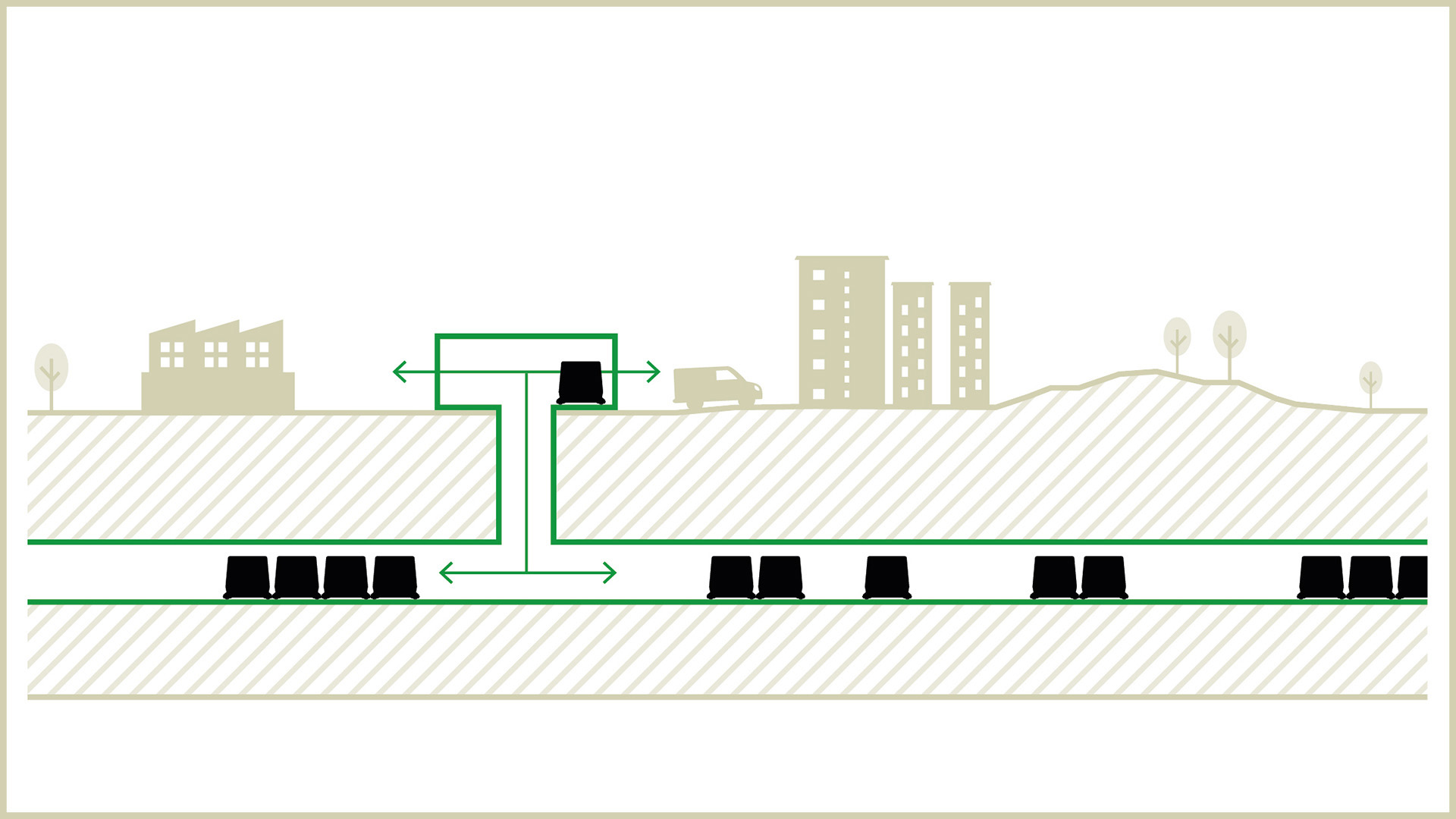
    With the Federal Council’s sectoral plan decision, the innovative Cargo sous terrain freight transport system is officially anchored in spatial planning for the first time. The privately initiated project will transport goods through an underground tunnel system from the Swiss Plateau to the cities. This will be done around the clock, with low emissions and independently of road traffic.

    The basis for this is the Federal Act on the Underground Transport of Goods (UGüTG), which came into force in 2022. It enables companies like CST to plan and implement such systems under clear legal conditions.

    First stage between Härkingen and Zurich defined
    The federal government has now defined the spatial planning corridor for the first section from Härkingen to Zurich in the newly inserted part of the sectoral transport plan. The planned locations for the logistics hubs are also spatially localised in the plan. The plan thus creates planning and legal certainty for all levels involved, from the federal government to the cantons and municipalities.

    Critical points will be incorporated into further development
    The cantons and municipalities affected were able to express their opinions during a consultation in the first half of 2024. Issues discussed included the impact on groundwater, the volume of traffic at the hubs and the handling of excavated material from tunnelling. The feedback will be integrated into the further development of the sectoral plan. According to the federal government, there are no contradictions with existing structure plans.

    Important step on the way to the construction permit
    The entry in the sectoral plan fulfils a key requirement for the subsequent construction permit. Further authorisation and approval procedures are still to come, but the current decision significantly strengthens the feasibility of the overall project.

    Paving the way for a new logistics era
    With the sectoral plan decision, the Federal Council is sending a clear signal in favour of sustainable and innovative infrastructure development. Cargo sous terrain could revolutionise freight transport in Switzerland in the long term – underground, quiet and space-saving. The spatial planning framework is in place, now the next stage of implementation begins.

  • ZIMEYSAVER – a future for Meyrin, Satigny, Vernier

    ZIMEYSAVER – a future for Meyrin, Satigny, Vernier

    This major development project is being carried out in close collaboration between the municipalities concerned, the Fondation pour les terrains industriels and various associations, entrepreneurs and local residents. This partnership ensures that multiple interests are taken into account and that commercial and residential areas coexist harmoniously.

    Attractive and affordable spaces
    One of the main challenges of the project is to create attractive and diversified land and property availability at affordable prices for productive activities. Emphasis is also placed on the skilful integration of commercial and residential spaces to create a coherent and pleasant environment for all concerned.

    Optimising the transport infrastructure
    Improving the transport of goods and the mobility of people is another important aspect. The planned traffic lanes and new motorway junctions will considerably improve accessibility to the area. Two high-speed bus lines will provide better links between the north and south of the region from 2024.

    Quality of the environment and housing
    The emphasis will be on improving the quality of the environment by creating qualified open spaces and providing new facilities for businesses and employees, such as crèches, restaurants and small shops.
    The next steps
    In 2024, further development of the master plan for mixed activities and the submission of planning permission for the “Bar de Montfleury” as well as the new motorway interchange. Next year will see a public review of the zoning changes and master plan for the Tuilire industrial estate, as well as the start of work on the right bank agglomeration road. By 2031, the “Montfleury bar” and the motorway interchange should be completed.

    Previous achievements
    The project has already succeeded in implementing a number of important milestones, including the adoption of several master plans and investment credits, as well as the preparation of future development phases. For example, the master plan for industrial and commercial zones was adopted by the State Council in May 2022.

  • Neustark inaugurates its largest CO2 storage facility

    Neustark inaugurates its largest CO2 storage facility

    Neustark, a pioneer in the permanent removal of carbon from the atmosphere, is launching its largest ever facility for storing CO2 in demolition concrete. It has been built in Biberist on the demolition site of a paper mill and was planned together with the two demolition recycling and concrete production companies Alluvia AG and Vigier Beton, according to a media release. The two companies operate the facility.

    The Bern-based company, which was spun out of the Swiss Federal Institute of Technology Zurich in 2019, is tackling the world’s largest waste stream with its technology: Neustark has developed a technology and a value chain that transforms demolition concrete into a carbon sink.

    To do this, the company works with biogas plants to capture CO2 there. It is then transported to nearby storage facilities where the CO2 is injected into the granules of demolition concrete. This triggers a mineralisation process. In the process, the CO2 is converted into limestone and thus permanently bound to the granulate. Recyclers can reuse the granulate enriched in this way according to the usual process.

    “Neustark was the first company to demonstrate in practice that permanent CO2 storage through mineralisation in concrete demolition makes economic and ecological sense,” founder and co-CEO Johannes Tiefenthaler is quoted as saying. In its first months of operation, Neustark says it has already permanently removed more than 300 tonnes of CO2. The goal is to reach at least 1 million by 2030. Further plants are currently being built in Germany, Austria and France. Clients include UBS, Microsoft and Verdane.

  • TerraRail Modalsplit transports excavated material by rail

    TerraRail Modalsplit transports excavated material by rail

    With the newly founded company TerraRail Modalsplit AG, the transport of excavated material for large construction projects in the canton of Zurich is to be shifted from road to rail. According to a press release by Eberhard Bau, the companies HASTAG (Zürich) AG based in Birmensdorf ZH, Schneider Umweltservice AG in Miles ZH and Eberhard Bau AG in Kloten ZH have merged to form the company. TerraRail Modalsplit is also based in Kloten.

    The reason for the merger of the three companies is a new legal provision in the canton, as the announcement shows. Since July 1, 2021, clean excavation from excavation pits with a volume of over 25,000 cubic meters must be transported away by train in the canton of Zurich.

    With the founding of TerraRail Modalsplit AG, the transport of excavated material and aggregate is offered by rail and truck traffic is shifted to rail. The excavated material can be delivered to the Rümlang, Volketswil, Winterthur and Birmensdorf sites and the aggregates can then be picked up. According to the announcement, the locations – Birmensdorf is still under development – all offer a direct rail connection and can cover the necessary handling capacities. The excavated materials are then transported away by train and deposited or recycled in a material extraction point.

    The new company can “cover the demand triggered by the law, use synergies with the previous construction site transport and relieve the traffic area with the train. We were already able to actively offer the service for the first tenders,” Markus Streckeisen, President of the Board of Directors of TerraRail Modalsplit AG, is quoted as saying.

  • Schindler optimizes transport times in buildings

    Schindler optimizes transport times in buildings

    Schindler has launched a new generation of building transit management called Schindler Port 4D. A smartphone app developed in-house is integrated into this latest version of its existing transit management solution.

    According to a media release from the Ebikon company, Schindler Port 4D reduces the energy consumption of an elevator group by up to 40 percent. In addition, functions such as face recognition, robotics and digital entertainment can be integrated. For example, architects and planners can use hardware and software interfaces to regulate who has access to a building, when and where, or who is transported, and when digital entertainment is played.

    “Buildings are built for people,” said Florian Troesch, who is responsible for transit management solutions. “With Schindler Port 4D, we are making buildings even more attractive, environmentally friendly and more easily accessible.”

  • Lidl halves footprint

    Lidl halves footprint

    Lidl has exceeded a self-imposed environmental target. By 2020, the company wanted to reduce its relative CO2 emissions by 35 percent compared to 2013, Lidl Switzerland explains in a press release . Ultimately, however, the CO2 emissions were reduced by 53 percent. Lidl emphasizes a change in its own transport area as a particularly effective measure. Here, the company plans to only use trucks powered by bio-liquefied petroleum gas by 2030.

    Lidl Switzerland has introduced a CO2 management system in which the company’s annual CO2 emissions are recorded, the communication further explains. Building on this, the company derives measures to reduce emissions. The remaining emissions are offset.

    This is the fifth time that Lidl Switzerland has met the conditions for certification with the Swiss Climate Label CO2-neutral, according to the announcement. According to her, Lidl Switzerland is the first company of its kind in Switzerland whose branches and goods distribution centers are all certified according to the ISO 50001 energy efficiency standard.

  • Public transport should expand photovoltaics

    Public transport should expand photovoltaics

    Photovoltaics offers all public transport companies the opportunity to take a large part of their energy supply into their own hands. A new guide from the Federal Office of Transport refers to this. The authority developed it together with the Swiss Association for Solar Energy, Swissolar .

    As Swissolar writes in a summary of this guide, solar energy can make a decisive contribution to replacing non-renewable energies in public transport. The electricity consumption of all transport companies is currently around 2.7 terawatt hours. In addition, there are 120 million liters of diesel. If all public transport is to be operated in a CO2-neutral manner in the future, it will need around 3.5 terawatt hours of electricity. Of this, 2 terawatt hours, or 60 percent, would already be produced by the hydropower plants of the SBB .

    The production of the remaining 1.5 terawatt hours with solar energy would require around 1 square meter of photovoltaic module area per inhabitant in Switzerland. The same area per inhabitant provides the energy required to transport a person 2,500 kilometers by train in one year. As the Federal Office of Energy states in its energeia plus magazine, the potential for solar power in the Swiss transport company's building stock is 67 terawatt hours per year. That exceeds the total current Swiss electricity consumption by 10 percent.

    The guide advises small and large transport companies on investment opportunities and approval procedures for real estate, rail technology and infrastructure. He also goes into funding opportunities and personal consumption. It also provides specific official recommendations that support public transport in becoming climate-neutral.