According to a press release, the Federal Office of Transport has granted planning permission for the expansion of the link between Zurich and Winterthur. A nine-kilometre double-track tunnel is to be built for this purpose, which will be reached in the south with two access routes from Bassersdorf and Dietlikon. In the north, it ends at Tössmühle in Winterthur. At the same time, the railway stations in Winterthur-Töss, Dietlikon, Bassersdorf and Wallisellen are to be rebuilt and extended.
The expansion will widen the current bottleneck through Effretikon and Kemptthal to four tracks throughout. This will shorten journey times and expand the range of regional connections in particular.
The costs are estimated at CHF 3.3 billion in 2014 prices. The expansion is part of the 2035 railway expansion phase approved by the Federal Parliament in 2019.
The planning approval can be appealed to the Federal Administrative Court within 30 days. Otherwise, SBB can determine the definitive expansion programme and start the preparatory work at the beginning of 2026.
Federal Councillor Albert Rösti opened the third tube of the Gubrist Tunnel on 3 July. “Functioning national roads relieve cities and villages of alternative traffic and enable economic growth and prosperity. The network must also be able to fulfil this task in the future,” said the Transport Minister at the opening ceremony, according to a statement from the Federal Roads Office(FEDRO). “Here we are building for the mobility of tomorrow.”
Zurich’s Director of Economic Affairs Carmen Walker Späh stressed the importance for the economic region. “With the opening of the third Gubri tube, traffic will flow much better in the direction of Bern and Lucerne – that is good for the nerves of motorists and for our national economy,” she was quoted as saying.
Zurich city councillor Michael Baumer pointed to the relief of traffic in Switzerland’s largest city. “It’s important that the infrastructure in and around the city can keep pace with population and economic growth, while relieving congestion in the city centre, so that efficient and sustainable mobility is possible for the whole population.”
The president of the Weiningen municipality, Mario Okle, praised the cooperation of the administrations involved. “The exchange with the cantonal and federal authorities has noticeably improved.”
Project planning for the third tube began in 2001. Construction of the tube started in 2016. A total of 1.55 billion Swiss francs will be invested in the construction of the new tube and the renovation of the two existing tubes. The renovation work will continue until the end of 2027. After that, the tunnel will have seven lanes.
In the past ten years, traffic to and from Lucerne has increased by around 20 percent. Further growth is forecast – but the A2 and A14 are already reaching their capacity limits. At the Rotsee junction outside Lucerne, the traffic flows of the A2 north-south axis and the A14 from Zurich-Zug meet. On the city thoroughfare, regional and local destination and source traffic are added. In order to ease the situation, the federal government wants to significantly improve the traffic situation on both motorways with the Lucerne bypass. Without the bypass, alternative traffic on the subordinate road network would increase, and as a result, public transport would also be impeded.
The core element of the bypass consists of two two-lane tunnels with a length of 3760 metres in the northbound direction and 3850 metres in the southbound direction, which pass under the city of Lucerne and the Reuss river. In the north, the connection points are in the Ibach area and in the south in the Grosshof area (Lucerne-Kriens). The planned tunnel bypass is primarily intended to accommodate transit traffic.
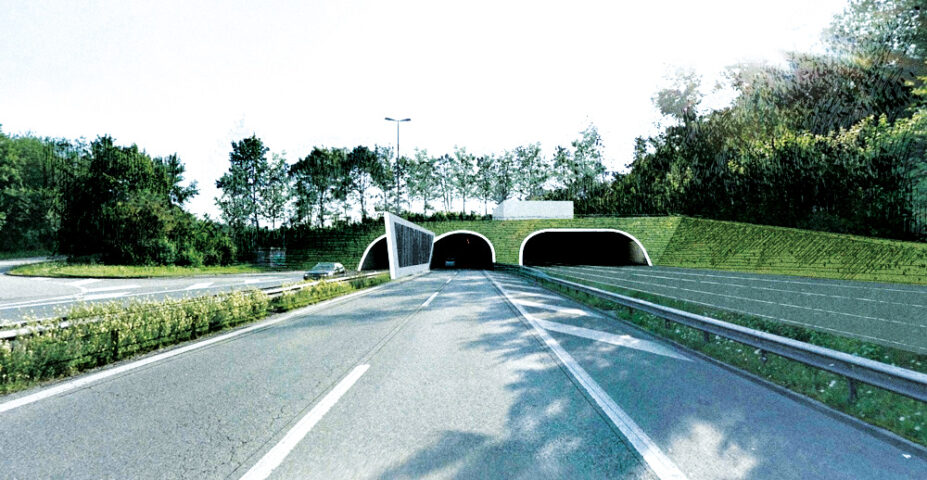
In addition, it is planned to expand the A14 in the north from four lanes today to six lanes in the future from the Rotsee junction to the Buchrain junction. To achieve this, the Rathausen tunnel will be extended with a third tube. The structures will be adapted at the Rotsee junction. At the Rotsee junction, the A2/A14 Basel lane will be widened to two lanes in the direction of Zug in order to eliminate the existing bottleneck.
Between the Rotsee junction and the Lucerne-Kriens junction, the A2 will become an urban motorway serving exclusively the destinations, sources and domestic traffic of the Lucerne conurbation. Emmen Süd, Luzern-Zentrum and Luzern-Kriens are connected to it. If necessary, for example in the event of an incident or during maintenance and repair work, the urban motorway serves as an alternative route to the bypass and vice versa.
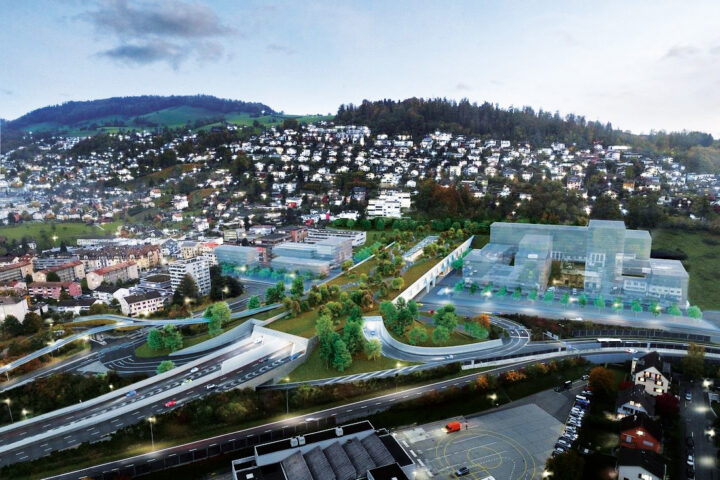
The Grosshof bridges as the new gateway to the city of Kriens.
In the south, the Spier tunnel between the Lucerne-Horw and Hergiswil junctions is to be re-marked with three lanes in each direction. The third lane will extend the entry and exit lanes. The new Grosshof bridges will provide the town of Kriens with a new gateway: a park with paths from Sonnenberg to Kriens, Horw and Lucerne is planned on the roof. Below the bridge, a diverse mix of uses is to be created, including cafés, shops and commercial space.
The Lucerne bypass envisages the construction of three new road wastewater treatment plants (SABA) in Rathausen, at the Rotsee junction and at Grosshof-Kriens. Thanks to these, the wastewater from the motorway will be cleaned in an ecological way before it flows into the surrounding water bodies.
The Bypass relief project is intended to improve the flow of traffic on the motorways and ensure the functionality of the north-south axis. It will also create alternative routes in case of accidents or maintenance work. Central Switzerland and the Lucerne agglomeration will benefit from better accessibility, and the urban motorway will be relieved of through traffic. Last but not least, safety for all road users will be increased.
The Rathausen tunnel will be extended with a third tube.
The total costs amount to CHF 1.8 billion and are financed by the federal government. If everything goes according to plan, the bypass should be open to traffic in about 2035 after about 12 years of construction – subject to the still pending planning permission.
The Pini Group based in Lugano takes over the geotechnical company Geodata based in Turin. According to a press release by the Pini Group, both companies are characterized by the fact that they started out as family businesses and have developed into global players in the engineering sector. With this acquisition, its CEO, Andrea Galli, wants to “strengthen all the values that have enabled this company to write engineering history”. According to Pini, it enables access to the renewable energy sector, especially hydropower.
The company now has 700 employees. The acquisition will greatly accelerate the development plans of the engineering and consulting service provider, which was founded 70 years ago, and will strengthen its position “as a leading company in planning, construction management and consulting services,” the statement said.
Geodata is mainly engaged in the planning of underground and hydraulic works. The company was founded in 1984, has 16 branches in Europe, North and South America, India and Malaysia and is active in 20 countries. With this strategic acquisition, the Pini Group wants to benefit from the expertise of a company that has planned and supervised the construction of more than 4000 kilometers of tunnels and more than 3500 projects worldwide, according to the Pini Group.
Construction work on Hamburg's district heating tunnel began on August 5, Implenia announced in a statement . The construction and real estate company from Opfikon is realizing the project on behalf of Wärme Hamburg . The 1.16 kilometer long tunnel will cross the Elbe about 2 kilometers west of the Elbe tunnel for the autobahn.
From the winter of 2024/25, this will be used to transport waste heat from industrial processes in the south to the north of the Hanseatic city. This is a requirement so that the coal-fired power plant in Wedel can be replaced by energy from the future Hafen Energy Park of Hamburger Energiewerke GmbH . "We are pleased that we can plan and implement this large and complex infrastructure project for the Hamburger Energiewerke and thus contribute to a sustainable energy supply in Hamburg," said Thomas Fiest, Head of Tunneling Germany at Implenia.
In the first construction phase, Implenia is constructing the start and target shaft with diaphragm walls 1.5 meters thick and 30 meters deep. Then a tunnel boring machine will bore the actual tunnel with a diameter of 4.55 meters. Access and operating equipment for the operation should be accommodated in the shafts.
The expansion of the heating network to the planned connection of the EuroAirport Basel Mulhouse Freiburg is progressing. The construction company SMCE forage et tunnel based in Sierentz has drilled two 90 meter long tunnels under the A35 motorway in Alsace, according to a press release from Primeo Energie from Münchenstein. The pipes that will transport the heat to the airport in the future will then be laid in the tunnels.
The heat comes from the biomass power plant in the Alsatian town of Saint-Louis. It is operated by the energy company R-CUE , a subsidiary of the energy supplier Primeo Energie. So far, R-CUE has been supplying the equivalent of 5,000 households with heat via the existing district heating network of 12.3 kilometers and producing electricity at the same time.
With the EuroAirport, a large heat consumer is added. The airport alone has a heating energy requirement of 3000 apartments. Its connection to the network “will reduce the consumption of fossil fuels by 90 percent” and thus decarbonize its energy mix. At the same time, the connection saves on heating costs, according to the press release.
Other urban and commercial areas are later to be connected to the district heating network in the Saint-Louis metropolitan area, including the Saint-Louis hypercentre, the centre, south and north zones, the Lys development zone (ZAC) and the Technoport. In total, the network is to grow to a length of 30 kilometers.
By 2030, up to 68 gigawatt hours of additional heat are to be distributed each year. This corresponds to 10,000 households and requires the construction of a new biomass heating plant, the press release continues. The expansion of the Saint-Louis heating network was decided at the end of 2020.
Implenia will build a 1.2 kilometer long tunnel for Wärme Hamburg , the construction and real estate company from Opfikon informs in a press release . The tunnel is to connect the north of Hamburg to a new heating network. To do this, it will cross under the Elbe around 2 kilometers west of the Elbe tunnel for the motorway.
The work is divided into two phases, with the planning phase starting in October. Implenia has now received the order for further planning and construction work from the beginning of 2022, according to the announcement. The total order volume there is estimated at around 75 million francs.
The work should be completed by the first quarter of 2025. To this end, Implenia will first create diaphragm walls for the start and finish shafts with a depth of up to 42 meters. A tunnel measuring 1.16 kilometers long and around 4.5 meters in diameter is then to be drilled between them and lined with precast concrete elements. Implenia is also responsible for planning and installing the operating technology for the district heating pipeline.
"We are very pleased that we are able to create this large and complex infrastructure project for our customer Wärme Hamburg", Erwin Scherer, Head of Tunneling at Implenia, is quoted in the press release. "The fact that we are making a contribution to improving the sustainability of heat generation gives us additional motivation, because sustainability is an Implenia corporate value that we will also live by in this project."
A joint venture run by Implenia has received an order from Tunnel Euralpin Lyon Turin ( TELT ). This involves the planning and construction of part of the Mont Cenis base tunnel in France. The affected section of the 57.5-kilometer tunnel is around 4 kilometers long and runs from the Villard-Clément portal.
Implenia's partners in the project are NGE , Itinera and Rizzani de Eccher . Implenia holds 34 percent of the joint venture. According to the information, the project partners won the contract due to the technical optimizations that they introduced during the tendering phase. They took first place in the evaluation of the technical solutions. The order volume is around CHF 248 million. The project will take about four and a half years.
"Implenia is proud to be able to plan and build such an important part of the future European rail network", Erwin Scherer, Global Head Tunneling at Implenia, is quoted in the press release. “We can use our vast experience in all areas of extensive infrastructure projects as a strength in such projects,” he adds.
The client TELT is a Franco-Italian company that is responsible for the construction and management of the cross-border section of the new Lyon-Turin line at the Mont-Cenis base tunnel. This section is to become a central ring of the Mediterranean Corridor – one of the nine axes of the European transport network TEN-T (Trans-European Transport Network). The expansion is intended, among other things, to promote the relocation of transport goods from road to rail.
The Federal Roads Office has awarded the ARGE secondo tubo (in German: second tube) the contract for the construction of a four kilometer long access tunnel to the second Gotthard tube. According to its press release, Implenia is in charge of this working group. It has a 40 percent stake in it, as does Webuild Group / csc . Frutiger holds a further 20 percent.
According to the information, ARGE secondo tubo was able to prevail against four other offers and two additional variants in the tender with the highest number of points from the evaluation of all award criteria. The award is still subject to a 20-day complaint period. Construction work is scheduled to begin this spring and last two and a half years.
"The Gotthard road tunnel is a central infrastructure project for Switzerland, to which Implenia, as the largest Swiss construction service provider with a lot of experience and concentrated specialist know-how, can make an important contribution," said the head of Implenia's Civil Engineering Division, Christian Late, quoted in the communication.
Implenia had already been awarded the contract to relocate the north safety tunnel in November 2020. This is the current lot for the construction of the second tube in the Gotthard road tunnel. This award precedes the publication of the invitation to tender for the two larger lots by a few months, the announcement said. In 2001 and 2014, Implenia was already heavily involved in the construction of the Gotthard Base Tunnel for the railways. At that time, the total order volume was 2.84 billion Swiss francs.
The entire Fornebubanen project includes the construction of a railway line from the Fornebu peninsula to connect to the Oslo subway. The construction work that began in December last year is expected to be completed in 2027. Under the project Fornebubanen has Implenia commissioned with the planning and construction of a tunnel for a distance of 2.3 kilometers, the construction and real estate company informed of Dietlikon in a release . The contract volume is stated there at 1.2 billion Norwegian kroner or the equivalent of 131 million francs.
Audun Aaland, Head of Tunneling and Country President Norway at Implenia, is quoted in the press release as quoted in the press release. In addition to the construction of the tunnel and its cross sections, Implenia will also build excavation pits and rock shafts for the Flytårnet and Fornebuporten stations.
"Those companies that invest the most in alternative fuel technologies and contribute to the electrification of machines and systems performed best in this competition," explains Grete Tvedt, project manager at Fornebubanen, in the press release. "The focus on sustainability seems to produce good solutions, not only in terms of environmental and climate protection, but also for the entire project."
The contract is to be signed after a ten-day objection period has expired. Construction work is scheduled to start in May of this year.
Implenia and the Hochtief construction group will jointly build the 2.2-kilometer-long Altona noise protection tunnel. According to a press release from Implenia, the project on the A7 motorway in Hamburg has an order value of around 580 million euros. Allotment gardens as well as green spaces and parks are to be created on the cover of this tunnel. In addition, the two neighboring districts of Othmarschen and Bahrenfeld will be connected to each other again.
The work between the A7 junctions Othmarschen and Volkspark is expected to begin in April 2021 and be completed by 2028. Implenia will manage the project commercially in a joint venture with Hochtief. Hochtief is the technical lead. Implenia's share of the total order volume is 35 percent.
As Christian Späth, Head of the Civil Engineering Division at Implenia, explains, his company was able to identify numerous optimization options in the bidding process that has been running since 2019. “Among other things, we brought forward parts of the implementation planning and gradually incorporated the results from more than 30 coordination dates into the calculation. In this way we were able to significantly minimize the project risks for everyone involved. "
The New Railway-Alpen-Transversale ( NEAT ) is largely completed. The Federal Office of Transport ( FOT ) has issued the permit for the scheduled operation of the Ceneri base tunnel, it writes in a message . This means that the tunnel will be available for scheduled passenger and freight trains from the timetable change on December 13th.
The Ceneri Base Tunnel was inaugurated on September 4th. Since then, around 5,800 commercial passenger and freight trains have been run through the tunnel in a trial run.
The 15 kilometer long tunnel is the third of the three large base tunnels that were built as part of the NEAT. It also enables direct connections between Lugano and Locarno. These form a central element of the Ticino S-Bahn.
The Lötschberg Base Tunnel with a length of 35 kilometers was the first of the three large tunnels to go into operation in 2007, the Gotthard Base Tunnel with a length of 57 kilometers followed in 2016. The almost 20 kilometers long Simplon Tunnel has been in operation since 1906. Switzerland now has two flat rail routes through the Alps.
Wir verwenden Cookies zur Unterstützung und Verbesserung unserer Dienste. Mit der Nutzung dieser Website erklären Sie sich mit der Verwendung von Cookies einverstanden. Weitere Informationen finden Sie in unserer Datenschutzerklärung.