Tag: Umbau

  • Adding storeys and extensions made easy

    Adding storeys and extensions made easy

    The further development of existing buildings offers clear advantages. It saves resources, reduces CO2 emissions and reduces the volume of construction waste. In contrast to demolition, the appearance of the neighborhood is preserved and new rentals are often lower, which ensures affordable living space. The local building culture also benefits, as established structures and identity-forming elements are preserved, which strengthens the sense of community.

    High hurdles hamper conversions
    Outdated regulations, complex procedures and a lack of legal certainty are currently hampering numerous extension projects. Older buildings in particular do not comply with the latest regulations, so many owners shy away from the effort involved and prefer to build new ones.

    Revision of the law brings simplifications
    The new proposal from the Building Department provides for targeted simplifications. At its heart is the simplification provision, Section 220a E-PBG: it allows owners to deviate from certain regulations, for example with regard to boundary distances, façade height and the number of full storeys. The aim is to better integrate the further developed building into the existing building regulations, create more scope for conversion and at the same time offer legal certainty.

    Densification and better utilization
    It will be easier to create additional residential units, particularly in residential buildings. The regulation encourages properties to exploit their full potential in accordance with the municipal zoning regulations without losing the existing building stock. This is an important step towards more densification and smart land use in urban and rural areas.

    Further simplifications and updates
    The revision also addresses the demands of the Cantonal Council. For example, procedures for solar installations and stair lifts have been simplified. Outdated regulations on fire protection and minimum heights are to be removed. This will make it easier to convert office buildings into apartments and provide impetus for innovative construction projects.

    Opportunity for Zurich
    The planned simplifications for the conversion and extension of existing buildings will enable sustainable urban development, ecologically, socially and culturally. The revision of the law creates clarity and motivates owners to use the potential of existing buildings instead of building new ones.

  • Simple building needs courage and less bureaucracy

    Simple building needs courage and less bureaucracy

    The term “building type E” stands for straightforward, pragmatic construction with reduced standards. This is enshrined in law in Germany and is possible in Switzerland as long as the minimum legal requirements such as fire protection and statics are met. Obstacles do not arise from paragraphs, but from excessive comfort requirements, a lack of expertise on the part of the authorities and pressure from investors.

    Conversion instead of new build as a lever
    The current regulations reach their limits, particularly in existing buildings. Conversions are often assessed according to the standards of a new building, which drives up costs and hurdles. Beat Flach, lawyer, National Councillor and SIA legal consultant, calls for more proportionality. Conversions should be treated more pragmatically, including when it comes to energy requirements. This would allow new, more affordable apartments to be built more quickly and save CO₂ at the same time.

    Standards as an opportunity, not a shackle
    SIA standards are not a rigid corset, but allow for alternative approaches. Planners can also achieve goals in other ways or define them through agreements. It is crucial that architects, engineers and authorities recognize and make use of this leeway. The fear of objections and dependence on third-party guidelines are currently leading to unnecessary bureaucracy and rising construction costs.

    Reforms for building permits
    The procedures are considered overly complex. Flach advocates a two-stage approval process. First a simplified examination of the central issues with the possibility of objection, followed by detailed clarification. This would give investors security, speed up the construction process and reduce costs.

    “Simple construction” does not mean less quality, but more courage to find pragmatic solutions. The key lies in conversion, in more flexible standards and in clear political guidelines. Only when planners, authorities and politicians pull together can construction become faster, cheaper and more sustainable.

  • Gebäudeversicherung Bern joins forces with Designform for sustainable remodelling

    Gebäudeversicherung Bern joins forces with Designform for sustainable remodelling

    Björn Ischi’s Designform GmbH has worked on the remodelling of the first floor at GVB – Gebäudeversicherung Bern in Ittigen. Together with the GVB team, “upcycling by design in its most beautiful form” was realised, writes Ischi in a post on LinkedIn. Specifically, material that was removed during the renovation was not disposed of, but reused directly on site.

    For example, “cool seating areas” were created from former wall sections of the old design for the new furnishings. Because not only can mobile phones and laptops be charged there, but users can also recharge their own batteries, the GVB team gave these seating areas the name “Powerbanks”, explains Ischi. For the owner and product designer of Designform GmbH, however, the project in Ittigen was “more than just upcycling with style”.

    This is because the GVB employees were involved in the planning and realisation of the conversion via two workshops. In the first workshop, needs were identified and ideas developed. In the second workshop, the employees then lent a hand in building the furniture themselves. “Screwdrivers instead of keyboards and suddenly the teams were literally behind the furniture,” says Ischi. Furniture specialist Girsberger from Thunstetten BE provided professional support for the project.

  • Monument becomes a home with history

    Monument becomes a home with history

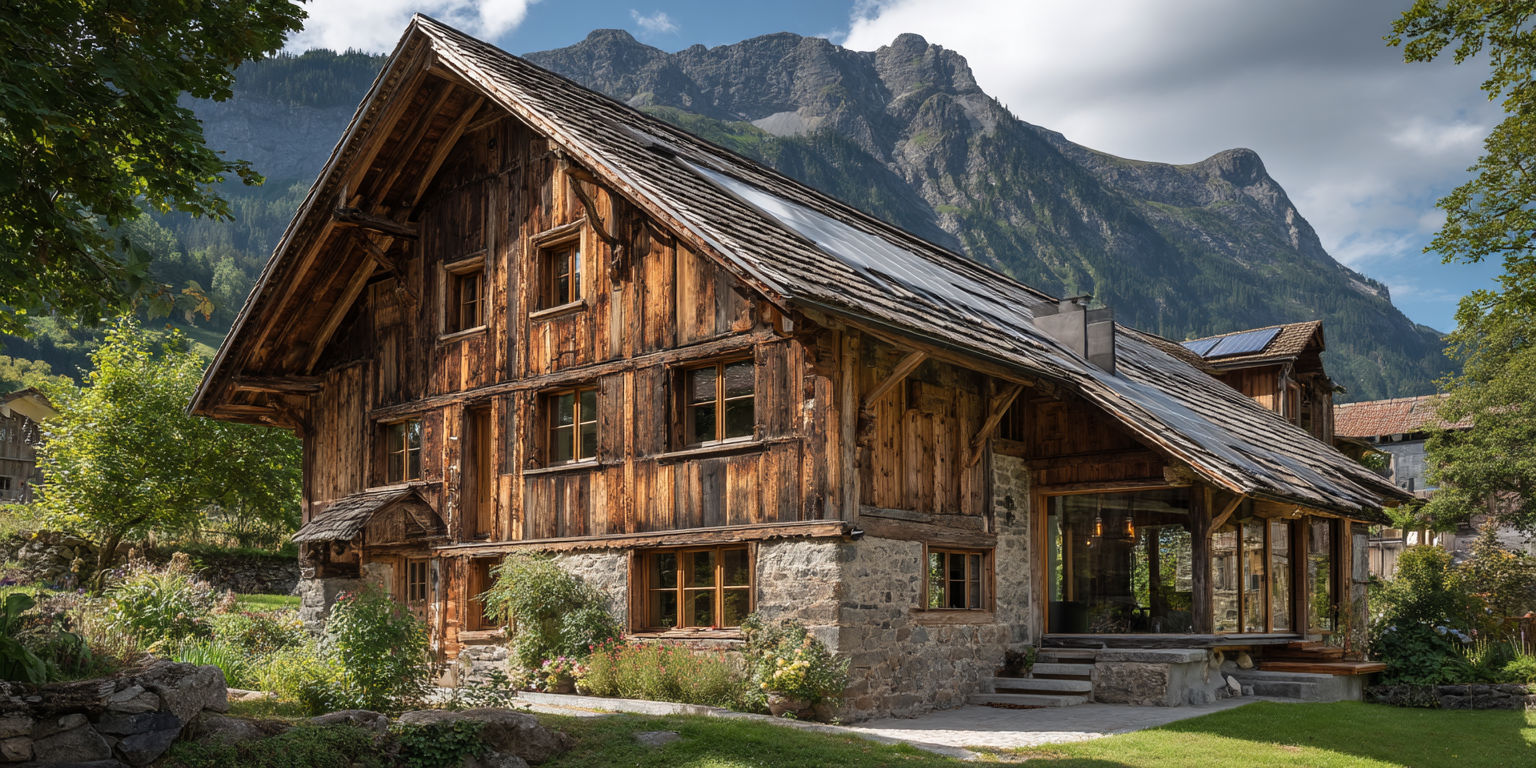
    It only took nine months to turn the listed Gütsch farmhouse in Lauerz SZ into a modern detached house. Strüby now reports on this in a press release. The company was commissioned to carry out the extensive conversion and renovation work. Strüby was able to contribute its strength and experience in dealing with listed buildings in project development, architecture, engineering and implementation.

    The early, close, constructive and solution-oriented collaboration with the cantonal monument preservation authority and its head Monika Twerenbold proved its worth, “so that the result was extremely satisfactory for everyone involved,” Kilian Boog, Head of the Conversion division at Strüby Unternehmungen, is quoted as saying.

    A lot has been done on the outside and inside, with the late medieval block building from 1492/93 “largely retaining its original character”. In combination with modern elements, an architectural “jewel” has been created that is “full of history and stories and fascinates with its symbiosis of old and new”.

    The wooden cladding, roof and windows were renewed. The outer shell was given an energy-efficient refurbishment, while the heating technology inside was switched to an energy-efficient heat pump and photovoltaics. When planning the rooms, emphasis was placed on highlighting existing “handcrafted details, interesting signs of use, religious symbols to protect against evil spirits and decorative elements”. The floor plan and room heights remained unchanged.

  • Real estate monitoring 2025

    Real estate monitoring 2025

    The residential construction balance will be lower than expected in 2025. Replacement new builds and extensions are increasingly replacing traditional new builds on greenfield sites. Although the number of building permits rose in 2024, net additions due to demolition projects will remain limited. The canton of Zurich is particularly affected, where only 73% of new construction projects actually lead to more living space.

    At the same time, the supply rate for rental flats has fallen to a historic low of 3.7 %. Demand clearly exceeds supply in almost all regions.

    Price increases due to boom in demand
    The reduction in interest rates and the rising net wealth of households are stimulating demand for residential property, particularly in the upper price segment. Transaction prices are continuing to rise. The momentum is particularly pronounced in Central Switzerland. An increase of 3.6 % for condominiums and 3.8 % for single-family homes is forecast for 2025. Rents on offer will also rise, albeit at a more moderate rate ( 1.7 %), while existing rents are likely to fall slightly due to the lower reference interest rate.

    Office space market stable with regional impetus
    Developments in the office segment are more subdued. Following moderate employment growth of 1.1 % in 2024, demand for space is expected to slow slightly in 2025. Although construction activity rose by 51.5 % in nominal terms, this was due to a small number of major projects. Growth across the board is significantly lower.

    Asking rents rose by an average of 2.4 %, in major centres by as much as 4.4 %. In Zurich and Geneva, prime rents fell slightly, while Bern saw an increase of 5.3 %.

    Building construction Trend reversal and renovation as the key
    After six years of decline, a new phase of growth in building construction will begin in 2024, with an expected increase of just under 5 % in 2025. The renovation sector in particular is becoming a growth driver ( 7.2 %), driven by the shortage of building land, the energy transition, tax incentives and the high need for renovation.

    Investment in apartment blocks is rising significantly, while traditional single-family house construction continues to decline. Investment activity is increasingly focussing on inner-city densification, renovation of existing buildings and energy-efficient refurbishments.

    Intermediate spurt with uncertainties
    The economic environment remains volatile. The Swiss economy is expected to grow by 1.3 % in 2025, driven by consumption and construction investment. Global trade continues to suffer from geopolitical tensions and customs conflicts, which is weighing on the export industry with the exception of the pharmaceutical sector.

    Inflation remains low ( 0.3 %), the key interest rate cut to 0.25 % is supporting the economy, but could exacerbate deflationary tendencies. At the same time, the labour market is cooling. Population and household growth is slowing, which could have an impact on demand for housing in the medium term.

  • Solar shading for historical architecture in Spain

    Solar shading for historical architecture in Spain

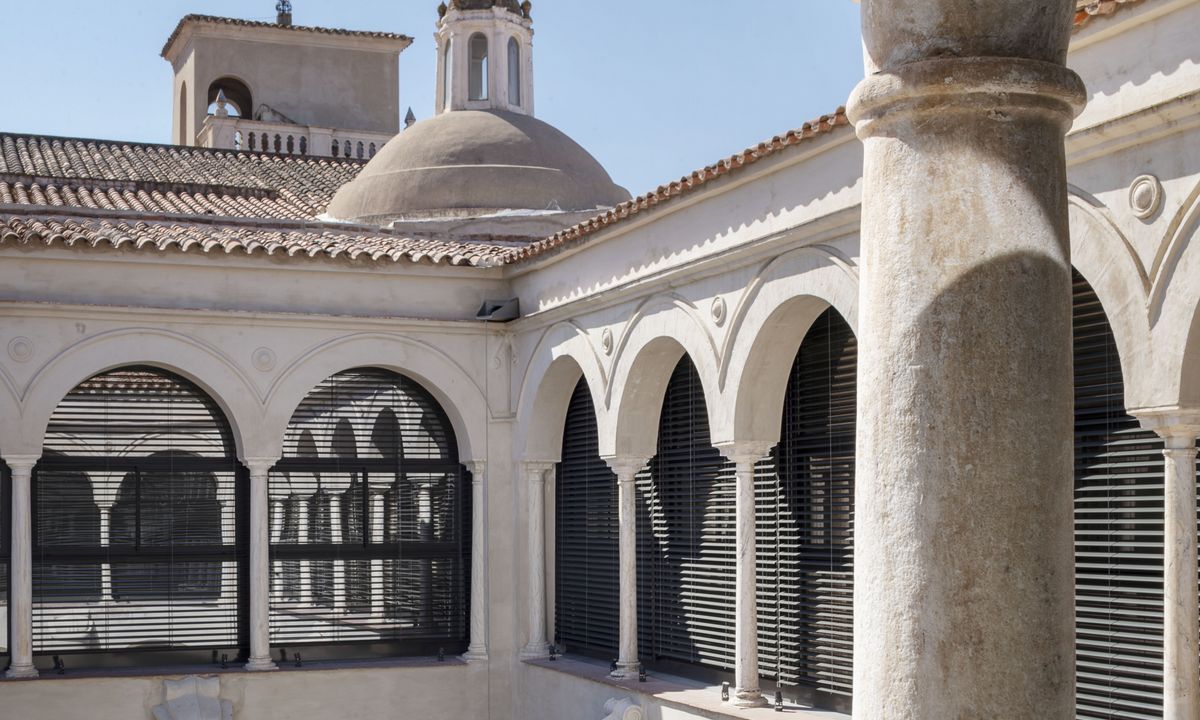
    Aadorf-based sun shading manufacturer Griesser is involved in the reconstruction and remodelling of the listed former San Agustín monastery in Badajoz, south-west Spain. This is being remodelled into a school of arts and crafts. According to a press release, the straight-lined building offers good conditions for an educational institution. In the past, the former monastery has been used as barracks, a courthouse and a school.

    The cloisters are also to be incorporated into the school during the current remodelling. Their arcades will be extensively glazed and require solar shading. Griesser is supplying its Solomatic 80 system for this purpose: the customised louvre blinds provide good shading on the one hand and a good supply of natural light on the other. Both the classic design of the slats and their colour scheme in RAL 7022, an almost anthracite grey shade, fit in with the historic appearance of the building.

    In addition, the incidence of daylight is controlled automatically. The resulting “harmonious atmosphere” is intended to increase “the students’ ability to concentrate and their sense of well-being”.

  • New offices and meeting rooms completed in Bern

    New offices and meeting rooms completed in Bern

    The remodelling and renovation of the offices and meeting rooms at the Halter construction company’s Bern site have been completed. They were realised by Integral design-build AG, part of the Halter Group in Schlieren, within six months. The keys were handed over last week, according to Integral’s LinkedIn page. “By using recyclable materials such as wood, glass and metal, we have created a space that not only minimises our ecological footprint, but also reflects our values of sustainability and aesthetics,” it continues.

    The Halter site in Bern is growing and with it the “need for a larger and more inspiring working environment”, according to a Halter press release. Since the beginning of March this year, an additional 600 square metres of the former Denner site have been rented at the location in the House of Religions realised by Halter. The conversion phase, including dismantling, began in November 2023 and was successfully completed in July 2024. The expansion has increased capacity from 40 to 58 workstations. There are now also additional touchdown workstations and meeting rooms with modern equipment. The move has been successfully completed and the premises have already been filled with life.

    A particular highlight of the remodelling is the impressive staircase, which connects the two floors and creates an open and dynamic working atmosphere, according to the Halter press release.

    The Halter Group comprises a total of ten companies. The head office is in Schlieren, with further locations in Münchenstein BL, Bern, Kriens LU, Lausanne, St. Gallen and Geneva.

  • Manor moves into the Jelmoli building

    Manor moves into the Jelmoli building

    In February 2023, Swiss Prime Site decided to remodel and sustainably develop the Jelmoli building. The aim is to adapt the retail space to current market requirements and make the building fit for the future. In Manor, Swiss Prime Site has now found a long-term tenant that will ensure the long-term attractiveness of the building and the lower Bahnhofstrasse.

    An inspiring shopping experience in the heart of Zurich
    Manor will rent around 13,000 square metres of space and is expected to take over the ground floor, basement and first floor in 2027. Manor will open a flagship store here, which will be directly accessible from Sihlstrasse and Seidengasse. Roland Armbruster, CEO of Manor, promises an inspiring shopping experience with a varied and curated product range in the areas of fashion, beauty, home and living. A diverse range of restaurants will round off the shopping experience.

    New office space and restaurants
    Following the renovation, the upper floors of the Jelmoli building will offer around 20,000 m² of office space, providing a new top address in Zurich city centre. This office space will be complemented by a wide range of catering and leisure facilities. The newly designed roof terrace will provide additional space for catering outlets.

    Partnership between Swiss Prime Site and Manor
    The long-term rental agreement between Swiss Prime Site and Manor is a significant step for both companies. Manor will also contribute to the investments for the remodelling in order to create attractive retail space. Existing tenancy agreements, in particular with the Holmes Place fitness club, will remain in place during and after the renovation. Holmes Place will continue to offer its services to customers during the renovation phase. With Manor and Holmes Place, around half of the space has therefore already been let before the start of construction.

    A unique meeting place for Zurich
    René Zahnd, CEO of Swiss Prime Site, emphasises: “Our primary goal was to preserve the Jelmoli building as a unique destination and open meeting place. With the arrival of the Manor department stores’ group and its long-standing tradition, the Jelmoli building will be filled with new life for Zurich and the Zurich population and will shine beyond the city limits.”

    The largest department stores’ group in Switzerland
    Manor, the largest department stores’ group in Switzerland, is represented in all parts of the country and employs around 7,500 people. The Manor Group comprises 59 Manor department stores, 27 Manor Food supermarkets and 23 Manora restaurants. The company pursues an omnichannel strategy that combines online shops and services. Manor is sustainably profitable and is part of Maus Frères Holding, which also owns leading lifestyle brands such as Lacoste.

    The repositioning of the Jelmoli building with the arrival of Manor marks an important step for the future of Zurich’s Bahnhofstrasse and emphasises the importance of Swiss Prime Site in sustainable urban development.

  • Ein neues Kapitel des Jelmoli-Warenhauses beginnt

    Ein neues Kapitel des Jelmoli-Warenhauses beginnt

    Das bekannte Warenhaus Jelmoli steht vor einem umfassenden Wandel. Bis Ende 2024 wird der Betrieb weitergeführt. Der Umbau startet Anfang 2025 und wird 2027 voraussichtlich beendet sein. Das Gebäude wird in eine moderne, multifunktionale Immobilie verwandelt. Swiss Prime Site investiert über 100 Millionen CHF, um das Jelmoli-Haus zu einer lebendigen, urbanen Begegnungsstätte zu machen.
    Dabei reduziert sich die Verkaufsfläche auf das Erd- und Untergeschoss sowie allenfalls Teile des ersten Obergeschosses. Die Umgestaltung bringt Vielfalt in Form von Verkaufsflächen, Gastronomie, Büros und Freizeiteinrichtungen. Diese Transformation macht das Gebäude belebter für die Stadt, bewahrt die historische Bedeutung und setzt dabei auf Nachhaltigkeit.
    Durch die Umgestaltung des bisher brachliegenden Dachs zu einem öffentlich zugänglichen Raum mit Grünflächen, wird das Jelmoli-Haus zu einer urbanen Oase mitten in der Zürcher Innenstadt. Die neu geschaffene Vielfalt an Verkaufsflächen, Gastronomie, Büros und Freizeiteinrichtungen zieht nicht nur Kunden an, sondern macht das Gebäude auch zu einem beliebten Treffpunkt. Die Investition in die Umwandlung des Jelmoli-Hauses zeigt das Engagement von Swiss Prime Site für eine nachhaltige und lebendige Stadtentwicklung.

  • Ipsach lake water plant wins innovation prize from InfraWatt

    Ipsach lake water plant wins innovation prize from InfraWatt

    Every year, InfraWatt awards an innovation prize for the implementation of exemplary energy systems. This year the prize went to Energie Service Biel/Bienne(ESB), the association for the use of energy from wastewater, waste, waste heat and drinking water informs in a press release. The Biel-based energy company received the award for its Ipsach lake water plant project: energy recovery in the reverse osmosis stage.

    In the project to replace the existing lake water plant, ESB wants to halve the already low trace substance content of the drinking water again. To achieve this, the company is using the process technology of reverse osmosis. Here, undesirable substances are removed from the water by forcing it through a semi-permeable membrane under high pressure.

    At the Ipsach lake power plant, ESB does not use any chemical additives, so-called antiscalants. In addition, the pressure of the discarded water is transferred to the water fed into the plant via a hydraulic energy recovery system. This will save about 740 megawatt hours annually, or 36 per cent of the plant’s total electricity consumption, the statement said.

    “The jury was impressed by the innovative character of the project and the efforts to ensure that new standards are set in terms of both drinking water quality and energy efficiency,” writes InfraWatt. The Yverdon-les-Bains-based association, founded in 2010 by the professional associations SVGW, VFS, VBSA and VSA, also attests to the project’s exemplary function for other water utilities.

  • Post opens new parcel center in Buchs

    Post opens new parcel center in Buchs

    Swiss Post has opened a new regional parcel center in Buchs. According to a press release , the company has invested around 15 million francs in the necessary conversion of a warehouse.

    After 15 months of planning and construction, the logistics center has been in operation since mid-July. Vertical, spiral conveyor belts are used here for the first time at Swiss Post. They save space and "heave the parcels to the sorting machine at a height of almost three meters in just a few seconds".

    In this way, up to 5,000 parcels per hour are sorted, which are posted and delivered in the greater Aarau, Lenzburg, Seetal, Suhrental and Wynental areas. You no longer have to go via the large parcel centers such as Härkingen SO, Frauenfeld and Daillens VD. This shortens transport routes and makes parcel processing faster and more sustainable.

    A total of 175 people are employed in Buchs, of which 60 positions were newly created. Another 100 are to move there from the Aarau letter delivery point in the coming year.

    “Post is an attractive employer in Aargau, employing almost 2,500 people. With the new logistics center, she is committed to our business location, which makes me very happy," Dieter Egli, government councilor and economics director of the canton of Aargau, is quoted as saying in the media release.

    According to Rümlang, Buchs is the second regional parcel center that Post has put into operation this year. The group has opened further regional parcel centers in Vétroz VS, Cadenazzo TI, Untervaz GR and Ostermundigen BE. In recent years, Swiss Post has invested a total of around 250 million francs in expanding its sorting and delivery infrastructure.

  • Energie 360° renovates its headquarters in Altstetten

    Energie 360° renovates its headquarters in Altstetten

    Energie 360° wants to convert and repair its headquarters at Aargauerstrasse 182 in Altstetten, which was built in 2003. The energy supplier, which is majority owned by the city of Zurich , is investing almost 28 million francs in this. In its capacity as client representative, the Office for Buildings of the City of Zurich has now submitted the corresponding building application, the city administration and energy company inform in a joint statement . They expect construction to begin next spring.

    The conversion work is intended to adapt the headquarters to the requirements of a modern working environment "with flexible and hybrid working concepts", according to the statement. For this purpose, the existing premises are to be redesigned “into an open office landscape” with correspondingly modernized building services. A large-scale photovoltaic system is planned for the facades and roof.

    After a "strategic review", the management of Energie 360° has given up on initial considerations of adding a new building to the existing building, the statement explains further. Instead, the existing building should be optimized "for an efficient and result-oriented working environment". Jessenvollweider Architektur from Basel is responsible for the architectural concept.

    By 2040, Energie 360° wants to switch its offer exclusively to energy from renewable sources. According to the announcement, the conversion of the headquarters is driving this “transformation of the company and enables targeted energy saving measures in our own operations”.

  • Dutch central bank builds with new strength

    Dutch central bank builds with new strength

    The Dutch Central Bank uses CO2-neutral concrete in the renovation of its Amsterdam headquarters. This is made possible thanks to a collaboration between the Dutch New Horizon Urban Mining BV and the Swiss start-up neustark , according to a LinkedIn announcement .

    New Horizon’s technology makes it possible to reduce the carbon footprint of concrete by 75 percent, they say. For this, cement is obtained from concrete recycling material. The remaining footprint is offset by neustark. The start-up has developed a technology with which CO2 from the atmosphere can be permanently stored in recycled concrete. For this purpose, liquid CO2 is introduced into demolition material.

    Neustark is a spin-off from the Swiss Federal Institute of Technology in Zurich ( ETH ) based in Bern. The company works with Holcim , among others, to drive innovation and sustainability in the construction sector. As part of the collaboration, neustark is investigating the CO2 conversion potential of Holcim’s recycled demolition concrete. Holcim, in turn, optimizes the concrete produced by neustark.

  • Walo Bertschinger renovates the Bad Ragaz thermal baths

    Walo Bertschinger renovates the Bad Ragaz thermal baths

    As part of a renovation work in the Bad Ragaz SG thermal baths, the Dietiker construction company Walo Bertschinger renewed the floor coverings. According to a message from Walo on Facebook, the Walo bedding Haypanol D was laid with a special system constellation.

    According to the company announcement, high demands were placed on slip resistance, UV resistance and optics in the thermal baths. In the system constellation used by Walo, these conditions of the client Grand Resort Bad Ragaz were met. The multi-layer structure of the covering and its technical properties also showed high chemical resistance, so that various cleaning agents, greases, other deposits and chemical solutions cannot harm the covering.

    According to Walo, the architecture of the famous thermal baths with its special appearance corresponds to the snow-white surface.

  • Building for the ZHAW in Winterthur

    Building for the ZHAW in Winterthur

    2021 Eulachpassage castling
    In summer 2020, the ZHAW Health Department will move from the Eulachpassage to the new Adeline Favre building on the Sulzer site. The ZHAW School of Engineering will temporarily use the space in the Eulachpassage as a Rochade building, while the new Technikumstrasse campus will be built over the next few years.

    2023 laboratory building RD
    A unique center for food and beverage technology will be built on the Reidbach campus in Wädenswil by summer 2023. The new building not only unites the ZHAW Institute for Food and Beverage Innovation in one place, but also the entire value chain of the food industry. In the future, food and beverages will be researched here, from raw materials to the market.

    Construction time: 2019-2023
    Architecture: Leutwyler Partner Arch.

    2024-2034 Campus T
    The ZHAW School of Engineering is getting a new, attractive campus with a park on the Technikumstrasse site in Winterthur. The buildings and green space required for this will be implemented in four stages by 2035.

    The first includes the two new laboratory buildings TT (2024) and TL (2027), with laboratory, teaching and office space as well as a cafeteria and a public park with access to the Eulach. In the longer term, all buildings around the main building by Theodor Gohl (1878), which is worthy of protection, and the east building by Hermann Fietz (1908) are to be replaced by new buildings. For the second stage, the renovation and densification of the building complex with the east and chemical building TE / TZ (2029) is planned.

    In the third stage, the historic main building TH (2032) will be renewed and expanded to the south. In the final fourth stage, the physics building is to be replaced by the new laboratory building TP (2035), provided that the old building by Hans Suter (1960) is removed from the inventory of buildings worthy of protection.

    2025 Shedhalle Reidbach
    The ZHAW has been renting the former factory premises of the Wädenswil AG cloth factory since 1999. As soon as the so-called shed halls have been converted, they will be used from 2025, for example, as a new university library as well as learning and common rooms for students from the ZHAW Department of Life Sciences and Facility Management.

    Construction period: 2023-2025

    2033-2034 Rochade Eulachpassage and meander
    In the long term, the ZHAW Department of Applied Linguistics will settle on the Eulachpassage and make room in the meander for the ZHAW School of Management and Law, which is to expand entirely on the St.-Georgen-Platz campus.

  • Jaisli-Xamax is working on the Vechigen school complex

    Jaisli-Xamax is working on the Vechigen school complex

    The electrical company Jaisli-Xamax from Dietikon carries out all electrical installations for the overall renovation and expansion of the Stämpbach school complex in Vechigen. According to a report in the employee newspaper Brilli's News , the work will be carried out during the three implementation phases while the school is still running. “One of the challenges was to carry out the work while the school was still in operation,” the construction fitter Adrian Thürig is quoted as saying. Nevertheless, it was possible to "produce a clean performance".

    The work will be carried out in three stages. According to Jaisli-Xamax, the new construction of the kindergarten, the day school, the special wing and the intermediate wing as well as the renovation of the two gyms were realized in the first construction phase. The renovation of the east class wing and the expansion of the group rooms were implemented in the second construction phase. The work on the third construction phase is still ongoing. The West class wing will be renovated.

    According to project manager Luciano Matturro from Jaisli-Xamax, the cooperation with everyone involved in the construction and with the school went smoothly. Matturro was quoted as saying that he was proud that the on-site team did its job well while the school was in operation. Matturro: “We are now on the final spurt to successfully complete the third construction phase.” Two apprentices from Jaisli-Xamax also worked on the project in the canton of Bern.

  • "We will launch the electronic submission of building applications this year"

    "We will launch the electronic submission of building applications this year"

    You are head of the building and justice department. What is the attraction of this office?
    I've been on the road for community welfare for over 40 years. Of these, I was the mayor of the community of Gunzgen for 14 years, then a cantonal councilor for 8 years and since then a member of the government council for as long. I am attracted by the active participation and shaping of political, social and cultural issues as well as searching for and finding solutions. I not only want to manage the canton, but also to advance it. What I generally like about my department is the range of topics and the diversity of the employees in terms of expertise and character.

    Where do you see the specific challenges that the office brings with it?
    Spatial planning and mobility are and will remain important issues. But there are also changes in the climate, digitization and society that must be taken into account.

    How far is your department specifically on the subject of digitization?
    In the department, as well as in administration in general, we are still relatively new. I am surprised that the public sector has not made any significant progress in 2021. We have been trying to advance digitization in the department for a long time – accompanying workshops are intended to support this. I see digitization as a key issue that absolutely has to be implemented quickly. However, there are still obstacles, starting with data protection aspects and ending with a lack of financial or personal resources.

    The canton of Aargau, for example, has introduced the digital submission of building applications with eBau. Is that also an issue in the canton of Solothurn?
    It's not just an issue. The project is already well advanced: We are already working internally with a pilot project. This works fine; we will soon be ready to offer this service throughout the canton. The aim is for all interested municipalities to be able to submit building applications digitally this year. We are also currently working on the introduction of document management software (DMS). A pilot project that provides for a digital archive is currently running in the building construction department.

    It feels like the canton of Solothurn is in a real building boom. Is this perception deceptive?
    No, it really is. The largest projects with an investment volume of 450 million francs include the new Kebag Enova facility, 340 million francs are being built for the new citizens' hospital, and 86 million francs have been budgeted for the overall renovation of the Olten Cantonal School. But big things are also happening on the Attisholz North and South areas. An important project is Biogen's biopharmaceutical production facility in Luterbach: the first stage was 1.6 billion Swiss francs. Hopefully more stages will follow. But we also have around 2000 residential units in and around the city of Solothurn that are either planned or already under construction.

    What about your own projects?
    We are currently looking into building a new education campus as well as a new administration building where different locations could be concentrated. Optimizing the sports infrastructure in the city of Solothurn is also an issue.

    From a cantonal point of view, are there still sufficient building land reserves to implement all of these projects?
    We are currently busy with spatial planning development. Here we find that the building land reserves should be sufficient for the next 15 years. But this also means that no new land will be zoned during this period. In return, none have to be zoned out. We also have many industrial wastelands or otherwise fallow land that we can convert.

    "The building department stands for solutions – not for managing problems"

    What makes the canton of Solothurn so attractive for new construction projects?
    On the one hand, we are very central and also offer a lot of quality of living and tranquility. The people of Solothurn particularly appreciate the Jura landscape and the diverse cultural offerings. Solothurn is also known as the most beautiful Swiss baroque city. We are also well connected to public transport and private motorized transport. And our land prices are still affordable. From an economic point of view, we have many innovative companies and niche players who are attracting attention worldwide, such as Ypsomed (insulin pump system) or Jura Elekt-roapparate (premium coffee machines).

    Which construction projects have you helped shape during your tenure so far?
    As a government councilor, of course, I don't work on projects myself – but I pave the political path and thus enable the start. I was most actively involved in the development of the Attisholz Süd area: As a former director of the Solothurn Chamber of Commerce, I was already involved in the test planning. One highlight is the transformation of the former Schöngrün prison into a residential complex. But I also have fond memories of the renovation of the Altes Zeughaus Museum and the indoor swimming pool at the Olten Cantonal School, where, by the way, I went to school myself. I also accompanied the project for the renovation and conversion of the Rosengarten property intensively – with this project we had to go to the federal court.

    The Capuchin monastery in Solothurn, the Fridau psychiatric clinic and the Allerheiligenberg high altitude clinic are considered problem children. What exactly are the problems with these objects?
    These three projects are simply not a sure-fire success. They are located in zones that do not allow every use. The Allerheiligenberg, for example, is located in the agricultural zone. There are additional usage restrictions here: the surrounding hospitals must not be allowed to compete. In addition, there is the financial outlay, which is immense for such large projects. The Capuchin monastery, for example, is a listed building. The Fridau Clinic is located together with the Allerheiligenberg in the Jura protection zone. The difficulties mentioned require a lot of patience from investors and owners.

    An inventory of spatial planning is currently taking place at the cantonal level. What is the detailed plan?
    The whole of Switzerland is challenged when it comes to spatial planning. The revision of the Spatial Planning Act from 2014 requires all cantons to revise the structure plans. We have already done this. Now all municipalities have to revise their local planning. We count 107 municipalities in the canton of Solothurn – it takes time before all thoughts on further development within the framework of the cantonal requirements have been made. The inward development of the settlement poses major challenges for the community. The Solothurn municipalities will have completed this process within the next five years.

    What about urban sprawl in the canton of Solothurn?
    In the past, people certainly paid too little attention to this – but that should apply to all of Switzerland. The municipalities supported the new spatial planning law by a majority in the run-up to the vote. What a law really means can often only be seen when it is implemented. This is also the case here – the accusation arises that the canton or the federal government would prevent a municipality from developing. In the canton of Solothurn, however, we are on the right track. The need for internal densification is now firmly anchored in the minds of those responsible for the community. The majority deal very well with the new challenges and framework conditions.

    The municipalities enjoy a great deal of autonomy in the canton of Solothurn. Do you perceive these as an advantage or disadvantage in the performance of your office?
    I know both sides. As a mayor, it's an advantage – as a councilor it's a disadvantage (laughs). No, seriously: The autonomy is one thing, the other is the high number of communities: We have 107. But we maintain a good exchange with the community association, so we always find solutions.
    They are stepping down in the summer for health reasons. Do you already have plans for the time after that?
    I will definitely continue to be active. I have already accepted various board memberships and have other open inquiries. But first I'll take care of my old sports injuries and then I'll see how things go from here.

    What do you wish for the future of the building department?
    The building department stands for adherence to deadlines, adherence to budgets, speedy work and high quality. It should stay that way even after my retreat. Of course, I don't just want to hand over the projects to the new hands, I also want my heart and soul to continue to flow into it. Our credo is: The building construction department stands for solutions and not for managing problems.

  • Map helps with the restructuring of the energy system

    Map helps with the restructuring of the energy system

    For the first time, progress in the expansion of renewable energies can be publicly viewed and checked. For this purpose, according to a press release , the Swiss Federal Office of Energy ( SFOE ) is making its geospatial base data available online for all around 110,000 electricity production plants in Switzerland. More than 100,000 of them are currently photovoltaic systems.

    All systems are displayed transparently on the Internet on an interactive map and updated monthly. According to the SFOE, this would enable the municipality and cantons to monitor the local expansion and, if necessary, take measures to accelerate it.

    In addition to the location of the system, the data also shows its output in kilowatts and the date on which it was commissioned. All systems with an output of more than 30 kilovolt amperes and small systems with more than 2 kilowatts that have been voluntarily registered are included. The database also contains systems that are funded through a feed-in or one-off payment, additional cost financing or an investment contribution.

  • The old spinning mill in Turgi becomes a commercial and industrial center

    The old spinning mill in Turgi becomes a commercial and industrial center

    Limmatkraftwerke AG wants to turn the listed old cotton mill in the center of Turgi into a modern commercial complex by leasing 7000 square meters of space for offices, studios, production or storage in the central and western parts of the building. The premises can be rented from April 1st. In a media release from the owner Limmatkraftwerke AG, a subsidiary of Regionalwerke AG Baden , it is said that the tenants could design and expand the rooms according to their needs, as far as this is possible on site.

    "We would like to see a lively and inspiring mix of various commercial and industrial sectors in the Turgi spinning mill," said Martin Schoop, Chairman of the Board of Directors, who lives in Turgi himself. He wants to promote the character of a modern economic center in Turgi by transferring part of the income for the promotion of Turgi. Schoop: "Part of the rent is used to feed a fund that is supposed to promote this sense of community."

    The spinning mill, which was built in 1826 and was the largest spinning company in Switzerland until 1858, is located in the center of Turgi and is easily accessible. According to the announcement, there are enough parking spaces available and the spinning mill is within walking distance of Turgi train station.

    The redesign also pays attention to sustainability. two parking spaces are to be equipped with charging stations for electric vehicles. The building is to be supplied with district heating from the KVA Turgi and in future it will again draw electricity from the neighboring hydropower plant operated by Limmatkraftwerke AG.

    Limmatkraftwerke AG see the purchase as a strategic decision. Schoop: “We operate one of our power plants right next to the spinning mill building. Thanks to the purchase of the spinning mill, we can also ensure the operation of this power plant in the long term. ”As the owner, the use of the building can be optimally coordinated with the operation of the power plant.

  • Jaisli-Xamax is rebuilding the traditional Beyer company in Zurich

    Jaisli-Xamax is rebuilding the traditional Beyer company in Zurich

    The employee newspaper Brilli's News of Jaisli-Xamax AG in Dietikon took the renovation of the traditional Zurich company Beyer Uhren & Juwelen for its 260th anniversary as an opportunity for an interview with Managing Director René Beyer. Under the title “Time for something new”, Beyer reports on the good cooperation with the construction management from Palmieri and the team from Jaisli-Xamax responsible for all electrical aspects. This “well-rehearsed team” carried out an initial renovation nine years ago and has now completed the renovation for the company's anniversary in the summer.

    Beyer is quoted as saying: “This is not the first conversion with the Jaisli-Xamax AG team. Not only for renovations, but also for various maintenance work during the year, I can count on the reliable specialists in your company. ”What he appreciates about the cooperation is that he knows all of the specialists personally. At Jaisli-Xamax AG there is a family atmosphere and togetherness. "It is important to me to have a competent partner on board who also 'ieferet' and not just 'laferet'", Beyer continues.

    As to the motivation for the total renovation, Beyer says that he has to think about handing over the business to the next generation and therefore wanted to equip the watch and jewelery boutique with a special feel-good atmosphere. Beyer: "That may sound like a flat marketing strategy, but in the end it is really what we can offer customers in contrast to the numerous online providers."

  • Coop verwandelt den Basler Märthof in ein Boutique-Hotel

    Coop verwandelt den Basler Märthof in ein Boutique-Hotel

    Im ersten Halbjahr 2021 soll im historischen Gebäude des Märthofs in Basel das Boutique-Hotel Märthof eröffnen. Die Eigentümerin, die Coop Immobilien AG, hat das Architekturbüro Burckhardt + Partner mit der umfassenden Renovation beauftragt. Geführt wird das Hotel nach der Eröffnung von der zu Coop gehörenden Bâle Hotelgruppe. Sie betreibt bereits die Hotels Pullman Basel Europa an der Clarastrasse sowie das Victoria am Centralbahnplatz und das Hotel Baslertor in Basel-Muttenz.

    Das Gebäude des Märthofs entstammt dem 19. Jahrhundert und bestand ursprünglich aus fünf einzelnen Häusern, die 1981 zu einem Gebäudekomplex zusammengeführt wurden. Die freiwillige Denkmalpflege Basel wehrte sich Anfang der 70er-Jahre gegen den geplanten Warenhaus-Neubau, der anstelle des alten Gebäudes vorgesehen war. Der Abbruch wurde 1976 in einer Volksabstimmung abgelehnt. Nun soll ein Hotel der oberen 4-Sterne-Kategorie entstehen, wobei die Fassade mit einem neuen Anstrich in ihrer jetzigen Form erhalten bleibt. Das Mauerwerk selber bleibt unverändert – auch die Natursteinpartien werden nur gereinigt.

    Laut Coop-Mediensprecherin Rebecca Veiga sollen im neuen Boutique-Hotel die Stilepochen der ehemals fünf bestehenden Gebäude unverkrampft und spielerisch vermischt werden. «Verspielte Motive des Neubarocks und die funktionale Gestaltung der Geschäftsfassade aus dem Jahre 1927 treffen im Inneren des Gebäudes auf die lineare 80er-Jahre-Struktur», sagt Veiga.

    Offene Übergänge und eine freundliche Atmosphäre
    Auf die insgesamt 68 geplanten Zimmer, davon acht Suiten und acht Juniorsuiten, werden Stehleuchten, Wandleuchten, Sessel und weiteres Mobiliar individuell verteilt – kein Zimmer wird exakt wie das andere aussehen. Die Zimmer erhalten unterschiedliche Farbschemen und widerspiegeln die Geschichte vom jeweiligen Gebäudeteil, in dem sie sich befinden. Die Farben sind abwechslungsreich und sollen nicht polarisieren – sodass sie das ganze Jahr hindurch auf die Gäste angenehm wirken.

    Des Weiteren sind ein Fitnessraum, eine Bibliothek, ein Res-
    taurant sowie eine Bar auf der Dachterrasse im 6. Stock mit 55 Sitzplätzen vorgesehen – und eine weitere im Erdgeschoss. Alle funktionalen Räumlichkeiten sind analog einer starken Wirbelsäule um den Erschliessungskern des Hauses angeordnet und stossen von innen nach allen drei Aussenseiten. Die Übergänge der unterschiedlichen Nutzungsflächen im Erdgeschoss sind offen gestaltet, sodass es als Fläche ohne Unterbrüche wahrgenommen wird.

    Eine helle und freundliche Atmosphäre empfängt den Gast im Standardzimmer. Der Raum wird mit Ausnahme der abgeschlossenen Dusche und einem separaten WC grosszügig offen gestaltet. Nebst der eingebauten Schrankzeile im Eingang sind alle Möbelstücke freistehend. Sanfte Rundungen gemäss dem Gesamtkonzept des Hauses werden auch im Zimmer durchdekliniert.
    Die Aussenbestuhlung und die grossen Fenster verbinden das Gebäude mit dem Marktplatz. «Die einmalige Lage und das lebendige Geschehen am Marktplatz soll nach innen spielen und umgekehrt», sagt Veiga. Das Boutique-Hotel will internationale wie auch lokale Gäste ansprechen und durch Restaurant und Bar entlang der Eisengasse als Treffpunkt für die lokale Bevölkerung und die Hotelgäste dienen. ■