Tag: Umnutzung

  • Industrial site makes way for hotel and modern office space

    Industrial site makes way for hotel and modern office space

    According to a statement, HGC, a building materials supplier operating throughout Switzerland, is relocating its Lucerne site. This move is in response to the development of the former industrial area of Tribschen into a central urban district.

    HGC already relocated its regional transport business to its new site in Inwil last September. The company will also serve all its regional customers from there over the next two years.

    The old site in Tribschen is being converted. The old building at Tribschenstrasse 7/9 was demolished last year. The new Boutiquehotel 6000 is being built here. The new headquarters of the Central Swiss Builders’ Association will be located in the attic.

    The building on the neighbouring property at Tribschentrasse 11 will be converted using the existing supporting structure. The upper five floors will be rented out as offices under the name Tribschen Office. Half of the space has already found tenants. A commercial enterprise and the HGC collection business will be set up on the ground floor.

    HGC has been using the Tribschen site since the early 1920s. The complete renovation and conversion will allow it to benefit from the development of the neighbourhood.

    HGC was founded as a cooperative in 1899 and has its headquarters in Zurich. It trades in building materials and related products. It belongs to its more than 3,000 cooperative members in all construction sectors.

  • New residential ensemble characterises Winterthur’s urban space

    New residential ensemble characterises Winterthur’s urban space

    Cham Swiss Properties is planning an urban ensemble with the construction of the Rocket high-rise and the three Tigerli residential buildings in Winterthur’s Lokstadt. Rocket & Tigerli, as the property company is calling the construction project, will offer space for 300 rental flats in future, 30 per cent of which will be in the affordable segment, according to a press release. The ensemble with the 100-metre high-rise building will therefore not only shape the Winterthur skyline, but also alleviate the city’s housing shortage.

    A building permit was already granted by the city of Winterthur in April 2025, albeit with several conditions. For example, the city demanded that the planned hotel use in the “Rocket” be abandoned in favour of the construction of rental flats. As a result of the revision, the construction company is now planning 5,000 square metres of extra living space and is dedicating the ground floor to publicly accessible retail and restaurant space instead of a hotel check-in. The top floor will also be converted with a viewing room and an area for events and catering.

    despite the challenges posed by the conversion, the architect is confident:

    “A public zone in a residential building brings challenges in terms of privacy and security. But we are confident that we will be able to implement a good solution so that the entire population can enjoy the view from a height of 100 metres,” Thomas Aebischer, CEO of Cham Swiss Properties, is quoted as saying in the press release.

    The sustainability concept of the high-rise building has also been improved: instead of a timber hybrid construction, Rocket will now be realised with CO2-equivalent alternatives that offer advantages in terms of cost-effectiveness, plannability and material availability. Certification according to the SNBS Gold standard remains planned.

    The building permit is expected to become legally binding in 2026, with construction scheduled to begin in mid-2027. Completion is expected in 2030.

  • Wipkingen church becomes an educational space

    Wipkingen church becomes an educational space

    The Wipkingen church is a remarkable example of adaptive space utilisation. No longer used for church services since 2019, it is now intended to meet the space requirements of the neighbouring Waidhalde school complex. A concept developed by Vécsey Schmidt Architekten BSA SIA in collaboration with Anderegg Partner AG won the architectural competition and promises a cautious yet future-oriented transformation. A newly installed ceiling allows for the creation of a multi-purpose room, a library and catering facilities at ground floor level, while the upper floor offers flexible usage options under the historic church vault.

    André Odermatt, Head of Building Construction, emphasises the importance of this initiative: “The intelligent conversion of existing buildings is essential in order to meet current challenges in urban areas.” The project not only provides solutions to the urgent need for school space, but also strengthens cooperation between the city and the church.
    Thanks to this conversion, the necessary rooms for six to eight additional classes will be created by the 2031/32 school year. Filippo Leutenegger, Head of School, sees this as an example of the effective utilisation of creative solutions.

    The cooperation with the Reformed parish of Zurich has already borne fruit and plans to open up further church buildings for charitable purposes. The project in Wipkingen is just the beginning of a series of initiatives that prioritise community benefit.

    The estimated construction costs amount to CHF 7.5 million, with completion planned for 2026, in time for the start of school in 2026/27. This project marks an important step in Zurich’s evolutionary urban development by showing how historical substance can be meaningfully brought into the future.

  • Conversion and modernisation of the former Swisscom building in Thun

    Conversion and modernisation of the former Swisscom building in Thun

    The presented project for the conversion and extension of the property at Gewerbestrasse 15 is characterised by its uniqueness and versatility. It includes various forms of utilisation as well as residential models, and combines existing structures with new buildings. A special feature of the project is that, once planning permission has been granted, it will be realised while the remaining tenants (Swisscom) continue to operate.

    In the first phase of the project, the building will be stripped of its current façade and the existing attic and two floors below it will be removed. These are to be replaced by three residential floors and a new parapet in timber construction. The remaining five floors of the building, from the 2nd basement to the 2nd upper floor, will remain largely unchanged and will continue to be used for commercial, storage and technical purposes. A newly added terrace to the south of the building, together with a ramp on the east façade, will bridge the difference in height between the ground floor and the street without barriers.

    The project also emphasises the differences between the existing building and the extension in the façades: the lower floors will have a rear-ventilated stone façade, while the extension will be clad in rear-ventilated ceramic cladding. Towards the west, the building volume gives way to the railway tracks in order to meet acoustic challenges and create a terrace that serves as an open space for both the residents and the commercial tenants. Access to the flats is via arcades, bridges and greenery, which characterise the building in the western quarter.

  • From a listed school building to a private hotel

    From a listed school building to a private hotel

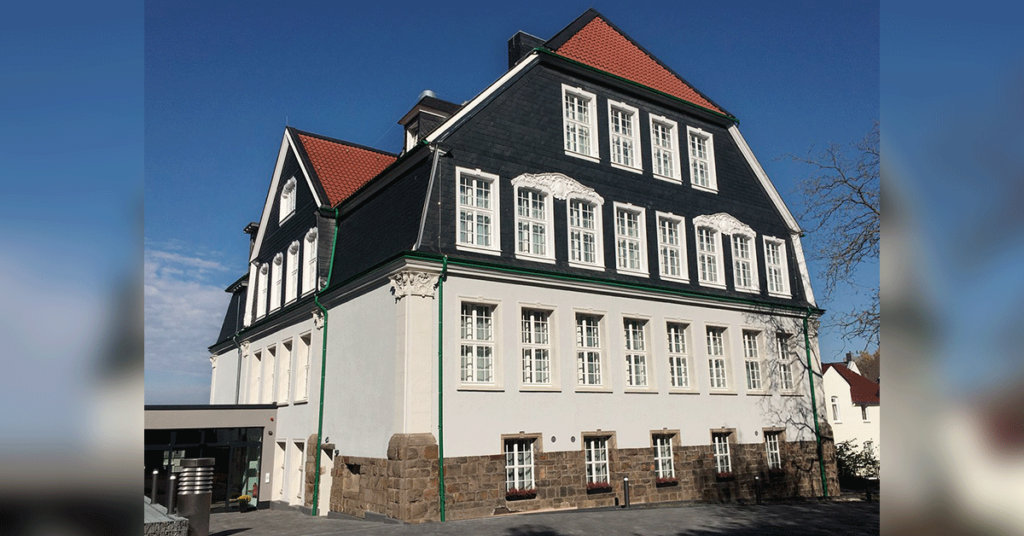
    The vision: A hotel is to be converted from a former school building, in which the original character of use and the original substance are to be retained. The Berlin hotelier Kurt Hermandung and his partner Marc Konopatzki have realized their dream of their own small private hotel. This is close to Düsseldorf, Cologne and the Ruhr metropolises. "We wanted a small, fine house with character that we can make something very special," say the owners. "After a long search, we came across this former elementary school – and an investor who could imagine turning it into a hotel and the former gymnasium into a restaurant." In terms of design and concept, the former schoolhouse from 1915 and the gymnasium added in 1980 were based on the original use of the building.

    Classrooms became elegant hotel rooms
    The local architecture firm Wilde and Wehnau implemented this ambitious conversion concept, from the design to the implementation planning and construction management. Their services also included the concept of the monument protection concept, the planning of the interior design and the lighting design. The exterior facade with its typical slate shingles, the representative bay window and the green rain gutters were restored and preserved under the watchful eye of the listed building. The former classrooms of the primary school have been transformed into elegantly furnished single and double rooms with oak parquet and spacious bathrooms. A junior suite was installed in the attic. The minibars that used to be in the rooms are a thing of the past. The alternative is much more original and ecologically more sensible: A central “school kiosk” on the ground floor offers a variety of drinks.

    A special feature in the house is the restored historical fountain with fresh drinking water, which extends over two floors, emphasize the hotel owners. Old certificates and photos are reminiscent of the earlier school days. You can find yourself in the whole building. Gym boxes serve as luggage racks in the rooms. The gym's old rung climbing wall was also given a new function. It serves as a partition to the stairs in the restaurant.

    Former gym as a restaurant
    The rather unadorned gymnasium was completely dismantled in the course of the renovation work. The result is a modern building which now houses the “Die Turnhalle” restaurant, the lounge and the bar. In the historic school building, a lift provides barrier-free access to all floors and connects the hotel rooms with the restaurant. The latter is also open to the public. A newly installed ceiling divides the former gymnasium into two floors. This enabled the area to be doubled to 800 square meters. This made space for four conference rooms and a small bar for catering in the conference area. The extension with its large glass surfaces is a successful contrast to the old and lovingly restored school building and complements it in an ideal way. ■