Tag: Unternehmer

  • First Swiss Hydrogen Congress

    First Swiss Hydrogen Congress

    The first Swiss Hydrogen Congress took place in Yverdon-les-Bains on 28 March. The event brought together entrepreneurs, experts from science and industry as well as political decision-makers. The diversity of the speakers made it possible to cover the topic from numerous angles. The first Swiss Hydrogen Congress was organised in collaboration with Planair, CleanTech Alps and the Western Switzerland H2 Network and was a complete success.

    Hydrogen is not a panacea for solving all of Switzerland’s energy problems, but it does offer numerous opportunities. The first Swiss Hydrogen Congress saw fruitful dialogue and strong collaboration. This demonstrates the importance of the topic for Switzerland, and everyone involved is willing to work together to strengthen the country’s competitiveness and build a sustainable energy future.

    What needs to be remembered from this day
    Representatives from the energy, gas and industrial sectors, entrepreneurs and politicians all agree that it is essential for Switzerland to be connected to the European grid. It is crucial that our country does not miss out on this opportunity.

    Another important point is the demand for a clear strategy and suitable framework conditions on the part of the federal government in order to drive the market forward.

    Despite the existing operational challenges, the congress was able to draw positive conclusions from ongoing projects such as Green Gaz in Aigle and Hydrospider. Participants were given an insight into the development of hydrogen projects such as H2 Bois, Gruyère Hydrogène Power and Prhysm.

    In addition, aeesuisse presented its positioning on the topic of hydrogen with the publication of the brochure “10 points on hydrogen”.

    A passion that transcends our borders
    Hydrogen is a hot topic now more than ever. It is moving experts and politicians beyond Switzerland’s borders. In Europe, discussions about its opportunities and risks are accelerating and are in full swing. Switzerland and its pool of expertise have a key role to play here. “We are currently experiencing a strong enthusiasm for hydrogen, with major announcements at international level. Switzerland is a leader in innovation in many areas, such as compression and storage. We must therefore consolidate our leading position and not allow ourselves to be overtaken by our European competitors,” says Laurent Scacchi, Director of Western Switzerland at aeesuisse.

  • SVIT five Real Estate Symposium 2024: Innovative ways of recruiting skilled labour

    SVIT five Real Estate Symposium 2024: Innovative ways of recruiting skilled labour

    The shortage of skilled workers is one of the biggest challenges in the property industry. To counteract this, the SVIT five Real Estate Symposium 2024 will bring together leading experts to discuss new approaches to recruitment. Jan-Egbert Sturm, renowned professor of applied economic research, will share his predictions for the future of the industry. Markus Steckeisen, experienced entrepreneur and head of studies at the HWZ, and Yannick Blättler, entrepreneur and expert on Generation Z, will contribute their perspectives. The symposium serves as an essential information and networking platform for the property sector to develop and implement innovative solutions to the shortage of skilled workers. With this focus, the annual Real Estate Symposium is establishing itself as a must for professionals in the property industry.

  • New business card for Sursee

    New business card for Sursee

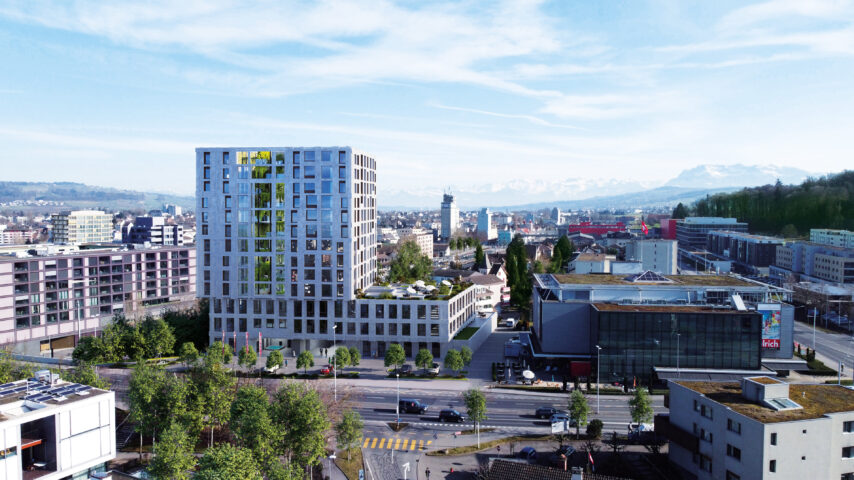
    Möbel Ulrich AG and Truvag AG, which have been based in Sursee for around 60 years, are jointly planning an office, commercial and residential building on the Ulrich site between Ringstrasse and Pilatusstrasse, which will complement and revitalise the existing furniture store. The project, called ALEA, is intended to become the new calling card for the location: The plan is to build 70 affordable rental flats with between 2.5 and 4.5 rooms using timber construction. In addition, there will be 2400 square metres of commercial and 1600 square metres of retail and restaurant space. The project scores not least with its central location directly at the railway station.

    The approximately 49-metre-high CO2-neutral timber construction was developed by the planning consortium Leuenberger Architekten AG from Sursee and Deon AG from Lucerne. The flats will have visible wooden beams and partly also wooden walls. The environmentally friendly material is breathable, insulating, very stable and load-bearing. In ancient Greek, ALEA means “warmth and protection” – these features should be visible and tangible for the future residents and employees. For fire protection reasons, only the façade design had to do without domestic and sustainable wood.

    But ALEA also does justice to its Latin meaning with its cube shape. The lower part of the building comprises three storeys – this is integrated into the slope. The silhouette is thus visible at a height of around 41 metres. While the upper part of the building is intended for residential use, the base area is available for offices, shops, commerce and gastronomy. A walkway creates a safe and fast pedestrian connection between the Kotten quarter and the railway station. All squares and connections in the new building are open to the public.

    The carefully thought-out traffic concept is intended to keep motorised individual traffic to a minimum: to this end, sharing services for cars, bicycles and e-scooters are planned. Accordingly, the parking garage will be equipped with a minimum number of parking spaces. The rental price structure is also intended to offer incentives for a life without a car. Generous parking spaces for bicycles have been designed to encourage non-motorised traffic.

    ALEA combines living and working.

    So that the tenants do not live anonymously, togetherness and mixing are to be promoted: A public square with a restaurant on the same level as the railway station creates meeting opportunities with various seating options around the building. The residents also have access to a green roof terrace for common use. Furthermore, several green terraces are planned.

    It is important to the initiators, who have strong regional roots, that “Surse residents build for Surse residents”:

    Not only were the partners chosen to carry out the construction work based on regional roots, but preference was also given to people who live or work in Sursee when renting out the apartments. In addition, Truvag AG, with around 80 employees, will relocate its headquarters to the new building. With the building planned by Möbel Ulrich AG and Truvag AG, the two traditional companies want to create added value for Sursee and enrich the area. The construction costs are expected to be in the double-digit millions.

  • Axpo spins off battery innovation

    Axpo spins off battery innovation

    A team from Axpo has been working on an environmentally friendly generator for four years in collaboration with regional construction companies. The result is a battery storage solution that can replace diesel generators at construction sites. The technology called emost (electric mobile storage) can also be used at events or in emergencies. It has already been awarded the IDEE SUISSE Innovation Prize in spring 2021.

    Now Axpo has decided to sell the technology to a consortium of the project’s existing management and several Swiss entrepreneurs. This will ensure optimal management continuity and knowledge transfer, Axpo writes in a media release. All relevant rights and contracts have been transferred to the newly founded emost AG, headquartered in Dietikon, as of the end of October 2022.

    The founding team reportedly consists of the entire management team that has developed the technology over the past several years. Benedikt Domke becomes CEO of emost AG. Christoph Sutter, who previously headed Axpo’s Renewables Division, will become Chairman of the Board of Directors. He intends to focus in particular on international expansion.

  • Branch Collab – everything is there, everything is included

    Branch Collab – everything is there, everything is included

    All the user has to do is bring their personal device – WiFi, printer, coffee bars and everything they need to work are already available in the Branch Collab. And here you not only work at your own table, but also in the work lounge and in creative zones, in lobbies, in big rooms and at the “work bar”. The opportunity to meet other entrepreneurs and exchange experiences over a casual coffee is a great advantage in creative work and networking.

    Work as a community project
    The new co-working area enables the exchange of ideas and opinions, increases productivity and enables more targeted work. More sustainable and often more unconventional results are achieved collaboratively. In addition, the Branch Collab provides meeting rooms with modern equipment, which allow presentations to be held with customers and employees in a professional environment.

    Industrial environment
    Branch Collab is an initiative of Halter AG, which also relocated its headquarters to Schlieren to JED last year. The architectural concept of JED combines sustainably converted industrial infrastructure with pioneering new office architecture and is designed entirely for knowledge transfer, creativity and innovation.

    Flexible booking packages
    Workplaces and meeting rooms can be rented flexibly and on an hourly or daily basis. Attractive packages offer individuals and smaller companies modern plug & work workplaces as well as meeting rooms, work lounges and creative rooms – all of this paired with varied gastronomy – from the Caffetino coffee bar with its own roastery to the Eve’s Kitchen restaurant.