Tag: Vision

  • Future prospects at the 103rd immoTable Zug

    Future prospects at the 103rd immoTable Zug

    Mayor André Wicki opened the event with an inspiring look at the economic future of the city of Zug. Under the motto “Zug remains Zug – liveable, visionary, vibrant”, he emphasised the challenges associated with sustainable growth, affordable housing and climate protection. His visions emphasise the aspiration to further develop Zug as an innovative and attractive place to live and do business.

    Sustainable strategies and economic success
    Beat Bachmann presented the “Spirit of Zug” long-term strategy, which strikes a balance between growth and resource consumption. Regional cooperation and attractive conditions for companies will strengthen the region as a leading business location. The innovation platforms, such as HSLU and the Tech Cluster Zug, promote technological advances in areas such as energy, mobility and decarbonisation.

    Successful projects for modern living and commerce
    Lukas Fehr presented the award-winning “Papieri Cham” project. The neighbourhood combines historical substance with modern new buildings, sustainable architecture and green open spaces. With around 1,000 flats and 40,000 square metres of commercial space, the Papieri site sets new standards for sustainable living and working.

    Material innovation in timber construction
    Pius Kneubühler spoke about the advantages of board stack constructions made with Swiss timber and minimal glue. This technology promotes sustainable cascade utilisation and combines high load-bearing capacity with an excellent carbon footprint. Material identity is at the centre of sustainable construction.

    Water treatment and infrastructure safety
    André Spathelf rounded off the event with a comparison of the Swiss market leaders in water treatment. He emphasised the importance of a proactive approach to monitoring and maintaining water networks. This approach ensures the quality and sustainability of vital infrastructure.

    The 103rd immoTable Zug once again demonstrated the importance of dialogue between business, science and politics in shaping a sustainable future. Visionary projects, technological innovations and economic strategies strengthen Zug as a leading region in Switzerland.

  • The Kammgarn area in the south

    The Kammgarn area in the south

    As part of a comprehensive vision for the city of Schaffhausen, the Kammgarnareal is to be further developed with new access points and better connections to the urban fabric. In addition to the existing access points from Baumgartenstrasse, Rheinuferstrasse and Rheinstrasse, a new passageway will be created along Klosterstrasse to improve accessibility. This will integrate the site even more closely into the urban infrastructure and enable new utilisation options.

    The Kammgarn area will become part of a “string of pearls” of meeting places along the banks of the Rhine, which will play an important role in the further upgrading of this area. With the start of construction in September, the approximately two-year construction phase will begin, with which Schaffhausen will gain a modern, attractive district that will significantly improve the urban quality of life as a meeting place and cultural centre.

    Upgrading the areas and increasing the quality of stay
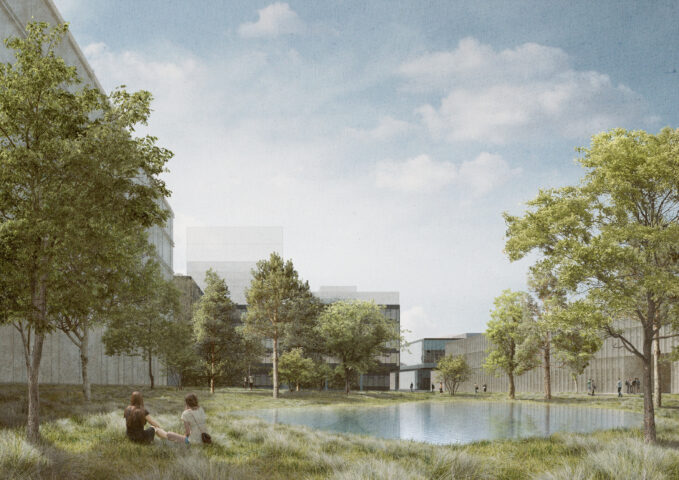
    The areas are also to be upgraded as part of the planned redesign. The creation of spacious green areas, seating and a water feature in the inner courtyard of the former worsted spinning mill will increase the quality of stay. These measures aim to transform the Kammgarnhof into an attractive place to meet and relax, which can be used for events and everyday activities.

    New uses and modern infrastructure
    A central element of the redesign is the construction of a single-storey underground car park with around 90 parking spaces, which is to be built under the Kammgarnhof. This will make the inner courtyard car-free and provide more space for events and recreation. A pergola is planned in front of the west wing, while a large terrace will be created in front of the north wing.

    The historic west wing of the Kammgarn site will be prepared for new uses as part of the refurbishment. The ground floor, along a new passageway to the inner courtyard, will house the library and the toy library. The glazed façades will give passers-by an attractive insight into the world of books and games.

    Half of the first floor will be used by the library, while the remaining space will be rented out in small to medium-sized units. The Schaffhausen University of Teacher Education will move into the upper floors, while the remaining space will be available for flexible use by other tenants.

    This comprehensive remodelling of the Kammgarn site strengthens the connection to the old town and the Rhine and gives the area a new significance in the urban fabric. The planned measures will contribute to long-term urban development and create a modern, vibrant neighbourhood that will significantly improve the quality of life in Schaffhausen.

  • ETH Campus Hönggerberg continues to develop

    ETH Campus Hönggerberg continues to develop

    The core mission of ETH Zurich is teaching and research as well as the transfer of knowledge to the economy and society. A modern infrastructure is a key factor in this. In order to cope with the increasing number of students and researchers and to create the necessary space for new research areas and innovative teaching methods, ETH Zurich is working on the further development of its main locations Zurich Centre and Zurich Hönggerberg. With regard to future space requirements, the Hönggerberg campus plays a central role. As a basis for its further development, ETH Zurich, together with the City and Canton of Zurich, has drawn up the master plan “Campus Hönggerberg 2040”. It describes the long-term spatial development goal. The structural densification and further development of the campus should preserve the current conditions of the site, such as the sensitive embedding in the local recreation area as well as listed buildings and gardens, and only take place in accordance with the emerging demand. In the next few years, a new building for quantum physics, a computer centre and a centre for student and entrepreneurial initiatives will be built, among other things. The central Wolfgang-Pauli-Strasse will also be renovated and upgraded as an important master plan element. Until the campus is fully developed, a conversion, new construction, extension or renovation of around a dozen buildings is planned, including four new high points. Various green areas are to be expanded. With the new master plan, ETH is building on the previous “Science City” master plan from 2005. ETH Zurich wants to develop its campus sustainably on various levels: ecologically, economically and socially. Among other things, it wants to take a big step towards climate neutrality and is focusing on energy supply without fossil fuels. A central element of this is the expansion of the current energy grid. Projects are also planned with regard to sustainable building, local climate, biodiversity as well as retention and drainage. For the further development of the campus, ETH Zurich is in dialogue with internal and external interest groups and involves selected people in a participatory manner on a selective basis.

    Attractive open spaces should ensure a high quality of stay and support biodiversity on the campus.

    In order to protect the surrounding landscape, the campus will be developed inwards and densified within the existing area. A green ring road around the campus symbolises this development and serves as a transition from the campus to the landscape. Attractive open spaces will ensure a high quality of stay and further promote biodiversity on the campus. The campus should be easily accessible by environmentally friendly means of transport such as public transport or bicycle. To relieve the local public transport system, a direct electrically powered bus, the so-called eLink, already runs between the Hönggerberg Campus and the Campus Zentrum for ETH members. Other local services such as bike sharing are available and are being continuously expanded. The current urban district character of the Campus is to be further strengthened. The central Wolfgang-Pauli-Strasse will become a lively and green promenade with versatile ground floor uses for the public. The central “piazza” will also gain in importance in the future and will invite people to meet and exchange ideas.

  • Buildings should become power plants

    Buildings should become power plants

    The Swiss Federal Office of Energy ( SFOE ) has published its vision for the Swiss building stock by 2050 in a document . By then, the majority of buildings should be able to meet their own electricity needs from sustainable energy sources. The excess electricity is to be used for electric mobility.

    At the same time, the electricity requirements of buildings are to be reduced. Overall, the final energy consumption of the Swiss building stock by 2050 should be around 65 instead of 90 terawatt hours.

    With a few exceptions, there should no longer be any heating oil, natural gas or electricity for direct consumption for heating. Oil and natural gas heaters and stationary electrical resistance heaters are to be replaced by renewable energy sources. Energetic operational optimization should be mandatory for all buildings by 2030.