Tag: Wärme

  • Airport tests water reservoir under glacial channel

    Airport tests water reservoir under glacial channel

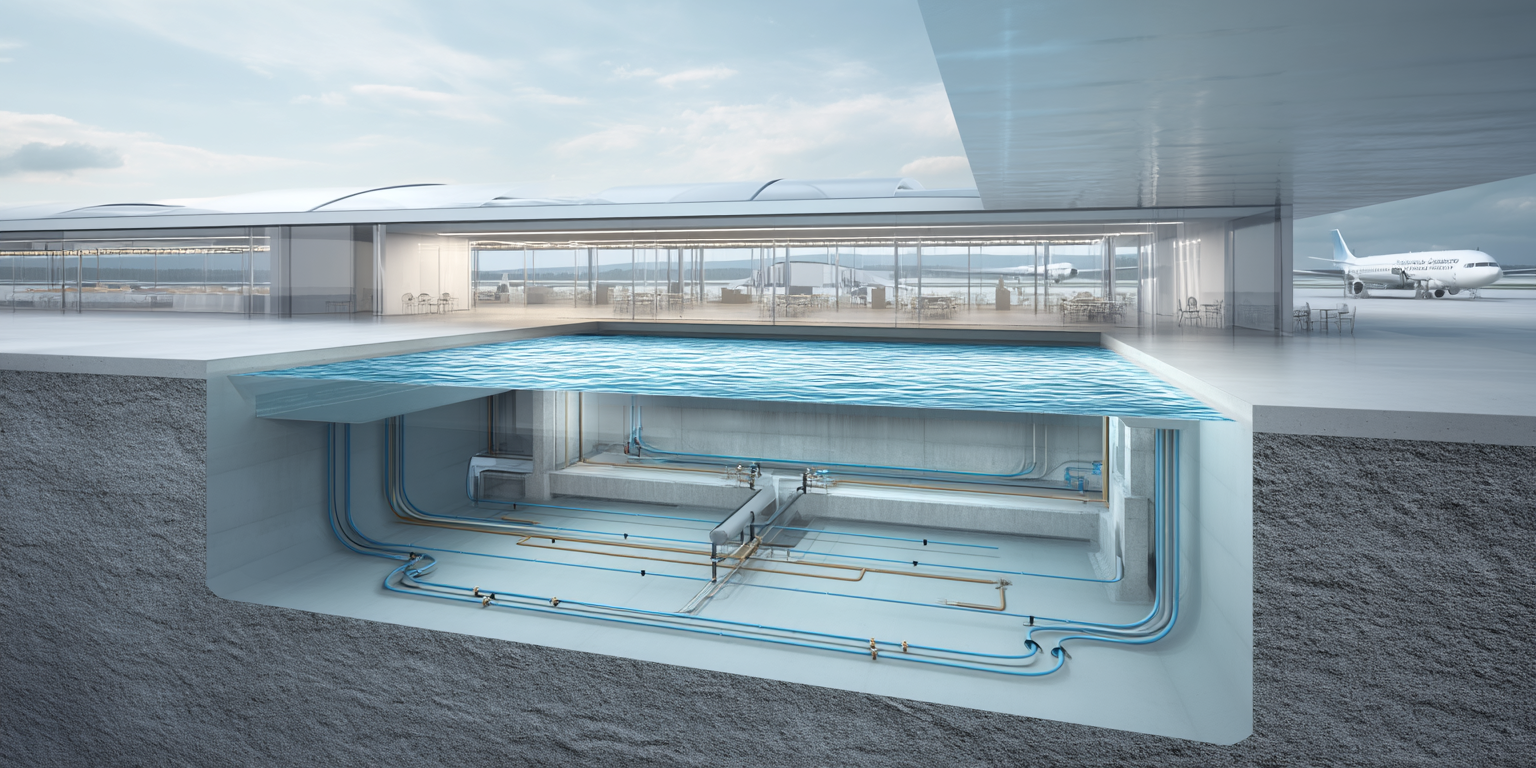
    Flughafen Zürich AG is starting the construction of a second test well in an ice-age channel located around 300 meters below the airport site, the airport operator announced in a press release. It plans to use the water-bearing channel as a heat and cold reservoir for emission-free heating and cooling of the airport building. A test well installed last fall had already delivered promising results.

    “The volumes of water that could be pumped and the flow rate of the water give us further confidence that the channel can be used to store heat and cold,” said Guido Hüni, Head of Energy and Decarbonization at Flughafen Zürich AG, in the press release. “Further tests are now needed to determine the extent to which this storage facility can be used.”

    A suitable location for the second well is currently being sought. Once installed, it will be connected to the first well for circulation tests. “This next step will allow us to test the efficiency of such a storage facility and, if the results are positive, we can then plan the actual expansion,” explains Hüni.

    The airport operator is counting on being able to cover the majority of the heating and cooling requirements for the airport building via the channel. Depending on the yield, the water reservoir could be combined with geothermal probe fields. The estimated cost of the investment is stated in the press release as around CHF 8 million. Flughafen Zürich AG can rely on financial support from the Swiss Federal Office of Energy.

  • Paradigm shift in energy planning

    Paradigm shift in energy planning

    Numerous countries have committed to being climate-neutral by 2050. For building and energy systems, this requires a rapid transition from fossil fuels to renewable energies and greater networking of different sectors. Buildings, mobility, industry, electricity, heat and synthetic fuels must interact and be planned in an integrated manner. Matthias Sulzer from Empa and Michael Wetter from the Lawrence Berkeley National Laboratory argue that the current planning processes do not do justice to this complexity and that a paradigm shift is therefore necessary.

    Current planning process – a silo mentality
    Today’s planning processes are organised by discipline, which leads to inefficient and suboptimal results. Engineers and architects work one after the other instead of collaborating across disciplines. This linear, “waterfall” approach leaves little room for iteration and optimisation in the overall system. Sulzer emphasises that this approach is no longer sufficient to meet the requirements of future, flexible energy systems.

    Inspiration from the chip industry
    Sulzer and Wetter propose a planning approach inspired by the chip industry. The electronics and computer scientist Alberto Sangiovanni-Vincentelli has revolutionised chip manufacturing with his “platform-based design”. This concept uses different levels of abstraction for the holistic analysis and optimisation of systems and creates universally valid, modularly combinable models. This model could also be applied to building and energy systems in order to automate and modularise planning.

    Advantages of a model-based planning process
    A model-based planning process would mean that models are used not only to analyse, but also to specify and build systems. These blueprints could be combined in a modular way to clearly define the design and functionality of a system. This would revolutionise planning, construction and operating processes and promote the necessary digitalisation and automation to achieve the ambitious decarbonisation targets.

    Pilot project at Empa
    The EU project GOES, led by Empa, is a first step towards the application of platform-based design in the energy sector. A pilot plant with 144 geothermal probes is being developed on the Empa campus in Dübendorf as the first application of this concept. The aim is to define the various abstraction levels of decision-making and to standardise the interfaces.

    The implementation of an automated and modular planning process is crucial for achieving climate neutrality by 2050, and Sulzer and Wetter are convinced that this paradigm shift will significantly increase the flexibility and efficiency of energy systems. The approach offers a promising solution to meet the challenges of decarbonisation and ensure security of supply.

  • A new home for families and creativity in Leutschenbach

    A new home for families and creativity in Leutschenbach

    The centrepiece of the housing estate consists of two U-shaped building complexes that are open to the green space and are complemented by pavilion buildings in the inner courtyard. This arrangement creates a lively, communal courtyard that houses kindergartens and communal spaces, making it a social meeting point.

    The housing estate offers a variety of 2- to 6½-room flats as well as special studio and communal flats to fulfil a wide range of living requirements. Particular attention is paid to spacious family flats and creative spaces that enable flexible and innovative living.

    Sustainability and energy efficiency are the focus of the housing estate. By building to Minergie-P-ECO and Minergie-ECO standards and utilising renewable energy sources for heat and electricity, it makes an important contribution to climate protection. The large-scale installation of photovoltaic modules ensures an environmentally friendly power supply.

    The design of the outdoor facilities promotes biodiversity and improves the microclimate in the neighbourhood. The upgrading of the green spaces along the Riedgraben and the “Inner Garden Leutschenbach” connecting the neighbourhood create natural recreational areas that offer residents a high quality of life.

    The Leutschenbach housing estate is an example of the successful combination of urban living, social mixing and ecological responsibility. It plays a key role in the development of Leutschenbach into an attractive and lively neighbourhood that meets the requirements of a modern, sustainable lifestyle.

  • “Fischermätteli” first site with Minergie certificate

    “Fischermätteli” first site with Minergie certificate

    The innovative and long-term residential construction project Fischermätteli was successfully completed by Strüby Unternehmungen in autumn 2023 after a staggered construction period of around three and a half years. The ten apartment blocks with a total of 168 condominiums were built on a former commercial site in Burgdorf BE. Over 6600 m3 of Swiss wood was used in the construction, which serves as a natural CO2 reservoir and has an excellent ecological footprint thanks to the short transport routes.

    One hundred per cent of the energy requirements for the entire site are covered by renewable sources. The electricity comes from the PV systems on the roofs of the buildings, while the heat for heating and hot water comes from a heating centre that runs on Swiss pellets. The well thought-out mobility concept is based on electric mobility, car sharing, bicycles and public transport. A co-working space supports working from home and thus indirectly relieves traffic congestion. In addition, the environmental design based on the sponge city principle ensures natural and efficient cooling in summer and turns the project into a true biodiversity hotspot thanks to the wide variety of native plants.

    Label with high requirements
    In April 2024, the largest real estate project to date was awarded the coveted certificate by the Minergie association: the Minergie-Areal label, having already been awarded the Minergie-A-ECO label. The new standard, which has been in place since September 2023, is supported by various organisations such as the Minergie Association, the cantons, the business community and the Swiss Federal Office of Energy. The Minergie site is characterised by minimal energy consumption, minimised greenhouse gas emissions during construction and operation and maximum self-sufficiency with renewable energies. The buildings have particularly efficient heat insulation and controlled air exchange. In addition, the outdoor space of the Minergie site is designed in such a way that climate resilience and quality of stay are increased, for example through green planting and shading options. Another advantage of the Minergie site is the promotion of climate-friendly mobility.

    The development in Burgdorf BE sets new standards in timber construction for flats. With 168 owner-occupied flats in ten apartment blocks, it is the largest construction project of its kind to combine Swiss timber and the Minergie-A-ECO standard. Sustainability aspects were at the centre of the project right from the start, which earned it the first Minergie-Areal certificate for a completed project.

    Thanks to the elegant timber façades, the ensemble blends in perfectly with its natural surroundings. The clearly defined meeting and play zones with village charm promote relationships between the residents. At the same time, the architecture ensures privacy and creates living spaces with ideal air, light and sound characteristics. Community-enhancing elements such as a spacious communal pavilion and the professional home office zone “fm produktiv” round off the offer.

    The flats offer 2.5 to 5.5 rooms and are designed for singles, couples and families of all ages. The floor plans are flexibly designed so that they can be adapted to future needs. From the ground floor upwards, the building was constructed using timber elements.

    The energy supply is consistently based on renewable sources. The electricity for the approximately 400 residents comes from the PV systems on the roofs of the apartment blocks (700 MWh/year). Heat is generated in a heating centre using Swiss wood pellets.

    The mobility concept focuses on cycling, public transport, electric vehicles and car sharing. Bicycle stands, charging stations, repair and cleaning areas are available. Residents can also use one of the two electric cars from the neighbourhood’s own car-sharing scheme via an app or conveniently use the bus, which runs every half hour from the neighbourhood to Burgdorf. Demand for the condominiums and rental flats was very high right from the start. All 168 flats were sold or rented months before completion. The fair sales and rental prices certainly contributed to the great success, e.g. a flat with 4.5 rooms was already available from CHF 610,000 (minus Minergie subsidies from the Canton of Berne).
  • Strategies against urban heat islands: The importance of green spaces and water

    Strategies against urban heat islands: The importance of green spaces and water

    The challenge facing urban and industrial centres in the face of global warming is the phenomenon of heat islands, which is exacerbated by a combination of climate change and urbanisation. The overheating of urban areas results from a lack of vegetation and an excess of heat-absorbing surfaces such as concrete and asphalt. The high density of buildings and the lack of air circulation on narrow streets further exacerbate the problem.

    To combat the negative effects of these heat islands, such as increased energy costs for air conditioning, air pollution and health risks, cities such as Zug and Zurich have begun to integrate comprehensive climate analyses and models into urban planning. The aim is to design new neighbourhoods in such a way that they contribute to reducing heat and do not lead to the creation of heat islands.

    However, the adaptation of existing structures requires additional efforts. Many cities are exploring a combination of greening, the creation of water features and the use of building materials that absorb less heat. One example of this is the city of Sion, which has built a Japanese garden on the roof of an agricultural school and created a pond in front of the school building. In addition, soil sealing is being broken up and replaced with lighter-coloured asphalt to reduce heat storage.

    It is clear that individual measures are not enough to solve the complex problem of heat islands. A holistic approach based on the motto “More green and blue instead of grey” is required to maintain and improve the quality of life in urban areas, even in hot summer conditions.

  • Long-term cost benefits and environmental friendliness of heat pumps

    Long-term cost benefits and environmental friendliness of heat pumps

    The decision to replace or renew a heating system is a long-term investment. Many consumers focus mainly on the initial installation costs, but often neglect to calculate the total costs over the life cycle of the heating system. In a new study, researchers at the Fraunhofer Institute for Solar Energy Systems ISE have analysed the costs of various heating technologies in existing residential buildings over a period of 20 years. They took into account future energy prices and the development of CO2 prices. Their conclusion: heat pumps and district heating are not only more climate-friendly, but also cheaper than gas heating in the long term.

    The study focused on existing residential buildings and took into account the subsidies that came into force on 1 January 2024 as part of the Building Energy Act (GEG) and the funding guideline “Federal funding for efficient individual building measures”. The researchers assessed the costs of replacing heating systems and analysed the emissions of various technologies.

    “When investing in a new heating system, all expected costs, in particular the energy costs including the CO2 price component, should be taken into account over the entire life cycle,” explains Robert Meyer from Fraunhofer ISE. According to the study, switching to heat pumps or district heating also results in a positive cost balance for old buildings.

    The study showed that heat pumps in single-family homes are not only more environmentally friendly, but also more economically advantageous. The use of photovoltaics for self-consumption can further reduce overall costs. Even in apartment blocks, switching to heat pumps or district heating is more cost-effective than a new gas heating system.

    The study included various heating technologies such as gas condensing boilers, air source heat pumps (with and without photovoltaic systems), geothermal heat pumps, pellet heating systems and district heating. The researchers recommend providing consumers with transparent information on expected emissions and energy prices, including CO2 prices, to facilitate decision-making.

  • Stäfa receives renewable heating and cooling

    Stäfa receives renewable heating and cooling

    The municipality of Stäfa’s heating and cooling supply is to be modernised with a sustainable energy project. According to a press release, local industry and 500 properties in Stäfa will be supplied with renewable heat from Lake Zurich from 2026. The industrial companies will also receive renewable cooling for their cooling processes from the lake. The project is being realised by Energie 360°. The project aims to save 7,000 tonnes of carbon dioxide in future by replacing gas and oil heating systems. According to the press release, this reduction in emissions corresponds to the consumption of 2.6 million litres of fossil heating oil. Heat is to be generated using heat exchangers in an underground system. Construction of the lake water intake and the underground energy centre will begin in summer 2024. The first pipes for the heating and cooling network will be laid in 2025, and the industrial companies and the first properties will then be connected to the new heating and cooling supply from 2026.

    “Energie 360° has set itself the goal of supplying its customers exclusively with renewable energy by 2040,” Romeo Deplazes, Head of Solutions at Energie 360°, is quoted as saying in the press release. “The Stäfa energy network is a further step in Switzerland’s transformation from fossil to renewable energy.”

  • Heating network in Villmergen utilises local waste wood

    Heating network in Villmergen utilises local waste wood

    On 16 November, AEW Energie AG celebrated the start of construction of the heating centre in the Villmerg industrial area with a ground-breaking ceremony. The heating centre will be built on the Cellpack Power Systems site. According to a press release, it will initially be equipped with a boiler for waste wood with a nominal output of 2,000 kilowatts and an oil-fired boiler for peak loads with a nominal output of 4,000 kilowatts.

    The plant will supply heat for the first time at the end of 2024. It will replace around 710,000 cubic metres of natural gas and thus avoid the emission of 1500 tonnes of CO2. A further waste wood boiler with a nominal output of 4000 kilowatts is to be added in the final stage. This should also be able to supply other companies in the industrial area. The expansion of the heating network to neighbouring areas is being considered.

    Most of the waste wood will come from untreated wood waste from the industrial estate and will be supplemented with wood from the region as required. The proportion of oil for the peak load should not exceed 10 per cent. A photovoltaic system will be installed on the roof and on two sides of the heating centre. This will achieve a peak output of 260 kilowatts.

  • Ennetsee heating network starts work

    Ennetsee heating network starts work

    With the opening of the transport pipeline between Perlen and Rotkreuz, WWZ has put the first section of its Ennetsee heating network into operation. “From now on, waste heat from the Renergia waste incineration plant (KVA) in Perlen will flow into the Rotkreuz distribution network and supply the first properties in the municipality with regional, environmentally friendly and CO2-neutral energy for heating and hot water,” explains the Zug-based energy, telecommunications and water supplier in a corresponding press release.

    Once completed, the Ennetsee heating network will be able to supply not only Rotkreuz but also the village of Holzhäusern, which belongs to Risch ZG, the Bösch area in the municipality of Hünenberg ZG, Hünenberg See and Cham with waste heat from the Renergia waste incineration plant. WWZ expects that the heat network will then prevent more than 12,000 tonnes of CO2 emissions annually. The company is currently working on further district heating pipelines in Rotkreuz and on the next section of the main transport pipeline from the waste incineration plant to Cham.

  • Wetzikon votes for the district heating network

    Wetzikon votes for the district heating network

    On 3 September, the voters of Wetzikon approved the foundation of Fernwärme Wetzikon AG. The district heating network with waste heat recovery will supply up to 50 per cent of Wetzikon households with CO2-neutral energy from 2025. According to a press release, the energy service provider Energie 360° and the town of Wetzikon will be joint shareholders in the new public limited company with 40 and 60 percent respectively.

    The new public limited company will conclude long-term heating contracts with the Wetzikon wastewater treatment plant and the Zürcher Oberland waste incineration plant (KEZO). The district heating is to be brought from the KEZO Hinwil to Wetzikon via a transport pipeline and distributed to the households from there. The energy centre is planned at the Wetzikon open-air swimming pool.

    “With energy networks, it is important to use locally available heat sources,” Romeo Deplazes of Energie 360° is quoted as saying. “In Wetzikon, district heating from waste recycling is available, which is ideal.”

    “The sooner we can realise district heating Wetzikon, the better,” thinks councillor Heinrich Vettiger. “This way we become less dependent on fossil fuels from abroad and use regional waste heat that accumulates anyway.” With its many years of experience and sound expertise, Energie 360° is the ideal partner.

    According to its own information, the energy service provider is already building and operating energy networks with lake water utilisation for various communities and companies around Lake Zurich. In Dielsdorf ZH, waste heat from data centres will be used to supply up to 3,500 households with heat in the future.

  • WWZ expands district heating business

    WWZ expands district heating business

    The WWZ Group is observing rising demand for district heating and cooling. The corresponding business area increased its sales by 15 per cent year-on-year in the first half of 2023, the Zug-based energy, telecoms and water supplier informs in a statement. In the half year under review, the group was able to connect further properties to its Circulago and Ennetsee energy networks.

    In the future, WWZ plans to further expand this promising business area. A feasibility study for a heating network has already been carried out in Steinhausen, and the group is currently working on a feasibility study with the municipality of Baar. Investments in district heating and district cooling did “temporarily lead to higher operating costs, but the investments will pay off in the medium term with stable cash flows”, writes WWZ.

    In the first half of 2023, the expansion of the district heating and district cooling business also increased the company’s operating costs by almost 4 per cent. The operating result nevertheless increased by 27 per cent to CHF 13.6 million. The background to this is a year-on-year increase of 24 percent to 166.5 million Swiss francs in net revenues from deliveries and services. At 15.7 million Swiss francs, net profit was 8.4 million Swiss francs higher than in the first half of 2022.

  • Construction of the Frick heating plant begins with a groundbreaking ceremony

    Construction of the Frick heating plant begins with a groundbreaking ceremony

    Industriellen Werke Basel(IWB) has begun construction of a new woodchip heating plant for the planned heat centre on the company premises of Stahlton Bauteile AG, based in Frick. The groundbreaking ceremony took place on 4 July 2023.

    According to a media release, the first customers will have access to heat from renewable production from autumn 2024. The raw material will be wood from the Thiersteinberg forest district. Currently, every third heating system in Frick is still fossil-fuelled.

    Regarding the efficiency of the heat network, IWB will be able to generate up to 20 gigawatt hours of heat per year. The savings potential for the community of Frick is 2700 tonnes of carbon dioxide per year. The expansion of the pipeline network for the regenerative heat supply is to begin in autumn 2023.

    The CEO of Stahlton Bauteile AG, Ernst Gisin, quoted in the press release, emphasises the company’s long-standing commitment to sustainability. “Among other things, we built the thermally activated office building to Minergie-P standard twelve years ago and have had a PV system with an output of one megawatt peak in operation for a year.” The next step, he says, is to replace the natural gas heating system in production by connecting it to the central heating system.

  • Alliances to supply 45 per cent of the heat in Winterthur

    Alliances to supply 45 per cent of the heat in Winterthur

    The city of Winterthur can cover 45 per cent of the city’s heating needs with public heating networks. Energy from the municipal utility’s waste incineration plant could cover 33 per cent of the city’s heating needs, the city writes in a statement. Wood, biogas and waste heat utilisation could provide another 10 per cent. The new Schützenwiese energy centre could cover another 2 per cent by using groundwater heat.

    About two-thirds of the necessary municipal heating networks have already been realised. Further investments are needed for the remaining third. For example, the electorate must approve the building loan for the replacement of incineration line 2 of the waste incineration plant. From 2028, this line will generate waste heat energy from the flue gas purification plant. In addition, around 300 million Swiss francs must be invested in the expansion of the city’s heating networks. For this purpose, a credit bill is to be prepared by the end of 2024, which will also be voted on by the electorate. These heating networks are to supply areas with high energy density with heat.

    The city council estimates that around 55 per cent of the city’s heating needs will have to be covered by private solutions. Another study will examine how areas with lower energy density can be developed economically and ecologically.

  • New heating plant in Emmen goes into operation

    New heating plant in Emmen goes into operation

    Energie Wasser Luzern(ewl) opened its new heating centre in Emmen on Tuesday, 4 April. It is located at the site of the RUAG armaments factory. According to a press release, the utility ewl expects to sell about 22 gigawatt hours of heat per year when it is completed. This corresponds to the heating needs of about 2200 four-person households. This will save a total of about 4,600 tonnes of CO2 per year in the region, according to the ewl statement.

    The opening of the Emmen Dorf heating plant was carried out by Fernwärme Luzern AG, a subsidiary of ewl Luzern, together with the building lease provider RUAG Real Estate and representatives of the municipality of Emmen. It is described as an important milestone in the regional district heating expansion. In total, Fernwärme Luzern AG invested around 31 million Swiss francs in the expansion of the district heating network in Emmen Dorf, with around 8 million Swiss francs going into the new control centre, including buildings and facilities.

    “The building lease to Fernwärme Luzern AG and the completion of this heating centre are the prerequisites for RUAG’s big ecological step – namely connection to the district heating network from the 2023/24 heating period. For RUAG, this will result in a reduction of around 2,000 tonnes of CO2 per year,” Matthias Hauswirth, RUAG’s Chief Real Estate Officer, is quoted as saying.

    After the start of construction in February 2022, delivery problems in the wake of the Ukraine war led to delays and uncertainties, according to a statement by Patrik Rust, Chairman of the Board of Directors of ewl. The fact that the project was completed on time is thanks to the great commitment, good cooperation and constructive exchange between the planning team, the construction companies and RUAG Real Estate as the lender of the building rights.

  • Voters approve credit for district heating in Chur

    Voters approve credit for district heating in Chur

    Chur’s energy supplier Energie Wasser Chur(IBC) can massively expand its district heating network. The electorate approved a corresponding municipal proposal by 60.85 per cent. It states that the city will contribute 80 million Swiss francs to the total costs for the expansion of the heating network over a period of twelve years. These costs amount to 314 million francs.

    According to its message to the polls on 12 March, the municipal council supported the proposal with 17 votes in favour and 4 against. Now Chur is supporting the generation project of the IBC, which is an independent institution under public law in the sole ownership of the city, with 60 million francs to increase the endowment capital and in the form of a loan. The city is holding a further CHF 20 million in reserve for any guarantee that may be required.

    In the view of the municipal council, the investment is necessary to ensure the conversion to a renewable heat supply within the city. “At the same time, the loss of the previous added value from the sale of gas can be absorbed and the revenues increased elsewhere,” the message continues. “The money that flows out today for the purchase of oil and gas will remain in the region in the future.”

    According to the information, IBC wants to borrow a total of 160 million Swiss francs from financial institutions. In addition, a contribution of 56 million francs from the federal government and the canton is expected. The company intends to invest 38 million francs of its own funds.

  • Implenia starts work on the tunnel in Hamburg

    Implenia starts work on the tunnel in Hamburg

    Construction work on Hamburg's district heating tunnel began on August 5, Implenia announced in a statement . The construction and real estate company from Opfikon is realizing the project on behalf of Wärme Hamburg . The 1.16 kilometer long tunnel will cross the Elbe about 2 kilometers west of the Elbe tunnel for the autobahn.

    From the winter of 2024/25, this will be used to transport waste heat from industrial processes in the south to the north of the Hanseatic city. This is a requirement so that the coal-fired power plant in Wedel can be replaced by energy from the future Hafen Energy Park of Hamburger Energiewerke GmbH . "We are pleased that we can plan and implement this large and complex infrastructure project for the Hamburger Energiewerke and thus contribute to a sustainable energy supply in Hamburg," said Thomas Fiest, Head of Tunneling Germany at Implenia.

    In the first construction phase, Implenia is constructing the start and target shaft with diaphragm walls 1.5 meters thick and 30 meters deep. Then a tunnel boring machine will bore the actual tunnel with a diameter of 4.55 meters. Access and operating equipment for the operation should be accommodated in the shafts.

  • Federal government uses geothermal energy for buildings

    Federal government uses geothermal energy for buildings

    Most of the buildings in the National Sports Center in Magglingen are currently heated with gas, according to a press release from the Federal Office for Buildings and Logistics (BBL). The BBL is currently realizing a number of new construction and renovation projects for the Federal Office for Sport at the sports center. For the first time, the federal government is using geothermal energy to supply heat to buildings. A new district heating network will supply both the existing and the new buildings.

    Geothermal energy from a depth of 1,300 meters is used for the heat supply. It is expected that the extracted water has a temperature of 30 to 50 degrees Celsius. For this purpose, two wells are being built. The warm water is pumped up via one, the cooled water is let down again via the other. In between, a heat exchanger on the surface takes the heat from the water and uses it to supply the building.

    While the gas supply currently emits 1,300 tonnes of CO2 annually, this should only be 70 tonnes in the future.

  • Empa-Forschende entwickeln Energiesparriegel für Fenster

    Empa-Forschende entwickeln Energiesparriegel für Fenster

    Forschende der Eidgenössischen Materialprüfungs- und Forschungsanstalt (Empa) haben eine neuartige Wärmedämmung für Fenster entwickelt. Laut Medienmitteilung ist der Dämmsteg eine Art Sandwich, mit einer umweltfreundlichen Füllung. Im Inneren befindet sich aus wiederverwerteten PET-Flaschen geformter Schaumstoff mit mikroskopisch kleinen Luftbläschen. Dieser sogenannte gefüllte Energiesparriegel für Fenster hat einen sehr hohen Wärmedämmwert.

    Entwickelt wurde der Riegel von einem Empa-Team um Michel Barbezat und Giovanni Terrasi von der Abteilung Mechanical Systems Engineering zusammen mit Experten des Metallbauunternehmens Hochuli in Wigoltingen TG. Frank Hochuli hat für das Vorhaben eigens die Tochterfirma hochuli advanced gegründet. Hochuli bietet den Dämmsteg unter dem Markenzeichen Alpet an. Verglichen mit heutigen hochwertigen Ausführungen liesse sich die Wärmdämmung, etwa in einem neuen Bürogebäude, durchaus um bis zu einem Fünftel verbessern, wird Frank Hochuli zitiert.

    Das neue Produkt ist von den Empa-Forschenden auf Verschleissfestigkeit bei Dauerbeanspruchung wie auf die Eigenschaften der Wärmedämmung geprüft worden. Eine weitere Prüfung des neuartigen Dämmstegs ist beim Prüfinstitut ift im bayerischen Rosenheim vorgenommen worden. Das ift gilt laut der Medienmitteilung in der Branche seit Jahrzehnten als Referenz. Die Fachleute dort setzten laut der Empa-Mitteilung die Prototypen auch Brandversuchen, Bruchtests und anderen Belastungen aus, wie auf nicht sichtbare Mikrorisse nach 1000-stündiger Lagerung in Öl oder leichter Säure oder nach starkem Zug in Querrichtung.

    Nach Angaben von Frank Hochuli liegen offizielle Zertifizierungen zum Brandverhalten und zur statischen Belastbarkeit vor. Das Attest zur Wärmedämmung steht noch aus.

  • New energy solutions at the start

    New energy solutions at the start

    The use of fossil fuels still dominates, especially in the area of heating living space. Thanks to innovative technologies, new climate-friendly alternatives are emerging here – for example, heating with sea thermal systems or the use of waste heat from computers. Both approaches use existing heat sources to heat buildings.

    Lake thermal energy is one of the youngest forms of energy generation and makes use of the lakes as huge heat stores. In summer, the lakes absorb the sun's warmth and give it off slowly. Even when it is below zero, the lake water retains a certain temperature in the depths – ideal for extracting heat from the water in the lower layers and using it as a natural source of heat. The water is then returned to the lake in a cooler condition. This is harmless to the ecosystem and to a certain extent even counteracts climatic warming. With this technology, the largest lake thermal project in Switzerland is successfully launched in Lucerne.

    The Paris startup “Qarnot” takes a different approach and relies on the waste heat from computers. Instead of laboriously cooling computers in large server rooms, they are built into radiators. In this way, data flows in the radiators instead of water. The decentralized computing power is sold to large companies, the digital radiators themselves to private households. After the initial investment, they no longer have any heating costs. The more heat is desired, the more data power is generated. The data is encrypted and is not saved, so it is not possible to trace which data is flowing. The same thing works with hot water boilers – an entire residential complex in Bordeaux has already been equipped with this technology. Due to the increasing amounts of data around the world, the future potential seems enormous.

    Read more about intelligent solutions here:
    https://proptechmarket.net/loesungen