Researchers from the Swiss Federal Laboratories for Materials Science and Technology(Empa) have conducted a joint project on the effect of hydrogen fuel cells in collaboration with the Hälg Group from St.Gallen, the Osterwalder Group, also based in St.Gallen, and Zurich-based H2 Energy AG. The experiment at the Empa Center in Dübendorf showed that the electrical energy generated by the fuel cells could relieve the burden on local power grids in district centers, according to a press release.
The core of the project was to reduce the electricity consumption of heat pumps by producing electrical energy from local district energy cells using hydrogen fuel cells. This energy is fed into the grid to operate the heat pumps, thus reducing the load on the grid. At the same time, the experiment tested using special heat exchangers to supply average temperatures of around 35 degrees Celsius to the heating network of the NEST innovation building and the Empa campus in Dübendorf. The test, which ran from October 2023 to September 2025, showed that the district energy cells were able to smooth out peaks in electricity consumption and reduce the overall cost of peak load by 10 percent.
“Our trials showed that fuel cells can effectively balance electrical and thermal peak loads in buildings. This made it clear that hydrogen-based peak load shaving is technically feasible and provides valuable insights for the control of complex energy systems,” Binod Prasad Koirala, Deputy Head of Empa’s Urban Energy Systems research department, is quoted as saying in the press release. When using green hydrogen, the fuel cells also make a contribution to reducing CO2 emissions.
Youdera Group SA has secured a strategic investment from Amundi Energy Transition. According to a statement, the funds will support the company’s next phase of growth and an implementation plan of around 150 million euros for decentralised energy infrastructure in the European commercial and industrial sector.
Youdera offers companies energy management, which involves the planning and development, financing, construction and operation of energy systems. The aim is to reduce dependence on the electricity grid, make energy costs more predictable and drive electrification. The offering includes photovoltaic systems, battery storage, building envelope refurbishments, heat pumps and other measures to increase energy efficiency.
The investment by Amundi Energy Transition, a subsidiary of French asset manager Amundi S.A., offers the opportunity to scale the model across Europe, says Pedro Miranda, CEO and co-founder of Youdera. “In a more volatile world, European companies need to act decisively to remain competitive.”
Youdera was founded in 2015, is based in Ecublens and has its main site in the EPFL Innovation Park in Lausanne. Its core markets are Switzerland, Spain and Portugal, but the company sees further growth potential in Europe. “As commercial and industrial customers are looking for more resilient and cost-efficient energy solutions, we are convinced that Youdera is ideally positioned to meet this growing market demand,” says Claire Chabrier, Head of Direct Investments – Private Markets at Amundi.
The Swiss federal and cantonal building programme, which promotes measures to reduce the energy consumption or CO2 emissions of properties, distributed around CHF 528 million in subsidies in 2024. According to a press release, the amount paid out remains at the level of the record year 2023 and has stagnated for the first time since 2016.
The subsidies for technical building systems increased by 5 per cent in 2024 to around 228 million francs (2023: 216 million francs) and enabled the replacement of 25,633 oil, gas or electric heating systems, 84 per cent of which with climate-friendly heat pumps. CHF 131 million was spent on thermal insulation projects, CHF 89 million on system renovations and CHF 23 million on district heating projects.
Energy-efficient new buildings in accordance with Minergie-P or GEAK-A/A standards received CHF 43 million last year, a significant increase of 76 per cent compared to the previous year. cHF 17 million went towards information and training projects as well as quality assurance, two thirds of which went towards the creation of cantonal energy certificates with an advisory report.
Subsidy commitments from the buildings programme amounted to around CHF 542.5 million in 2024, the majority of which (CHF 190 million) went to building technology projects and around a quarter (CHF 123 million) to system renovations.
Thanks to the federal and cantonal subsidies, measures were implemented in 2024 that will save around 12 billion kilowatt hours and 3.5 million tonnes of CO2 over their lifetime, according to the press release. The impact per franc of funding also improved from 152 francs per tonne of CO2 (2023) to 147 francs in 2024.
Flughafen Zürich AG is building an underground energy centre located between multi-storey car park 6, the Radisson Blu Hotel and Operation Center 1. The centre will be equipped with heat pumps and chillers with a total output of 12 to 15 megawatts. In the medium term, it will cover around two thirds of the heating and cooling requirements of the terminal and the surrounding buildings at the airport head. Commissioning is planned for autumn 2027, Flughafen Zürich AG announced in a press release.
At the same time, the company is exploring an ice-age channel at a depth of 300 metres in order to store thermal energy there and make it usable again. The first well has been in operation since 2024 and a second one is being built. Exploration of the channel is being funded by the Swiss Federal Office of Energy.
Together with the energy centre and a planned low-temperature network, the channel should save around 6,500 tonnes of CO2 per year in future and help to reduce CO2 emissions at the airport head by 35% to 15,900 tonnes per year by 2030. Flughafen Zürich AG aims to reduce its own CO2 emissions to net zero by 2040.
“Technically, we are relying on innovative systems with our plan to decarbonise the infrastructure. The combination of heat pumps, seasonal energy storage in an ice-age channel or via geothermal probe fields and a low-temperature network allows us to significantly reduce the climate impact of heating and cooling,” says Guido Hüni, Head of Energy and Decarbonisation at Flughafen Zürich AG.
Heat pumps are considered a key technology for the energy transition in the building sector. But how efficiently do they work in everyday life? Researchers at ETH Zurich have analyzed 1023 systems in ten European countries over a period of two years as part of the largest field study to date. The results show that actual efficiency varies greatly, with a number of dramatic deviations from the technical standards.
Misconfiguration and oversizing Many heat pumps are incorrectly set up or oversized. The heating curve is often set too high, night setbacks lead to unnecessary additional heating and high heating limits extend running times. In Switzerland, 41% of the systems tested were found to have an excessive temperature range. 17 % of the air source heat pumps in the international study were even below the applicable efficiency standards.
Digital tools as a solution The researchers are calling for uniform European standards for the digital monitoring of heat pumps. Intelligent control systems and algorithms could continuously analyse operating efficiency and provide suggestions for optimization. Initial pilot projects with smart meters and AI-supported data evaluation in Switzerland confirm this potential.
Efficiency increases acceptance Efficient operation not only reduces electricity consumption, but also increases confidence in the technology. This is crucial for establishing heat pumps as a climate-friendly solution across the board. The ETH studies show that the technology is ready; what is needed now are standards, monitoring and greater awareness of its operation.
Energie Wasser Bern wants to supply the north-east of Bern with climate-friendly heat. To this end, the Bernese energy supplier is planning to build a corresponding heat production infrastructure, ewb announced in a press release. One of the sources of heat will be the water from the River Aare.
Specifically, ewb wants to draw water from the Aare on the western bank at Engehalde and channel it into an existing cavern. Heat is to be extracted from the water here, which will then be transported to a new Aare Wyler energy centre to be built on the eastern side of the river. Properties in neighbourhoods adjacent to the energy centre could then be heated with district heating from the energy centre’s heat pumps. Ewb is also considering setting up a second, smaller Aare Engehalde energy centre on the west side of the river. It could supply the Tiefenau area with district heating.
The company has already submitted a licence application to the Office for Water and Waste of the Canton of Bern for the construction of a catchment structure and the extraction and return of water from the Aare, explains ewb. The company expects a decision in spring 2026. In the meantime, a precise location for the planned Aare Wyler energy centre is to be found.
Successes include the introduction of a procurement guideline for CO2-free vehicles in the cantonal administration and the creation of a legal basis for financial support for flood protection measures. Two measures that have been finalised, while a further 47 are currently being implemented. New administration vehicles must now have a CO2-free drive system, which represents an important step towards a more climate-friendly administration. In addition, the Water Management Act has created the basis for promoting flood protection projects, which are essential for adapting to climate change.
Public relations work as the key to raising awareness Another key aspect of the climate strategy is raising public awareness. Every year, a “climate walk” is organised on a climate-related topic to present projects to citizens. This year’s focus was on the energy-efficient refurbishment of an apartment block, which was upgraded from efficiency class G to class B. This shows how effective refurbishment measures can help to reduce energy consumption and CO2 emissions.
Challenges in the area of fossil fuels and renewable energies The latest climate figures show that the proportion of oil heating systems in residential and service buildings has fallen by 5 per cent, while the proportion of heat pumps has risen by the same amount over the same period. Nevertheless, the proportion of natural gas heating systems remains unchanged, which contradicts the climate policy goals. In order to achieve the goal of a climate-friendly energy supply, the transition from fossil fuels to renewable energies must be accelerated. On a positive note, electricity production from photovoltaic systems in the canton has more than doubled since 2015. This shows that the use of renewable energies is progressing, even if considerable efforts are still required to achieve the climate targets that have been set.
Potential for improvement in the cantonal administration The cantonal administration has set itself the goal of acting as a role model in climate protection. Despite initial progress, it is clear that energy consumption for heating and hot water in cantonal buildings has only been reduced by 2 per cent. More than half of the heating energy is still obtained from fossil fuels. CO2 emissions from the combustion of these fuels have remained virtually unchanged since 2016, indicating a need for additional action.
Adjustments to energy requirements and future steps The Government Council has submitted measures that can be implemented quickly for consultation in order to increase the use of renewable energies. Among other things, these relate to the replacement of heating systems and the generation of self-generated electricity in new buildings. One example is the requirement that a renewable energy system should always be used in future when replacing heating systems in canton-owned buildings. Overall, it is clear that the canton of Schaffhausen is on the right track, but that targeted measures are still required to accelerate the transition to a climate-neutral future.
Switzerland emitted a total of 41.6 million tonnes of CO2 equivalents of greenhouse gases in 2022, the Federal Office for the Environment(FOEN) announced in a press release on the Swiss Greenhouse Gas Inventory 2022, which was submitted by the FOEN to the UN Climate Change Secretariat in April. Compared to the previous year, Switzerland emitted 3.5 million tonnes of CO2 equivalents less in the reporting year. Compared to the base year 1990, emissions fell by 24 per cent.
The building sector can take credit for the lion’s share of the reduction in emissions. At 9.4 million tonnes of CO2 equivalents, greenhouse gas emissions here were 44 percent lower than in 1990. “Due to the exceptionally mild winter, less heating oil and gas were burned to heat buildings compared to the previous year,” explains the FOEN. At the same time, its experts point out that the trend is pointing downwards despite a sharp increase in heated areas. This is due to improvements in energy efficiency and the installation of heat pumps.
At 9.6 million tonnes of CO2 equivalents, the industrial sector was able to reduce its emissions by 27 percent compared to 1990. The transport sector produced 13.7 million tonnes of CO2 equivalents, which corresponds to a reduction of 8 percent compared to the base year. At 8.9 million tonnes, other emissions were almost 13 percent lower than in 1990.
The city administration of Lucerne wants to free itself from fossil fuel consumption by 2035. According to a press release from the city, the first step is to replace around 200 service vehicles from petrol and diesel with electric drives by 2030. By the target year of 2035, the heating systems and hot water supplies in the city’s 150 or so properties are also to be converted from oil or gas firing to renewable systems such as heat pumps. Photovoltaic systems are to generate electricity on the roofs of these buildings. This could cover 35 to 40 per cent of the city’s current demand.
In a recent report, the administration was already able to point to 65 converted properties in the conversion of heating systems that began five years ago. The aim of the heating system conversion is to emit a total of 3300 tonnes less CO2 from 2035. The costs of the conversion are estimated at around CHF 60 million.
“We are not only calling on other property owners to take action, we are also getting involved ourselves,” Katja Dürst, Head of the Environmental Protection Department, is quoted as saying in the press release.
The decision to replace or renew a heating system is a long-term investment. Many consumers focus mainly on the initial installation costs, but often neglect to calculate the total costs over the life cycle of the heating system. In a new study, researchers at the Fraunhofer Institute for Solar Energy Systems ISE have analysed the costs of various heating technologies in existing residential buildings over a period of 20 years. They took into account future energy prices and the development of CO2 prices. Their conclusion: heat pumps and district heating are not only more climate-friendly, but also cheaper than gas heating in the long term.
The study focused on existing residential buildings and took into account the subsidies that came into force on 1 January 2024 as part of the Building Energy Act (GEG) and the funding guideline “Federal funding for efficient individual building measures”. The researchers assessed the costs of replacing heating systems and analysed the emissions of various technologies.
“When investing in a new heating system, all expected costs, in particular the energy costs including the CO2 price component, should be taken into account over the entire life cycle,” explains Robert Meyer from Fraunhofer ISE. According to the study, switching to heat pumps or district heating also results in a positive cost balance for old buildings.
The study showed that heat pumps in single-family homes are not only more environmentally friendly, but also more economically advantageous. The use of photovoltaics for self-consumption can further reduce overall costs. Even in apartment blocks, switching to heat pumps or district heating is more cost-effective than a new gas heating system.
The study included various heating technologies such as gas condensing boilers, air source heat pumps (with and without photovoltaic systems), geothermal heat pumps, pellet heating systems and district heating. The researchers recommend providing consumers with transparent information on expected emissions and energy prices, including CO2 prices, to facilitate decision-making.
Sales of heat pumps have stabilised at a high level. This is shown by a look at the market figures recorded by GebäudeKlima Schweiz. In 2021 and 2022, the Swiss association of manufacturers and suppliers of heating, ventilation and air-conditioning technology regularly recorded over 20 percent growth in sales of heat pumps. In the second quarter of 2023, it was still up ten per cent compared to the same period last year. “This has brought some calm to the market and allows us to gradually reduce the pent-up heat pump order intake from last year,” says Luigi Di Cola, managing director of Hoval Switzerland and board member of GebäudeKlima Schweiz. In fact, delivery times of up to twelve months have been experienced in some cases over the past two years. The heat pump market has grown by more than 50 per cent since 2020 against the backdrop of higher prices for fossil fuels and the targeted energy turnaround, explains Luigi Di Cola. At the same time, the numbers for fossil heat generators dropped sharply, especially in the small output range. “However, there is still demand for larger oil and gas heaters, among other things in connection with bivalent heating systems.”
Increase in district heating In response to the explosion in demand, Hoval, for example, has expanded its production of heat pumps by 300 per cent, which is now having an effect. In addition, the supply chains have also stabilised somewhat, although not yet completely. “Unfortunately, not all suppliers kept up with the expansion of capacities. The result is that sometimes specific elements, such as plate heat exchangers, are suddenly missing and we can no longer produce individual heat pump models. Or there is a lack of water storage tanks, so that the entire system cannot be installed.” According to Luigi Di Cola, however, the supply chains should continue to normalise in the coming months. The managing director of Hoval Switzerland also does not expect the growth figures for heat pumps to be as high as in recent years in the foreseeable future. On the one hand, because many system owners with lower financial and/or planning hurdles have already switched. “On the other hand, we are now seeing a strong increase in sales of district heating stations in urban areas, which of course has an influence on other heating technologies.”
Continue to plan early As a homeowner, you should still think about the future of your own heating early on. The situation has calmed down on the part of manufacturers and suppliers. “But now the ordered systems are being implemented, and the workload of the installation companies is correspondingly high,” observes Luigi Di Cola. Manufacturers and suppliers are therefore doing everything they can to simplify the work of planners and installers as much as possible with good documentation and other assistance. At the same time, the Managing Director of Hoval Switzerland appeals to end customers for understanding for any installation bottlenecks that may arise and continues to advise that planning be tackled in good time with all those involved and that under no circumstances should the gas or oil heating system be removed too early.
Helion has opened its own training centre. At the Helion TrainingCenter, future specialists in the energy sector learn hands-on “just like on a real construction site”, according to a media release from the provider of energy solutions on the opening. The training centre consists of a model single-family house with a pitched and flat roof in original size. It offers space for the training of more than 200 solar specialists per year. In addition, 50 training courses per year are possible.
The goal is eight to ten apprenticeships per year. People coming from other backgrounds could also be qualified to become solar specialists through adult education. Thanks to the linking of photovoltaics, electromobility, bidirectional charging and heat pumps, the training centre covers the training of specialists for both the energy and mobility sectors. “Both areas will shape the future,” Anja Bates, head of HR at the AMAG Group, is quoted as saying. Helion is part of AMAG.
With a total area of 200 square metres, the facility forms the most comprehensive learning environment for renewable energies in Switzerland. The training centre can meet the “high quality demand for urgently needed specialists”, Frank Rutschmann, head of the Renewable Energies Section at the Swiss Federal Office of Energy, is quoted as saying. They are “our capital for the expansion of renewable energies”.
Helion has already been training new staff on its own initiative for four years, including numerous lateral entrants. Before the creation of the solar training programmes for “solar installers and solar installers with a federal vocational certificate”, they were taught the skills in a two-week course. This laid the foundation for the Helion TrainingCenter. It is supported by the Federal Office of Energy and the Canton of Solothurn.
SENS eRecyling has developed a sustainable solution for the disposal of heat pumps in cooperation with the Swiss Association of Manufacturers and Suppliers of Heating, Ventilation and Air Conditioning Technology ( GebäudeKlima Schweiz ) and the Swiss Heat Pump Association. Heat pumps that have reached the end of their service life and have been returned to the installer, manufacturer or importer are collected by SENS eRecyling and taken to recycling companies that have the necessary permits and a SENS licence to process such appliances. There, the climate-damaging refrigerant is removed from the heat pumps and professionally destroyed. Raw materials such as metals and plastics are recycled and returned to the raw material cycle.
SENS eRecycling announced in a press release that the new industry solution will be launched on 1 July. The model will be financed from the advance recycling fee that accrues when a heat pump is purchased. “Many manufacturers and importers see the new industry solution as a way to fulfil their obligation to take back discarded heat pumps in an efficient and uncomplicated way,” SENS eRecycling managing director Pasqual Zopp is quoted as saying in the press release.
According to Konrad Imbach, managing director of GebäudeKlima Schweiz, the manufacturers and importers of heat pumps who have already joined the industry solution have a market share of 70 to 80 per cent. Stephan Peterhans, managing director of the Swiss Heat Pump Association, is convinced that almost all of the other companies in the sector will also decide to join by the end of the year.
AMAG , based in Cham, is acquiring the Helion division of the Zug-based company Bouygues Energies & Services . The car dealership reached a contractual agreement on this with the provider of building and energy supply technology on September 2, according to a media release .
Accordingly, the purchase should be completed by the beginning of November. The Helion division, which specializes in photovoltaics, heat pumps and e-mobility, is to be fully integrated into the newly founded AMAG Energy & Mobility business unit of AMAG Group AG as an independent stock corporation. AMAG will take on all of Helion's employees as part of a business takeover.
The AMAG Group specializes in the import and sale of Volkswagen, Audi, SEAT, Skoda, Cupra and VW Commercial Vehicles vehicles. In the future, she would like to “develop into the leading provider of sustainable individual mobility”. In the field of electromobility, the company wants to use the takeover of the solar specialist to offer its customers new services and to produce the electricity itself to operate the electric vehicles it sells.
"Helion makes it possible to offer our private customers complete solutions for everything to do with electromobility via our trading and service partner network," Helmut Ruhl, CEO of the AMAG Group, is quoted in the media release.
The newly founded AMAG Energy & Mobility division is headed by Martin Everts. He was previously Head of Corporate Development at AMAG and is a proven energy expert. According to the information, Helion will continue to be managed by the previous management team around the two founders Noah Heynen and Samuel Beer.
Enormous solar potential After a steady increase over the years, photovoltaics recorded a record increase in 2020. According to the "Solar energy statistics" of the Federal Office of Energy (SFOE), around 118,000 photovoltaic systems with an output of almost 3 gigawatts were installed at the end of 2020. The strong market growth continued in 2021, so that according to Swissolar, photovoltaics (PV) today covers more than 6 percent of Switzerland's electricity requirements. Experts assume that this trend will continue, not least in view of the efforts towards much more energy independence.
Ecological and economic advantages Photovoltaic systems bring a whole range of advantages for owners of real estate portfolios. On the one hand, they can protect themselves against rising electricity prices. On the other hand, they already meet possible future self-production specifications today. Also with regard to subsidies, new rules will make the production of solar power more attractive in the future. In addition, portfolio owners with their own solar systems benefit from a clear reputation advantage.
In most cases, PV power from your own roof is cheaper than power from the grid. The fact that power consumption due to heat pumps and electromobility will continue to rise in the future contributes to the financial attractiveness of PV systems. Improving the ecological balance sheet is also becoming increasingly important, because sustainability aspects are part of the strategy of more and more companies. Furthermore, PV systems are also interesting because they increase the value of real estate. If the photovoltaic systems produce more electricity than can be consumed on site, it is possible to use the solar power in other properties.
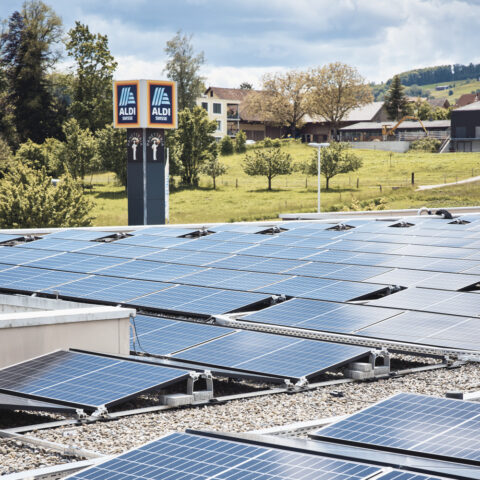
In the ALDI SUISSE solar project, for example, sustainability and cost-effectiveness play a key role. In just over a year, ewz equipped 68 store roofs between Romanshorn and Geneva with photovoltaic systems. ALDI SUISSE uses most of the solar power itself for its own branch operations. Thanks to the large PV systems, the implemented solution enables a high solar yield with an average self-consumption of 55 to 60 percent.
High self-consumption increases profitability There is already a heat pump in around 90 percent of new buildings, and new registrations of electric cars are continuing to rise sharply. However, heat pumps and electric vehicles are only really low in CO2 if they use renewable electricity. The combination with a photovoltaic system therefore makes sense: Solar power reduces CO2 emissions, and high self-consumption increases the profitability of the PV system. This is because the production costs for solar power are lower than the electricity tariff for households and because the energy suppliers pay a low tariff for the solar power fed into the grid.
A good way of using a large part of the solar power yourself is to organize several end users in a group for self-consumption (ZEV). These are possible both in rental properties and among property owners. The degree of self-consumption of photovoltaic systems is on average 30 to 40 percent. This value can be significantly increased with self-consumption solutions.
A large part of the electricity is used on site through the targeted control of consumers such as heat pumps or electric vehicles. The advantage for property owners and their tenants: the cost of solar power, at 8 to 16 centimes per kilowatt hour, is lower than the electricity tariff for households, which costs 15 to 25 centimes per kilowatt hour.
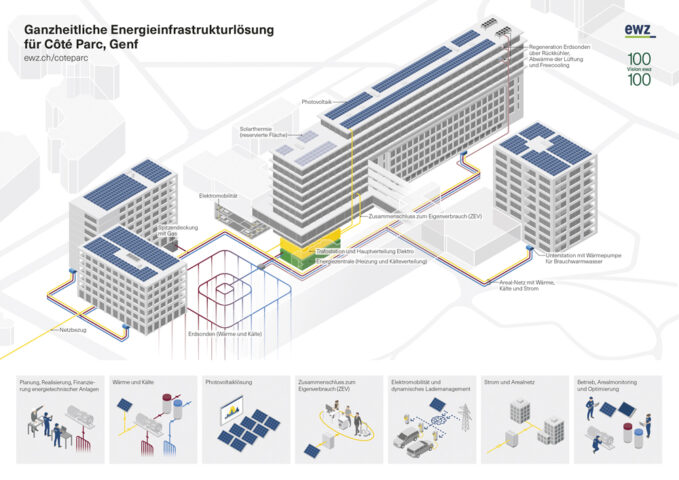
An interesting practical example of this is the "Côté Parc" project in Geneva. 776 photovoltaic panels on the roofs of the area form the basis for an integrated solar solution with heat pumps, charging stations for electric cars and the area's own power grid, including self-consumption for the users.
For property owners with large roof areas (from approx. 700 m2), a contracting model is an option worth considering. The provider takes over all services – from planning to financing, implementation to operation over several decades. Including the integration of photovoltaic systems, it is a holistic energy solution with heating, cooling, electromobility and self-consumption models.
Business customers of ewz can rely on efficient and tailor-made solutions from competent teams with many years of experience. Investment, maintenance and repair costs are not incurred during the contract period. After the end of the contract period – usually 20 to 30 years – the photovoltaic system becomes the property of the customer.
Wir verwenden Cookies zur Unterstützung und Verbesserung unserer Dienste. Mit der Nutzung dieser Website erklären Sie sich mit der Verwendung von Cookies einverstanden. Weitere Informationen finden Sie in unserer Datenschutzerklärung.