Tag: Wärmeversorgung

  • Where electricity will come from in 2050

    Where electricity will come from in 2050

    For Switzerland to become CO₂-neutral by 2050, transport, heat supply and industry must be largely electrified. Today’s electricity demand of 56 terawatt hours will increase to around 75 TWh by 2050. At the same time, 23 TWh will come from nuclear energy. The necessary reorganisation of the energy system is far-reaching in technical, economic and social terms.

    Massive expansion of renewable energy
    According to the EDGE report, around 60 % of electricity must be covered by new renewable energies by 2050, specifically 45 TWh per year. This would be possible with 28 TWh from photovoltaics, 13 TWh from wind power and 4 TWh from biomass. To achieve this, photovoltaic capacity would have to be quadrupled to 26.8 GW. Wind power would need to be expanded 80-fold to 8.4 GW, especially for winter operation. According to the researchers, this is hardly realisable without strong subsidies.

    Limiting electricity imports makes the system more expensive
    The new Electricity Act limits net electricity imports in winter to 5 TWh. In order to meet this target, an additional 80 % more wind power, 11 % more gas capacity and 10 % more solar capacity would be required. This would increase electricity generation costs by 20 % and electricity prices could more than double.

    Europe remains decisive
    If European electricity trading were to be severely restricted, e.g. through a 70 % reduction in cross-border grid capacities, Switzerland would have to expand wind power by a further 20 %. Supply costs would rise by an additional 8 %. A survey by the EDGE consortium shows the conflicting priorities. 60 % of the population would like to cooperate with Europe, while at the same time 70 % want energy independence and favour domestic energy sources.

    Investments flow abroad
    Another study shows that more than half of the annual investments made by Swiss energy suppliers in large-scale renewable energy projects are channelled mainly to Germany, France and Italy. Only 1 % of these funds are invested in Switzerland. There is a lack of suitable projects or framework conditions in Switzerland. This means that Switzerland is often financing the energy transition indirectly, but not at home.

    Net zero has its price
    The cost of living could rise between 2020 and 2050, for example due to CO₂ taxes, emissions trading or higher production costs. The annual consumption loss of a household could be 0.63-0.75 %, depending on the global climate protection pathway. Without offsetting options abroad, the costs could rise to up to 1%. In the long term, however, this would be more favourable than the consequences of unchecked climate change.

    The energy transition is feasible and challenging
    A CO₂-neutral electricity supply by 2050 is technically possible if photovoltaics and wind power are massively expanded, imports are used intelligently and investments are channelled in a targeted manner. Access to the European electricity market remains crucial. At the same time, we need broad social support and an understanding that inaction will be more expensive than a bold transformation.

  • Online tool to simplify district heating expansion

    Online tool to simplify district heating expansion

    The cooperative Elektra Baselland(EBL) wants to accelerate the expansion of district heating with a new service, according to a press release. Wärmecheck.ch is a service that provides homeowners and companies with a quick answer to the question of whether their property can be connected to an EBL district heating network.

    wärmecheck.ch can be operated intuitively via the browser and is fully interactive. According to the information, users can navigate to all addresses located in EBL’s heat supply areas on a digital map on their desktop or smartphone. This means that the relevant information from publicly accessible data is available for each property. Registration is not necessary.

    If a connection is possible, wärmecheck.ch quickly and easily creates a non-binding model calculation or puts you in touch with an EBL contact person for personal clarification. If a connection is not possible at the time of the inquiry, interested parties are shown alternatives and given an overview of relevant information platforms.

    The background to this measure is EBL’s goal of creating more district heating networks. As EBL writes, information on connecting to district heating or on alternative heating options must be easily accessible to interested parties.

    The response to wärmecheck.ch should enable the energy supplier to respond specifically to demand from the population and businesses, to consolidate existing heating networks and to examine the development of further areas.

  • Lake Zurich heats properties in the Riesbach neighbourhood

    Lake Zurich heats properties in the Riesbach neighbourhood

    Since 26 February, the first 80 properties in the Riesbach district of Zurich have been heated with heat from the Tiefenbrunnen energy network, Energie 360° announced in a press release. When the energy network is completed in 2032, the number of properties heated with heat from the waters of Lake Zurich is expected to rise to around 400. Energie 360° has invested around 60 million Swiss francs in the project.

    “We have reached an important milestone with the commissioning of the main centre and are proud of our contribution to a sustainable heat supply in the Tiefenbrunnen area,” said overall project manager Andreas Abdon from Energie 360° in the press release. For Dženan Draganović from Liegenschaften Stadt Zürich, energy networks such as the one now in operation are crucial for the city’s own net-zero target: “We have set ourselves the goal of heating all properties without fossil fuels by 2035.”

    When completed, the Tiefenbrunnen energy network will be able to supply around 5,300 Tiefenbrunnen residents with renewable heat from Lake Zurich. By replacing fossil heating systems, 6500 tonnes of CO2 can be avoided each year, writes Energie 360°.

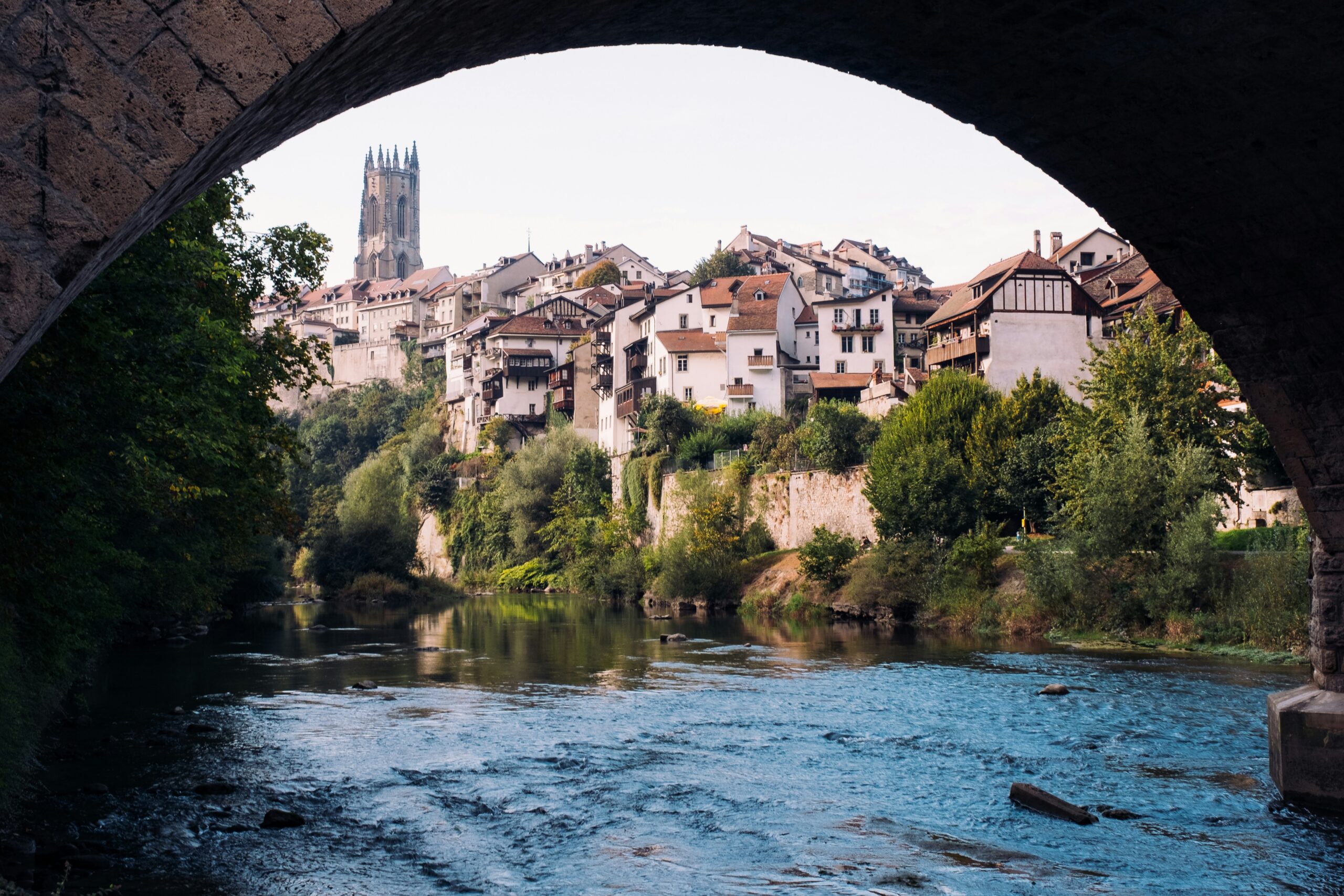
  • Saane water to heat Freiburg

    Saane water to heat Freiburg

    By 2027 at the latest, water from the Saane will cover 10 per cent of the heat demand in the Fribourg area, Groupe E announced in a press release. The energy supplier from Granges-Paccot is planning to build a three-part infrastructure to generate around 60 gigawatt hours of renewable thermal energy per year. This is enough to cover the needs of around 7500 households.

    The PLACAD project provides for the expansion of the existing heating centre on the former Ritter site. In future, three water-to-water heat pumps will operate here. They will be supported by two gas boilers in winter or in an emergency.

    The associated pumping station is planned in the Magere Au dam building. The connection between the heating centre and the pumping station is via two parallel pipes, each 1.2 kilometres long. They run through the Perolles forest, under the tennis courts of the Heilig Kreuz college and across the Saane.

    The pipeline route will partly follow existing paths, but any environmental impact will be compensated for, Groupe E explains. This includes plans to extend the Lake Perolles nature reserve to include an island of old woodland. Groupe E will provide information online about any adverse effects on leisure activities in the Perolles forest. The corresponding website also provides an insight into the development of the project.

  • Sette aziende creano un’agenzia comune per la fornitura di calore sostenibile nella Svizzera orientale

    Sette aziende creano un’agenzia comune per la fornitura di calore sostenibile nella Svizzera orientale

    Sette fornitori di servizi energetici della Svizzera orientale hanno fondato Wärme Netz Ostschweiz AG (WNO), secondo un comunicato stampa. I partecipanti sono EKT Holding AG, il Comune di Uzwil, il Comune di Wil, St.Gallisch-Appenzellische Kraftwerke AG, Schmid AG energy solutions, Technische Betriebe Flawil e Technische Betriebe Wil.

    L’obiettivo della nuova società è quello di sviluppare e gestire soluzioni di riscaldamento integrate innovative e rispettose del clima nei cantoni della Svizzera orientale di Thurgau, San Gallo, Appenzello Interno e Appenzello Esterno, nonché nelle regioni limitrofe. In qualità di fornitore di servizi energetici sovraregionali, WNO sostiene i Comuni e i clienti privati e aziendali nel passaggio a una fornitura di calore sostenibile, secondo il comunicato stampa. Le rispettive comunità locali e le aziende regionali sono coinvolte nello sviluppo e nel funzionamento delle reti di riscaldamento.

    “La fondazione di WNO è un passo decisivo verso una fornitura di calore rispettosa del clima nella Svizzera orientale. Insieme, stiamo portando avanti la transizione energetica, rafforzando la nostra regione e utilizzando tecnologie innovative”, ha dichiarato Marco Huwiler, membro del Consiglio di Amministrazione di WNO e Amministratore Delegato di Technische Betriebe Wil.

    Secondo il comunicato stampa, l’attenzione fino alla metà del 2025 si concentrerà sulla costituzione dell’azienda, ossia sulla creazione del personale, sullo sviluppo delle basi aziendali e delle soluzioni di finanziamento, nonché sui colloqui con i comuni e i potenziali azionisti. Lo sviluppo del primo progetto in un comune dovrebbe iniziare a metà del prossimo anno.

    Il settore del riscaldamento rappresenta circa il 50% del consumo energetico in Svizzera e causa oltre il 35% delle emissioni di gas serra, prosegue il comunicato stampa. WNO vuole sostituire i combustibili fossili con soluzioni di riscaldamento rinnovabili.

  • Kriens electricity suppliers realise heating network

    Kriens electricity suppliers realise heating network

    The two electricity suppliers to the town of Kriens, Energie Wasser Luzern(ewl) and Centralschweizerische Kraftwerke(CKW), are also becoming heating suppliers: according to a press release, the Kriens town council has decided in favour of the Kriens heating network consortium with ewl and CKW following a public tender for the construction and planning of a heating network.

    The heating network will help to supply additional properties in Kriens, namely the Obernau, centre and Kupferhammer-Kehrhof areas, with thermal energy. According to the city council, this is in line with the goals of the city’s climate strategy to achieve net-zero greenhouse gas emissions from buildings by 2045.

    According to the information provided, the winning project assures Kriens a high level of territorial coverage and provides for transitional solutions that guarantee the population a high degree of planning security for the changeover in their heat supply. CKW and ewl are planning their project with a broad mix of different renewable energy sources, including regional wood. According to City Councillor Maurus Frey, this will create an attractive offer “so that together we can take a step towards our climate targets”.

    In the upcoming construction work in Hergiswaldstrasse, the renovation work is to be carried out at the same time as the pipeline construction for the heating network, if possible. The city and ARGE intend to announce further details once the legally prescribed deadlines have expired.

  • Heating network in Villmergen utilises local waste wood

    Heating network in Villmergen utilises local waste wood

    On 16 November, AEW Energie AG celebrated the start of construction of the heating centre in the Villmerg industrial area with a ground-breaking ceremony. The heating centre will be built on the Cellpack Power Systems site. According to a press release, it will initially be equipped with a boiler for waste wood with a nominal output of 2,000 kilowatts and an oil-fired boiler for peak loads with a nominal output of 4,000 kilowatts.

    The plant will supply heat for the first time at the end of 2024. It will replace around 710,000 cubic metres of natural gas and thus avoid the emission of 1500 tonnes of CO2. A further waste wood boiler with a nominal output of 4000 kilowatts is to be added in the final stage. This should also be able to supply other companies in the industrial area. The expansion of the heating network to neighbouring areas is being considered.

    Most of the waste wood will come from untreated wood waste from the industrial estate and will be supplemented with wood from the region as required. The proportion of oil for the peak load should not exceed 10 per cent. A photovoltaic system will be installed on the roof and on two sides of the heating centre. This will achieve a peak output of 260 kilowatts.

  • City council plans reorganisation of heat supply

    City council plans reorganisation of heat supply

    So far, there are three municipal providers of heating networks on city territory: Elektrizitätswerk ewz, Entsorgung + Recycling Zürich (ERZ) and Energie 360° AG. All large-scale heating networks are now to be united under the umbrella of ewz. Through their joint efforts to achieve the city’s net zero targets, the three providers of district heating networks have intensified their cooperation in recent years. Then, about two years ago, the city council formalised this cooperation by establishing the Wärme Zürich office. Since then, Wärme Zürich has been coordinating the expansion of the networks of the three providers. Currently, it is being examined whether the existing heating networks can also be physically connected to each other, so that an overall network is gradually created on city territory, which further increases the security of supply. The planned reorganisation takes these changes into account and represents the next integration stage in the area of heat supply.

    Implementation plan in progress
    A project headed by City Council members Michael Baumer (Head of the Department of Industrial Operations), Simone Brander (Head of the Department of Civil Engineering and Waste Disposal) and Andreas Hauri (Head of the Department of Health and Environment) will show in an implementation plan by the end of the year how and in what timeframe such a reorganisation can take place. The consultation with the staff associations will also take place during this period.

    Integration of ERZ’s district heating activities
    ERZ’s district heating activities will be integrated into ewz. The implementation plan will show how the integration of the district heating activities is to be structured and how and when the employees concerned are to transfer from ERZ to ewz. The experts from ERZ will play a decisive role in shaping the new organisation with their knowledge and many years of experience in the heating sector.

    New prospects for Energie 360°
    Energie 360° will also transfer part of its heating networks in the city of Zurich to ewz, with the employees remaining with Energie 360°. Ownership and operation of the gas grid and all other activities will remain with Energie 360°. Energie 360° is a joint-stock company owned by the public sector. The main owner is the city of Zurich. The company’s strategy of driving forward the transformation throughout Switzerland and supplying exclusively renewable energy by 2040 will be maintained. As the focus of Energie 360°’s activities will shift even more to activities outside the city in the future, the city council wants to offer the company new perspectives and open up the field for cooperation. In order to gain more freedom of action, the city council’s authority to sell shares in this company is to be extended.

  • City of Lucerne wants to heat entirely with renewables

    City of Lucerne wants to heat entirely with renewables

    The Lucerne City Council is requesting a special credit of 5.05 million Swiss francs from the City Council for the conversion of the heating supply to 100 per cent renewable energy. In addition, a supplementary credit of 194,000 francs was requested for the 2023 budget. According to a press release, this is to finance the increase in staffing in the real estate department that is needed until 2034.

    Additional staff percentages had become necessary because the voters of Lucerne had approved the city’s climate and energy strategy in September 2022. It stipulates that the city’s own buildings and facilities of the administrative assets, such as schools and administrative buildings, must be supplied with 100 per cent renewable energy by 2030.

    Thanks to the increase in personnel in the real estate department, the conversion to renewable heat supply should be implemented by 2035 and the upcoming renovations of the properties in the financial assets can be managed. This is planned for a total of 39 properties.

    With the conversion of the properties of the financial assets to 100 per cent renewable energy, the city council wants to set a good example for its own properties, according to the statement. The city will help with any interim solutions for tenants.

  • Comprehensive energy systems by EKZ

    Comprehensive energy systems by EKZ

    The pressure on holistic ecosystems around real estate and their energy solutions is growing. EKZ simplifies this task with clever solutions.

    The combination and central management of electricity generation and storage, heat and cooling generation and electromobility in an integrated energy system leads to the simplification of property management, maximum living and working comfort and optimal energy efficiency in production. In addition, ecological sustainability is ensured.

    The goals of the Energy Strategy 2050 are being built here. Most of the Verdeblu development has been completed and inhabited since autumn 2019. It is noteworthy that this development covers a large proportion of its energy needs itself, and that exclusively from renewable sources.

    "The specifications of the Energy Strategy 2050 are also an opportunity for the real estate industry," explains Dieter Stutz from Atlantis AG, which is active in the areas of environmental consulting, settlement planning and architecture and who developed the project. The heat supply via groundwater was the best and most convincing solution for the area. Atlantis planned and implemented this complex construction project together with EKZ.

    On-site energy production
    The “Grand Chemin” development was built in Epalinges in western Switzerland, with some of the electricity required being produced on site by a photovoltaic system (PV). A new multi-family house is being built in Emmen (LU), which will be characterized by four heat pump systems with groundwater as an energy source and a photovoltaic system with ZEV. Seen in this way, the future of energy has long since begun in this country as well.

    Text: Mohan Mani, Image: zVg.

  • Federal government uses geothermal energy for buildings

    Federal government uses geothermal energy for buildings

    Most of the buildings in the National Sports Center in Magglingen are currently heated with gas, according to a press release from the Federal Office for Buildings and Logistics (BBL). The BBL is currently realizing a number of new construction and renovation projects for the Federal Office for Sport at the sports center. For the first time, the federal government is using geothermal energy to supply heat to buildings. A new district heating network will supply both the existing and the new buildings.

    Geothermal energy from a depth of 1,300 meters is used for the heat supply. It is expected that the extracted water has a temperature of 30 to 50 degrees Celsius. For this purpose, two wells are being built. The warm water is pumped up via one, the cooled water is let down again via the other. In between, a heat exchanger on the surface takes the heat from the water and uses it to supply the building.

    While the gas supply currently emits 1,300 tonnes of CO2 annually, this should only be 70 tonnes in the future.

  • Regional plants are expanding networks for heating and cooling

    Regional plants are expanding networks for heating and cooling

    Regionalwerke AG Baden want to make the supply of heating and cooling in Baden climate-friendly. To this end, they envisage expansions for the heating supply to an extent of 40 gigawatt hours and for the cooling supply to an extent of 10 gigawatt hours over the next ten years, they write in a press release . The share of renewable energy sources should be 80 percent right from the start and steadily increase to 100 percent. The CO2 emissions in the heat supply are to be reduced by 20,000 tons by 2030, district heating alone is to contribute half of this.

    Baden Nord has been connected to the Turgi waste incineration plant with a district heating pipe since the summer, and the Kappelerhof heating network has been in operation since autumn 2020. The heating and cooling network for the cantonal hospital campus is under construction. The Baden Nord district heating network is to be expanded towards the city center. From 2025, the amalgamation of the energy clusters Kappelerhof, Vorstadt and Limmat to form a single urban heating and cooling ring is planned.

    The potential for the heating and cooling supply was determined with the help of a 3D model. The feasibility of groundwater pumping systems was also examined. A planning map on the regional works website allows property owners, architects and planners to gain insight into the planned projects.

    "With this expansion, the course has been set for the substitution of fossil fuels for a renewable heating and cooling supply in Baden", Michael Sarbach, managing director of the regional plants, is quoted in the announcement.