Tag: Wasserenergie

  • Where electricity will come from in 2050

    Where electricity will come from in 2050

    For Switzerland to become CO₂-neutral by 2050, transport, heat supply and industry must be largely electrified. Today’s electricity demand of 56 terawatt hours will increase to around 75 TWh by 2050. At the same time, 23 TWh will come from nuclear energy. The necessary reorganisation of the energy system is far-reaching in technical, economic and social terms.

    Massive expansion of renewable energy
    According to the EDGE report, around 60 % of electricity must be covered by new renewable energies by 2050, specifically 45 TWh per year. This would be possible with 28 TWh from photovoltaics, 13 TWh from wind power and 4 TWh from biomass. To achieve this, photovoltaic capacity would have to be quadrupled to 26.8 GW. Wind power would need to be expanded 80-fold to 8.4 GW, especially for winter operation. According to the researchers, this is hardly realisable without strong subsidies.

    Limiting electricity imports makes the system more expensive
    The new Electricity Act limits net electricity imports in winter to 5 TWh. In order to meet this target, an additional 80 % more wind power, 11 % more gas capacity and 10 % more solar capacity would be required. This would increase electricity generation costs by 20 % and electricity prices could more than double.

    Europe remains decisive
    If European electricity trading were to be severely restricted, e.g. through a 70 % reduction in cross-border grid capacities, Switzerland would have to expand wind power by a further 20 %. Supply costs would rise by an additional 8 %. A survey by the EDGE consortium shows the conflicting priorities. 60 % of the population would like to cooperate with Europe, while at the same time 70 % want energy independence and favour domestic energy sources.

    Investments flow abroad
    Another study shows that more than half of the annual investments made by Swiss energy suppliers in large-scale renewable energy projects are channelled mainly to Germany, France and Italy. Only 1 % of these funds are invested in Switzerland. There is a lack of suitable projects or framework conditions in Switzerland. This means that Switzerland is often financing the energy transition indirectly, but not at home.

    Net zero has its price
    The cost of living could rise between 2020 and 2050, for example due to CO₂ taxes, emissions trading or higher production costs. The annual consumption loss of a household could be 0.63-0.75 %, depending on the global climate protection pathway. Without offsetting options abroad, the costs could rise to up to 1%. In the long term, however, this would be more favourable than the consequences of unchecked climate change.

    The energy transition is feasible and challenging
    A CO₂-neutral electricity supply by 2050 is technically possible if photovoltaics and wind power are massively expanded, imports are used intelligently and investments are channelled in a targeted manner. Access to the European electricity market remains crucial. At the same time, we need broad social support and an understanding that inaction will be more expensive than a bold transformation.
  • Historical technology meets modern research

    Historical technology meets modern research

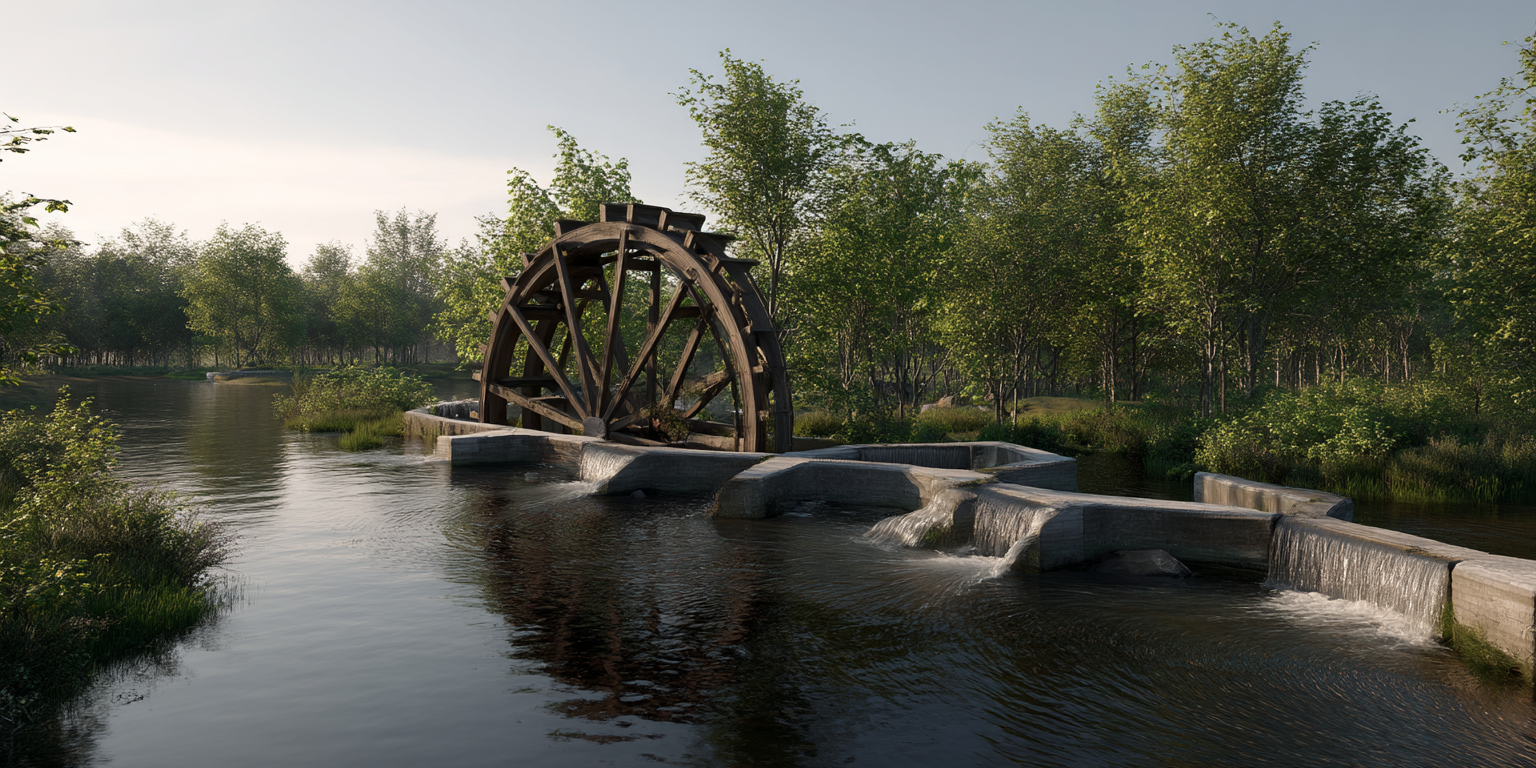
    Researchers from the Mechanical Systems Engineering department of the Swiss Federal Laboratories for Materials Science and Technology (Empa) in Dübendorf have been involved in the construction of a water pumping wheel in Steffisburg. According to a press release, the construction became necessary after the Zulg was lowered by two meters to protect the village from flooding. The Mühlebach stream, which had supplied Steffisburg’s businesses with water energy for centuries, was in danger of drying up, as was the surrounding ecosystem.

    The challenge was to adapt the plant to the requirements near Steffisburg. “With a minimum Zulg outflow of one cubic meter per second, it must feed at least 125 liters of water into the Mühlebach,” Silvain Michel, project manager at Empa, is quoted as saying in the press release, “and even with lower inflows, at least 100 liters per second must still be pumped in order to preserve the biotopes.”

    The model for the water pumping system was the pumping wheel developed by Walter Zuppinger in 1849. The water wheel, whose efficiency was scientifically confirmed in extensive tests in 2016, has already been used in the Glattfelden project installed by Empa.

    In the current project in Steffisburg, the water wheel was modified again and fitted with a separate drive wheel. In addition to Empa, the EKZ design office in Thun and CFD-Schuck GmbH were involved in the technical implementation.

  • Erstfeldertal power plant produces its first electricity

    Erstfeldertal power plant produces its first electricity

    In the canton of Uri, a further 7200 households can be supplied with CO2-free electricity. The hydropower plant of the energy supplier EWA at the entrance to the Erstfeldertal started up on Thursday and produced electricity for the first time. "In two and a half years from the first approval step to commissioning is absolutely unique for a power plant of this size," the chairman of the EWA management, Werner Jauch, is quoted in a press release from the EWA.

    Before that, a wide variety of studies and projects had been developed for a good 100 years. “They all disappeared back into the drawer,” writes the EWA. And this project, too, “stood on a knife's edge several times”. Speed was now of the essence because in a month's time the national subsidy contributions to the power plant would have expired. That would have failed the project. “We believed it was feasible and we succeeded in putting the power plant into operation more than a month before the deadline,” said Jauch.

    Around 45 companies from Uri were involved in the construction, explains Peter Dittli, Vice President of the Board of Directors of KW Erstfeldertal AG . 75 percent of the total investment of 37 million francs remained in Uri as added value. In addition, there would be water interest and tax revenues. And finally, operation and maintenance also secured jobs. All of this is "particularly valuable in economically challenging times," said Jauch. "The corona pandemic shows us how important local production is when the international supply chains collapse very quickly."