Aventron has announced its key financial figures for the 2025 financial year. In total, the producer of electricity from renewable energies generated around 1.3 billion kilowatt hours of electricity – around 15 per cent less than in the previous year (2024: 1.498 billion kilowatt hours). Aventron cites historically weak weather conditions and high price volatility, including negative electricity prices, as the reasons for this.
Despite the decline in production, the result remains “solid” according to a statement. Net revenue amounted to 120.5 million Swiss francs (2024: 134.9 million Swiss francs), while the EBIT margin (earnings before interest and taxes) was around 21 per cent. Net profit after taxes reached CHF 10.3 million.
In 2025, aventron continued its diversification strategy with solar, wind and hydro technologies and further developed its portfolio. In Switzerland, construction began on the Sedrun Solar (Grisons) and APV Sidenplangg (Uri) alpine photovoltaic projects. In Italy, realisation of the 25-megawatt Lazio 01 solar power plant began, while two wind farms are under construction in France and Germany. The company invested a total of CHF 67 million. At the end of the year, the portfolio comprised a consolidated total output of 819 megawatts (previous year: 797 MW) in operation or under construction.
In the medium term, aventron intends to focus increasingly on successful electricity marketing and the expansion of data management and monitoring systems. The aim remains to build up a portfolio with a total output of 1000 megawatts. The Münchenstein-based company operates and develops power plants in the areas of hydro, solar and wind energy in Switzerland and selected European countries.
Repower commissioned Hanser Consulting to analyse how much added value the Graubünden-based energy supplier generates compared to energy companies outside the canton. In its study, the consulting firm puts the additional added value of the Repower Group for the canton at around CHF 144 million for the year 2024. According to its press release, Repower presented the results to the Graubünden cantonal parliament at an information event on 23 April 2026.
Hanser Consulting summarises the main findings as follows: Firstly, due to the Repower Group’s headquarters in Graubünden, more than twice the added value per kilowatt hour of electricity produced from Graubünden hydropower remains in Graubünden compared to companies outside the canton. Secondly, this would result in “many other advantages” for the Graubünden economy, particularly with regard to the diversity of the labour market, tax revenues for the canton and municipalities and the inclusion of local suppliers for headquarters activities.
“Against the backdrop of the Graubünden hydropower strategy and the pending home cases in the coming years, the question of how the use of hydropower is organised in the long term and where the associated added value is generated is becoming increasingly important,” writes Repower. “The study aims to provide a factual basis for discussion.” As Repower emphasises, although the company paid for the study and provided the necessary basis, it had no influence on the methodology or results.
Repower employs around 500 people in Graubünden and operates along the entire value chain, from production to the grid and supply to trading. The largest shareholders are Elektrizitätswerke des Kantons Zürich (38.49 per cent), the canton of Graubünden (27 per cent) and UBS’s Clean Energy Infrastructure Switzerland fund (23.04 per cent).
According to a press release, Kraftwerk Meiental AG celebrated the start of construction of the Meiental power station in the municipality of Wassen with an official ground-breaking ceremony on 11 March. The actual construction work began back in September. Work is currently underway on the penstock and the new power station control centre.
The power station utilises water from the Meienreuss. This is collected at an altitude of 1,317 metres and channelled through a 3,250-metre-long penstock to the new hydroelectric power station, which is situated at an altitude of 1,100 metres in Fedenbrügg. With a capacity of 10 megawatts, the power station is expected to generate around 34 gigawatt-hours of electricity per year. It is scheduled to come into operation at the end of 2028.
A total of 40 million Swiss francs is being invested. The canton of Uri and the municipality of Wassen anticipate additional tax revenue, whilst the canton and the Corporation of Uri expect water rights fees of half a million Swiss francs per year. “We are utilising our local hydropower, strengthening regional value creation and, at the same time, making an important contribution to a climate-friendly energy supply,” Uri State Councillor and Director of Public Works Hermann Epp is quoted as saying in the press release.
Kraftwerk Meiental AG is owned by the cantonal energy supplier energieUri AG, the canton and the Corporation of Uri, as well as the municipality of Wassen.
ANDRITZ Hydro is moving to a new headquarters, but will remain based in Kriens. According to a press release, research and development, sales, project management and administration with around 130 employees will move to the Schappe Centre near the reconstructed premises of the former Bell Maschinenfabrik. A new neighbourhood will be built on the site of the predecessor company.
By moving to the modern company centre, ANDRITZ Hydro wants to secure its options for further growth, according to the press release. The relocation of the company management to the Schappe Centre should be completed by the end of 2026. The company already announced in spring that it plans to relocate its service workshop from the centre in Kriens to the industrial area of Buchrain in the north of Lucerne, around 10 kilometres away, by 2028. The company offers services such as electromechanical equipment and services for hydropower plants worldwide for new and existing hydropower plants, from small hydropower plants to large-scale plants.
“This is a good solution for us,” says site manager Claudio Nold. “We can continue to work and grow under optimal conditions.” Logis Suisse, the landowner of the Bell site, also sees the relocation of the ANDRITZ Hydro headquarters as a benefit in terms of developing the former industrial site into a new urban neighbourhood, according to the press release.
The Cantonal Office for Environmental Protection and Energy(AUE) is responsible for awarding licences. The exact locations of the planned hydropower plants can be found in the press release. Interested companies are invited to submit a request for information online. The AUE will then determine the award procedures for the individual sites.
The canton of Basel-Landschaft has set itself the goal of covering 70 per cent of its energy consumption, excluding mobility, from renewable sources by 2030. The planned six small hydropower plants should contribute to the realisation of this goal.
Senn AG from Oftringen, which specialises in steel and metal construction as well as crane and other transport, took second place for Crane Work of the Year 2025 under 120 tonnes at the BSK Annual General Meeting on 12 October. The company was nominated in several categories with challenging projects.
According to a press release, the basis for the award is the overhaul of the Luterbach SO hydropower plant, which Senn carried out together with ADEV. As part of the project, a 20-tonne generator with a height of 3.5 metres and a 3.4-metre turbine wheel had to be removed from the hydroelectric power plant, transported, overhauled and finally reinstalled. Lifting the generator and turbine wheel through a roof opening in the power station required millimetre precision work from the crane operators. A specially designed steel frame and a customised heavy-duty transport solution then ensured the smooth removal to the overhaul plant.
The Luterbach project is an example of the company’s own combination of engineering skills, precision and experience in heavy haulage, which enables successful project execution, explains Senn AG.
Senn AG operates in the fields of steel and metal construction, sheet metal and stainless steel centres, emergency power systems, cranes and transport. With more than 200 employees, the company claims to be one of the most important employers in the Zofingen district.
Energie Thun AG officially began the construction of a new fish ladder in the Selve Thun Aarewerke with a ground-breaking ceremony on 1 September. The preliminary construction work had already started in January 2025. The new fish ladder with two entrances will enable improved fish migration. Commissioning is scheduled for March 2028. The project is being financed via the grid surcharge fund, which is fed via a surcharge on the electricity price.
The construction was necessary because the damming of the Aare at the Aaare works by a flap weir is hindering undisturbed fish migration. There is currently only one entrance in the tailwater at the little-used power plant 94.
Energie Thun submitted the project application back in 2013 after the need to restore fish passability was recognised as part of the recertification of the Aare power plants with the naturemade star environmental label. The Office for Water and Waste (AWA) approved the early restoration in 2014. This was followed by several years of preliminary examination and development of the construction project. The overall construction decision was made in 2022 and tenders were invited in 2024.
The cantonal structure plan regulates the main features of the desired spatial developments. It sets out in text and on maps how the cantons and municipalities should develop.
The need for more affordable living space is recognised by politicians and the canton: In addition to “conventional” flats, flats for families, affordable flats and flats for the elderly are also being built in the various areas.
A wide variety of site developments are taking place across almost the entire perimeter of the “valley communities”. In addition to the sites, the traffic situation is also being further developed and adapted to the increased utilisation: Examples range from the conversion of bus stops to bypasses to relieve the burden on Cham town centre. This also includes car-sharing concepts, such as at the Papieri site in cooperation with AMAG.
A lot is also happening in public transport. In future, the Papieri site in Cham is to receive an express bus via the bypass motorway and the Unterfeld Süd site will have a bus stop in the neighbourhood.
Sustainability plays a decisive role in new projects in particular. The Zug area plays a pioneering role in this respect. The Papieri site in Cham was honoured with the prestigious Watt d’Or award from the Swiss Federal Office of Energy. This emphasises the site’s initiative in the field of renewable energies. A climate-neutral district is being created here that relies entirely on renewable energy sources and covers 75% of its energy requirements on site. The innovative technologies contributing to the high level of energy self-sufficiency include hydroelectric power plants and photovoltaic systems. Geothermal energy is used for heating and cooling.
The sustainability certificate, awarded by the Swiss Sustainable Building Council to Suurstoffi in Rotkreuz, recognises the sustainable construction methods and holistic planning of the project. The award proves that the highest standards in terms of energy efficiency, mobility and biodiversity have been met. The projects show that Zug not only assumes ecological responsibility, but also serves as a model for forward-looking urban development in Switzerland. By utilising innovative concepts and technologies, the canton of Zug is positioning itself as a pioneer in the sustainable design of urban living spaces.
The other sites are also impressive. The construction of a high-rise building in timber construction is planned on the Tech Cluster site. The “lighthouse project” called “Project Pi” envisages the construction of an innovative residential tower block. With a height of 80 metres, the plan is to build one of the tallest timber high-rises in Switzerland with affordable flats.
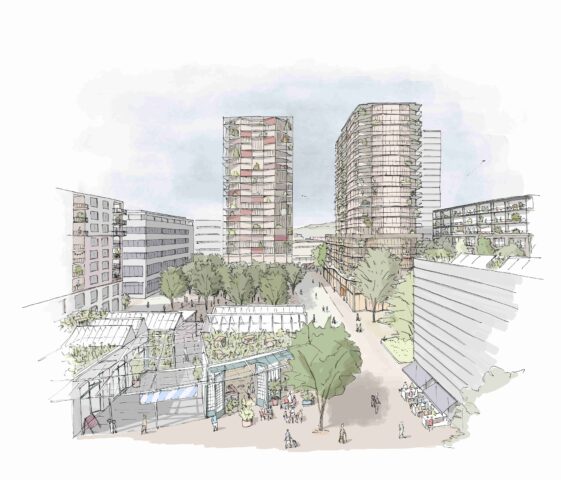
Baar – Unterfeld Süd A mixed-use neighbourhood with around 400 residential units and around 1,000 workplaces is planned for the Unterfeld Süd area. The basic structures were defined by representatives of the population of Baar together with experts under the leadership of the municipality. The development plan for the first of three construction phases was put to the people of Baar for a vote on 22 September 2024. The plan was approved with 74 per cent of votes in favour.
The realisation of the first stage includes the high-rise building at the Baar Lindenpark light rail station and the neighbouring commercial building. These will be transferred to a joint development plan. The earliest possible start of construction of the first stage is planned for 2025. The remaining building plots will be developed in parallel and realised in subsequent construction phases. According to current planning, Implenia’s project will be completed in 2029, provided the subsequent plans are approved by the relevant authorities and construction proceeds according to plan.
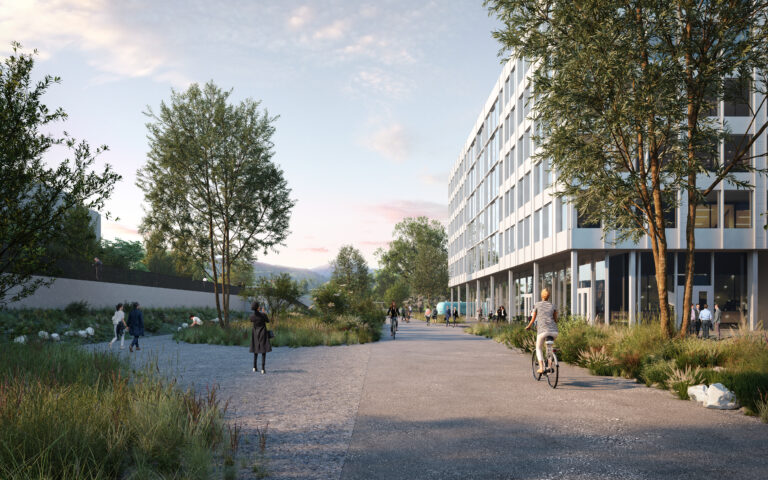
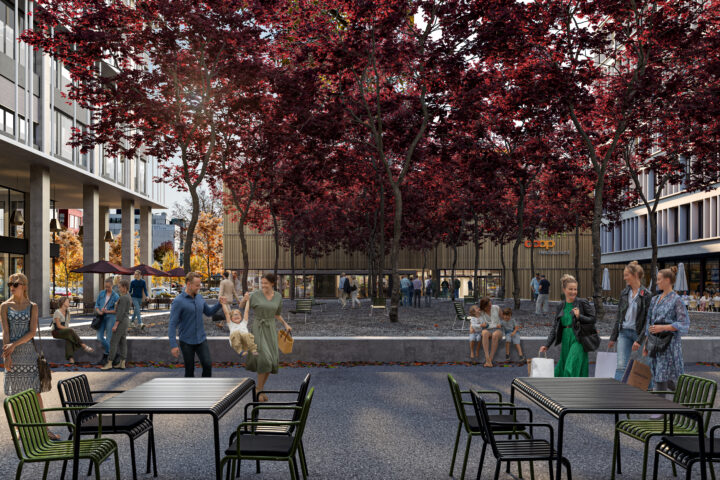
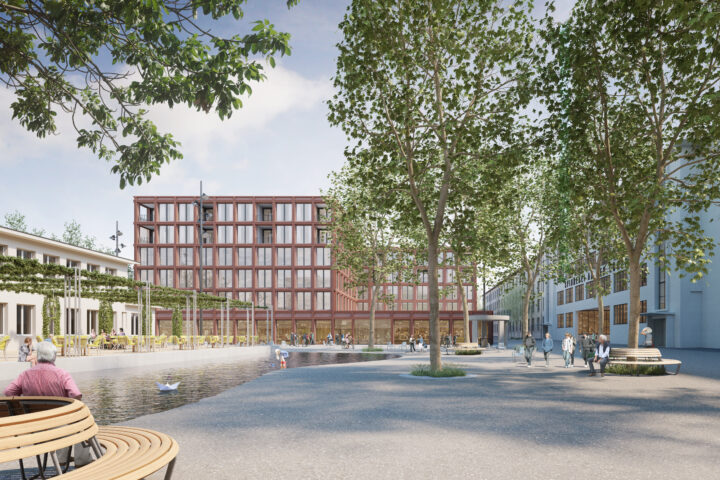
Hinterberg South (Städtler Allmend) The Hinterberg Süd site in the Städtler Allmend employment area in Cham will become a new, lively and easily accessible working and shopping centre for the local population. It offers attractive space for new companies to set up shop and ground-floor uses for the neighbourhood. The upper floors of the office buildings offer flexible spaces that can be customised to the individual needs of future companies.
Publicly accessible uses such as a restaurant, café or bakery are located on the ground floors. They offer workers, shoppers, visitors and passers-by various consumption options and contribute to the revitalisation of the area and the entire neighbourhood. The four buildings surround a public square – the actual centrepiece of the site, which is open to the general public as a place to meet and spend time.
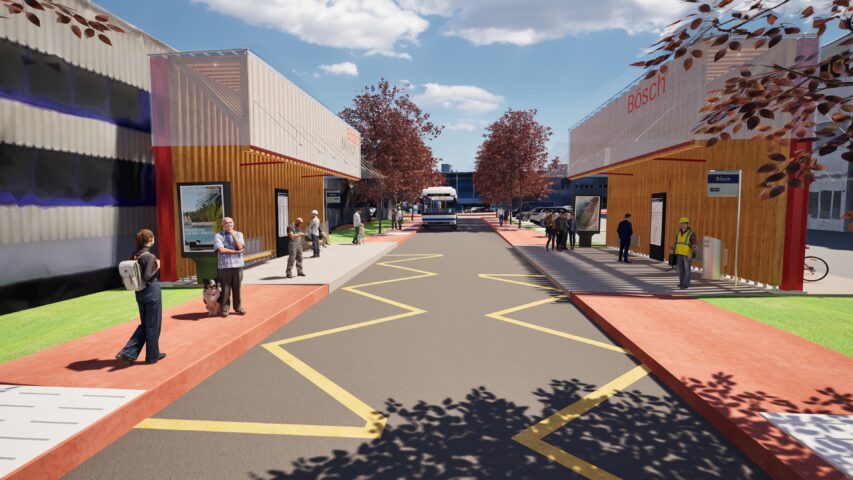
Bösch Hünenberg In order to meet the requirements of a growing service and commercial area, the infrastructure needs to be adapted. The Bösch area should become more attractive for workers and companies and offer space for 6,000 jobs in future. This densification is provided for in the cantonal structure plan. It is binding for the municipality of Hünenberg. The vision is for the Bösch area to develop into a modern and urban place of work that is attractive to investors. To this end, space is to be created through structural densification, which can also lead to an increase in jobs. A holistic landscape design and well-organised mobility will ensure a better quality of life in Bösch. New leisure, supply and catering facilities ideally complement everyday working life in Bösch. On 9 December 2024, the municipal assembly will decide on the road credit of CHF 2.9 million to finance the first stage of the implementation of the operating and design concept in Bösch.
LG Zug Due to its size and prominent location, the LG site is of central importance for the urban perception and urban character of Zug. A lively urban district with a convincing architectural design is to be created on the site of the former industrial area. With the necessary development plan, the planning and building law of the Canton of Zug ensures high-quality development and realisation.
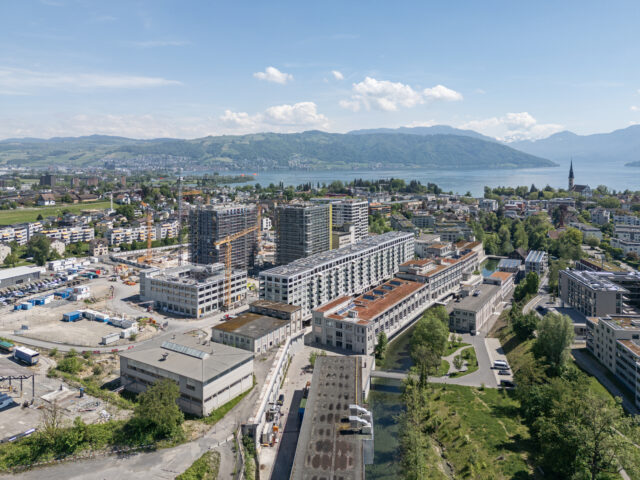
Papieri Cham The Cham Group is developing a new residential and working neighbourhood with industrial charm on the Papieri site. Directly on the River Lorze, the distinctive existing buildings of the former paper factory are being supplemented with striking new buildings and realised in a sustainable way. A new meeting place with supra-regional appeal is being created here, where past and present go hand in hand. A new urban district with around 1,000 flats and 1,000 jobs is being built in several stages over eleven hectares on the site of the former paper factory. It is not being built on a greenfield site, but in the midst of buildings steeped in history: The conversion of characteristic existing buildings preserves the connection to the past – the industrial roots of the neighbourhood remain tangible.
They are complemented by striking new buildings, including five tower blocks with impressive views. The new neighbourhood directly on the Lorze offers an attractive mix of commercial space, flats, lofts, workplaces, studios, open spaces and public-oriented uses. All of this on a sustainable and well-balanced site that maintains – and continues to write – its own history.
The Papieri site creates new foundations for an energy-efficient, climate-neutral and sustainable society. It is a pioneering project throughout Switzerland.
Spinning mill on the Lorze Many threads once ran together in the largest spinning mill in Switzerland. The construction of the spinning mill on the River Lorze shaped the development of Baar in the middle of the 19th century. A new, lively neighbourhood with shops, cafés and other local businesses is being created around the historic spinning mill building, which characterises the public pedestrian zone. In addition to family flats and affordable flats, there will also be flats for the elderly. These will be complemented by vegetable gardens, green façades and shady trees.
Suurstoffi The Suurstoffi site was the first site in Switzerland to be awarded the DGNB platinum certificate for sustainable neighbourhoods in planning and construction by the Swiss Sustainable Building Council (SGNI). The DGNB certification confirms that Zug Estates has realised a prime example of sustainable site development with the Suurstoffi site in Rotkreuz. It meets the comprehensive quality requirements of the DGNB certification system, which includes criteria such as energy efficiency, CO2 emissions, life cycle assessment, grey energy, flexibility of use and recyclability of the materials used. The Suurstoffi site is one of the first lighthouse projects of the last 10 years. This also includes the “XUND” health education centre, for which one of the last buildings is currently being completed.
Tech Cluster From June 2018 to May 2019, five renowned Swiss and one Austrian team took part in an overall performance study to explore how affordable living in a high-rise building can be made possible using state-of-the-art construction methods and sustainable materials. At the same time, a study contract was drawn up for an overall urban development concept for the surrounding area of the city of Zug between Baarerstrasse, Göblistrasse, Industriestrasse and Mattenstrasse.
The Tech Cluster Zug builds on the preliminary investments made by V-Zug and other companies in the Metall Zug Group. Its potential lies in the diverse relationships and synergies between the future users. These will transform the current factory site into an innovative and exciting part of the city of Zug.
The Forces Motrices de Martigny-Bourg (FMMB) have commissioned Switzerland’s first low-pressure turbine. As Alpiq writes in a press release, 850,000 kilowatt hours of electricity can now be generated per year in the underwater channel of the river power plant on the Dranse. The power plant’s current three production units generate 89 million kilowatt hours per year.
Depending on the flow rate, the low-pressure turbine can turbine between 1.25 and 10.2 cubic metres of water per second. It is designed for a head of up to 2.5 metres. It has no additional impact on the environment and does not affect existing electricity production. “The installation of this new low-pressure turbine makes it possible to make the best possible use of the available water resources while at the same time being considerate of the environment,” said power plant manager Georges-Alain Zuber in the press release.
Planning for the plant began in 2011. It is being subsidised with funds from the cost-covering feed-in remuneration.
The power plant was built in 1908 as an electricity generator for Electro-Chimie de Paris. Today, the municipalities of Bovernier with 23.04 per cent, Sembrancher with 18.72 per cent, Martigny with 17.22 per cent, Martigny-Combe with 15.58 per cent and Vollèges with 1.64 per cent as well as Alpiq with 18 per cent and the Valais energy supplier FMV with 5.8 per cent have a stake in FMMB.
The voters of the city of Zurich have clearly approved the ewz framework credit with a clear majority of 82.0% and a yes majority in all city districts. This means that the city of Zurich’s energy supplier can continue to expand renewable energies as proposed by the city council. The framework credit of CHF 300 million is intended to finance the expansion of existing hydropower plants and the relicensing of hydropower plants, alpine photovoltaic plants and wind farms, among other things. It should also enable the city to invest in companies that plan, build or operate renewable energy plants.
The funds are also to be used explicitly for investments by the city of Zurich’s energy supplier ewz in the expansion of renewable energies abroad. France, Germany, Norway and Sweden are currently the focus countries of ewz’s involvement abroad.
This is the fourth framework credit for the expansion of renewable energies since 2008 and is intended to enable ewz to remain competitive. The framework credit was approved by the municipal council with a majority of 97 votes to 14. Only the SVP spoke out against it.
As part of the comprehensive renovation work, the stone wool producer is replacing its cupola furnaces, which were previously operated with coking coal, with an electric melting furnace. Flumroc AG will cover the energy requirements of the electric melting furnace entirely with certified, sustainable electricity from Swiss hydropower. With the conversion of the production process, Flumroc is reducing its CO2 emissions by 80 percent and thus massively improving its ecological footprint. “For the future, we need climate-friendly solutions in all areas – including industry. Our customers, our environment, the Flums site and our company all benefit from the renewal,” says Flumroc managing director Damian Gort. The commissioning of the plants is expected to take place in the summer of 2023. Only a small part of the total energy demand will still be covered by fossil fuels.
The Hilcona Group has installed a photovoltaic system at its Landquart site. The international food producer invested CHF 920,000 in this. The almost 4,000 square meter solar power plant produces up to 830 megawatt hours of electricity per year, which according to a press release is sufficient for around 165 households.
The head of quality management and sustainability, Oliver Bindel, is quoted as saying that the Hilcona catchment area already uses 100 percent hydropower. "Our electricity is already 100 percent renewable today." Hilcona wants to further expand its own electricity production and gradually reduce the proportion of purchased electricity.
"Lighthouse projects such as the current one at the Hilcona site in Landquart show that Hilcona is not too big a project to have net zero CO2 emissions in the long term. It is important to us to make a positive contribution to achieving global climate goals.”
Photovoltaics should be next to the hydroelectric power to buttress a climate-friendly energy future, the association of independent power producers (writes Vese ) in a release . The specialist group of the Swiss Association for Solar Energy has developed an online map on which the development status of photovoltaics in the individual communities, districts or cantons is shown. The interactive map also optionally shows the nationwide status or the expansion of individual power plants.
VESE explains that the map shows a very heterogeneous picture of the state of photovoltaics. Depending on the canton, the installed capacity per inhabitant is up to five times higher or lower. The cantons of Appenzell Innerrhoden and Jura have the highest level of development with more than 600 watts of power per inhabitant. In contrast, in the canton of Zurich, only 134 watts of power per inhabitant have been installed so far.
This could not be due to a lack of space, explains VESE in the press release. Even the front-runner Appenzell Innerrhoden is only using its potential to an "infinitesimally small 5.2 percent". For VESE project manager Diego Fischer, the photovoltaic policy is more responsible. It is "a big patchwork in which the hot potato is pushed back and forth between the federal government, the cantons, the municipalities, the electricity companies and the investors, and in the end everyone is wondering why things are not moving faster".
In order to promote the expansion of photovoltaics, the cantons and municipalities have to make better use of the instruments available to them, says Fischer. Specifically, the VESE project manager addresses the remuneration of solar power fed in and subsidies to supplement one-off payments. Fischer wants to increase the expansion of photovoltaics on the roofs of rental properties through building regulations.
Axpo wants to produce green hydrogen from the hydropower of the Rhine in the future. For this purpose, a hydrogen production plant at the Eglisau-Glattfelden power plant is to be put into operation as early as autumn 2022, according to a media release . This should produce 350 tons of hydrogen annually. According to Axpo, this can save over 1.5 million liters of diesel per year in road traffic.
The new hydrogen production plant will have an output of 2.5 megawatts. However, it can be expanded to 5 megawatts. Axpo is also planning to implement additional systems at other locations. The company has already set up its own department for the hydrogen business area.
Axpo works with Opfikon-based Hydrospider AG to transport the hydrogen to the filling stations. This is a joint venture between H2 Energy , Alpiq and Linde GmbH . Both Axpo and Hydrospider see great potential for hydrogen in the mobility sector. There are already more than 50 trucks with fuel cells in Switzerland today. According to the partners, it should be more than 1,600 by 2026.
Axpo had already planned a hydrogen production plant for the same power plant in 2015. At that time, however, the project was not pursued because the sales volume of hydrogen remained below the company's expectations. "Since then, the fight against climate change has gained significantly in importance and hydrogen has proven to be a suitable energy source for the decarbonisation of mobility and industry," said Guy Bühler, Head of Hydrogen at Axpo, quoted in the press release.
EKZ draws a positive balance for the 2019/20 financial year with stable sales, expansion of the production of renewable energy, especially in wind power, and an operating result that has enabled a profit distribution of CHF 41.3 million to the canton and municipalities for the first time. According to the press release, the operating result (EBIT) was CHF 61.3 million and the company's result, i.e. total income minus total expenses, was CHF 88.2 million.
EKZ's electricity sales remained stable in the first half of 2020 despite the lockdown. The lower sales among traders and the closure of shopping centers have been compensated for by shifting to higher sales in home offices. The EKZ supplies around 315,000 households and businesses with renewable energy.
The production capacities from renewable energy were expanded. The EKZ in Switzerland relies on the expansion of solar energy and domestic hydropower. The Dietikon river power plant was put back into operation. In Spain and Portugal the investment focus was on solar energy, in France and Germany on electricity production from wind power. With above-average wind conditions, 496 gigawatt hours of electricity were generated from wind energy, reports the EKZ.
Other focal points of the shopping center were charging solutions for tenants, apartment or house owners as well as the prosumer area. These are electricity consumers who are producers themselves at the same time as their own solar systems.
EKZ has been involved inPrimeo Energie AG since January 1st to work together in energy sales for energy supply companies and business customers.
In the canton of Uri, a further 7200 households can be supplied with CO2-free electricity. The hydropower plant of the energy supplier EWA at the entrance to the Erstfeldertal started up on Thursday and produced electricity for the first time. "In two and a half years from the first approval step to commissioning is absolutely unique for a power plant of this size," the chairman of the EWA management, Werner Jauch, is quoted in a press release from the EWA.
Before that, a wide variety of studies and projects had been developed for a good 100 years. “They all disappeared back into the drawer,” writes the EWA. And this project, too, “stood on a knife's edge several times”. Speed was now of the essence because in a month's time the national subsidy contributions to the power plant would have expired. That would have failed the project. “We believed it was feasible and we succeeded in putting the power plant into operation more than a month before the deadline,” said Jauch.
Around 45 companies from Uri were involved in the construction, explains Peter Dittli, Vice President of the Board of Directors of KW Erstfeldertal AG . 75 percent of the total investment of 37 million francs remained in Uri as added value. In addition, there would be water interest and tax revenues. And finally, operation and maintenance also secured jobs. All of this is "particularly valuable in economically challenging times," said Jauch. "The corona pandemic shows us how important local production is when the international supply chains collapse very quickly."
Repower has put the Madulain hydropower plant back into operation. According to a press release , the company invested around 2.3 million francs in its comprehensive renovation. Among other things, the control system, the control technology, the electrical installations and the entire medium-voltage switchgear were replaced. In addition, the turbine and generator had to be overhauled.
The Madulain hydropower plant produces around six gigawatt hours of electricity annually. This corresponds to the average annual consumption of 1,300 households.
The hydropower plant, built in 1903, was last renovated in 1980. It uses the tributary of the Ova d'Es-cha mountain stream on a slope of around 400 meters.
Wir verwenden Cookies zur Unterstützung und Verbesserung unserer Dienste. Mit der Nutzung dieser Website erklären Sie sich mit der Verwendung von Cookies einverstanden. Weitere Informationen finden Sie in unserer Datenschutzerklärung.