On 26 September, the National Council cleared the way for an agreement with the Council of States on the federal law on a secure electricity supply with renewable energies. The so-called Energy Decree sets binding target values for the expansion of renewable energies and extends previously limited support instruments. Special emphasis is placed on securing the electricity supply after the phase-out of nuclear power and, in particular, on the electricity supply in winter.
Lastly, Kurt Egger (GP/TG) had cleared the way for agreement. According to the minutes of the National Council, he withdrew a motion by the minority that would have prescribed the construction of photovoltaic systems on new car parks from a size of 500 square metres from 2030. Egger also regretted that the new law only stipulates a solar obligation for new buildings from a floor area of 300 square metres.
Previously, the Council of States had accommodated the large chamber. For example, less residual water in hydroelectric power plants may only be permitted if there is an imminent shortage of electricity. The small chamber also approved the introduction of a market for energy efficiency measures proposed by the National Council.
Federal Councillor Albert Rösti thanked both chambers for their ability to compromise. He said he hoped that Parliament had thus achieved a “medium level of satisfaction” on all sides. He said that the law would lead to Switzerland generating 3 to 5 terawatt hours more winter electricity in the next five to ten years. “Then we will be back on the safe side,” Rösti said. But this would require new hydropower projects, namely Grimsel, Trift and Gorner, as well as alpine solar plants.
The new federal law is to come into force on 1 January 2025. But the political debate continues. Kurt Egger pointed out that the Greens would launch their solar initiative for compulsory solar energy on roofs and facades of new buildings.
The inauguration ceremony for the Palanggenbach power plant took place on 3 June. This means that the latest hydroelectric power plant in Uri is now officially open, around six months after commissioning, completed tests and some optimisation work, informs EWA-energieUri in a statement. The energy service provider realised the Palanggenbach power plant together with aventron AG, Korporation Uri and the municipality of Seedorf.
“We can be proud of what we have realised with the Palanggenbach power plant,” Werner Jauch, Chairman of the Board of Directors of Kraftwerk Palanggenbach AG, is quoted in the statement from his speech at the inauguration. “With its annual production of 11.5 gigawatt hours of electricity, the Palanggenbach power plant will contribute to the security of supply in the future, and it will do so in a CO2-free, sustainable and renewable manner.” In addition, Jauch pointed out that over 85 per cent, or about 18 million Swiss francs, of the investment in the project benefited the canton of Uri in the form of contracts. Even during operation, the power plant generates “considerable contributions to the corporation of Uri, the canton of Uri and the municipality of Seedorf”.
For the official inauguration, the doors of the power plant were open to the interested public. There was an exclusive opportunity to explore the 1.3-kilometre-long tunnel down to the water intake. The power station control centre and turbine were also open to the public.
12 years ago, CKW subsidiary Steiner Energie built the last hydroelectric power station in the canton of Lucerne in Malters. Even then, CKW was intensively involved in the planning of the Waldemme power plant. A lot of water flowed down the Waldemme before the excavators could finally drive up and drive their shovels into the ground.
Within a year, some of this water will be used to produce clean, renewable electricity. At today's ground-breaking ceremony in Flühli, government councilor Fabian Peter, head of the building, environment and economic department, expressed his delight: "With the new construction of this power plant, CKW is making another important contribution to achieving the energy and climate policy goals in the canton of Lucerne. »
Expansion of renewable energies is urgently needed In his speech to more than 70 invited guests, CKW CEO Martin Schwab was primarily pleased that the power plant is finally being built. Because it was a long and rocky road. Schwab positively emphasized the great commitment in Entlebuch. "The region is a pioneer in using its own local energies." At the same time, Schwab warned: “We urgently need to expand the production of renewable energy in Switzerland. The corona pandemic and the war in Ukraine clearly show how dangerous strong dependencies on foreign countries can be, »said Schwab. Today things are progressing much too slowly in Switzerland. “This is primarily due to the long approval process. The Waldemme power plant is the best example of this: it took more than 17 years from the first plans to the groundbreaking.»
"We want to move forward and make a significant contribution to the energy transition in Switzerland – in hydropower, wind power, solar energy and other renewable technologies. But the resistance is often great. This is paradoxical, as we all want the energy transition and need more renewable energies for it."
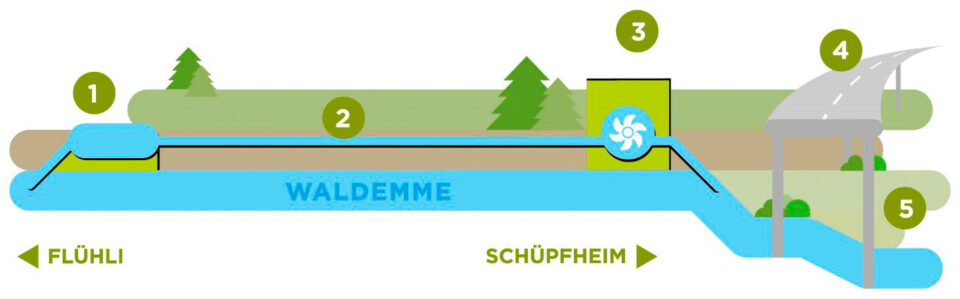
Electricity for 1500 households The roughly one-year construction phase begins with the ground-breaking ceremony. The water intake is at the hamlet of Matzenbach in Flühli. From this location, part of the water from the Waldemme is routed via a 2.1-kilometer-long underground pressure line to the power plant headquarters, where ecological electricity is produced. The power plant control center is located directly in front of the Lammschlucht at the Chrutacher Bridge. Immediately afterwards, the water is fed back into the natural course of the Waldemme and flows through the Lamm Gorge. The power plant has an output of 1.4 megawatts and produces an average of 6.5 GWh of electricity. This means that clean electricity can be generated from mid-2023, which will cover the annual needs of around 1,500 average four-person households. CKW is investing CHF 12.4 million in the power plant.
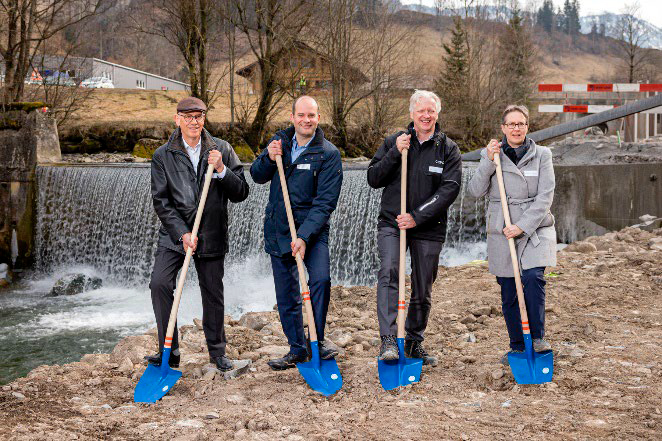
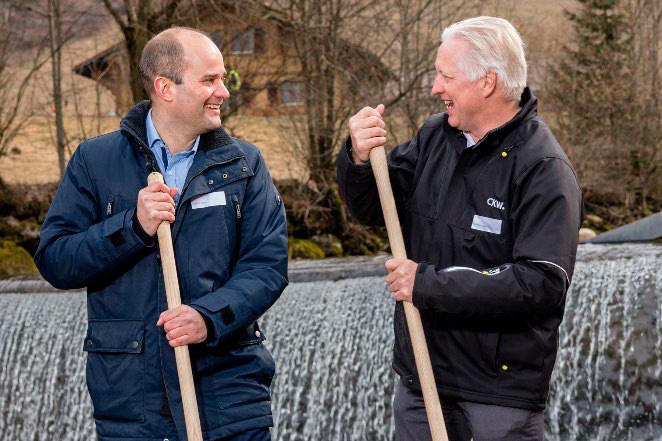
In the hamlet of Matzenbach, the water intake (1) takes part of the water from the Waldemme. In the approximately two-kilometer-long underground pressure line (2), the water is routed to the power plant center (3) at the Chrutacher Bridge (4), where it drives a turbine and generates electricity. Directly at the headquarters, the water is fed back into the natural course of the Waldemme and flows through the Lamm Gorge (5), which is untouched by the project. Breaking ground at the Waldemme: (from left) Hans Lipp, Flühli municipal mayor, Fabian Peter, member of the cantonal government and head of the building, environmental and economic departments of the canton of Lucerne, Martin Schwab, CEO of CKW and Hella Schnider-Kretzmähr, Flühli municipal president. Happy about the start of construction: Fabian Peter, member of the government and head of the building, environment and economic department of the canton of Lucerne, and Martin Schwab, CEO of CKW.
About CKW: The CKW Group is a leading Swiss provider of integrated energy and building technology solutions. For more than 125 years, the company has been supplying electricity to over 200,000 end customers in the cantons of Lucerne, Schwyz and Uri. In addition, there are innovative products and services throughout Switzerland in the fields of connectivity & IT infrastructure, electrical engineering, energy technology, IT & communication and security. The CKW Group employs over 2,100 people. With around 350 apprentices in 14 professions, it is the largest private-sector training company in Central Switzerland. In the 2020/21 financial year, CKW generated sales of CHF 916 million. With 81 percent of the shares, Axpo Holding AG is the majority shareholder of CKW. Further information at www.ckw.ch
In its first, not quite full year of operation, the Schächen hydropower plant produced 14.8 million kilowatt hours of electricity to supply around 3,300 households. In full operation there will be 3,600 households. The new power plant will thus make an important contribution to the CO2-free supply of electricity from renewable sources, emphasized Werner Jauch, Chairman of the Board of Directors, at the general meeting of KW Schächen AG .
According to a press release, he also highlighted that two of the three machine groups of the power plant commissioned in November 2019 started work six weeks ahead of schedule. This was not a matter of course, especially in Corona times. "This enabled us to make optimal use of the good water supply in winter and spring 2020."
In general, the construction work in the middle of the lively Uri basin was “a great challenge”, says Jauch: “The project experienced many ups and downs in a planning and approval marathon of around eight years, and the construction phase was also very demanding.” It turned out to be very demanding however, "definitely worth it to accept and successfully master all challenges up to and including the corona pandemic at KW Schächen".
CKW has submitted the concession and building application for the Waldemme small hydropower plant in Flühli LU to the Canton of Lucerne. In the past few months, the project has been revised with the involvement of environmental protection organizations, as CKW writes in a press release. In contrast to the original plan, the Lammschlucht gorge, among other things, is to remain untouched.
According to CKW's plans, the power plant is to be completed by 2023. It should have an output of 1.4 megawatts and produce around 6.5 gigawatt hours of electricity per year. According to the information, this will cover the needs of around 1,500 four-person households. CKW expects an investment sum of around 13 million francs.
With the investment, CKW is "making a contribution to a secure and sustainable energy supply" and "taking care of orders for the Lucerne economy", says CKW CEO Martin Schwab. The major part of the order volume will remain in the canton of Lucerne.
Government Councilor Fabian Peter (FDP) welcomes the project. “The canton of Lucerne must also make its contribution to the energy transition in 2050 and to achieving the climate targets. There is potential for this in the field of renewable energies that should be used and promoted with suitable framework conditions ”, he is quoted in the communication from CKW.
Wir verwenden Cookies zur Unterstützung und Verbesserung unserer Dienste. Mit der Nutzung dieser Website erklären Sie sich mit der Verwendung von Cookies einverstanden. Weitere Informationen finden Sie in unserer Datenschutzerklärung.