Tag: Wasserstoff

  • Fuel cells to support power grids

    Fuel cells to support power grids

    Researchers from the Swiss Federal Laboratories for Materials Science and Technology(Empa) have conducted a joint project on the effect of hydrogen fuel cells in collaboration with the Hälg Group from St.Gallen, the Osterwalder Group, also based in St.Gallen, and Zurich-based H2 Energy AG. The experiment at the Empa Center in Dübendorf showed that the electrical energy generated by the fuel cells could relieve the burden on local power grids in district centers, according to a press release.

    The core of the project was to reduce the electricity consumption of heat pumps by producing electrical energy from local district energy cells using hydrogen fuel cells. This energy is fed into the grid to operate the heat pumps, thus reducing the load on the grid. At the same time, the experiment tested using special heat exchangers to supply average temperatures of around 35 degrees Celsius to the heating network of the NEST innovation building and the Empa campus in Dübendorf. The test, which ran from October 2023 to September 2025, showed that the district energy cells were able to smooth out peaks in electricity consumption and reduce the overall cost of peak load by 10 percent.

    “Our trials showed that fuel cells can effectively balance electrical and thermal peak loads in buildings. This made it clear that hydrogen-based peak load shaving is technically feasible and provides valuable insights for the control of complex energy systems,” Binod Prasad Koirala, Deputy Head of Empa’s Urban Energy Systems research department, is quoted as saying in the press release. When using green hydrogen, the fuel cells also make a contribution to reducing CO2 emissions.
  • Hydrogen can do a lot, but not everything

    Hydrogen can do a lot, but not everything

    The Fraunhofer ISI analyzed 774 individual statements as part of a meta-fact check and condensed them into 77 core statements. The result was not a new opinion paper, but a synthesis of the current state of knowledge. The result is nuanced, but the key points are unambiguous. Lead author Nils Bittner puts it in a nutshell: hydrogen can have an enormous impact where there are no equivalent alternatives. Where such alternatives do exist, its use costs valuable resources and time.

    The efficiency bottleneck
    The basic problem lies in physics. Green hydrogen is produced by electrolysis. Depending on the process, this requires around 50 to 60 kWh of electricity per kilogram. Compression, transportation and reconversion swallow up further energy. In the end, often only a fraction of the kilowatt hours originally used remain. Heat pumps and battery-powered vehicles therefore use the same electricity many times more efficiently.

    Where H₂ remains indispensable
    Nevertheless, there are areas in which hydrogen has no viable alternative. The steel industry needs it to reduce iron ore, the chemical industry as a raw material for ammonia and methanol. Aviation, shipping and heavy goods transport can hardly be directly electrified. Hydrogen is the fuel of choice here. There is also currently no comparable alternative for the seasonal long-term storage of energy over weeks and months. In Switzerland, this assessment is in line with the federal government’s hydrogen strategy, which envisages H₂ primarily for high-temperature process heat and transport sectors that are difficult to decarbonize.

    The chicken-and-egg problem is slowing down the ramp-up
    A functioning hydrogen economy requires infrastructure such as pipelines, cavern storage facilities and electrolysis plants. However, companies only invest when the supply is secured and network operators only build when there is sufficient demand. This chicken-and-egg problem is slowing down the market ramp-up considerably. The Fraunhofer ISI therefore recommends concentrating on industrial clusters instead of a nationwide network extending into residential areas.

    Imports only solve half the problem
    Germany will have to import up to 80 percent of its hydrogen requirements. Transportation over long distances usually requires conversion into ammonia or liquid hydrogen, with further energy losses. This creates new global supply chains instead of fossil dependencies. Switzerland will not become self-sufficient in hydrogen either. The cantons of Basel-Stadt and Basel-Landschaft adopted a joint hydrogen strategy for the first time in February 2026 and calculate a demand of 0.4 to 3.4 percent of total energy requirements for 2050, concentrated on industry and heavy goods vehicles.

  • Hydrogen plant in Seewen suspended – market development remains crucial

    Hydrogen plant in Seewen suspended – market development remains crucial

    According to a press release, ebs Wasserstoff AG is suspending its project to produce hydrogen at the site of the surfacing plant in Seewen. The reason given for the decision is that sales and profitability are currently insufficient. However, the market situation is being monitored. Should demand increase, the project could be resumed.

    The Schwyz-based energy supplier ebs Energie AG holds a 60 per cent stake in ebs Wasserstoff AG, the road and civil engineering company A. Käppeli’s Söhne AG Schwyz holds a 25 per cent stake and the Basel-based energy supplier IWB holds a 15 per cent stake. Together, they submitted a planning application for a production plant in Seewen in 2022.

    According to a breakdown by ebs, the plant would produce hydrogen with a capacity of 5 to 6 megawatts for up to 100 lorries a day. This would have been sufficient for 11.1 million lorry kilometres per year and would have saved 7.8 million kilograms of CO2. The investment costs were estimated at CHF 16.8 million.

    Some of the hydrogen could also have been fed into the gas grid by ebs Erdgas Biogas AG. The waste heat from the electrolysis process could have been utilised in the surfacing plant.

  • Power-to-X tracker shows momentum in Switzerland

    Power-to-X tracker shows momentum in Switzerland

    With the new Power-to-X Tracker, the Swiss Power-to-X Collaborative Innovation Network (SPIN) and the Coalition for Green Energy & Storage (CGES) are presenting a nationwide overview of Power-to-X activities. The interactive platform maps all known projects, from pilot plants to commercial applications. This shows the rapid growth of a technology that could become the centerpiece of the energy transition.

    The aim is clear: to pool knowledge, promote synergies and facilitate investment. “The tracker creates a common data basis that accelerates collaboration and decision-making processes,” emphasize CGES Co-Directors Christoph Sutter and Antonello Nesci.

    The key to defossilization
    Power-to-X processes make it possible to convert renewable electricity into chemical energy carriers. This makes renewable energy storable and versatile, for example in industry, mobility or heat supply. For SPIN Co-President Martin Bäumle, these technologies are crucial for the transition to a climate-friendly economy. “Transparent data and networked players are the basis for turning ideas into scalable solutions,” explains Bäumle.

    Networking research, business and politics
    The tracker will be presented at the CGES annual event at Swissgrid in Aarau. The initiative is backed by a broad alliance of business, science and the public sector – supported by the ETH Domain. The systematic survey and visualization of the projects will provide an overview of the Swiss power-to-X landscape for the first time, offering guidance to researchers, politicians and investors alike.

  • New storage concept for stable power grids presented

    New storage concept for stable power grids presented

    The Zug-based greentech company PLAN-B NET ZERO and its subsidiary PLAN-B NET ZERO BESS GmbH presented their new concept for an energy storage system at this year’s D-A-CH Hydrogen Symposium at the Höhere Technische Bundeslehr- und Versuchsanstalt Wiener Neustadt. According to a company press release, it combines battery storage (Battery Energy Storage System, BESS), green hydrogen and artificial intelligence (AI) to create an integrated, flexible energy system that stabilises power grids and increases security of supply.

    Tjark Connor Hennings-Huep, battery systems expert at PLAN-B NET ZERO, argued at the symposium that class A grid planning is no longer sufficient in Germany, Austria and Switzerland because volatile feed-in of energy from wind and photovoltaics, slow grid expansion and increasing weather extremes are putting a strain on grid stability: “We need intelligent decentralised systems that can react independently to fluctuations.”

    As the company emphasises, it does not see combined battery-hydrogen solutions as competition to other systems, but rather as a complementary building block in a more resilient energy system for regional energy centres. “Together, both technologies form the bridge to a robust, fully renewable energy system and, when combined, offer additional parameters in terms of control and flexibility,” says Hennings-Huep.

    Battery storage and hydrogen are complemented by AI-supported forecasting and control algorithms that dynamically balance generation, storage and consumption. “Our goal,” says the expert, “is an energy system that stabilises itself – digital, decentralised and decarbonised.”

  • Climate-neutral industry – Vision 2026

    Climate-neutral industry – Vision 2026

    Founded in 2022, the Association for the Decarbonisation of Industry aims to reduce emissions to a minimum through innovative technology. At the forefront is the methane pyrolysis process, which enables emission-free energy utilisation by splitting hydrogen from methane. The remaining carbon is utilised as a resource, for example as humus in agriculture or as a building material, which binds the carbon in the long term.

    Cooperation between business, research and politics
    Without the cooperation of 16 leading companies, Empa and politicians from the Canton of Zug, the project would hardly be possible. Together, they are contributing to the development and scaling up of the pyrolysis process, which is to be scaled up from laboratory to industrial size by 2026. The partners are providing funding of over CHF 8 million, thereby sending a strong signal for the decarbonisation of industry.

    Methane pyrolysis Reduction of CO2 emissions
    The association is focusing on methane pyrolysis, a process that minimises CO2 emissions when using natural gas. Instead of traditional combustion, hydrogen is obtained from methane, while the carbon is in solid form and therefore does not cause any emissions. This technology could save up to 270 g of CO2 per kilowatt hour produced and is therefore a potential key to the net-zero targets by 2050.

    Sustainable ecosystem without waste
    The association is working to create an ecosystem that optimally utilises all components of the process. Through the circular economy concept, not only hydrogen, but also carbon and waste heat are to be efficiently reused to avoid waste. This holistic strategy creates a model that is ideally suited to a climate-friendly future.

    Membership of the Association for the Decarbonisation of Industry
    Companies that are committed to the climate-neutral future of industry and would like to benefit from the findings of the association can become members. The association is tax-exempt and donations are deductible in the canton of Zug. Members gain access to advanced knowledge and support an initiative that lays the foundations for an emission-free
    industry.

  • New partnership promotes hydrogen from wood waste

    New partnership promotes hydrogen from wood waste

    H2 Bois has a new minority shareholder. According to a press release, the Vaud-based energy supplier Romande Energie will acquire a 33.7 per cent stake in January 2025. Groupe Corbat, based in Vendlincourt JU and active in the timber industry, will then hold 50.3 per cent and the consulting firm Planair Vision SA, based in La Sagne NE, 16 per cent of the company they founded in 2021.

    H2 Bois plans to build a plant to produce hydrogen from wood waste in 2025 and put it into operation in 2026. The production process also produces biochar, which can permanently store some of the CO2 contained in the wood. When fully operational in 2030, the plant will be able to produce a total of 450 tonnes of clean hydrogen from 14,000 tonnes of wood and wood waste and store 2,500 tonnes of CO2 per year. H2 Bois utilises technology from the French company Haffner Energy.

    The hydrogen is transported to an industrial zone in the village via a 1.5 kilometre long gas pipeline. There it is used by industrial companies and for mobility via a petrol station. The biochar is used in agriculture.

    For Romande Energie, the investment is a step towards a decarbonised western Switzerland. “This investment allows us to participate in a bold project that is a pioneer in Switzerland in the use of an innovative negative emissions technology,” said Jérémie Brillet, responsible for hydrogen at Romande Energie, in the press release.

    Benjamin Corbat, CEO of Groupe Corbat, welcomes Romande Energie’s involvement. “We are looking forward to the start of production, but also to breaking new ground in the local use of wood.”

  • The future of renewable fuels in Switzerland

    The future of renewable fuels in Switzerland

    Switzerland is lagging behind countries such as Germany in the use of renewable energies for the production of fuels. However, with its companies and research institutions working in this field, it is well positioned to catch up. This was the conclusion of the two Power-to-X Days at the JED in Schlieren, which were organized by the Swiss Power-to-X Collaborative Innovation Network(SPIN), Avenergy Suisse and Swissmem. Around 140 representatives from business, science and politics, including Federal Councillor Guy Parmelin and Zurich Government Councillor Carmen Walker Späh, spoke about the possibilities of scaling up Power-to-X production.

    The participants pointed out that the development of Power-to-X is dependent on cooperation between industry, the financial sector and research and requires the right framework conditions. “Industry can do its part, but the market launch of new technologies cannot happen without universities and the financial world on board,” said Patrik Meli, Co-President of SPIN, according to a blog post on the first day of the event.

    Markus Bareit, hydrogen project manager at the Swiss Federal Office of Energy, referred to the hydrogen strategy for Switzerland, which the Federal Council intends to adopt in the coming weeks. The canton of Zurich, for its part, is planning a competence center for sustainable aviation fuel (SAF). Synhelion co-founder Philipp Furler pointed out that the proportion of SAF is to be increased fifty-fold by 2035. Regional initiatives are also part of the transformation, such as the Association for the Decarbonization of Industry in Zug and the hydrogen bus that has been running in Brugg AG since March.

    According to a press release from SPIN, the results of the discussions will be prepared and published in the coming weeks.

  • Swiss cleantech start-ups conquer the South African market

    Swiss cleantech start-ups conquer the South African market

    As part of the Academia-Industry Training Cleantech program (AIT), four Swiss cleantech start-ups were able to present their innovative solutions in South Africa. Subasol, Neology Hydrogen, Gaia Turbine and Soft Power presented their pioneering technologies and were given the opportunity to make valuable contacts and secure access to an emerging market.

    Subasol impresses with photovoltaic storage solutions
    Subasol, which develops innovative PV storage systems for the African market, won the pitch competition and prevailed against strong competition. The locally installed storage systems are intended to secure the energy supply in rural and off-grid areas of Africa and thus make a significant contribution to the continent’s sustainable development.

    Low-cost hydrogen for the future
    Neology Hydrogen scored highly with a technology that converts ammonia into hydrogen, providing low-cost and easily accessible hydrogen solutions for the global market. This innovation will accelerate the transition to a hydrogen-based economy.

    Practical solutions for clean energy
    Gaia Turbine and Soft Power completed the field of participants with compact water turbines and sustainable cooking solutions for developing countries. Both start-ups offer practical solutions to promote the use of renewable energy worldwide and reduce dependence on fossil fuels.

    Forward-looking exchange
    The next step is an exchange program in which five South African entrepreneurs will visit Switzerland to further develop their business models and explore opportunities for cooperation. This program is an important step towards promoting international cleantech partnerships and opening up new markets.

    Cleantech made in Switzerland conquers South Africa
    The success of the Swiss start-ups shows the potential of innovative cleantech solutions on the African market. Participation in the SA Innovation Summit has laid the foundation for future collaborations and offers promising prospects for international expansion.

  • Green hydrogen: Study identifies Canada as a top location

    Green hydrogen: Study identifies Canada as a top location

    Researchers at the Paul Scherrer Institute(PSI) have focussed on the question of where hydrogen can be produced efficiently and cost-effectively with the aim of stopping climate change and emitting no more greenhouse gases in the future. According to a press release, the researchers have compiled geographical and economic data and forecasts to describe the development of a hydrogen economy. To do so, they analysed four scenarios with a hydrogen demand of between 111 and 614 megatonnes per year. The study can currently be read in the scientific journal “Nature Communications“.

    There are various technologies for producing hydrogen. In polymer electrolyte membrane electrolysis (PEM), hydrogen is extracted from water in an electrolyser. The great advantage of this process is that the energy for the conversion can be obtained from green electricity. The question to be resolved is where the high demand for green electricity can best be met.

    “We primarily applied economic criteria,” says Tom Terlouw, PhD student at PSI and lead author of the study, quoted in the press release. “In other words, where is production most favourable?” Two focal points crystallised: Where is there enough wind or sun to cover the enormous demand for green electricity? And where is there enough free space to set up the plants required for production? Canada proved to be ideal here. “There are many open areas there that are very windy and therefore ideal for setting up wind turbines,” adds Terlouw. The central USA, parts of Australia, the Sahara, northern China and north-west Europe are also ideal locations. Central European countries such as Switzerland, on the other hand, are less suitable as there is neither open space nor sufficient sunlight. The researchers also point out that the production of green hydrogen still generates residual greenhouse gas emissions from the production and transport of the required materials. In order to compensate for these residual emissions, corresponding quantities of carbon dioxide would have to be filtered out of the atmosphere, according to the study.

  • Empa tests hydrogen use for peak loads

    Empa tests hydrogen use for peak loads

    On behalf of the Swiss Federal Office of Energy(SFOE), the Swiss Federal Laboratories for Materials Science and Technology(Empa) are investigating the use of hydrogen and fuel cells to reduce the load on the electricity grid on the coldest days. According to a press release, the joint project H2 districts was initiated for this purpose, in which the Hälg Group, the Osterwalder Group and H2 Energy AG are involved in addition to Empa. For the pilot project, a simulation model for operation under peak loads is being set up on the Empa site in Dübendorf.

    The Osterwalder Group is contributing its expertise and supplying renewable hydrogen. H2 Energy AG is contributing its many years of experience in the field of fuel cells. The Hälg Group is responsible for building technology.

    “We will set up a real system on the Empa campus in Dübendorf as part of the two research platforms ‘NEST’ and ‘move’ and validate the parameters for grid-friendly operation and the potential CO2 savings,” Philipp Heer, Head of the Energy Hub and Deputy Head of Empa’s Urban Energy Systems research department, is quoted as saying in the press release. The project is funded by the SFOE and is expected to run until September 2025.

  • First Swiss Hydrogen Congress

    First Swiss Hydrogen Congress

    The first Swiss Hydrogen Congress took place in Yverdon-les-Bains on 28 March. The event brought together entrepreneurs, experts from science and industry as well as political decision-makers. The diversity of the speakers made it possible to cover the topic from numerous angles. The first Swiss Hydrogen Congress was organised in collaboration with Planair, CleanTech Alps and the Western Switzerland H2 Network and was a complete success.

    Hydrogen is not a panacea for solving all of Switzerland’s energy problems, but it does offer numerous opportunities. The first Swiss Hydrogen Congress saw fruitful dialogue and strong collaboration. This demonstrates the importance of the topic for Switzerland, and everyone involved is willing to work together to strengthen the country’s competitiveness and build a sustainable energy future.

    What needs to be remembered from this day
    Representatives from the energy, gas and industrial sectors, entrepreneurs and politicians all agree that it is essential for Switzerland to be connected to the European grid. It is crucial that our country does not miss out on this opportunity.

    Another important point is the demand for a clear strategy and suitable framework conditions on the part of the federal government in order to drive the market forward.

    Despite the existing operational challenges, the congress was able to draw positive conclusions from ongoing projects such as Green Gaz in Aigle and Hydrospider. Participants were given an insight into the development of hydrogen projects such as H2 Bois, Gruyère Hydrogène Power and Prhysm.

    In addition, aeesuisse presented its positioning on the topic of hydrogen with the publication of the brochure “10 points on hydrogen”.

    A passion that transcends our borders
    Hydrogen is a hot topic now more than ever. It is moving experts and politicians beyond Switzerland’s borders. In Europe, discussions about its opportunities and risks are accelerating and are in full swing. Switzerland and its pool of expertise have a key role to play here. “We are currently experiencing a strong enthusiasm for hydrogen, with major announcements at international level. Switzerland is a leader in innovation in many areas, such as compression and storage. We must therefore consolidate our leading position and not allow ourselves to be overtaken by our European competitors,” says Laurent Scacchi, Director of Western Switzerland at aeesuisse.

  • Hydrogen project a location with potential

    Hydrogen project a location with potential

    The location in Domat/Ems, directly next to a main traffic axis in the Swiss Alps and in the immediate vicinity of electricity producers and an electricity plant operator, is creating a pioneering hydrogen project. Especially for HGVs that need to refuel with hydrogen at strategic junctions, the location in the Graubünden Rhine Valley is of great value.

    The technical performance spectrum of the newly planned facility is impressive: At full capacity, the 2 MW plant can generate over 300,000 kg of hydrogen per year. This corresponds to the energy content of 1,000,000 litres of diesel. Such a production rate not only affects the diversity of energy sources, but can also have a significant positive impact on the environment by reducing annual CO2 emissions by more than 3,600 tonnes.

    Energy storage as the biggest challenge
    Renewable energies have been the talk of the town for some time. However, storing them brings some challenges, especially because nature dictates when and how much energy is produced. This is where hydrogen comes on the scene as an optimal storage element. Especially in times of high energy production in summer, it can be advantageous to convert surplus electricity into hydrogen. However, constant production is essential for profitable operation. Current legal requirements suggest that such plants should be built near energy production sites.

    The first considerations in this direction were initiated in 2017. Soon after, Fanzun AG’s team of experts set out to find a suitable location. Urs Simeon, partner and project manager, expressed: “We were aware that the topic of hydrogen requires a lot of education. That’s why we started looking into it intensively at an early stage and were able to quickly build up comprehensive expertise.” According to Simeon, the biggest hurdle in the planning phase was the economic calculation – because the project only makes sense if it is economically viable.

    In the beginning there was a Norwegian investor

    When searching for the roots of this project, one comes across the name of Per Sandven, a visionary investor from Norway known for his pioneering and sustainable approaches. Sandven, as co-founder and former main shareholder, played a central role in the foundation and development of Calanda Solar. He also had a significant influence on the implementation of the adjacent Calinis photovoltaic project. This project, located in the former quarry of Felsberg and operated by Rhiienergie, was the largest photovoltaic facility in the canton of Graubünden in 2020. With a remarkable annual yield of 1,500,000 kWh, it supplies electricity to about 400 households.

    Further projects are in the pipeline

    In the past, Sandven and Fanzun have already worked hand in hand, for example on the 105%-PlusEnergie Hotel Muottas Muragl in Samedan, which also won a solar prize. Their cooperation illustrates the shared aspiration and vision to drive the change towards a more environmentally friendly and climate-neutral energy future. Fanzun AG is currently planning additional initiatives in the high-mountain solar segment, also known as the “Solarexpress”.

  • Use of stationary hydrogen fuel cells to support the energy transition

    Use of stationary hydrogen fuel cells to support the energy transition

    Hydropower, photovoltaics and wind power are the mainstays of a renewable and ecologically sustainable energy infrastructure in Switzerland. However, the increased integration of solar energy and wind power into the electricity grid poses certain risks, as these energy sources are volatile in nature and thus pose a potential threat to the grid balance.

    The use of hydrogen offers a way to compensate for such energy fluctuations. Surplus, unpredictable solar and wind energy is not fed directly into the grid, but used to produce hydrogen by means of electrolysis. In times of energy shortage, for example caused by no wind and very cloudy weather in winter, the stored hydrogen can be used as an energy source.

    Since 2020, the Hälg Group has been working on the topic of “stationary hydrogen fuel cells in buildings”. In this context, a project team of three partner companies was formed: Osterwalder AG in St. Gallen is responsible for the production of green hydrogen through hydropower and its transport, H2Energy acts as a technology and production partner in the field of fuel cells, while the Hälg Group, as a provider of integral building technology and energy systems, is responsible for the planning, implementation and support of the entire building technology building. The vision of this project team is to create ideal energy networks in which environmentally friendly hydrogen as an energy storage medium fills the gaps left by other renewable energies.

    Stationary hydrogen fuel cell: a promising approach for a green energy economy
    The basis of the hydrogen fuel cell system has existed for almost two centuries. The increased use of hydrogen as an energy medium and substitute for fossil energy sources has led to significant further development of fuel cell technology in the recent past. The production method of hydrogen is essential for the ecological compatibility of this process. So-called “grey” hydrogen is produced by decomposing fossil fuels. Green” hydrogen, on the other hand, is produced by electrolysis of water using environmentally friendly energy sources such as hydropower, solar energy and wind power.

    By using only “green” hydrogen in the project group’s ecosystem, the stationary fuel cell generates electricity and heat in an environmentally friendly way. Hydrogen and oxygen are combined in the fuel cell. By applying electrical voltage between an anode and a cathode, the two elements react and combine to form water vapour. In the course of this, electrical energy and heat are also generated, which can be used directly to supply buildings and areas. The water produced in the process is reused.

    The hydrogen fuel cell is characterised by its environmental friendliness precisely because no pollutant emissions are produced or released in the course of the chemical reaction. Only pure, low-energy and harmless water vapour escapes as “waste gas”. Consequently, the function of the hydrogen fuel cell is considered to be completely emission-free.

    Advantages of the hydrogen fuel cell building technology solution

    • Maximises the value of the property and increases its attractiveness
    • Enhances the reputation of the facility owner and makes a progressive responsible statement on environmental protection, climate change and green transformation.
    • Emergency power supply in the building: partial or full self-sufficiency possible
    • Reduction of power and connection costs
    • Low maintenance costs due to non-moving parts
    • Modular design: from 80 kWel / 78 kWth, scalable as required.
    • Reduction of winter electricity demand, grid load, winter electricity gaps
    • Assistance in decarbonisation, environmental protection and reduction of greenhouse gases
    • Peak shaving of the electrical grid

    Ideal energy network
    It is important that energy producers and consumers have access to a wide range of environmentally friendly technologies. In addition to hydrogen fuel cells, these include heat pumps, chillers, solar thermal, wind energy and photovoltaics, as well as battery short-term storage and bidirectional e-vehicles. Further information at https://haelg.ch/stationaere-wasserstoff-brennstoffzelle/

  • Greenpower: Unique energy ecosystem in Dagmersellen

    Greenpower: Unique energy ecosystem in Dagmersellen

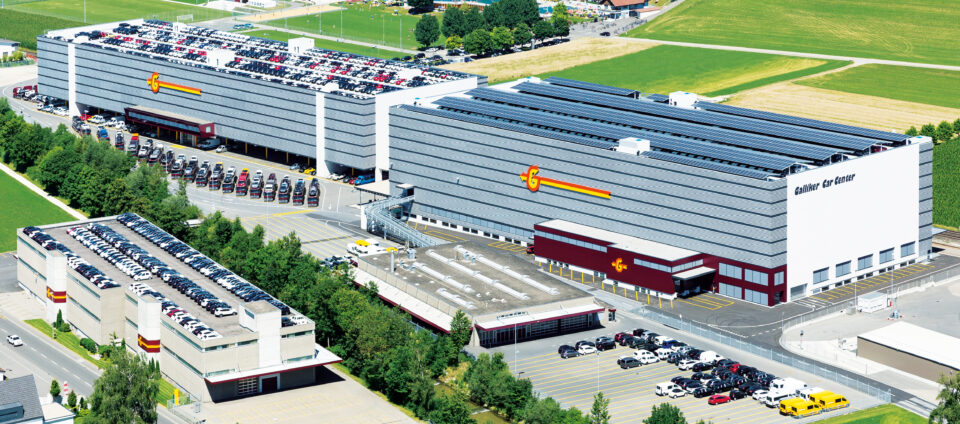
    An energy ecosystem unique in Switzerland is to be created in Dagmersellen over the next few years. The transport company Galliker, the milk processor Emmi, the producer of biogas PanGas and the energy supplier CKW have signed a joint declaration of intent at the end of 2022.

    For the partners, the project is an important step towards achieving the energy strategy goals of the companies involved and of Switzerland. “Together we want to drive forward the energy transition and make a significant contribution to the decarbonisation and diversification of the energy supply with the planned energy ecosystem,” explains Martin Schwab, CEO of CKW.

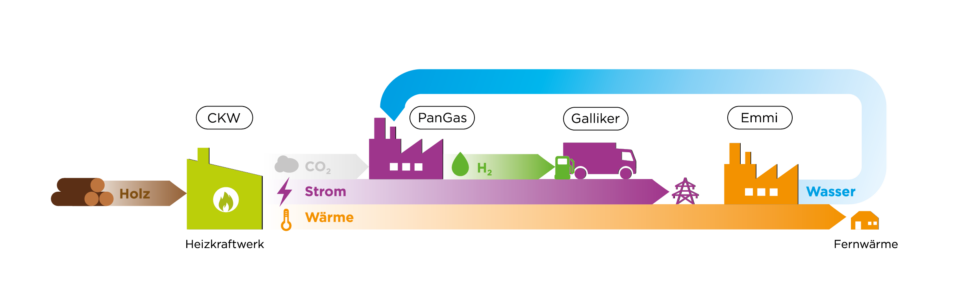
    The energy ecosystem will start with a wood-fired power plant operated by CKW to produce heat and electricity. PanGas will use part of the electricity to produce hydrogen to supply Galliker’s fleet of trucks. In addition, PanGas will extract green CO2 from the combustion process; for use in the food industry, for example.

    “At PanGas, we have always been involved with hydrogen. We are very pleased that we can make a significant contribution to CO2 reduction with this project and come a big step closer to the Swiss decarbonisation target”, says Roger Britschgi, Managing Director PanGas.

    With the renewable energy from the wood-fired power plant, Emmi covers part of the thermal energy required at the Dagmersellen production site for the production of fresh cheese specialities such as mozzarella or ricotta as well as milk powder. With a view to closing the loop, Emmi also supplies demineralised water from the production of dairy products for hydrogen production.

    The energy ecosystem is intended to function as a closed loop.

    “This unique energy ecosystem, designed in conjunction with three regionally based national partners, enables more sustainable production of our dairy products and reduces our dependence on fossil fuels,” says Marc Heim, Head of Emmi Switzerland.

    The wood-fired power plant will produce electricity and heat when fully operational. Emmi will use a good third of the heat. Other possible heat consumers are local industry and heating networks in the surrounding villages. As far as possible, the wood-fired power plant will be operated with regional forest chips and waste wood. This will require up to 200,000 tonnes of wood per year.

    The four companies plan to invest a total of about 200 million Swiss francs in the production, distribution and use of renewable energy. Before the energy ecosystem can be built, further planning and approval steps are needed. In the detailed planning, the entire value chain is to be organised. Before building applications can be submitted, the zoning plan of the municipality of Dagmersellen must also be adapted.

    The population will be regularly informed about the project status. The current planning anticipates commissioning in 2027 at the earliest.

  • Revolutionary energy storage

    Revolutionary energy storage

    The apartment buildings in Seebrighof store solar power in the form of hydrogen. Dr. Martin Nicklas, Head of Energy Contracting at EKZ, explains the revolutionary power-to-gas concept: “On summer days, the solar system on the roof of the Seebrighof will produce more electricity than the residents can use. The so-called power-to-gas plant turns this into hydrogen. In winter the energy requirement is higher. Then the stored hydrogen is converted into energy. Around 55 percent of this is used to generate electricity in the system’s fuel cells. The remaining 45 percent of the energy escapes as waste heat, which is used to heat the building. ” The hydrogen is produced from tap water that is processed directly in the plant. Oxygen is created as a quasi waste product, which escapes into the ambient air. This is environmentally friendly because in winter the hydrogen is converted back into water and renewable energy with oxygen from the air. This closes the cycle. The system only uses locally produced solar power for production, and the public power grid is relieved.

    EKZ as a pioneer
    With a battery in the house, short-term fluctuations in solar power production in the summer are absorbed and, for example, solar power is stored for the night. The P2G system constantly converts the excess remaining free into hydrogen. As a result, it can be implemented more cost-effectively and operated more efficiently. For Nicklas, EKZ is taking on a pioneering role in the conversion to renewable energy supply: “For the first time in Switzerland, a P2G system is being implemented that can also be used cost-effectively in other properties of different sizes – even in existing buildings. With the system, we are testing the potential of seasonal energy storage from solar power for the winter. ” There are a few properties with hydrogen systems in Switzerland, including in the canton of Zurich. The difference in the project in the Seebrighof is the standardized concept, which can be easily and inexpensively applied to other buildings.

    Power-to-gas system
    But it gets even better: thanks to the power-to-gas system, most of the solar power can be used locally. The electrical efficiency of the P2G system is around 30 to 35 percent across all processes. The rest is generated as waste heat, which is used for hot water heating in summer and for heating in winter. Would you be able to supply yourself with energy completely independently at the Seebrighof? – «This would be technically possible and is already being done in this way in individual properties. However, this would be very costly and was therefore not the aim of this project. “

    Safe hydrogen storage
    Appropriate safety precautions must be taken when storing flammable and potentially explosive gases such as natural gas or hydrogen. These measures are checked by the authorities to ensure safe installations. Hydrogen is usually stored outdoors, with any leakage gas quickly volatilizing and thus preventing an explosive mixture. In the current case, according to Nicklas, the H2 is stored in commercially available gas cylinders that fully meet Swiss safety standards and norms.

    When is a P2G system worthwhile?
    The answer depends on many factors and must always relate to the specific building project and the requirements of the client, as Nicklas explains: “The fundamental question is how often the hydrogen storage tank can be charged per year. Because with each charging cycle, the system generates a contribution margin that contributes to amortization. We are also testing this potential with the system and are further developing the concept accordingly. ” The client of the Seebrighof is also demonstrating a pioneering spirit with the project. In this way, she does not only have the system installed from a purely monetary point of view. One would like to lead the way here and make a contribution to reducing the supply gap in winter – making society more independent of energy imports from fossil sources. The facility at Seebrighof can be financed well thanks to its cost-effective implementation, says Nicklas. She makes a significant contribution to research into seasonal storage technologies: “How economically effective the technology is is the subject of our investigations. In the next few years, however, we expect another significant price reduction on the hydrogen market, which could give the technology a boost.

    Energy strategy 2050
    In the Federal Council’s Energy Strategy 2050, storage technologies based on gases and liquids have a high priority. With the first standardized power-to-gas system, EKZ has reached an important milestone that could serve as an example for future developments. Nicklas concludes: “If we want to fully feed heat and power supply as well as mobility with renewable energy sources, we need efforts in all areas. Hydrogen as a storage medium can help to defuse the challenges of power supply in winter ».

  • Partners want to bring hydrogen into the building sector

    Partners want to bring hydrogen into the building sector

    Romande Energie , GreenGT as well as the Nomads Foundation and the Realstone Group are joining forces to use local hydrogen in the energy supply of the real estate sector. As part of a project called Aurora, the French-speaking partners want to develop the necessary solutions.

    Aurora is intended to cover various aspects of the production, distribution and use of hydrogen, according to a communication . The aim is to introduce integrated solutions such as water electrolysis or fuel cells into existing systems such as photovoltaics and battery storage.

    The joint project should take several years. First the modeling, then the installation of the developed systems in several buildings is planned. After that, the developments are to be marketed.

    The Nomads Foundation is a private, non-profit foundation that promotes multidisciplinary collaboration. GreenGT is active in hydrogen technology and also offers advice. The Realstone Group is a specialist in collective real estate investments. Romande Energie is an energy supplier that relies on renewable energies.

  • The first Swiss hydrogen hub is being built in the Rhine ports

    The first Swiss hydrogen hub is being built in the Rhine ports

    The first Swiss hydrogen hub is to be built in the port areas of Birsfelden and Muttenz. According to a press release, four partner companies have agreed on this. Swiss Rhine ports , the energy company Varo , the filling station operator AVIA and the Basel energy supplier IWB have signed a joint declaration of intent for the construction of such a hydrogen node. As a green energy carrier, hydrogen will play an important role in the CO2-neutral future, according to the press release.

    The four partners from the energy industry and logistics see the ports of Muttenz and Birsfelden as ideal locations for a hydrogen hub, according to the joint media release published by Varo. The H2-Hub Schweiz project should include the production, distribution and use of hydrogen. The plans envisage not only distributing the hydrogen with the existing infrastructure, but also producing, storing and making available the green energy on site. The tank storage company AVIA AG and the energy company Varo Energy Holding AG are already active in the Rhine ports.

    IWB (Industrielle Werke Basel) produces and sells renewable and CO2-neutral energy as electricity, heating and cooling and for mobility. According to the announcement, IWB founded GreenH2 AG together with the petrol station operator and AVIA member company Fritz Meyer AG. The company is to build hydrogen production plants.

    Applications of hydrogen will soon be tested in the H2 hub Switzerland as a fuel for trucks, trains, other road vehicles and ships.

  • Axpo wants to produce hydrogen

    Axpo wants to produce hydrogen

    Axpo wants to produce green hydrogen from the hydropower of the Rhine in the future. For this purpose, a hydrogen production plant at the Eglisau-Glattfelden power plant is to be put into operation as early as autumn 2022, according to a media release . This should produce 350 tons of hydrogen annually. According to Axpo, this can save over 1.5 million liters of diesel per year in road traffic.

    The new hydrogen production plant will have an output of 2.5 megawatts. However, it can be expanded to 5 megawatts. Axpo is also planning to implement additional systems at other locations. The company has already set up its own department for the hydrogen business area.

    Axpo works with Opfikon-based Hydrospider AG to transport the hydrogen to the filling stations. This is a joint venture between H2 Energy , Alpiq and Linde GmbH . Both Axpo and Hydrospider see great potential for hydrogen in the mobility sector. There are already more than 50 trucks with fuel cells in Switzerland today. According to the partners, it should be more than 1,600 by 2026.

    Axpo had already planned a hydrogen production plant for the same power plant in 2015. At that time, however, the project was not pursued because the sales volume of hydrogen remained below the company's expectations. "Since then, the fight against climate change has gained significantly in importance and hydrogen has proven to be a suitable energy source for the decarbonisation of mobility and industry," said Guy Bühler, Head of Hydrogen at Axpo, quoted in the press release.

  • Energy companies want to promote the expansion of hydrogen

    Energy companies want to promote the expansion of hydrogen

    The association of Swiss H2 producers , newly founded on Thursday, wants to campaign for better local conditions for the production of green hydrogen. So far, seven energy companies belong to the association. "Together they will help the CO2-neutral hydrogen production in Switzerland to break through", it says in their press release.

    Important areas of application could be found in heavy haulage, as a replacement for diesel on non-electrified railway lines and in the chemical industry. Production is preferably carried out directly from a hydro or wind power plant. Because only if the electricity required for the production of hydrogen comes from renewable sources, it is CO2-neutral.

    While neighboring countries recognize hydrogen technology as an indispensable part of the energy transition and state funding for it accordingly, Switzerland is still having a hard time with it. "In addition, the production of hydrogen in Switzerland has so far only been possible at a limited number of locations," said Arthur Janssen, President of the new association and Head of Innovation and Strategy at the Basel energy supplier IWB , quoted in the press release.

    In addition to these regulatory hurdles, few actors had sufficient knowledge. That is why the association members want to support each other in the planning and construction of new production facilities. The association also wants to work closely with universities and research institutes.

    The founding members include: Elektrizitätswerk Altdorf, Oiken, St. Gallisch-Appenzellische Kraftwerke, Satom, SIG and the joint ventures Swiss H2 Generation AG (from ENGIE Services AG and Groupe E) and greenH2 (Fritz Meyer AG and IWB).

  • Trafigura invests in H2 Energy

    Trafigura invests in H2 Energy

    The Dutch commodity trading giant Trafigura , with a branch in Geneva, is investing heavily in the Zurich-based H2 Energy Holding . In a first step, the company has committed, according to its media release , to provide 62 million dollars. 20 million of this will flow into H2 Energie AG as a capital contribution. This is intended to support the development of the production, storage and distribution of green hydrogen for filling stations and industrial customers.

    Trafigura, one of the world’s largest traders in fossil fuels, will provide the remaining 40 million dollars to set up and finance a 50:50 joint venture, H2 Energy Europe, based in Zurich. It aims to bring green, hydrogen-based ecosystems to the markets. In addition, it will invest in hydrogen infrastructure and in projects that work with hydrogen throughout Europe, with the exception of Switzerland.

    H2 Energy has developed “a successful business model that is present in every part of the hydrogen value chain,” said Jeremy Weir, Executive Chairman and CEO of Trafigura, in the press release. “And by providing fuel cell solutions on a large scale, they have created a demand for hydrogen.” Now Trafigura will contribute its ability to further develop traditional supply chains and open up new markets.

    The joint focus is on the profitable decarbonization of various sectors, says H2 Energy boss Rolf Huber. “The joint venture with Trafigura will enable the partners to carry out the planned projects across Europe. In addition, it will enable us to further develop fuel cell applications for the transport sector on land and at sea, but also for stationary applications. “

  • Coop delivers with hydrogen trucks

    Coop delivers with hydrogen trucks

    In future, Coop will increasingly supply its sales outlets with hydrogen trucks. According to a media release on Wednesday, the food cooperative put one of the world's first mass-produced fuel cell electric trucks into operation. A total of seven of these will be in use by the end of the year. Because there are no other emissions besides water vapor, Coop is assuming potential savings of 80 tonnes of CO2 per truck per year. In addition, Coop is establishing additional hydrogen filling stations in Switzerland.

    As the message goes on to say, Coop is working together with the Swiss company H2 Energy AG and the Hyundai Motor Company . Hyundai is considered a world leader in the development of hydrogen fuel cell technology. The performance, refueling time and range of their hydrogen trucks are comparable to those of conventional trucks.

    Coop has set itself the goal of being CO2-neutral in the relevant areas of the company by 2023. This is why the food wholesaler and retailer is doing “pioneering work” for electromobility with green hydrogen. In 2018, the H2 Mobility Switzerland association was founded on the initiative of Coop. It includes seven large operators of petrol stations and truck fleets.

    "The H2 Mobility Switzerland association promotes clean, CO2-free motorized individual traffic in Switzerland and implements the technology of hydrogen mobility in road traffic on a private basis," says Jörg Ackermann, member of the Coop management and president of the association. The aim of the association is to create a nationwide network of hydrogen filling stations throughout Switzerland by 2023.

  • The first industrial power-to-gas plant is built in Dietikon

    The first industrial power-to-gas plant is built in Dietikon

    The showcase project for the use of renewable energies is being developed in collaboration between eight energy suppliers and the Swisspower public utility alliance. The project aims to show how power-to-gas systems can complement renewable electricity production and operate economically, according to a media release . The largest power-to-gas plant in Switzerland to date will have an electrolysis capacity of 2.5 megawatts and will feed synthetic renewable gas into the grid from winter 2021 to 2022.

    The operating principle of the new plant is described in the communication as follows: “The power-to-gas plant uses renewable electricity from the waste incineration plant to produce hydrogen. This is mixed with the CO2 in the sewage gas, creating renewable methane gas. Limeco thus gains a CO2-neutral energy source from waste and wastewater. ”In the existing gas network, the renewable gas replaces fossil energy sources. According to the information, this can save 4,000 to 5,000 tons of CO2 annually.

    At the groundbreaking ceremony for the construction project, Stefano Kunz, Chairman of the Board of Directors of Limeco and City Councilor of Schlieren: "With waste recycling and wastewater treatment at the same location, we have the perfect conditions to produce green gas." Ronny Kaufmann, CEO of the Swisspower public utility alliance, which who co-initiated the project, says: "The project shows: We have to work together for a renewable and climate-neutral energy system, across company boundaries." The Federal Office of Energy ( SFOE ) is supporting the project as part of its pilot and demonstration program.

    Systems like the one being built in Dietikon are important for the implementation of the Energy Strategy 2050. The plan is to replace the electricity from nuclear power with solar, water and wind power. This means that much more electricity will be produced in the summer than consumed. In winter, on the other hand, when the energy demand is greater, Switzerland has to import electricity. Power-to-gas is a key technology for storing excess renewable electricity seasonally.