
Tag: Weiterbildung

  • How Switzerland is training the PropTech specialists of tomorrow

    How Switzerland is training the PropTech specialists of tomorrow

    Interdisciplinarity is the key
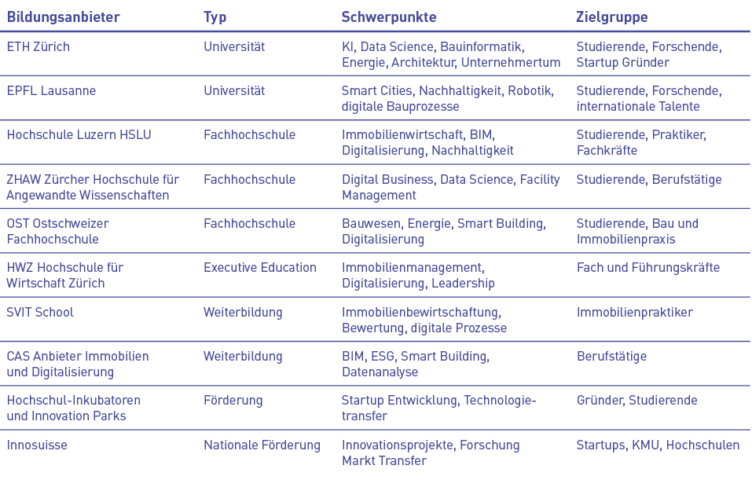
    PropTech is not a traditional field of study. Rather, expertise is created by combining different disciplines. In Switzerland, training programmes combine subjects such as property economics, construction, IT, data analysis, sustainability and management.

    This interdisciplinarity reflects the reality of the industry. PropTech specialists need to understand technical solutions, categorise regulatory frameworks and think economically at the same time. Swiss educational institutions are responding to this with modular programmes and practice-oriented formats.

    Universities as drivers of innovation
    ETH Zurich and EPFL Lausanne form the academic foundation of many technological developments. Degree courses and research programmes in civil engineering, architecture, computer science and data science provide expertise that flows directly into PropTech solutions.

    Universities of Applied Sciences such as HSLU, ZHAW or OST complement this offering with a strong practical focus. Projects in collaboration with companies, start-ups and public institutions enable students to work on real-world problems. This results in a direct transfer of knowledge into application.

    Further education for property practice
    In addition to academic education, in-service training is becoming increasingly important. Many specialists in administration, valuation, development or management need to catch up on or deepen their digital skills.

    In Switzerland, there are a growing number of CAS and MAS programmes with a focus on digitalisation, BIM, data analytics, sustainability and real estate management. These programmes are aimed specifically at practitioners and impart applicable knowledge for everyday working life.

    Collaboration with the industry
    A key success factor is the close cooperation between educational institutions and the property industry. Companies act as practice partners, provide use cases or participate in the content design of training courses.

    This keeps training content up-to-date and close to the market. Students and further education participants benefit from real insights into ongoing transformation processes and establish relevant networks at an early stage.

    Entrepreneurship and start-up promotion
    Many training programmes integrate entrepreneurial elements. Incubators, innovation programmes and student initiatives promote a spirit of entrepreneurship and experimentation. Students are encouraged to develop their own ideas and pursue them as start-ups.
    This combination of education and entrepreneurship is an important driver for the Swiss PropTech scene. Numerous successful companies have emerged from university projects and have been able to establish themselves on the market thanks to targeted support.

    Challenges and outlook
    Despite the strong educational landscape, the shortage of skilled labour remains a challenge. The demand for specialists in the fields of data analysis, software development, BIM and ESG is outstripping supply.

    At the same time, the need for hybrid profiles that combine technology and property practice is increasing. Educational institutions are therefore faced with the task of continuously developing their programmes and addressing new target groups.
  • New training programme for professional location management

    New training programme for professional location management

    The University of Applied Sciences Northwestern Switzerland(FHNW) is offering a further education programme in the field of location management in collaboration with the Standort Schweiz network. According to a press release, the course is the first CAS in the field of location promotion in Switzerland. It is being organised by the FHNW for the second time, with the course starting on 26 March 2026 at the Brugg-Windisch campus.

    The course comprises the modules location analysis and location marketing, business promotion and cluster management, location development, innovation, change management and communication. Participants are familiarised with the local characteristics of locations and the needs of the companies living or based there. As economic, marketing and communication experts, location managers can design development concepts for locations and represent and implement these in practice with authorities and in politics, according to the FHNW.

    The certification course (CAS) comprises 15 seminar days spread over two semesters. The course fee is CHF 600 per day. Members of the Swiss Business Location Network receive a 10 per cent discount.

  • Further training for modern fire protection expertise

    Further training for modern fire protection expertise

    The Technopark Zurich-based AFC Academy, which claims to be a leader in training and further education in the areas of fire protection, safety and building technology, has developed the BSV 2026 retraining concept, which prepares specialists for the new BSV 2026 fire protection regulations, according to a press release.

    In Module A of the training programme, the academy provides an overview of the key innovations of BSV 2026 at fire protection specialist level and practises drawing up plans and concepts in accordance with the regulations. Module B, on the other hand, teaches the practical application of the new requirements and documentation methods at fire protection expert level.

    According to the AFC Academy, the new fire protection regulations BSV 2026 mark a fundamental change in Swiss fire protection and significantly increase the requirements. Risk-based verifications are replacing standard solutions and make in-depth knowledge of structural, technical and organisational contexts essential. As fire protection is becoming an integral part of architecture, utilisation, operation and technology, it is necessary to work together on all these levels – interdisciplinary thinking is therefore becoming crucial, according to the Academy. In future, clear communication will also be required: specific requirements for documentation, quality assurance and enforcement must be clearly communicated to clients, authorities and project partners.

    The AFC Academy has been offering training programmes for fire protection, sustainable construction, safety and building technology since 2016.

  • Further training in the property sector gains momentum

    Further training in the property sector gains momentum

    A total of 35 new students celebrated the start of their CAS Smart Real Estate AI, Data & Values HWZ and CAS General Real Estate Management HWZ degree programmes at the HWZ with a drinks reception, as detailed in a press release. Ten graduates of the CAS Smart Real Estate Business HWZ also received their certificates at the same event.

    The CAS Smart Real Estate AI, Data & Values HWZ is aimed at managers from the property sector, as well as property owners and financial specialists. You will learn interesting facts about data and figures in the property sector.

    The CAS General Real Estate Management HWZ is aimed at candidates for a Master of Advanced Studies (MAS) who wish to expand their knowledge. Both programmes are part of the MAS Real Estate Management, but can also be taken as a self-contained CAS programme.

  • Partnership for future-oriented engineering training

    Partnership for future-oriented engineering training

    The Zurich School of Business(HWZ) has agreed partnerships with the Swiss Association of Industrial Engineers(VWI Switzerland) and the Swiss Chamber of Experts (STV). The collaboration is intended to bring science and practice closer together and open up new topics at the interface between business and technology, according to a press release.

    The collaboration with the national platform for industrial engineering and the competence centre for expert opinions in technology, construction and business is to be reflected above all in the continuing education sector. As a first step, a CAS Future Engineering continuing education programme will be launched at the HWZ from spring 2026. The programme is aimed at industrial engineers, technology managers, executives and consultants who want to strategically implement technological innovations, apply agile methods in practice and actively shape change in companies, according to the press release.

    “With the CAS Future Engineering HWZ, we are creating a continuing education programme that not only responds to today’s requirements in the technical environment, but also actively develops skills for tomorrow,” said Linard Barth, Head of the Department of Entrepreneurship, Innovation & Academy at the HWZ, in the press release. “The partnership with the VWI and the STV Chamber of Experts allows us to intelligently combine expertise from science, business and technology.”

  • New training program for real estate professionals launched

    New training program for real estate professionals launched

    Real estate company Naef Holding SA has launched its in-house training program, the Naef Acedémie. As Naef reports in a LinkedIn post, the six-month program aims to train the next generation of real estate professionals. The first cohort of the program will start in autumn. Interested parties can apply now via Jobup.

    The Naef Académie combines practical work with theoretical modules under the guidance of Naef experts. The aims of the program include introducing students to key professions in the real estate industry, supporting career transitions and initial work experience, and attracting talent from various institutes. The programme includes introductions to Naef’s services such as administration, condominium development and accounting, individual mentoring and personalized coaching.

    Naef is already established in the largest French-speaking cities in Switzerland and is active in all areas of the real estate sector. With its subsidiaries, Naef also offers various services in the areas of real estate valuation, construction and architectural project management.

  • Practical training programme prepares students for a career in real estate

    Practical training programme prepares students for a career in real estate

    The real estate company Naef Holding SA has launched its in-house training programme, the Naef Acedémie. As Naef reports in a LinkedIn post, the six-month programme aims to train the next generation of real estate professionals. The first year of the programme starts in autumn. Interested parties can apply now via Jobup.

    The Naef Académie programme combines practical work with theoretical modules under the guidance of Naef experts. The aims of the programme include introducing students to key professions in the real estate industry, supporting career transitions and initial work experience, and attracting talent from various institutes. The programme includes introductions to Naef’s services such as administration, condominium development and accounting, individual mentoring and personalised coaching.

    Naef is already established in the largest French-speaking cities in Switzerland and is active in all areas of the property sector. Through its subsidiaries, Naef also offers various services in the areas of property valuation, construction and architectural project management.

  • sfb course in building automation HF increases efficiency in companies

    sfb course in building automation HF increases efficiency in companies

    Students on the Building Automation HF programme at sfb – Höhere Fachschule für Technologie und Management develop innovative projects for practical application, almost all of which are implemented, according to the press release. This benefits the Swiss economy, for example in the context of the Energy Strategy 2050 or other efficiency improvements. According to the sfb, the programme, which focuses on energy efficiency and building informatics, provides knowledge on how to operate the trades in a complex building as energy-efficiently as possible. 90 per cent of the final theses have a practical relevance, and it is not uncommon for students to make a career leap as a result. This is demonstrated, for example, by alumni Fabian Haist, who has completed further training to become a qualified building automation engineer HF and was available to answer questions for a series of sfb interviews.

    Based on his experience as an electrical planner, Fabian Haist prepared for his next career step with the sfb further training programme. “It played a key role in helping me to reach my current position, as a lot of the content was a perfect fit for my job profile,” he is quoted as saying. As an energy engineer at the Office for Environment and Energy of the Canton of Basel-Stadt (AUE), he is now responsible for implementing the cantonal energy law.

    In his diploma thesis, he planned an energy-related operational optimisation in a Basel school building and further developed the enforcement practice. According to Fabian Haist, the analysis has shown that even simple energy optimisations can lead to considerable savings: Energy savings of 15 per cent and cost savings of 17 per cent had been achieved in the Basel school building. The measures he has defined should now simplify the verification of operational optimisation.

    According to the sfb, the further education programme in building automation takes six semesters to complete, provided that the student has completed relevant vocational training. In addition to building automation, the module content includes data security, digital construction, renewable energies and fire protection. Skills in leadership, communication and teamwork are also taught. Details are available at information events in person and online as well as from a further education counselling service. The next start date is 13 August 2025.

  • New certification raises the standard of advice in the property sector

    New certification raises the standard of advice in the property sector

    Property agent Betterhomes is increasing the quality of its advice, according to a press release. “The trainee programme is followed by a mandatory in-depth training course. All of our real estate agents complete the SAQ certification, a new quality standard for real estate marketers in Switzerland that is recognised throughout the industry,” said Cyrill Lanz, founder and CEO of Betterhomes AG in Zurich. All employees are to become certified SAQ real estate agents. The standard is an initiative of the Swiss Association for Quality(SAQ), the IREM (Institute Real Estate Management) and property marketers in Switzerland, including REMAX, Raiffeisen Immobilienmakler and Immoleague, according to the press release.

    “In view of the dynamic developments and increasing complexity of the property market, it is essential for real estate agents to be up to date at all times. New laws, changing customer needs and market changes require constant adaptation and further training,” quotes Christian Brunner, the founder of IREM based in Winterthur.

    The certification is valid for three years and must be renewed through regular further training, according to the press release. “The certification can also lead to the Swiss Federal Diploma in Real Estate Marketing or be recognised as part of a Certificate of Advanced Studies (CAS) as part of a Master of Advanced Studies (MAS) in Real Estate Management,” CEO Lanz is quoted as saying.

    With over 29,000 brokered properties and around 140 estate agents, Betterhomes Switzerland claims to be the largest independent estate agent in Switzerland.

  • Suissetec opens new building on the education campus in Lostorf

    Suissetec opens new building on the education campus in Lostorf

    The Swiss-Liechtenstein Building Technology Association suissetec is expanding and modernising its training and further education centre in Lostorf, according to a press release. By the beginning of 2025, a building with workshops, laboratories, training rooms and meeting areas is to be built on around 1,800 square metres. The new building will be presented to the public at an open day on 16 November 2024.

    The infrastructure offers new opportunities for the quality of training and further education in construction professions, according to the statement. Students can learn in a concrete shell at an outdoor workstation just like on a real construction site. Interdisciplinary workshops for plumbers and heating engineers as well as the integration of construction data modelling into the didactic concept would serve as a role model. Müller Wüst AG, which belongs to Debrunner Acifer, has created a digital fabrication model for construction, which is also intended for use in teaching.

    Digital tools allow for flexible, hybrid forms of learning. “Learners will work with real materials, but also practise digitally with virtual reality glasses,” says suissetec Director Christoph Schaer.

    The new two-storey building is the first part of an expansion comprising several buildings. From 2026, the other existing buildings will be renovated in three stages. Suissetec operates the campus as one of three training centres as a “meeting place as well as a place for training and further education” for the construction industry.

    The campus was certified as the country’s first Minergie site in 2023. This means that it fulfils strict energy criteria. The aim is to maximise self-sufficiency with renewable energy, which is generated on the site itself all year round.

  • New training course on construction organization launched

    New training course on construction organization launched

    The University of Applied Sciences Northwestern Switzerland(FHNW) is introducing a four-day course on construction organization from 24 September, according to a press release. The Certificate of Advanced Studies (CAS) in Construction Organization will be added to the Master’s degree course in Construction Management. The FHNW Construction Organization continuing education course is an intensive program that takes place over four days in one week from Tuesday to Friday, according to the press release.

    The course covers seven relevant topics that are crucial for the effective planning and organization of construction sites. Participants have the opportunity to register for the entire CAS until the end of the course, provided there are still places available and the admission criteria are met.

    According to the FHNW, a central component of the course is practice-oriented exercises, which are carried out either individually or in small groups and then discussed. Presentations and exchanges of experience take place in plenary sessions to create an interactive learning environment. The use of a laptop is recommended for participants to optimize the learning experience.

    The FHNW Construction Organization continuing education course is aimed at architects and engineers from all disciplines with a university degree or comparable qualification and professional experience in the construction and planning sector. Experienced site managers who would like to refresh their knowledge and less experienced site managers who are looking for initial impetus for their work are also welcome. The practical training course offers an ideal opportunity for construction professionals to deepen their specialist knowledge and develop their skills in the field of construction organization, according to the FHNW.