Tag: Whitepaper

  • New findings from 45,000 building permits

    New findings from 45,000 building permits

    The white paper “Retrofitting the Future, The Costs, Timelines, and Strategies Shaping Swiss Real Estate”, which was produced in collaboration with E4S, combines comprehensive data analyses with practical recommendations for action. The aim is to paint a realistic picture of renovation activity in Switzerland. The researchers have systematically investigated the dynamics of renovations, both in terms of speed and costs as well as the type of projects.

    Findings from 45,000 building permits
    By analyzing more than 45,000 building permits issued, the report provides a detailed overview of the actual pace of renovation in Switzerland for the first time. The results show that positive trends are definitely emerging. At the same time, however, it is clear that only a small proportion of renovations are directly aimed at improving energy efficiency. This means that the transition to more climate-friendly buildings has so far remained incomplete.

    Strategic importance of real estate funds
    A central aspect of the report is the role of real estate investment vehicles (REIVs) in achieving the climate targets by 2050. In order to achieve these targets, REIVs must mobilize an average of 13 percent of their net assets, or CHF 28.3 billion, for energy improvements. However, the study points to major differences between the individual market players when it comes to implementing these investments. Some will have to go far beyond the average requirement.

    New tools for well-founded decisions
    The white paper is part of a series of CRML initiatives designed to provide decision-makers with a solid data basis.

    PRESS Scoresa comprehensive ESG rating system for over 126 Swiss real estate funds that takes environmental and social criteria into account.

    PRESS Index: The first sustainable stock market index based on ESG performance metrics, creating transparency in the real estate sector.

    ES Score Whitepaper: An in-depth analysis of 20,000 buildings managed by REIVs to identify regional differences and prioritize investments.

    These tools have a common goal, they make change in the real estate sector measurable and highlight areas for action that often remain hidden. This creates a basis on which decision-makers can not only react, but also proactively steer.

    Focus on future-oriented strategies
    “By combining current data and project typologies, we can move from a theoretical and retrospective view to a concrete and prospective reading of ongoing changes,” explains Dr. Nathan Delacrétaz, one of the authors of the report. Together with his colleagues, Professors Eric Jondeau and Fabio Alessandrini, he makes it clear that it is not enough to simply manage the status quo for existing buildings.

    The researchers emphasize that REIVs will have to focus more on three strategic approaches in future: adapting their portfolios through targeted acquisitions and sales, renovating existing buildings and developing new, energy-efficient properties. The targeted upgrading of underperforming properties will also play a key role in improving the sector’s energy balance in the long term.

    Quantitative basis for the real estate turnaround
    The white paper provides a rare insight into the actual dynamics of renovation and construction activities in Switzerland. It makes it clear that building permits are a key indicator of progress towards climate neutrality, but also a warning. Only if these renovations are specifically geared towards energy efficiency and climate neutrality can the targets set be achieved.
  • Insight into building permits and renovation dynamics

    Insight into building permits and renovation dynamics

    With the white paper “Retrofitting the Future”, the CRML at HEC Lausanne, together with E4S, is presenting a sound basis for assessing progress in the building sector. The analysis of over 45,000 building permits issued in 2024 provides a precise picture of how the Swiss real estate sector is progressing towards climate neutrality and where it is still encountering obstacles.

    Lots of potential, little energy efficiency
    The study shows that significant trends are emerging in the renovation of buildings. However, only a small proportion of renovations are directly aimed at improving energy efficiency. Although the transition to low-emission buildings has begun, it is not yet sufficient to achieve the ambitious climate targets.

    Financial challenge for real estate funds
    The report also highlights the role of real estate investment vehicles (REIVs). In order to achieve the climate targets by 2050, they would have to mobilize an average of 13 percent of their net assets, a total of CHF 28.3 billion, for energy-efficient renovations. Some market players will have to invest far more than this average, as the authors emphasize.

    Data-based perspective for the future
    “By combining current data and detailed project typologies, we create a bridge from theoretical analysis to a concrete basis for action,” explains Dr. Nathan Delacrétaz, co-author of the white paper. Together with Professors Eric Jondeau and Fabio Alessandrini, he is thus providing a decisive impetus for the urgently needed real estate turnaround in Switzerland.

  • CDE market analysis 2024 with a focus on BIM functionalities

    CDE market analysis 2024 with a focus on BIM functionalities

    In the updated white paper, 17 project CDE solutions were analysed in detail. It was found that the user-friendliness of many tools has been improved compared to the previous year in order to support user groups without extensive BIM expertise. Nevertheless, the operation of most CDEs remains complex. Only three tools received full marks in the “usability” criterion, while six tools achieved four out of a possible five points. Almost half of the tools analysed were rated with three or fewer points on the five-point scale, which shows that the expected improvements in terms of usability were only partially achieved.

    Focus on BIM functionalities
    The expansion of BIM functionalities in most CDE solutions is particularly striking. A third of the tools analysed now offer comprehensive functions for complete BIM information management. Significant improvements were noted in BIM viewers in particular, which now offer better graphics and performance for large models. Geometric model checking has also been improved, particularly through the ability to perform clash checks directly in the CDE and visually analyse geometric changes in different project statuses.

    Integration capabilities can be expanded
    Despite this progress, there is still a need to optimise the integration and consistency of information management. The options for checking information are still rarely available and the use of artificial intelligence remains inadequate. The transfer of data between different parties and the integration of executing companies are also often rated as inadequate at present. Only one of the tools analysed allows data to be processed directly in the tool, which highlights the shortcomings in this area.

    About the market analysis
    The CDE market analysis has been conducted annually since spring 2023. In the first update, 17 project CDEs were analysed using around 40 evaluation indicators in the areas of usability, information management, interfaces, file storage, BIM functions and data protection. The analysis provides a comprehensive overview of the current status of technical developments and shows where there is still room for improvement.

  • New white paper on ‘Climate-conscious building’

    New white paper on ‘Climate-conscious building’

    Climate change is causing summer temperatures to rise in Switzerland. This is particularly apparent in densely built cities with extensive sealed surfaces. Buildings and their surroundings must be designed to offer a comfortable quality of life in the climate of the future. ewz’s new white paper on ‘Climate-conscious building’ offers an overview of this topic. The publication serves as a knowledge base and inspiration for construction in the context of climate change and is free to download here.

    Focus on cities
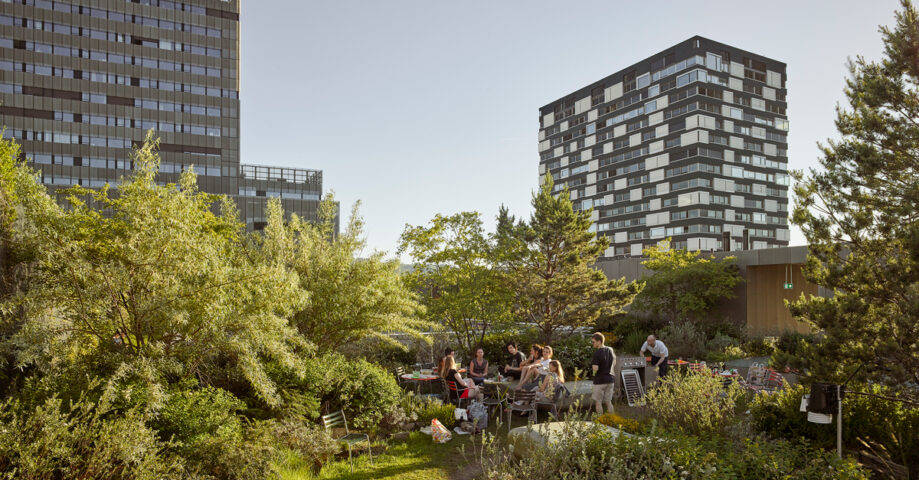
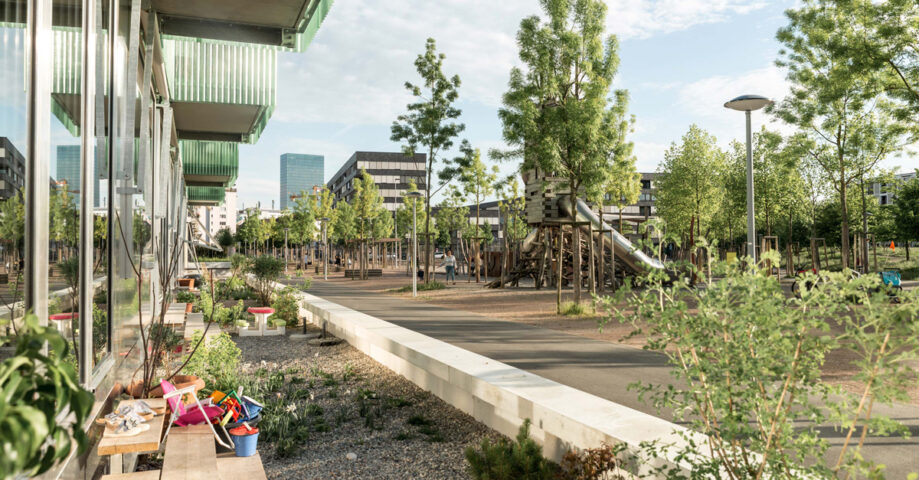
    Green spaces with shady trees and cold air corridors intended to bring cooling are often either entirely absent or inadequate, meaning heat islands form in urban areas – where temperatures can be up to ten degrees higher at night than in surrounding areas. A catalogue of measures tailored to each specific location is needed to counteract this heat island effect. Important principles for eco-friendly urban planning and building include building position and sizing, green areas, facades and roofs, and shading.

    Copyright Roland Bernath

    Moderate window proportions
    It’s not just exterior spaces that need to be planned and built in a climate-conscious way, but also the buildings themselves. To keep interiors as cool as possible when external temperatures rise, parameters such as building orientation, window surface areas and the building’s retention capacity are critical, starting at the design stage. Solid ceilings and floors, for example, store heat due to their mass and the room temperature rises more slowly. Windows also need special attention. Large-scale glazing is beneficial in that it lets abundant natural daylight into the interior and keeps solar heat input high in winter. In summer, however, this heat is undesirable. It is therefore recommended to avoid floor-to-ceiling windows as far as possible, and to strike a balance between aesthetics and comfortable temperatures. A window proportion of up to 30 per cent in residential buildings and up to 40 per cent in office buildings is a benchmark.

    Ventilation and cooling
    During long periods of hot weather, even a well-planned building heats up. It is extremely effective to dissipate the accumulated heat at night. This can be achieved by cross-ventilation, for example. Even better is to design a building that develops a chimney effect. Ventilation flaps in the façade – adjacent to the windows, for example – allow cool outside air to enter the interior and then discharge through an opening in the roof by way of the stairwell. Solutions like this entail no or minimal additional costs and work more efficiently than air conditioning units.

    Unlike residential buildings, today’s office buildings are often equipped with cooling systems. This is due to the high internal loads produced by users and IT infrastructure, not to mention the high proportion of glass in the façades. There are office buildings whose requirements for cooling and heating energy are now already identical. By 2100, office buildings could require up to ten times more energy for cooling than for heating, depending on climatic developments. This would presumably increase operating costs significantly and make it more difficult to operate buildings economically.

    An array of local energy sources
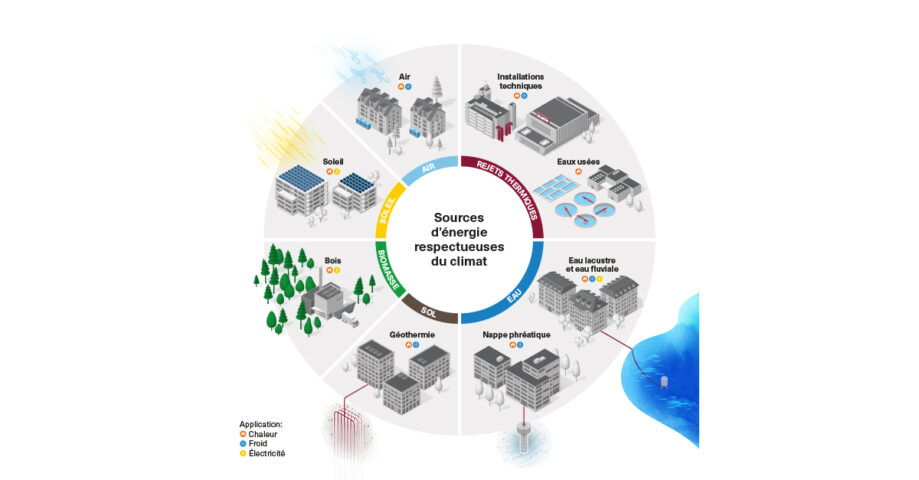
    Environmentally friendly passive cooling is ideal for meeting the basic cooling requirements of office and residential properties. Known as free cooling, there are various energy sources in Switzerland that are suitable for this.

    Geothermal heat accessed via probes is often used. In winter, thermal energy from the ground is used as a heat source, while in summer it serves also for cooling, because required temperatures are significantly below room temperatures. Lake water is another particularly suitable energy source, as the many Swiss lakes provide a valuable thermal storage mass. Because their shores are often densely populated, the lake water can be efficiently used to supply numerous buildings.

    Whether it comes from geothermal probes, lake water or other sources, it is crucial that cooling uses as little energy as possible. So it’s a good idea for building owners, investors and architectural specialists to discuss this issue with an energy service provider such as ewz as early as possible and see which options are feasible. This enables the construction of buildings that can offer high comfort levels even in the hot summers of the future, without placing an additional burden on the environment.

    Environmentally friendly heating remains important
    It is important to bear in mind that the cooling energy needed for residential buildings is relatively low compared to the heating required. Decarbonisation of heat supply must therefore remain a priority in order to achieve net zero. Sustainable heating is not a problem nowadays, with various technically mature and economically attractive renewable heating systems available.

    The ‘Climate-conscious building’ white paper provides in-depth information, detailed insights and a range of best-practice examples highlighting specific solutions for tackling this issue. The new white paper is free to download for all interested parties.

    https://www.ewz.ch/en/business-customers/real-estate.html

  • Whitepaper: Energetic renovations as an opportunity

    Whitepaper: Energetic renovations as an opportunity

    Knowing that the building sector is responsible for around a quarter of emissions, there is an urgent need to renovate the building stock. Because the few climate-friendly and energy-efficient new buildings will not have a major effect on the entire sector. At the moment we are in a renovation backlog. The current renovation rate of one percent must be doubled in order to achieve the climate targets.

    Practical experience shows that during renewal processes, too little attention is paid to energy-related refurbishment compared to replacement new buildings. The landowners often lack basic information that shows them the economic, ecological and social potential of energy-related renovations. The whitepaper is intended to make a contribution to precisely this. There is a basic overview of the urgency, legal framework, benefits, opportunities and possible strategies of energy-related renovations.

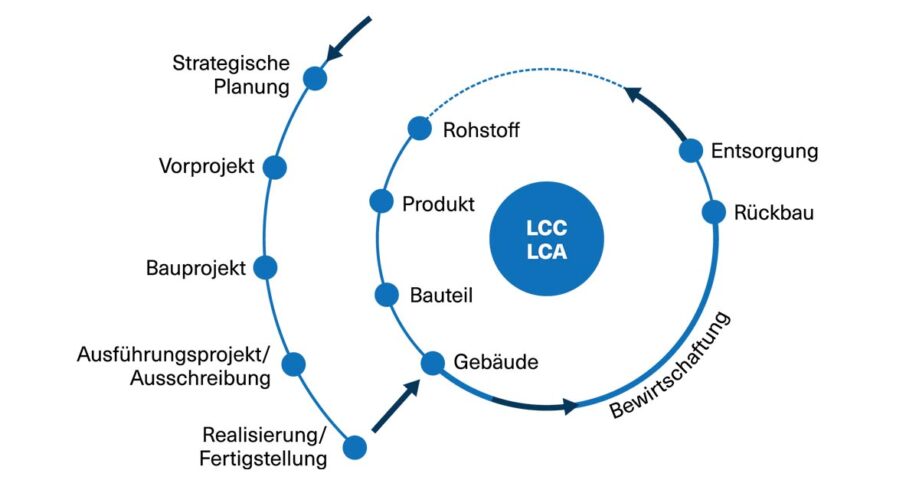
    The results of an ecological balance sheet (life cycle analysis, LCA) and an analysis of the life cycle costs (LCC), for example, form an excellent basis for decision-making. These quantitative assessment methods take into account the entire building life cycle.

    To the white paper

    Comprehensive redevelopment of the Webermühle housing estate
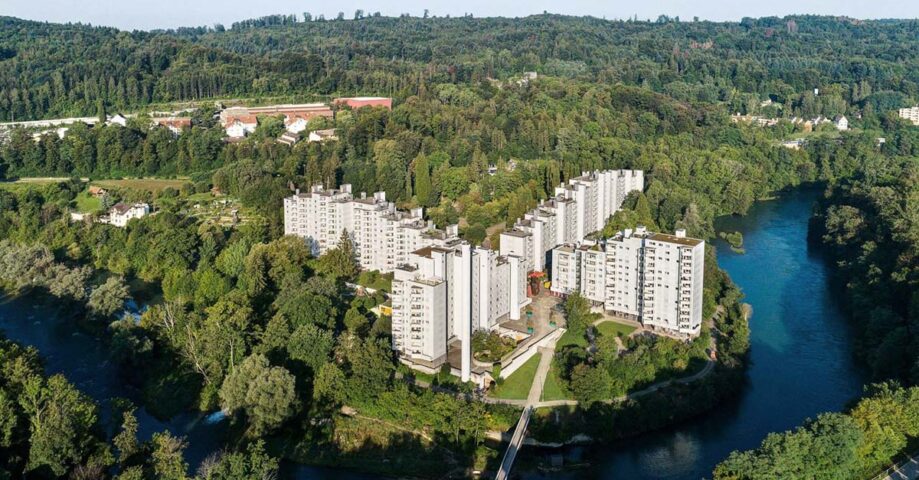
    One example of a successful renovation is the large Webermühle development in Neuenhof. The former Göhner settlement, which was occupied in 1984 and has been owned by a real estate fund from Credit Suisse Asset Management since 2008, houses 368 rental apartments with around 1,500 residents.

    The core of the energetic renovation of the Webermühle is the reorientation of the heat supply. To this end, the client defined a clear goal right from the start: in the future, the heat supply should be at least 70% CO₂-free. Due to the size of the facility, Credit Suisse Asset Management wanted to have the heating system replaced by a contractor instead of producing heat itself. The sustainability of the solution proposed by ewz with a river water heat pump convinced the client.

    Find out more