Tag: Wiederverwertung

  • Automated production for sustainable energy use

    Automated production for sustainable energy use

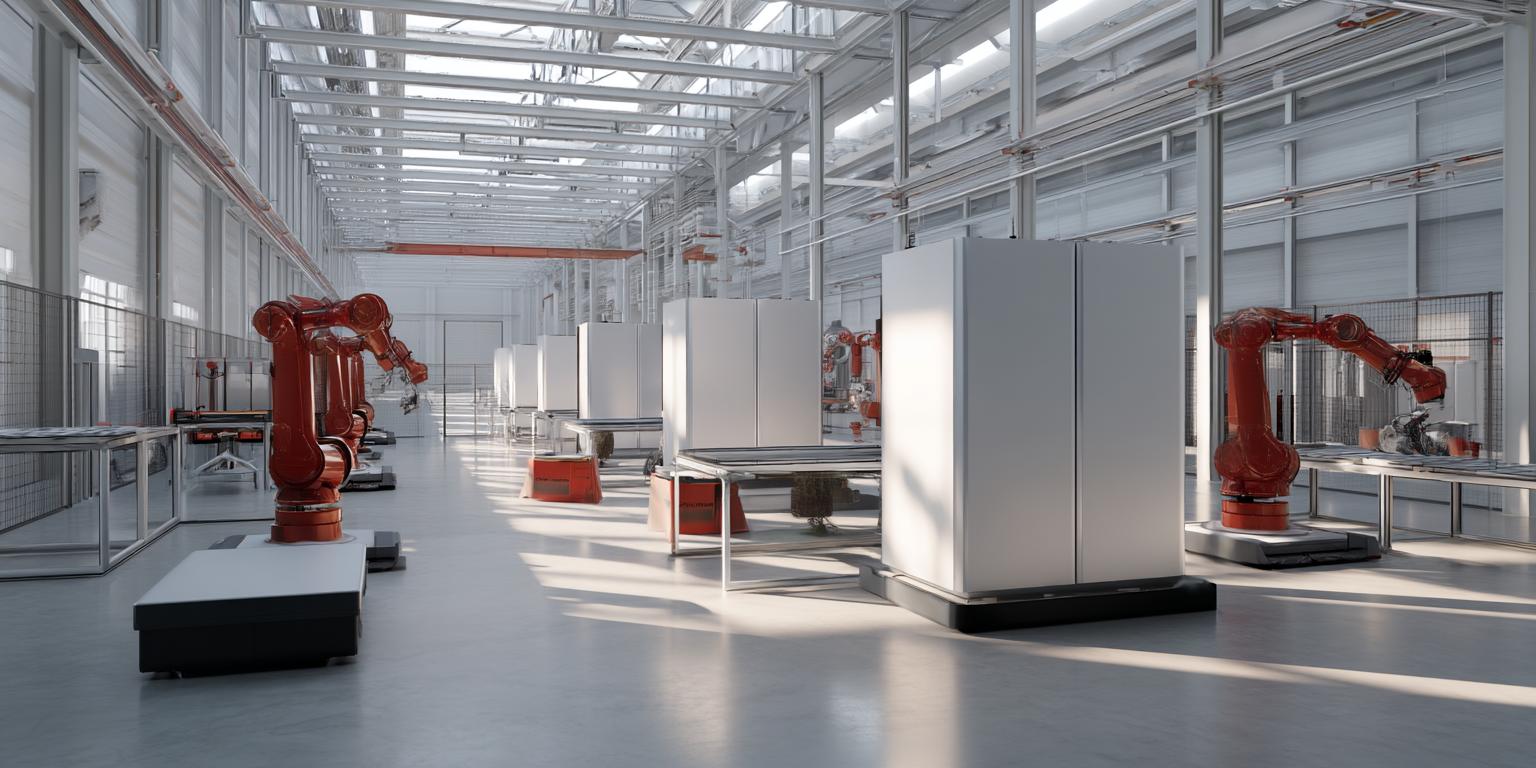
    Libattion AG, based in Opfikon, has opened a new plant in Biberist for processing used batteries from electric cars. Here, the batteries are used to produce modular stationary energy storage units. According to the company, this is Europe’s largest plant of its kind. The production facility was set up on the site also used by battery recycling company Librec.

    The new facility has a high degree of automation. “Our new production hall enables us to respond flexibly to market requirements and make an important contribution to conserving resources in Europe,” said Stefan Bahamonde, CEO and co-founder of Libattion, in the press release. “By automating our production, we can not only operate efficiently, but also economically and adapt our capacities precisely to demand.”

    In 2022, Libattion produced stationary storage systems with a total capacity of 7 megawatt hours; last year, the company already achieved a total capacity of 27 megawatt hours. The company aims to increase its total capacity to 500 megawatt hours by 2026. Libattion’s storage systems have a modular design and can have capacities ranging from 97 kilowatt hours to 60 megawatt hours. Safety is the top priority, explains Bahamonde: “Thanks to automated production and strict quality controls, we can guarantee the highest safety standards for every storage system”.

  • New player in the UK recycling market

    New player in the UK recycling market

    Holcim is acquiring the ballast recycling company Land Recovery, based in the British county of Cheshire. With its 85 employees, it uses railway ballast and demolition material for the production of ready-mix concrete, precast elements and asphalt.

    According to a press release, this acquisition expands Holcim’s access to construction waste. Land Recovery processed 300,000 tonnes of this material last year.

    “Land Recovery strengthens Holcim’s leading position in circular construction,” Holcim CEO Miljan Gutovic is quoted as saying. “This brings us closer to our Group target of recycling 10 million tonnes of construction waste in 2024.”

    Land Recovery was founded in 1982 by the Beecroft family. With four sites in the UK, the company’s services include the supply of primary ballast for rail transport, the handling and processing of spent ballast and its recycling into new construction solutions.

    The transaction follows Holcim’s acquisition last year of Sivyer Logistics, a manufacturer of recycled demolition materials for the London construction market.

  • Holcim launches platform for recycling construction waste

    Holcim launches platform for recycling construction waste

    Zug-based building materials giant Holcim has launched an internal digital platform for recycling construction waste. According to a media release, this is intended to efficiently distribute, process, shred and assemble demolition materials into new construction solutions. The platform, called ECOCycle, is designed to help in the transition of construction to circularity.

    This will reportedly allow Holcim to recycle 100 per cent of its construction waste. For example, decarbonised raw materials are reused in low-carbon cement formulations. Aggregates can be reused in concrete and fillers in road construction.

    “With our ECOCycle technology, we can build cities from cities by recycling 100 per cent of demolition materials for new solutions, so everything is reused and nothing is lost,” Holcim CEO Jan Jenisch is quoted as saying in the media release. Recyclable construction is imperative in the face of a growing world population and urbanisation.

    Holcim is currently building a residential complex in the UK that is half made of ECOCycle granulate. This granulate in turn consists entirely of recycled demolition material. In France, a residential complex is being built for which Holcim is using exclusively recycled concrete. And in Switzerland, the company offers a cement that consists of one-fifth old construction waste.

  • Zurich relies on Madaster

    Zurich relies on Madaster

    The real estate division of Zurich Insurance Group’s investment management is testing Madaster’s material passport in a housing project in Holland, Madaster Switzerland informs in a statement . All materials used in the building are recorded in the Madaster material pass. In this way future recycling of the material is made possible. Zurich wants to use the building ID card for future decisions about the development of its own real estate portfolio.

    “Through the data transparency of a material passport, we want to learn more about the impact of a building on people and the environment,” Roger Baumann, Chief Operating Officer and Head of Global Real Estate Product Development at Zurich, is quoted in the statement. “We hope to be able to identify new decision-making scope for a significant decarbonization of our real estate portfolio.”

    Madaster wants to strengthen the circular economy in the construction and real estate sector. To this end, it offers digital tools on its platform, such as material passports and indices for recording the economic and circular value of buildings. In addition, companies that are committed to the circular economy in the construction and real estate sector are networked. “We want to show that buildings are dynamic systems whose value retention can be realized through data transparency,” explains Marloes Fischer, Managing Director of Madaster Services Switzerland.

  • Graubünden promotes recyclable building materials

    Graubünden promotes recyclable building materials

    Graubünden wants to increase the demand for recycled building materials. As the Canton now tells , he has to this end, together with the Association of Grisons concrete and gravel industry developed a brochure. It is intended to show project developers and building owners the possibilities of using recycled building materials.

    Every year around 250,000 cubic meters of mineral construction waste are delivered to the 42 processing stations in the canton of Graubünden. That corresponds roughly to the volume of 1,300 single-family houses. As the canton further explains in its announcement, concrete demolition is already being recycled and used in new concrete structures.

    However, mixed demolition and road pavement are often not returned to equivalent circular applications, but are used loosely, for example in foundations or deposited in landfills. That is neither ecologically nor economically sensible. That is why the message passed by the government on the Green Deal Action Plan provides for measures to close material cycles and to increase the recycling of building materials.

    What is often missing is the demand for these recovered building materials. In terms of price, they would be on par with the primary materials. They also offer the added value of a sustainable use of resources. However, it is often overlooked that building materials are also polluted with CO2. The brochure now presented shows "for all conceivable applications in civil engineering which recycling products can be used".

  • Sika sets new standards in the recycling of concrete

    Sika sets new standards in the recycling of concrete

    According to a message from Sika , the Zug-based building materials group has "developed a new, groundbreaking recycling process for old concrete". With the help of additives, the demolition material is broken down into its components pebble, lime and sandstone. In addition, around 60 kilograms of CO2 per tonne of old concrete would be bound, writes Sika.

    "In the five largest EU countries alone, around 300 million tons of old concrete are produced annually," Sika CEO Paul Schuler is quoted in the press release. "By completely recycling, up to 15 million tons of CO2 emissions can be saved."

    The new process allows the complete recycling of concrete waste, explains Sika in the press release. Conventional processes, on the other hand, have only made it possible to recycle around a third of the raw materials recovered. The new concrete obtained in the reCO2ver process, on the other hand, comes close to that of new concrete in terms of quality.

    According to Frank Hoefflin, reCO2ver is a unique method in the industry for recycling old concrete. "We are already working on developing chemical additives and means to continuously improve quality in order to further advance the industrialization of our technology," explains the head of technology at Sika in the message.