Tag: Wirtschaftlichkeit

  • Energy-efficient refurbishments pay off

    Energy-efficient refurbishments pay off

    In a study,Wüest Partner has analysed the economic viability of energy-efficient renovations to the Swiss residential building stock. Two scenarios were analysed for all 931,000 residential buildings that are not yet sustainably heated, the service provider for the real estate industry explains in a press release on the study. In the first scenario, a comprehensive energy refurbishment was analysed, in the second scenario only the replacement of the heating systems.

    In terms of ecological sustainability, both scenarios fulfil the requirements of the Climate Act, explains Wüest Partner. The property service provider’s experts put the investment requirement up to 2050 at between CHF 52 billion and CHF 228 billion. This is offset by increases in value of between 81 billion francs in the case of pure heating replacement and 168 billion francs in the case of comprehensive energy-efficient refurbishment.

    Replacing heating systems alone is therefore economically attractive across the board. In the case of comprehensive energy-efficient refurbishments, investments and increases in the value of the building stock balance each other out overall. In the case of apartment blocks with rental properties, a good half of the refurbishments can cover the costs. In the case of owner-occupied housing, the financial benefit increases due to the considerable savings in heating costs.

    The falling heating costs also benefit tenants of refurbished properties, as they generally more than compensate for a possible increase in net rents, writes Wüest Partner. “Purely energy-efficient refurbishment of rental flats can therefore be socially acceptable, so that ecological sustainability does not have to stand in the way of social sustainability.”

  • Future development of residential construction activity in Switzerland

    Future development of residential construction activity in Switzerland

    A study by property consultants Wüest Partner, headquartered in Zurich, concludes that residential construction activity in Switzerland will pick up in the medium term. The rise in interest rates in the years 2021 to 2023 has slowed down construction activity and thus the growth of the property stock. This has led to falling building land prices, according to a press release from the Federal Office for Housing(BWO) on the study. Building will therefore become more economical again in the medium term. In addition, the higher reference rate for rents has increased income. This is also stimulating construction activity.

    The housing market is currently in a transitional phase, after which equilibrium will be restored. However, the expected increase in construction activity is likely to be lower than before the interest rate hike. In March, the Swiss National Bank lowered the key interest rate again from 1.75 per cent to 1.5 per cent.

    Wüest Partner conducted the study “Rise in interest rates: effects on residential construction and prices” on behalf of the BWO. It analysed the development of interest rates and construction activity between 2021 and 2023.

  • Sustainability & profitability – achieving returns with climate-friendly, intelligent energy solutions.

    Sustainability & profitability – achieving returns with climate-friendly, intelligent energy solutions.

    Integrated and intelligent
    Integrated energy solutions combine different energy sources and technologies to achieve high energy efficiency and flexibility. Intelligent energy management systems are used to optimise energy consumption and reduce CO2 emissions. They help to reduce operating costs and increase property value. IWB offers companies in the construction and real estate sector carefree packages for a high return on investment. Customers can choose between centralised, decentralised or combined solutions depending on their location and portfolio strategy. To achieve an optimal sustainable energy supply and use, the early involvement of the energy partner is crucial.

    Sustainable and economical
    Implementing renewable energies and intelligent energy management systems not only saves costs and increases the value of properties, but also achieves environmental sustainability. A good ESG score is becoming increasingly important and can also influence financing options.
    Property owners can reduce CO2 emissions and optimise the energy consumption of buildings by using photovoltaic systems and climate-friendly heating solutions such as heat pumps or district heating from renewable sources. Intelligent energy management systems monitor energy consumption in real time and regulate it by automatically controlling heating, ventilation and cutting off energy peaks.

    Sensible and profitable
    Investing in good energy solutions and intelligent energy management is sensible and profitable for a sustainable real estate portfolio. With IWB as a partner in the field of energy and sustainability, companies in the real estate sector can benefit from customised, efficient and smart solutions. The focus is on developing individual solutions tailored to the specific needs and goals of the customers. Together, they can invest in a sustainable future that offers not only ecological but also economic benefits.

  • Photovoltaics: Economic and ecological benefits for real estate owners

    Photovoltaics: Economic and ecological benefits for real estate owners

    Enormous solar potential
    After a steady increase over the years, photovoltaics recorded a record increase in 2020. According to the "Solar energy statistics" of the Federal Office of Energy (SFOE), around 118,000 photovoltaic systems with an output of almost 3 gigawatts were installed at the end of 2020. The strong market growth continued in 2021, so that according to Swissolar, photovoltaics (PV) today covers more than 6 percent of Switzerland's electricity requirements. Experts assume that this trend will continue, not least in view of the efforts towards much more energy independence.

    Ecological and economic advantages
    Photovoltaic systems bring a whole range of advantages for owners of real estate portfolios. On the one hand, they can protect themselves against rising electricity prices. On the other hand, they already meet possible future self-production specifications today. Also with regard to subsidies, new rules will make the production of solar power more attractive in the future. In addition, portfolio owners with their own solar systems benefit from a clear reputation advantage.

    In most cases, PV power from your own roof is cheaper than power from the grid. The fact that power consumption due to heat pumps and electromobility will continue to rise in the future contributes to the financial attractiveness of PV systems. Improving the ecological balance sheet is also becoming increasingly important, because sustainability aspects are part of the strategy of more and more companies. Furthermore, PV systems are also interesting because they increase the value of real estate. If the photovoltaic systems produce more electricity than can be consumed on site, it is possible to use the solar power in other properties.

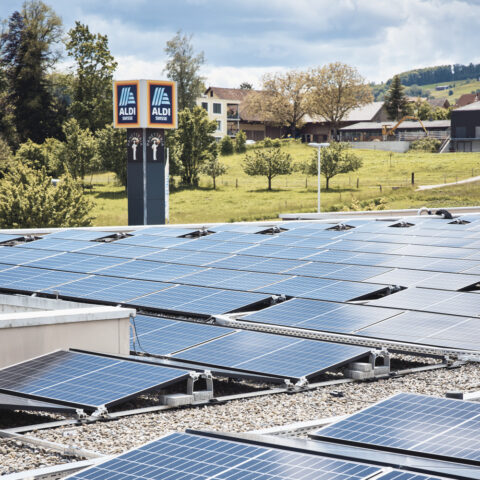
    In the ALDI SUISSE solar project, for example, sustainability and cost-effectiveness play a key role. In just over a year, ewz equipped 68 store roofs between Romanshorn and Geneva with photovoltaic systems. ALDI SUISSE uses most of the solar power itself for its own branch operations. Thanks to the large PV systems, the implemented solution enables a high solar yield with an average self-consumption of 55 to 60 percent.

    High self-consumption increases profitability
    There is already a heat pump in around 90 percent of new buildings, and new registrations of electric cars are continuing to rise sharply. However, heat pumps and electric vehicles are only really low in CO2 if they use renewable electricity. The combination with a photovoltaic system therefore makes sense: Solar power reduces CO2 emissions, and high self-consumption increases the profitability of the PV system. This is because the production costs for solar power are lower than the electricity tariff for households and because the energy suppliers pay a low tariff for the solar power fed into the grid.

    A good way of using a large part of the solar power yourself is to organize several end users in a group for self-consumption (ZEV). These are possible both in rental properties and among property owners. The degree of self-consumption of photovoltaic systems is on average 30 to 40 percent. This value can be significantly increased with self-consumption solutions.

    A large part of the electricity is used on site through the targeted control of consumers such as heat pumps or electric vehicles. The advantage for property owners and their tenants: the cost of solar power, at 8 to 16 centimes per kilowatt hour, is lower than the electricity tariff for households, which costs 15 to 25 centimes per kilowatt hour.

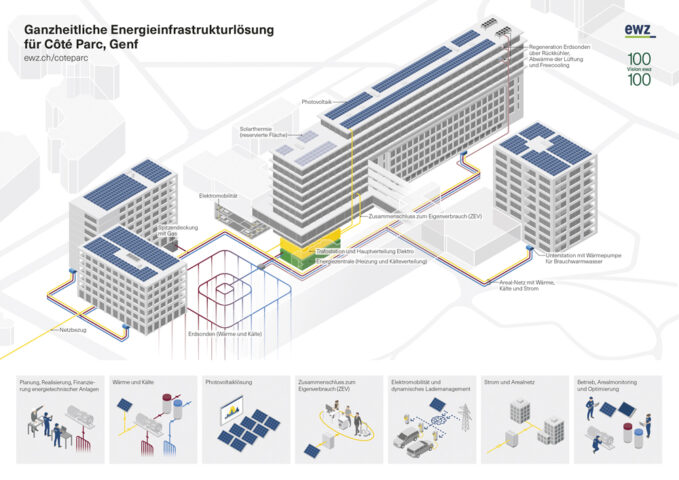
    An interesting practical example of this is the "Côté Parc" project in Geneva. 776 photovoltaic panels on the roofs of the area form the basis for an integrated solar solution with heat pumps, charging stations for electric cars and the area's own power grid, including self-consumption for the users.

    For property owners with large roof areas (from approx. 700 m2), a contracting model is an option worth considering. The provider takes over all services – from planning to financing, implementation to operation over several decades. Including the integration of photovoltaic systems, it is a holistic energy solution with heating, cooling, electromobility and self-consumption models.

    Business customers of ewz can rely on efficient and tailor-made solutions from competent teams with many years of experience. Investment, maintenance and repair costs are not incurred during the contract period. After the end of the contract period – usually 20 to 30 years – the photovoltaic system becomes the property of the customer.

  • Holistic solar solution for ALDI SUISSE

    Holistic solar solution for ALDI SUISSE

    The project is about sustainability and profitability: Photovoltaic systems with a total output of around 15,000 kWp were installed on around 70 store roofs. If you add up the systems, you get one of the largest solar energy projects in Switzerland. It will produce around 14 million kilowatt hours of electricity per year, which corresponds to the consumption of around 5,300 households. In this way, the retailer makes a valuable contribution to the sustainable energy supply in Switzerland – and at the same time can significantly reduce its operating costs.

    The electricity from the systems is used by the shops themselves, which – like all retailers – consume a relatively large amount of energy because of the many refrigerated shelves, the oven, the heating and the lighting. In addition, where available, the solar power is used in the e-charging stations next to the branches and, if there is excess, fed into the grid.

    Time pressure as a challenge and opportunity
    At the end of 2019, ewz Energy Solutions was awarded the contract to build the systems. In close cooperation, ewz developed a pilot system with its subsidiary SunTechnics Fabrisolar and another partner. This procedure made it possible to use the know-how of all those involved and to clarify technical questions in advance. ALDI SUISSE’s extensive requirements for the construction process, safety requirements and functionality were also taken into account. ewz prepared the rollout during the pilot phase and continuously incorporated the findings from the construction of the first systems. The time pressure thus proved not only to be a major challenge, but also an opportunity. Because of the almost simultaneous construction of the 70 or so plants, many synergies could be used, which enabled efficient implementation.

    Elaborate static test
    Before the modules were installed, each roof had to be statically tested. This is particularly important for existing buildings, as the additional loads from modules, fastening systems and cast concrete blocks are high. For each store roof, the specialists used calculation software to create a ballast plan that specifies the number and positioning of the modules. The modules are usually set up in an east-west direction. A southern orientation would also be possible in principle due to the high direct solar radiation at midday, but over the course of the day the east-west orientation proves to be more profitable.

    Maximum solar yield
    “When planning, we didn’t look at the size of the house connection, but at the available roof area and the maximum number of modules we could place there,” says Roland Jucker, overall project manager at ewz. The goal of ewz was clearly to generate as much solar yield as possible. However, this fundamental decision presented the planners with a number of challenges. The biggest was to integrate the PV system into the existing power supply of the branches.

    The electricity produced by the PV system is primarily used directly in the ALDI branch to cover its own consumption. If the branch is using less electricity than the PV system is producing, the excess electricity is fed into the grid. The electrical house connection must therefore be matched to the maximum output of the PV system (e.g. sunny Sunday with maximum production and low self-consumption). However, because this situation occurs extremely rarely and only for a short time, strengthening the house connection would be disproportionately expensive.

    The solution is dynamic power control. It is constantly measured how much electricity the PV system is currently producing, what the consumers are drawing and how much electricity is being fed back into the grid. If the feedback current is above a certain limit, the control unit gives the command to the inverter to throttle the power. The house connection fuse cannot be overloaded and self-consumption is not restricted.

    Thanks to the large PV systems, the solution implemented for ALDI SUISSE enables a very high solar yield with an average self-consumption of around 60 percent.

    ALDI SUISSE has concluded a contracting agreement with ewz
    To put it simply: ALDI SUISSE provides the roofs and, as far as possible, obtains the solar power to cover the electricity consumption directly in the branch. The PV systems belong to ewz, which is also responsible for maintenance, billing and renewal. The “carefree package” also includes the overall coordination of the project, obtaining building permits, remote monitoring and the use of residual electricity.

    Roland Jucker, overall project manager at ewz says: “The idea of equipping as many roofs as possible with a standardized PV solution is visionary”. “In the end, around 45,000 modules were installed.” Jucker is particularly proud of the fact that the installation was able to take place during ongoing operations. “We had to be off the network for 30 minutes after closing time – that was the only interruption.”

    Christoph Deiss, Head of the Energy Solutions division at ewz, says: “I am not aware of a similar project in Switzerland. In this way, ALDI SUISSE is making a valuable contribution to climate protection together with us.» Christoph Deiss emphasizes the great experience: “We have been using photovoltaic technology for over 30 years – we have been a solar pioneer from the very beginning.” Thanks to its great know-how and many years of experience, ewz prevailed against around a dozen competitors in the tender. “ewz is a Swiss company with locations in Zurich, Graubünden and Vaud,” emphasizes Christoph Deiss. “Thanks to the regional operating teams, we guarantee the highest security of supply and short response times.”

    Further information at: ewz.ch/aldisuisse