The canton of Aargau will rejoin the Greater Zurich Area (GZA) on 1 January 2027. This was decided by the Grand Council at its meeting on 13 January. It is providing CHF 5.5 million for membership of the location marketing organisation for the first four years. In its proposal, the cantonal government had requested CHF 8.5 million for six years.
In its deliberations in November, the preliminary consultation committee pointed out that, compared to the rest of Switzerland, the canton’s population is growing at an above-average rate, but its economy is growing at a below-average rate. Joining the location marketing organisation was a “clear opportunity to attract new value-added jobs to the canton,” it wrote in a statement at the time. It justified its request to reduce the initial period from six to four years by citing concerns about competition among the member cantons. The shorter period would allow for careful assessment of the effectiveness of membership.
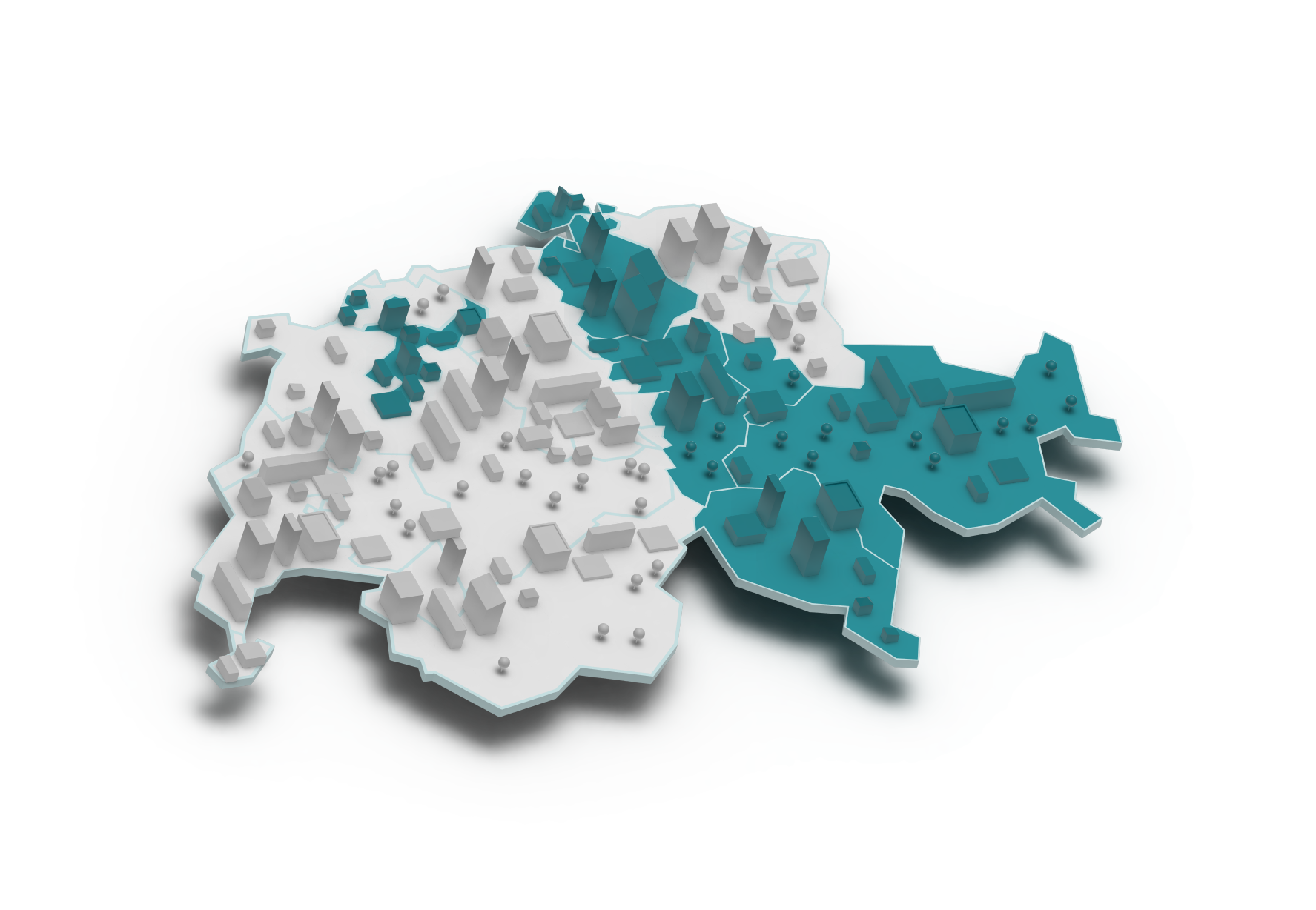
The Greater Zurich Area includes the cantons of Glarus, Graubünden, Schaffhausen, Schwyz, Solothurn, Ticino, Uri, Zug and Zurich. It promotes the Zurich economic area in the USA and China in particular, with the aim of attracting high value-added companies to settle there. Aargau was a member of the GZA between 2007 and 2010.
On 13 January, the Grand Council also approved economic development in areas with potential. This will allow groups of municipalities with economic potential to join forces to promote their location professionally. The focus will be on establishing business contacts and brokering sites and land. The canton will cover 50 per cent of the costs. The Grand Council has now approved CHF 4.5 million for this purpose.
At the beginning of April 2025, representatives from Lucerne municipalities and regional development agencies met for the third “Location and economic development in the municipalities” forum. The event was organised by Lucerne Economic Development and the Association of Lucerne Municipalities. The forum at Lucerne University of Applied Sciences and Arts focussed on the question of how municipalities can strategically secure and develop areas for economic activities.
Cantonal framework and digital tools After the opening by Ivan Buck, Director of Lucerne Economic Development, and VLG President Sibylle Boos-Braun, the Business Development team presented practice-orientated tools. These included a guide and the digital tool from start.swiss, which enables automated welcome processes for new companies in the municipality. A step towards efficient administration and location management.
Cantonal planning as a driving force André Duss from the canton of Lucerne presented the planned measures for the development of workplace areas in the draft cantonal structure plan. The focus was on areas for the expansion of local companies and attractive locations for new settlements. Coordination between the canton and municipalities is to play a central role in this.
Regional practical examples provide impetus Specific projects were used to illustrate how municipalities are already taking action today. LuzernPlus demonstrated successful area management with LuzernNord, flanked by developments in LuzernSüd, LuzernOst and Rothenburg-Station. The Sursee Plus pilot project, presented by Matthias Senn, also showed how densified construction in work zones can also work for land-intensive companies. Florian Furrer from Schüpfheim gave an insight into the municipal process of zoning new employment areas, an example of forward-looking planning at municipal level.
Municipalities are actively shaping the future with The forum made it clear that location and business promotion starts locally. Innovative approaches, digital tools and targeted cooperation between the canton, municipalities and regions are creating new spaces for entrepreneurial development. Lucerne shows how the future is being realised.
The Unteres Bünztal region now has its own specialist office to promote the regional economy. The Bünztal Economic Development Agency commenced its activities at the beginning of April, the new agency announced in a press release. “With the new economic development agency, we are strengthening our region in the long term and sending out an important signal for future-oriented economic development,” said Arsène Perroud, President of the Lower Bünztal Regional Planning Association.
Claudia Heger will take over the management of the Bünztal Economic Development Agency. The 37-year-old business economist studied public and non-profit management in particular. Heger has gained extensive experience in location promotion in previous roles, including for Wirtschaftsregion ZUGWEST and IDEE SEETAL, according to the press release. “I am looking forward to working with the municipalities, companies and partner organizations to further develop the economic potential of the Bünztal region and make it visible,” the new Head of Economic Development Bünztal is quoted as saying.
Bünztal Economic Development is to act as a “bridge builder between the economy, authorities and educational institutions”. Current tasks relate to the cantonal development focus Wohlen-Villmergen and the Wil/Huebächer business park. The Unteres Bünztal region includes the Aargau municipalities of Büttikon, Dintikon, Dottikon, Hägglingen, Hendschiken, Othmarsingen, Sarmenstorf, Uezwil, Villmergen, Waltenschwil and Wohlen.
In terms of location marketing, 2024 surpassed previous years in terms of quality, size and excellence. These are the results of GZA ‘s activities in the past year. As the location promoter explains in a press release, the GZA supported a total of 91 international companies in their expansion projects in this “year of top quality” together with the public location and economic development agencies of the joint economic area.
The GZA describes it as “particularly pleasing” that four out of five of these relocations came from the actively marketed key technologies of cleantech and artificial intelligence, the strategic focus for 2024. “In 2025, sustainability and innovation will become even more of a strategic focus for the GZA,” Managing Director Lukas Huber is quoted as saying. “Since the beginning of 2024, we have been evaluating projects not only in terms of economic aspects, but also from an ecological and social perspective.”
According to GZA, the most significant new additions include companies such as Revolut, Anthropic, OpenAI, the Robotics and AI Institute, BYD and Estun Automation. The strong international focus of these new companies confirms the attractiveness of the Zurich economic area for companies from the fintech, robotics, electromobility and artificial intelligence sectors.
The Starlab Space project also deserves special mention. The Greater Zurich Area is thus also positioning itself as a central innovation location in the future sector of the new space economy. “The location factors that make up the success of the Greater Zurich Area – from quality of life and security to tax attractiveness, entrepreneurial-minded administrations, infrastructure and talent pool – must continue to be actively cultivated,” summarises GZA Chairman of the Board of Directors Dr Balz Hösly.
The canton of Lucerne is planning an investment offensive to promote the location. Due to international tax developments such as the OECD minimum taxation, the canton is “losing its competitive advantage of low corporate profit taxes for large international companies”, explained the cantonal state chancellery in a press release. Specifically, there are fears that affected companies will relocate or limit their investments in the canton. The cantonal government wants to counteract this with targeted investments in the canton as a place to live and do business.
A proposal submitted for consultation by the cantonal government on 10 March envisages investing CHF 300 million a year in a broad package of measures from 2026. “The canton of Lucerne is doing well, so we have the opportunity to invest in our living and economic environment and remain attractive in the long term,” said Fabian Peter, Head of the Cantonal Department of Building, Environment and Economic Affairs, in the press release. “That is the aim of this bill.”
Two thirds of the funds will be used to strengthen the business location. The focus here is on promoting innovation and improving the framework conditions for digitalisation, the availability of business premises and customer-oriented administration. Of the remaining CHF 100 million in favour of the people of Lucerne, the lion’s share of CHF 70 million is earmarked for a reduction in the tax rate for natural persons.
Six projects from Baden AG, Neuchâtel, St.Gallen, Thusis GR, Greater Geneva Bern area and Central Switzerland have been nominated for the Network Location SwitzerlandAwards 2024, the umbrella organization of Swiss location and business promotion agencies announced in a press release. A total of twelve projects applied for the annual award for targeted, effective and innovative projects in the areas of location marketing, location development and business promotion. The nominees will have the opportunity to present their projects to a jury in mid-September.
The nominees are the city center project BAUZONE 5400 – submitted by the BAUZONE 5400 consortium and the city of Baden, the Jimmy Jackson marketing campaign – submitted by the Greater Geneva Bern area, the Industrial Smart Map platform – submitted by the canton of Neuchâtel, the DynREK 2.0 planning tool – submitted by OSRI AG, the Sankt location marketing campaign – submitted by the City of St.Gallen location promotion agency and the Thusis location STORY – submitted by Viamalastorys.ch AG. They were evaluated according to the criteria of strategic approach, organizational form, relevance for stakeholders, innovation, practical relevance and long-term impact.
The jury will select the winning projects from the nominees in September. The award ceremony will take place as part of the Dialog conference on November 21 at the Wankdorf Stadium in Bern. At the same event, Network Location Switzerland will also honor the location manager of the year.
As the current service contract with Generis AG expires at the end of 2024, the Schaffhausen government decided to put the mandate to manage the economic promotion and regional and location development office out to public tender at an early stage. Generis AG prevailed over its competitors in the two-stage tendering process.
Extension of the mandate until 2032 The new service contract comes into force on 1 January 2025 and ends on 31 December 2032, ensuring continuity and stability in location development in the canton of Schaffhausen.
Future-oriented measures Generis AG will continue its successful work, with a particular focus on digitalisation and demographic challenges. Close collaboration with local and regional partners remains central to this.
Trust and stability The Schaffhausen cantonal government sees the renewed award of the mandate to Generis AG as a confirmation of its previous successes and expects it to further strengthen Schaffhausen as a business location.
Lukas Huber is to head Greater Zurich Area AG(GZA). The Board of Directors of the location marketing organisation has appointed the relocation expert, who has been working for the organisation since 2002, as the successor to Sonja Wollkopf Walt, GZA announced in a press release. Wollkopf Walt will be leaving the location promotion organisation at her own request at the end of 2024. A symbolic handover of office will take place on 20 August as part of GZA’s 25th anniversary celebrations.
Lukas Huber joined GZA as an analyst in 2002. The business economics graduate later took over responsibility for the Life Sciences division. The designated Managing Director is currently COO and Market Manager Asia for the location marketing organisation.
“We would like to thank Sonja Wollkopf Walt for her many years of outstanding work and her constant 100 per cent commitment to the Greater Zurich Area AG,” said Balz Hösly, Chairman of the Board of Directors of GZA, in the press release. “With Lukas Huber, GZA will be able to continue on its successful course and expand its focus on innovation, sustainability and a strong market presence.”
In the same press release, GZA announces a change to the Board of Directors. Reto Bleisch, Head of the Office for Economy and Tourism of the Canton of Graubünden, will replace Christoph Schärrer. The Delegate for Economic Development of the Canton of Schaffhausen is stepping down from his post as scheduled. “This change is part of GZA’s corporate governance, which aims to reflect a variety of perspectives on the Board of Directors,” the press release explains.
In 2023, the Vaud Economic Development Agency provided financial support for 733 business projects. Support for internationalisation increased by almost 20%, while support for the cleantech sector rose by 23.7%, reflecting the growing importance of innovation in the energy and climate sector. The number of branches of foreign companies remained stable at 28 new branches.
Network and partnerships Isabelle Moret, Head of the Department of Economy, Innovation, Employment and Heritage (DEIEP), emphasises the importance of a strong network: “In 2023, more than a thousand companies and project promoters benefited from the Vaud government’s support measures, particularly in the areas of innovation and sustainability.” These measures supported 3722 jobs.
Strong growth in the medtech sector Vaud start-ups raised CHF 444 million, with 29 of them among the top 100 best start-ups in Switzerland. The medtech sector is particularly noteworthy: 52% of investments in medical technology across Switzerland were channelled into Vaud start-ups.
Attracting foreign companies Innovaud, the agency for the promotion of innovation and foreign investment, supported the establishment of 28 new companies in the canton of Vaud. The life sciences sector had a particularly strong presence, accounting for more than a third of the new companies.
Promotion of research and development The innovation parks in the canton of Vaud were home to a total of 661 companies and 8326 jobs at the end of 2023. The new unlimitrust campus and the expansion of the EPFL Innovation Park with the Ecotope project are examples of growth and support for research and development.
Support from the Innovation Promotion Fund The Innovation Promotion Fund was endowed with an additional CHF 50 million in 2023. This fund supports the Foundation for Technological Innovation (FIT) and various programmes such as Tech4Trust, Trust Valley’s leading acceleration programme for start-ups, and FIT Impact for young projects in the field of impact entrepreneurship.
Sustainability as a central task Sustainability plays a central role in the 2022-2027 legislative planning. The “4-season tourism” framework credit of CHF 50 million aims to improve the quality and sustainability of tourism infrastructure. in 2023, 84 projects totalling almost CHF 4 million were supported to help companies make the transition to sustainability.
A strong economic ecosystem The PESI also supported organisations such as Innovaud, which accompanied 328 companies and contributed to the creation of 31 new companies. Genilem, specialised in project diagnostics and entrepreneurship consulting, supported 24 companies. The Foundation for Technological Innovation (FIT) awarded over CHF 4 million in grants and loans to start-ups.
Regional economic promotion and territorial advertising The regional economic promotion offices supported 712 companies and provided over 1,000 services. Vaud Promotion encouraged 165 local producers to label their products with the VAUD CERTIFIES D’ICI label. The attractiveness for tourists increased by 8.6%, with most visitors coming from Switzerland, France and the USA.
These comprehensive measures and partnerships emphasise the successful strategy of the Vaud Economic Development Agency, which focuses on sustainability, innovation and strong networks.
The location promotion programme of the federal government, regions and cantons can record the relocation of a total of 206 companies to Switzerland in 2023, the Conference of Cantonal Directors of Economic Affairs(VDK) announced in a press release. Once a year, it compiles statistics on the number of foreign companies relocating to Switzerland. As in previous years, companies from the life sciences and ICT sectors dominated the new settlements in the reporting year. Four out of ten new relocations came from the USA, Germany or France.
The 206 companies that relocated last year helped to strengthen cantonal and regional value creation. They have already created 640 jobs throughout Switzerland in their first year of operation. Over the next three years, the number of new jobs is expected to rise to a total of over 2500.
The national location promotion, which is a joint task of the federal government and the cantons, has commissioned the official Swiss organisation for export promotion and location promotion Switzerland Global Enterprise(S-GE) with the national promotion activities. The service agreement for 2024 to 2027 between the Confederation, the cantons and S-GE reinforces the focus on innovative and sustainable industries and technologies. Quality takes precedence over quantity. For example, the companies located here “should also contribute to strengthening the entire regional and local value creation as well as the SME landscape with their innovative expertise in their network”, according to the press release.
The Economic Development Agency of the Canton of Fribourg, or WIF for short, supports companies wishing to expand their activities in the canton or relocate here. It is also responsible for implementing the New Regional Policy (NRP) in the canton. Last year, the WIF supported a total of 40 company projects and 23 NRP projects. Of the business projects, 24 were expansions and 16 were new establishments. The majority of the 16 new establishments (10 projects) came from Switzerland. One example of a Swiss new establishment is the Algaltek GmbH project, which has settled on the AgriCo-Campus in St-Aubin. Algaltek is a biotech spin-off of the EPFL and specialises in the production of algae.
Strengthening 1000 jobs in Fribourg companies In addition to expansions and new settlements, projects are also helping to strengthen existing jobs in the long term. Last year, around 1000 jobs were secured in the canton thanks to WIF measures. One example of this is SMG Swiss Marketplace Group AG in Flamatt. The WIF supported SMG in its search for a new location in order to retain the 160 jobs in the canton of Fribourg. The choice fell on the bluefactory site in the centre of Fribourg, an attractive location that is easily accessible for employees from all over Switzerland and especially from western Switzerland. The move is planned for the second half of 2024. “The work of the Economic Development Agency is geared towards the long term,” said State Councillor Olivier Curty, Director of Economic Affairs and Vocational Training. “Every year, its work has a profound impact on our economy, both quantitatively and qualitatively, which pleases me.” WIF Director Jerry Krattiger also emphasised that the WIF is increasingly supporting research and development projects. “The importance of R&D projects in Fribourg companies is increasing. in 2023, we supported 13 such projects, 6 of which were co-financed by Innosuisse at federal level.”
The municipality of Mellingen wants to reorganise its location promotion and take a proactive approach. To this end, it has engaged Hofer Kommunalmanagement AG for location promotion, the municipal administration announced in a press release. The consultancy firm from Rinken will provide services for the establishment of new companies, economic and residential location promotion and location communication.
Statistics show that Mellingen needs more jobs, writes the municipal administration. It wants to meet this need by attracting new, sustainable companies. In addition to the old town, the upstream neighbourhoods on both sides of the Reuss are also included in the corresponding reorganisation of location promotion.
Hofer Kommunalmanagement AG uses its self-developed Systemic Municipal Management method for its services. The service contract now signed with the municipality of Mellingen was preceded by a seminar for the entire municipal council and meetings of a prepared working group.
Mr Roth, you are qualified to practise law, were head of department at the Financial Intelligence Unit of the Principality of Liechtenstein in Vaduz and managed the Musikkollegium Winterthur. What prompted you to accept the position of Director of the House of Winterthur in 2020? Samuel Roth: I found it very exciting to be working at the interface between business, education, tourism and culture and to be so committed to the Winterthur region.
What have you been able to achieve in the almost three years since you took office? Roth: It was important to me to focus our activities on our core competences of communication and networking. This enables us to raise the region’s profile as a technology location, education centre and cultural city. To this end, we have put together an attractive programme of around 40 events per year. The “Tech Lunches” are particularly popular: our guests can visit production companies or attend the events on the topic of “House Culture”, where we visit the Winterthur Music Festival with our members, for example.
Ms Lomoro, House of Winterthur was created in 2017 from the two associations Winterthur Tourismus and Standortförderung Region Winterthur. The city is thus operating a special model: topics such as business, tourism, education and culture are united under one roof. What are the advantages? Antonietta Lomoro: The various stakeholders now only have one point of contact for location promotion issues instead of two, as was previously the case. Marketing for the region now comes from a single source. We also promote mutual networking between the various stakeholder groups.
What synergies have been achieved through the joint presence? Lomoro: Today’s workforce attaches more importance to a good work-life balance. They appreciate the great leisure and cultural activities on offer in the Winterthur region. Employers make sure that their employees can work in an attractive location where the quality of life is right as well as the economic conditions. It therefore makes sense to promote these locational advantages from a single source.
How many people does House of Winterthur employ? What is the budget? Lomoro: House of Winterthur currently employs 20 people in full-time equivalents. The budget is CHF 3.5 million.
Winterthur has a diverse economy, a lively old town, a high-calibre cultural offering and a prestigious university of applied sciences. Why is it necessary to market a city that has so much to offer? Roth: Winterthur may be the sixth largest city in Switzerland, but it is often underestimated. It is therefore important that House of Winterthur showcases the region’s qualities as an outstanding technology location, practice-oriented education centre and great cultural city.
How is House of Winterthur being received by the population and companies? Lomoro: The population of Winterthur approved the establishment of House of Winterthur by a clear majority in 2017. After the original subsidy agreement with the city expired, the city parliament extended the agreement for a further five years without a dissenting vote. The activities of House of Winterthur have met with a positive response from companies, as evidenced by the lively participation in our events.
How have House of Winterthur’s membership figures developed over the last three years? Lomoro: Since the beginning of 2020, the number of members has risen by 20 per cent to a total of 420.
“Tourism has recovered almost completely since corona “
How attractive is Winterthur as a business location? Roth: Every year, we conduct a business survey in which over 300 companies take part. The last survey showed that almost 87 per cent of companies are fairly or very satisfied with the general conditions in Winterthur. This is due to the proximity to universities and the good availability of skilled labour. the city is also attractive for start-ups. For example, the “Start-up Nights”, Switzerland’s largest start-up event, takes place in Winterthur every year. What measures are you taking to further increase its attractiveness? Lomoro: With “Winterthur 2040”, the city council has defined how it wants to make Winterthur fit for the future. Our task is to emphasise the advantages and opportunities of the entire region.
Which sites, properties and locations are currently most sought after by companies? Lomoro: We have received many enquiries – namely for the Sulzer site in the city centre and The Valley in Kemptthal. We are currently seeing a strong increase in interest in space in Neuhegi and in the centre of Effretikon.
Which regulations are in urgent need of adjustment? Roth: For the economy, any regulation is one too many. Sometimes, however, regulations are needed to promote the interaction between living and working, to enable short distances and to revitalise public spaces and achieve a high level of diversity of use.
How do you expect Winterthur as a business location to develop over the next 10 years? Roth: The number of jobs has developed in proportion to the population growth of around one per cent per year in recent years. We therefore assume that not only construction activity will contribute to further economic growth, but also that new technology companies will settle in Winterthur. In addition, our company survey has shown that almost half of the companies surveyed are planning to invest in the coming years. The Winterthur region can therefore look forward to rosy times.
How is the city positioned in terms of tourism and where is it today? Lomoro: Tourism has almost completely recovered since coronavirus and – measured by the number of overnight stays – is only 15 per cent below the record year of 2019. The most important tourist attractions in the region include the Rhine Falls and Technorama, followed surprisingly by the Skills Park in third place. FC Winterthur and Pfadi Winterthur are also crowd-pullers. The city of culture scores with the international appeal of its museums, the wide variety of festivals and the International Short Film Festival, as well as the Casino Theatre and the Musikkollegium Winterthur.
Last year, House of Winterthur reduced the number of board members. What were the reasons for this? Roth: With the previous 15 to 16 board members, the board was too large. This meant that the individual Board members were not able to contribute enough. According to the Articles of Association, the Board may now only have a maximum of 9 members, which greatly increases the efficiency of the Board’s activities.
Are further internal changes planned in the coming years? Roth: House of Winterthur is basically on track. The Annual General Meeting will elect a new Board of Directors on 25 May. It will review the strategy and make any necessary adjustments.
Mr. Zettel, what are the goals of the Lucerne Economic Development Agency?
We pursue three main goals. The first is exciting and good jobs for our population. The second is to generate tax revenue for the services provided by the canton and municipalities. And the third is the positive perception of Lucerne as a business location, both internally and externally.
What are your responsibilities as Head of Corporate Development?
As Head of Corporate Development, my main focus is on the existing companies of the Canton of Lucerne. We have just over 30,000 companies and support them in developing positively. Most of our projects with companies revolve around their location. For example, when a company grows, its needs change. In this context, questions about expansions or a change of location may arise. What are currently the biggest challenges facing companies? Issues around limited resources such as building land and commercial space often pose challenges to businesses. Another major issue is currently the shortage of skilled workers and labour. There are currently major uncertainties, such as the Ukraine war or inflation. This also includes issues such as energy prices and supply bottlenecks. These challenges show us once again how dependent we are on what happens outside Switzerland.
What are currently the most important construction projects in the canton of Lucerne?
The entire canton of Lucerne has a high level of construction dynamism. A lot is currently going on in the two development focal points of Lucerne North and Lucerne South. The new central cantonal administration is being built in the Smart City Lucerne North. In Lucerne South, many projects are already underway, such as the Nidfeld site or the Pilatus Arena with the Pilatus Tower, Lucerne’s tallest skyscraper. The Horw campus of the Lucerne University of Applied Sciences and Arts will be expanded and renovated by the end of this decade.
What makes Canton Lucerne an attractive place to live?
In Canton Lucerne there is something for everyone. We have great places to live and very different regions and landscapes. We have a great city with a wonderful cultural offer. We have lakes, mountains and a tourist offer that is also available to the population. All this makes Lucerne an attractive overall package. Moreover, Lucerne is a manageable place in terms of size. You can integrate well here, we have many clubs and great events. Overall, the quality of life in Lucerne is outstanding.
What about free and affordable housing in the Canton of Lucerne?
Housing is also an issue in Lucerne. We have a vacancy rate of just under one percent. That is an average value: some communities have practically no vacant flats, in others there are definitely offers. It’s the same with prices: while housing in the city of Lucerne, for example, is relatively expensive, there are also municipalities where there are cheaper offers. At the same time, a lot is being built. That is also the most important thing at the moment: that construction projects are realised and new flats come onto the market quickly.
Besides the city of Lucerne, which municipalities are particularly popular with companies?
We have 80 great municipalities in the canton of Lucerne, and each municipality has its own strengths. In terms of the number of companies, the large municipalities in the agglomeration such as Emmen, Kriens, Horw and Ebikon are important locations in addition to the city of Lucerne. Sursee, the second centre of the canton, is also attractive for companies due to its location. But there are also many great companies in regions such as Willisau or Hochdorf, especially in industry. This broad and diverse economic structure is one of Lucerne’s strengths.
Why should a company come to Lucerne instead of Zurich, Bern or Basel?
The central location in the middle of Switzerland is a big plus. You can get to Basel or Zurich quickly, but also to Italy or Germany. In addition, we have very attractive corporate taxes, a broad educational landscape and a good skilled workforce.
Where does Canton Lucerne stand in terms of digitalisation?
I look at the topic primarily from the perspective of the economic structure. For example, we have many IT service providers who specialise in digitalisation. For most companies, the topic has been around for a long time. But digitisation doesn’t stop there. The transformation into a digital business model is ongoing, and new topics are constantly being added. We also take up these topics. Last year, for example, we co-founded a hub for artificial intelligence. This makes the topic of AI visible and helps companies in its application. We also support companies in networking with suitable partners for digitalisation projects.
As an economic developer, you have a relatively young profession. What distinguishes this profession for you?
I come into contact with an incredible number of interesting people – be it from companies, from politics or from the administration. In addition, we are at the source of new ideas and projects. Professionally, this job also has many facets: from business administration to spatial planning and real estate to politics and communication. For me, it is a privilege to be able to do this work.
Of the 41 projects supported, 25 are business expansions and 16 are business relocations. Of the 16 relocations, 3 are from Switzerland and 13 from abroad. These include the Japanese company Epson, which has set up in the Marly Innovation Centre, and the Brazilian company Carob House in Fribourg. Among the expansions, the projects of Immomig in Düdingen and Wago Contact in Domdidier are worth mentioning.
Although the WIF devoted considerable resources to it in 2022, the Rolex project is not included in the figures in the annual report. The project will take shape in 2023 with the finalisation of the spatial planning and construction process and the establishment of temporary production and training facilities. This project of exceptional scope and quality will strengthen Fribourg’s industrial base and accelerate the canton’s competences in the fields of automation, robotisation and, more generally, Industry 4.0.
Olivier Curty, State Councillor for the Economy and Vocational Training, told the media conference: “Fribourg companies have demonstrated their resilience over the last few years and months, and neither the global pandemic nor the war in Europe can stop them from investing and creating new jobs. The canton of Fribourg is continuing its economic development successfully and vigorously
WIF Director Jerry Krattiger summarises: “The WIF has had a good year despite the difficult global economic context. After the Council of State defined the bio-economy and Industry 4.0 as the main axes of the cantonal economic development strategy almost three years ago, the Canton of Fribourg has successfully continued its positioning in these areas
New regional policy with 15 new projects Under the 2020-2023 implementation programme of the New Regional Policy (NRP), 15 projects were approved last year, with a contribution of CHF 1.35 million. These projects are divided into the following areas: Community projects (9), programme for mountain regions (3), tourism (2) and new themes (1).
Work has also started on the NIP implementation programme 2024-2027. Industry and tourism remain the two priority themes. New cross-cutting themes include the local economy, sustainable development and digitalisation. In addition to its usual activities to support the creation, establishment and development of businesses and its activities in the field of NRP, the WIF has finalised the last COVID business support package last year.
You have been a member of the government since 2011 and are running for a fourth term in April. What do you like about your current position as Finance Director of the Canton of Lucerne?
Even after 12 years, I consider it a privilege to be a government councillor in the Canton of Lucerne. For me, it is an exciting, varied and challenging task. As Finance Director, I take care of IT, real estate and personnel in addition to finances. I enjoy these cross-sectional functions and the resulting responsibilities. Our department is allowed to provide the resources that the other departments need in order to provide the corresponding services to the population.
Where do you see the greatest challenges at the moment?
From an overarching perspective, mobility and sustainability are among them, along with health care. Within the Finance Department, we have several interesting real estate projects that we are allowed to push ahead with – for example, the expansion of the Horw campus. With a budget of 365 million francs, this is the largest project in the Canton of Lucerne to date. We have also just submitted the building application for the cantonal administration at Seetalplatz in Emmen. We want to bundle the administration in this new building for about 175 million francs. One of the challenging tasks is the ongoing search for a location in the city of Lucerne for the Lucerne Museum and the Cantonal Court. Since we need several thousand square metres of space for both, the project is not entirely simple.
You are currently working on the revision of the Tax Act 2025. Are global uncertainties such as the climate problem or the war in Ukraine being taken into account?
In the Canton of Lucerne we are registering a very positive development. The tax law reform is intended to create the conditions for the Canton of Lucerne to remain an attractive location for natural persons and legal entities and to develop optimally. In 2000, we still had debts of 2.5 billion francs – today we have net assets of more than 300 million francs. We have achieved this thanks to an ambitious and demanding tax and financial policy. In parliament, we discussed a climate and energy report and are implementing the corresponding measures. The situation in Ukraine naturally affects many areas. Taking the current situation into account, we have created a stable foundation for the tax law reform and are looking forward to it positively.
You see yourself as a bridge builder between city and country. Where do the discrepancies lie?
In addition to the city and the agglomeration as an urban centre, there are many agricultural regions, especially in Lucerne’s hinterland. It is precisely this diversity that makes the canton interesting. We are centrally located, easily accessible and can offer attractive local recreation areas. In this respect, I don’t want to talk about discrepancies, but about different starting points. It is our task to keep these differences in mind in all decisions. An agglomeration city has different needs than a rural community in the Entlebuch. Thanks to the cantonal financial equalisation system, we can offer comparable services to the population in all municipalities.
You completed an apprenticeship as a draughtsman and then studied to become a civil engineer. To what extent does the knowledge you acquired then flow into your current job?
I am a great friend of the dual education system: vocational training is not better or worse than the academic path. It is simply different. During my apprenticeship, I learned to take responsibility for the work I do and to do it very accurately. This benefits me in my current job as finance director. Especially in the real estate sector, I know how construction projects are set up and I know the processes. Basically, an education like the one I enjoyed is a good basis for a broad range of tasks.
What strategy are you pursuing in your department in terms of digitalisation?
I am convinced that the digital transformation is an important basis for the further development of our society and economy. In this respect, we have developed a digital strategy that is geared towards the entire canton and is intended to ensure its future-oriented development. Within the administration, we want to provide our services in a contemporary – i.e. digital – manner. We have launched the service portal together with the Lucerne municipalities. It is intended to offer communal and cantonal services online. The plan is to create a digital gateway for all public services in the Canton of Lucerne. Our aim is not only to find an optimal solution for the administration, but also one that makes life easier for the residents.
What makes the Canton of Lucerne attractive for companies?
We offer good framework conditions, for example in profit taxation, which we halved in 2012. As a result, we were the canton with the lowest profit taxation of legal entities for several years – this has had a positive effect. With the planned revision of the tax law, we are ensuring that we will continue to be an attractive business location in the future. But our educational institutions are also an important factor. We have consciously invested in education and belong to the rather younger education cantons. We also benefit from our central location and the sufficient space available for businesses. We are aware that we are in a competitive environment with the neighbouring cantons. We have to move constantly in order to remain attractive.
The Canton of Lucerne relies on a special model for economic development.
Correct. We are the only canton in Switzerland that does not regulate business promotion at the cantonal level, but has outsourced it to a foundation. The companies are represented there as partners of the cantons and municipalities. We are convinced that it is important that the business community has a say in decision-making and feels valued. That is why we attach great importance to the maintenance of the existing business community and want to ensure good framework conditions for the private sector. We strive for qualitative growth and receive good feedback for our model.
What is the situation regarding urban sprawl in the Canton of Lucerne and what is being done about it?
We support the economical use of land and try to promote this with legal foundations. Densified building is the order of the day in our structure plan and in the communal zoning plans. Due to the Federal Spatial Planning Act, we now have 21 municipalities that have to reduce their building zones by up to 70 hectares – so-called rezoning municipalities. This is not an easy process, but we are keeping at it. With our structure plan, we want to enable development and at the same time take care of our cultural landscape.
There is a housing shortage, especially in the centres. What measures must be taken to alleviate the situation?
The public sector alone cannot solve this problem. What is needed here is interaction between the private sector, investors and the public sector. We create incentives for dense building by allowing higher utilisation. In addition, we make suitable areas available for residential buildings, such as at Seetalplatz or in Ebikon. In this way, around 200 flats can be realised.
Stack Infrastructure Switzerland SA is building a large data centre in Beringen by 2025. The Swiss subsidiary of the globally active specialist for large data centres wants to achieve the highest possible energy efficiency. The engineering company Amstein + Walthert has now prepared a feasibility study for the use of waste heat for heat networks on behalf of the Schaffhausen building department.
According to the study, the energy requirement of the data centre in its final configuration is 30 megawatts, the thermal waste heat capacity 9 to 15 megawatts, and the waste heat quantity at least 79 gigawatt hours per year. Of this, a maximum of 26 gigawatt hours can be used for thermal grids.
The feasibility study concludes that the thermal energy of the data centre can be used for the expansion of an existing thermal network in Beringen and for three new networks. The canton, the city of Schaffhausen, the municipality of Beringen and Stack now hope that companies will show interest in setting up and operating such heating networks. According to a statement by the cantonal energy office, the cantonal economic development agency is acting as a contact for interested parties.
The Swiss Association for Location Management SVSM has been presenting the SVSM Awards since 2007. These are awards for particularly innovative projects in the fields of location marketing, location development and economic promotion. For the 2022 awards, 14 applications were received – from municipalities, cities and organisations from Lake Constance to the Upper Valais. A jury evaluated them on the basis of defined criteria and nominated six projects for the 2022 Awards. The nominees then had the opportunity to present their project to the jury. The presentation of the coveted awards finally took place at the beginning of November at the Capitol in Olten as part of the “SVSM Dialogue on Economic Promotion” conference. The SVSM Award 2022 went to the Upper Valais Regional and Economic Centre for the “valais4you” project, which aims to promote the immigration of skilled workers. According to Katharina Hopp, jury president of the SVSM Awards and SVSM board member, the regional cooperation and exemplary collaboration between the private and public sectors were the deciding factors in the jury’s decision: “The various contact points and services cooperate across sectors and thus cover the various needs of newcomers. In addition, the jury found the agile organisational form, which can react flexibly to requirements, to be particularly innovative,” said Hopp in her laudation.
The jury president was also able to award a second prize on the stage of the Capitol: a special SVSM recognition prize. This went to the Stadtufer cooperative, which is promoting the conversion of the old spinning mill in Lichtensteig, Toggenburg. According to Katharina Hopp, the young, fresh organisation has defied a difficult environment and adverse circumstances: “The jury would like to appreciate the commitment of the cooperative, which has given the project charisma at local and regional level and created an example of innovative location promotion in rural areas, with the recognition award.” The jury president also paid tribute to all the other nominees who received a nomination certificate.
As part of the SVSM Awards, the SVSM also honours a deserving personality as location manager of the year. in 2022, Christoph Lang, CEO of the Zurich Airport Region FRZ, received the award from Sonja Wollkopf Walt, CEO Greater Zurich Area and jury member of the SVSM Awards. In her laudation, Wollkopf Walt noted that Christoph Lang was not only an undisputedly deserving location manager, but had also played a significant role in shaping the SVSM, as he had been a member of the board since the association was founded in 1998 until 2008.
The Swiss Association for Location Management SVSM has been presenting the SVSM Awards annually since 2007. These are awards for particularly innovative projects in the areas of location marketing, location development and business promotion. 14 applications were received for this year's awards – from municipalities, cities and organizations from Lake Constance to Upper Valais. A jury evaluated these based on defined criteria and nominated the following six projects for the 2022 awards:
• “Big Air Chur” city event – submitted by the city of Chur's business contact point
• Conversion of the old spinning mill in Lichtensteig – submitted by the Stadtufer cooperative
• "valais4you" project to promote the immigration of skilled workers –
submitted by the regional and economic center of Upper Valais
• Joint project "BIGNIK" to strengthen identification –
submitted by REGIO Appenzell AR-St.Gallen-Bodensee
• “Werkstadt Zürisee” to develop the Rütihof workplace area –
submitted by the city of Wädenswil
• Launch of the integrated location promotion for the Zurich Oberland –
Submitted by the Zurich Oberland Promotion Association
With the nomination, however, the applicants are not yet guaranteed an award: At the end of August, all nominees have the opportunity to present their projects to the jury. The jury consists of the following experts: Katharina Hopp, jury president and board member SVSM; ambassador dr Eric Jakob, Head of the Directorate for Business Promotion SECO; Pascal Jenny, President of Arosa Tourism; Karin Jung, Head of Office for Economy and Labor Canton of St.Gallen; Prof. Dr. Markus Schmidiger, Head of the Real Estate Competence Center
University of Lucerne; Sonja Wollkopf-Walt, CEO Greater Zurich Area.
The awards will be presented on Wednesday, November 2, 2022, as part of the hybrid conference "SVSM Dialogue Economic Promotion" in the Capitol cinema in Olten. Incidentally, the location manager of the year is also honored at this event.
With the “SVSM Dialogue” series of events, the Swiss Association for Location Management SVSM imparts specialist knowledge and connects location managers, business developers, real estate experts, spatial planners and other interested parties. At the upcoming spring event, which will take place on March 31, 2022 from 3 p.m. to 6.30 p.m., practical presentations from Upper Valais, the city of Baden and the Wil region will provide valuable technical input for day-to-day work. At the “SVSM Dialogue on Location Management”, three exciting speakers will use case studies to show practical solutions and strategies and discuss current challenges: Thomas Lütolf, Head of Location Promotion City of Baden, will present the regional economic vision of the Baden North district. Anne Rombach-Jung, managing director of REGIO WIL, talks about the future of WILWEST and Esther Schlumpf, project manager at the Upper Valais regional and economic center, deals with the question of whether governance can be a success factor for regional development.
Be there – on site or via live streaming The “SVSM Dialogue Site Management” is held as a hybrid event: The participants either attend the event on site in the unique ambience of the garden hall of the Villa Boveri in Baden or join the event virtually – the entire event is streamed live and offers thanks to a special Event platform also gives virtual participants the opportunity to interact. After registering online, all participants will receive a personal participation link with which they can log into the event via a browser. The event is free for members of the SVSM. Non-members pay a fee of CHF 50. If a membership is registered during or after the event, this amount will be refunded.
SVSM Awards for innovative projects In addition to the hybrid specialist conferences, the “SVSM Awards” are another focus of the SVSM. These will be awarded again in 2022 after a two-year break due to the pandemic. The awards are aimed at small and large projects – from local to national. The “SVSM Awards” want to make the variety and quality as well as the innovative strength of projects from all over the country visible and thus strengthen the position of the corresponding organizations and initiatives. The “SVSM Awards” are both an incentive and a reward for those involved in the area of location and business development. Projects with a particularly high degree of innovative strength are awarded. Possible examples are location strategies, area developments and corresponding positioning, projects to promote innovation and business clusters, projects to establish or strengthen location brands, promotional activities and campaigns, events that strengthen a location, or organizational development and cooperation models. Applications for the awards are made using an online form. A jury of experts selects the nominated projects from all submissions. The nominees then have the opportunity to present their project to the jury in a virtual session. The announcement of the winning projects and the presentation of the awards will take place as part of the “SVSM Dialogue Economic Promotion” on November 2, 2022.
Further information and online application: https://svsm-standortmanagement.ch/awards
The umbrella organization for location promotions The Swiss Association for Location Management SVSM is a professional association founded in 1998. It enables the interdisciplinary exchange of information and experience, links teaching, research and practice, promotes professionalization in site management and is the contact for questions about site management. The SVSM currently has around 80 members from the areas of location and business development, c, real estate as well as training and further education. Twice a year, the SVSM organizes the hybrid conference “SVSM Dialog”; in spring with a focus on topics related to location promotion, in autumn with a focus on economic development. After a break due to the pandemic, the trade association is again presenting the “SVSM Awards” this year for innovative projects in the area of location management and business development. At the beginning of October, the SVSM – also after a two-year break – once again organizes the popular guided visit to Europe’s largest trade fair for locations and real estate, the Expo Real in Munich.
Further information on the SVSM: https://svsm-standortmanagement.ch
Due to the corona situation, the first SVSM dialogue for business development did not take place as a hybrid event as planned, but as a purely virtual event. The event conveyed specialist knowledge and networked location managers, business developers, real estate experts, room planners and other interested parties. The speakers presented impressive practical examples from a wide variety of regions – from Montreux to Uri to St. Gallen – and also reported on challenges, organizational issues and experiences in the spirit of best practice. The participants received valuable input for their daily work. Thanks to dedicated question and answer sessions and a panel discussion, professionally moderated by SVSM board member Markus Müller, the professional exchange of experience and networking were not neglected.
Interaction between economy and tourism Stefan Büeler, Head of the Office for Economic Affairs and Public Transport in the Canton of Uri, demonstrated the approaches to economic development in Uri based on current projects such as tourism development in Andermatt, the Gotthard base tunnel or educational and research institutes. He also discussed which procedures and organizational forms have proven themselves in practice and which challenges need to be mastered in everyday life. Samuel Zuberbühler, head of location promotion for the city of St. Gallen, gave an insight into the "Sankt ohne Senf" campaign, with which the city in eastern Switzerland is marketing itself and residents, homesick St. Gallen and “newcomers” in a target group-oriented way. He impressively demonstrated how closely business, location promotion and tourism are related. This was also confirmed by Bernard Schmid, Managing Director of Promove. Schmid provided a glimpse of the working methods, structure and current issues of an economic development organization in French-speaking Switzerland: The Promove association aims to promote the economy in the Riviera-Lavaux region on the Swiss shore of Lake Geneva and connects authorities, business and tourism. The cooperation between the various areas, some of which are also organizationally linked, is correspondingly close. Schmid showed how this works in practice using the "Dolce Riviera" project, which was launched in 2020 and aims to integrate the entire tourism value chain in the Montreux Riviera destination.
The start of the new series of events was a success: The consistently positive feedback from the participants on the presentations shows that the SVSM is on the right track with the new event format. The next SVSM dialogue is already being planned, this time with a focus on location management. Make a note of the date – more information will follow: SVSM dialogue location management: Thursday, March 31, 2022, 3 p.m. to 7 p.m
Further information: Swiss association for site management SVSM office Ricketwilerstrasse 135 8352 Ricketwil (Winterthur)
For many years, the SVSM has organized the site management day every spring. On this all-day event, experts from location management, business development and the real estate industry as well as representatives from municipalities, cities and cantons met to listen to case studies, discuss industry-specific topics, exchange experiences and maintain their network. Due to the corona pandemic, the event in 2020 and 2021 could not be held. The board of the SVSM used this “compulsory break” to fundamentally rethink and redesign the event. The result is the new series of events «SVSM Dialog»: From autumn 2021, the SVSM will be organizing two half-day events every year – in autumn with a focus on business development issues, in spring on location management issues. In keeping with the spirit of the times, the events will be hybrid: interested parties can participate physically, on site, or thanks to live streaming virtually from their desks.
Practice-related presentations and exchange of experience The first SVSM Dialog Wirtschaftsförderung will take place on Wednesday, November 17, 2021, from 3 p.m. to 7 p.m. in the Capitol cinema in Olten. The event conveys specialist knowledge and connects location managers, business developers, real estate specialists, spatial planners and other interested parties. Three practical presentations with a focus on business development offer the participants valuable technical input for their daily work and use case studies to show possible solutions and strategies for current challenges. Stefan Büeler, Head of the Office for Economy and Public Transport of the Canton of Uri, uses current projects such as tourism development in Andermatt, the Gotthard Base Tunnel or educational and research institutes to demonstrate the approaches of Uri Economic Development. He also goes into which procedure and which organizational forms have proven themselves in practice. Samuel Zuberbühler, Head of Location Promotion City of St. Gallen, gives an insight into the marketing of the city in eastern Switzerland under the provocative title “Sankt ohne Senf” and shows how current issues – such as the revitalization of the inner city – are being addressed there. He also takes up critical points in order to enable a practical exchange of experiences. Bernard Schmid, Managing Director of Promove, provides a look at the working methods, structure and current issues of an economic development organization in French-speaking Switzerland: The Promove association aims to promote the economy in the Riviera-Lavaux region on the Swiss shores of Lake Geneva and connects authorities, Business and other important partners. An extensive aperitif at the end of the event – this part is also streamed live – offers the opportunity to maintain and expand your personal network.
With them – on site or via live streaming The event is carried out as a hybrid event: the participants either visit the event on site at the Capitol cinema in Olten or join the event virtually – the entire event is streamed live and, thanks to a special event platform, also offers virtual participants the opportunity to Interaction. After registering online, all participants will receive a personal participation link with which they can log into the event via a browser. The event is free of charge for members of the SVSM. Non-members pay a contribution towards expenses of CHF 50. If you register for membership during or after the event, this amount will be refunded.
Generis AG will continue to run the economic development agency for the canton of Schaffhausen until 2024. The same applies to the office for the promotion of regional and location development. The government council decided this at its meeting on Tuesday.
The service contract currently runs until the end of 2022. After that, it can be extended for a further two years for the last time. At the beginning of 2015, Generis AG was awarded the contract to manage both facilities.
As stated in a communication from the government council, Generis AG has “so far fulfilled its mandate very well. The results achieved to date in the field of business development represent a real success story. ”That is why the service contract is now being extended.
You, our members, are much more directly and substantially affected by the corona pandemic. Numerous location and economic promotions have had to experience that years of development work can become practically meaningless within a few weeks because of the lockdown or because of regional easing. Suddenly completely different factors were decisive for shopping, leisure and travel behavior, primarily the question: What is still allowed where? In such a situation – in which, in my view, federalism is reaching its limits – location and economic development can hardly exert any influence. To make matters worse: where the industry is struggling to survive, there is neither time nor energy, let alone money, left over to secure and promote regional location advantages. But right now it is important to think long-term, invest and expand on what has been achieved.
In these special times, we would like to thank you all the more for your loyalty to our association – even if you could not benefit from all the services to which you are entitled as part of your membership in 2020. We would also like to take this opportunity to thank our sponsors, UPC Switzerland and the electricity works of the Canton of Zurich EKZ, for their commitment. We very much hope that we can hold a half-day event as a new format in autumn 2021. Our general assembly in spring will also take place virtually this year. We will send you all relevant information and documents in the next few weeks. Of course, we will also keep you up to date on our annual program, including with our newsletter.
The Department of Economics of the Canton of Solothurn wants to strengthen the development of the location, according to a media release . In this context, the business development department is renamed the business development department. Organizationally, the department changes directly to the department secretariat.
The new name of the department is intended to express that it will deal more intensively with site development in the future. In addition, it should, for example, be more networked and cross-departmental when implementing projects within the framework of the location strategy or the new regional policy of the federal government (NRP).
In addition to site development, the support of companies in Solothurn and the processing of settlement projects will continue to be part of the core business of the department.
The SVSM was founded in 1998 as an umbrella organization for location and business promoters in Switzerland. While the focus was initially on city marketing, the fields of activity have expanded significantly since then: According to the approach of integrated location promotion, the SVSM is one of their around 90 Today, members not only include location and economic development agencies, but also tourism regions, real estate specialists, event agencies and educational institutions. To this changed framework To take this into account, the board of the SVSM met for a closed conference. The focus was on sharpening the association's profile, the services offered and the benefits for the members. In intensive discussions, focal points emerged and new tasks emerged. The main goals of the SVSM – enable the interdisciplinary exchange of experiences, promote professionalization and link teaching and practice – remain the same. However, members will be able to benefit from more services and improved networking opportunities in the future. The board members will now tackle the challenges of the association with a lot of motivation and commitment to develop further; Because everyone agreed: The SVSM is an important point of contact for all questions about location management.
Mr Zettel, the canton of Lucerne, all Lucerne municipalities and network partners from business and industry are making a financial and non-material commitment to Lucerne as a growing business and residential location. How do you rate their success? If we look back over the last few years, we can see the dynamic development of Lucerne as a business location. Between 2012 and 2017, the number of companies and jobs grew at an above-average rate compared to the rest of Switzerland. Over 2,000 companies and more than 15,000 jobs were created across the canton during this period. That is a national record. The joint efforts have therefore paid off. Last year, the number of companies again increased by over three per cent.
What makes the canton of Lucerne particularly attractive? I would emphasise the attractive combination of various location factors. Ultimately, this is what defines the quality of the location. In addition to the coherent hard factors such as low taxes, availability of labour and good accessibility, the canton of Lucerne is also scenically attractive and culturally exciting. Many tourists visit the Lucerne region every year. The tourist offers the local population also benefits directly from the tourist offers.
Back to the hard facts. Are there still areas available for companies to set up and develop? The market has indeed changed considerably in recent years. The availability of building plots and developed workspaces is a key challenge for the future. The new Spatial Planning Act sets tight limits. Zoning is only possible under certain conditions. As a result, the focus in future will clearly be on inward development and better utilisation of land. This also affects companies to a large extent, especially local SMEs. The property industry in particular is called upon to create new, attractive and affordable offers for these businesses.
Where do you see local opportunities for new businesses? Attractive new areas are being created in the new city centres of Lucerne South and Lucerne North. In the centre of the city of Lucerne, development is limited in terms of space, i.e. development here is taking place within the framework of site developments, which have to fill the last gaps between buildings and integrate into the existing city. From a regional perspective, this means that the city of Lucerne is expanding as a functional area and new, attractive city centres are emerging in the surrounding municipalities, which are excellently developed and can offer a new urban quality. Personally, I am a little concerned about the purely employment zones, as these have often been put to other uses in the course of inner-city development without any replacement. These areas are then lacking in commercial space.
So these areas are a scarce commodity? Well, this impression can indeed arise. However, a closer look reveals that there are still a considerable number of plots of land in the canton of Lucerne that are zoned but not yet developed. The question here is whether the landowners want to develop at all. We are noticing a certain tendency towards building land hoarding, which is clearly not in our interests. However, sometimes there is not only a lack of will, but also simply a lack of knowledge about how these areas could be developed. The prime sites in particular need to be developed very cleverly and sustainably so that the next generation can also benefit from them to the maximum.
What is the development strategy in the canton of Lucerne? Twelve so-called cantonal development centres (ESPs for short) have been defined in the current structure plan. These are large-scale employment areas in well-developed locations. The aim is to achieve qualitative development, whereby the coordination of settlement and transport also plays an important role. The ESPs are a central element of Lucerne’s location policy and an important instrument of joint economic promotion by the canton and municipalities.
Where are these development centres located? Due to their economic potential, they are orientated towards the main transport axes of the canton of Lucerne. They are mainly located in areas with good transport links, both by car and by public transport.
What is the status of these development centres? Very differently. While the Lucerne South and Lucerne North areas in the Lucerne city region, for example, are relatively advanced and are already being implemented, there is considerable potential for catching up in the two regional centres of Hochdorf and Willisau, for example. It is these areas that will increasingly become the focus of investors and developers in the coming years.
Where can I find out more about the individual development centres? Investors and interested companies can get in touch with us, as we have a good overview of the status of these areas and know all the contacts. In addition to the local municipalities, the four regional development organisations in the canton of Lucerne are also key to the development of these ESPs. These are LuzernPlus, Sursee-Mittelland, Region Luzern West and Idee Seetal. The positive interaction between the state and the economy is a core element of our joint economic policy. We want to further improve this. ■
Wir verwenden Cookies zur Unterstützung und Verbesserung unserer Dienste. Mit der Nutzung dieser Website erklären Sie sich mit der Verwendung von Cookies einverstanden. Weitere Informationen finden Sie in unserer Datenschutzerklärung.