Tag: Wissenschaft

  • Smart City Winterthur 2030

    Smart City Winterthur 2030

    Since the first smart city strategy in 2018, Winterthur has established itself as one of the most progressive cities in Switzerland. At that time, the focus was on quality of life and resource efficiency, supplemented by topics such as energy, mobility, education and health. With the revision of the strategy towards Smart City Winterthur 2030, the City Council is now focussing on new cross-cutting topics such as innovation, needs orientation and co-creation. These topics are crucial to meeting the requirements of a changing society.

    Two programmes are driving implementation
    The new strategy is being implemented through two programmes, the Innovation Programme and WinLab. The innovation programme supports employees of the city administration in the development and implementation of innovative projects. The aim is to strengthen the culture of innovation within the administration.

    The WinLab, on the other hand, acts as an urban real-world laboratory in which representatives from business, science, civil society and municipal institutions work together. In this creative space, forward-looking solutions for the city are developed and tested. Both programmes create scope for experimentation and promote sustainable innovations that meet the needs of citizens.

    A strategy for the future
    The Smart City Winterthur 2030 strategy comes into force on 1 January 2025 and is part of the long-term goal of shaping Winterthur as a sustainable and adaptable city. The strategy will be reviewed after five years at the latest to ensure that it continues to meet the needs of the city and its population.

  • First Swiss Hydrogen Congress

    First Swiss Hydrogen Congress

    The first Swiss Hydrogen Congress took place in Yverdon-les-Bains on 28 March. The event brought together entrepreneurs, experts from science and industry as well as political decision-makers. The diversity of the speakers made it possible to cover the topic from numerous angles. The first Swiss Hydrogen Congress was organised in collaboration with Planair, CleanTech Alps and the Western Switzerland H2 Network and was a complete success.

    Hydrogen is not a panacea for solving all of Switzerland’s energy problems, but it does offer numerous opportunities. The first Swiss Hydrogen Congress saw fruitful dialogue and strong collaboration. This demonstrates the importance of the topic for Switzerland, and everyone involved is willing to work together to strengthen the country’s competitiveness and build a sustainable energy future.

    What needs to be remembered from this day
    Representatives from the energy, gas and industrial sectors, entrepreneurs and politicians all agree that it is essential for Switzerland to be connected to the European grid. It is crucial that our country does not miss out on this opportunity.

    Another important point is the demand for a clear strategy and suitable framework conditions on the part of the federal government in order to drive the market forward.

    Despite the existing operational challenges, the congress was able to draw positive conclusions from ongoing projects such as Green Gaz in Aigle and Hydrospider. Participants were given an insight into the development of hydrogen projects such as H2 Bois, Gruyère Hydrogène Power and Prhysm.

    In addition, aeesuisse presented its positioning on the topic of hydrogen with the publication of the brochure “10 points on hydrogen”.

    A passion that transcends our borders
    Hydrogen is a hot topic now more than ever. It is moving experts and politicians beyond Switzerland’s borders. In Europe, discussions about its opportunities and risks are accelerating and are in full swing. Switzerland and its pool of expertise have a key role to play here. “We are currently experiencing a strong enthusiasm for hydrogen, with major announcements at international level. Switzerland is a leader in innovation in many areas, such as compression and storage. We must therefore consolidate our leading position and not allow ourselves to be overtaken by our European competitors,” says Laurent Scacchi, Director of Western Switzerland at aeesuisse.

  • Revolution in descaling technology

    Revolution in descaling technology

    The build-up of limescale in appliances that work with hot water is a challenge that should not be underestimated, both in households and in thermal power stations. The conventional removal of limescale deposits is often laborious and, in the case of large systems such as power plants, involves considerable costs and energy losses. Researchers at ETH Zurich have now presented a pioneering technology that has the potential to provide a comprehensive solution to this problem.

    The scientists have developed an innovative limescale-repellent hydrogel coating that uses a microscopic ribbed structure to prevent the adhesion of limescale. This structure, modelled on shark scales, reduces the direct contact of limescale crystals with the surface, making it more difficult for them to deposit. Tests have shown that up to 98 per cent of limescale deposits on a surface treated in this way can be avoided.

    This breakthrough in material technology is not only able to increase the efficiency of heat exchangers in power plants, but also to extend the service life and functionality of household appliances. In addition, the environmentally friendly hydrogel offers a biocompatible and chemical-free approach to limescale prevention.

    The developers have deliberately chosen not to patent and have made their findings public, encouraging the application of this pioneering technology in the property sector and beyond. This openness could significantly improve the efficiency of building operation and management by providing a simple and sustainable solution to a widespread problem.

  • Shaping Zurich’s future: First location day sets new accents

    Shaping Zurich’s future: First location day sets new accents

    On “Location Day”, an initiative of the Zurich Department of Economic Affairs, leading figures from business, science and the Zurich government came together to formulate joint visions for the future direction of Zurich as a business location. The aim of the event was to identify innovative ideas and measures through constructive dialogue in order to strengthen Zurich as a business location in the long term.

    The discussions focussed on the canton’s core strengths, such as its dynamic entrepreneurial landscape, cutting-edge research and education as well as its high-quality infrastructure. In a series of panels and workshops, topics such as technology, skills shortages, business development, mobility and sustainability were explored in greater depth. The workshops generated a large number of proposals that are now to be developed further in order to realise practical solutions for Zurich as a business location.

    A study on the attractiveness of the Canton of Zurich as a business location, prepared especially for the “Location Day”, served as a basis for discussion. It analysed key factors influencing the business location and identified both the canton’s strengths and areas with potential for improvement. Based on these findings, the participants were able to address specific areas requiring action and channel them into productive channels.

    Due to the positive response and the recognisable need for ongoing exchange between the various sectors, the Department of Economic Affairs has already announced that it will establish the “Location Day” as an annual event. This emphasises the Canton of Zurich’s commitment to further positioning and strengthening itself as an innovative and future-oriented business location.

  • Limmattal should actively shape its urbanisation

    Limmattal should actively shape its urbanisation

    Urbanist Thomas Sevcik assumes that the region between Schlieren and Turgi will increasingly become a city. In his publication “Limmattalstadt – Impulse für die Region entlang der Limmat” (Limmat Valley City – Impulses for the Region along the Limmat), he proposes to shape this urbanisation “actively and strategically”. “The Limmattal city will come anyway. But we should make it as good as we can,” he writes.

    Among other things, Sevcik proposes so-called neo-areas. These should close gaps between settlement areas. For example, a campus on part of the marshalling yard could offer space for a Hochschule Limmat, a computer centre, but also a congress and entertainment centre. A new residential quarter could be built between Neuenhof and Killwangen, and a future-oriented quarter for new forms of living and working in the Tägerhard to the east of Wettingen. In the Hard in Siggenthal, too, a new district could combine work, living and leisure.

    Sevcik points out that the Limmat has so far had little presence in the region. He suggests upgrading the river landscape in Dietikon to a riviera.

    Economically, the future Limmat Valley city should rely on its strengths in applied technology and design, logistics and trade, as well as medtech and biotech. Mobility in the region should be facilitated by the extension of the Limmattalbahn, the use of the railway line between Dättwil and Wettingen, cable cars and the bicycle network. Sevcik also proposes a take-off site for vertical take-off electric helicopters at the Würenlos motorway service station.

    Sevcik developed the strategy ideas on the initiative of the Limmatstadt Location Promotion Agency and presented them at the general meeting of Limmatstadt AG on 15 August. 20 companies, mainly from the region, supported the project. The publication can be ordered digitally.

  • Holcim creates 1.5 degree frames for cement industry

    Holcim creates 1.5 degree frames for cement industry

    Holcim announces the launch of the world’s first science-based framework for decarbonizing the cement industry . This emerged from a partnership with the Science Based Targets Initiative ( SBTi ). Previously, Holcim independently of the SBTi, together with a group of experts from academia, civil society and industry, had developed such a framework to achieve the decarbonization of the industry “in a rigorous and science-based way”. The building materials producer has realigned its own net zero climate targets for 2030 and submitted them to the SBTi for validation.

    For the first time, cement companies have a clear plan “on how to align their decarbonization strategies with climate science,” Alberto Carrillo Pineda, co-founder and CTO of SBTi, is quoted in the release. “The shift to low-carbon technologies is critical to the long-term viability of the industry.” That’s why the SBTi encourages all cement manufacturers to “set science-based targets and play their part in building a climate-resilient economy.”

    “With the growing population and increasing urbanization, the construction sector has a key role to play in building a net-zero future,” says Holcim CEO Jan Jenisch. It’s about “building better with less effort”. Holcim encourages all colleagues to “join us to increase our impact together”. mm

  • "Zurich should become even stronger as an innovation location"

    "Zurich should become even stronger as an innovation location"

    At the beginning of this year you took over the management of location promotion. What measures have you taken to settle in well and quickly?
    Fabian Streiff: An important point for me was networking with cantonal actors, representatives from business and science. Due to the circumstances, this first had to be done virtually. But even more relevant for me was the question of how we can support companies – especially during the pandemic. The companies’ need for information was enormous. Especially in times when instruments such as short-time work and hardship aid were used.

    What exactly have you done to support the companies?
    The Office for Economy and Labor sought an intensive exchange with entrepreneurs early on in order to find out which issues we need to address at national level and which we can solve within the canton. We have also set up a hotline for companies and continuously updated various websites. Now we are looking to the future and addressing the question of how we can positively influence the attractiveness of Zurich as a business location.

    What is this plan like?
    Discussions with Zurich-based companies confirmed that we should focus even more on an attractive innovation location. Innovations are increasingly emerging in networks, which is why strong innovation ecosystems make a significant contribution to the future success of Zurich’s economy. This needs to be strengthened. A central theme are new hybrid forms of work such as home offices or working from co-working spaces. We have to ask ourselves what this means for the location and its development. It is also exciting to see how Zurich can remain an attractive business location for companies. Are there opportunities to improve access to talent and specialists, especially in the context of mobile working? What role can the state play in making a contribution here? These are all open questions – we are already seeing trends, but of course also the consequences of them, such as the discussion about making labor law more flexible.

    Is Zurich really losing its attractiveness as a business location?
    Many companies answer this question with a resounding no. But shifts are becoming apparent. Large companies are forecasting a concentration on individual locations within the next two years. This means that certain properties could become vacant. On the other hand, these could quickly be used again for new forms of work such as co-working spaces. Rural centers are likely to be revitalized thanks to home office options. The business location Zurich is also strengthened by the universities, which do a great job with their successful spin-offs and research work and are right at the top of the rankings. The companies in the canton of Zurich were also able to attract risk capital on a large scale last year, which is very gratifying.

    How did this positive development come about despite the pandemic?
    Zurich has positioned itself well in recent years, especially with a view to digital transformation. Top talent is needed here and can be found at the Zurich location. This is thanks to the universities and the talent pool, which has been able to develop significantly in recent years. At first the banks had a magnetic effect, now it is the large companies from the information and communication technology sector. The interaction of the various industries is very promising for the future. We are also registering positive developments in the area of research. The points mentioned are becoming more and more relevant in the location competition. But other locations don’t sleep and have positioned themselves very well nationally and internationally, which is why the leading position of the Canton of Zurich cannot be taken for granted. It must continue to be strengthened in the area of innovation.

    The canton of Zurich is Switzerland’s leading business location. Why?
    The attractiveness of Zurich is based on various factors. Starting with education, through a highly qualified workforce, to strong sectors from the financial sector and increasingly from the areas of life science technology, cleantech and information and communication technology. This diversity of competencies enables strong ecosystems, which strengthen cross-industry learning and innovation. The quality of life per se also speaks in favor of Zurich as a location.

    What are you doing to secure this status in the future?
    Our new strategy has three focal points: The first is the strong focus on innovation topics in the areas of financial technology, digital health, biotech, cleantech and new mobility. Here we want to create more networking and opportunities for cooperation. The second focus is on cooperation with regional location subsidies in order to strengthen the diversity of the industry. The size of the Canton of Zurich requires networked work in order to do justice to the diversity of the individual regions. In this way, we can also support exciting regional projects, such as was the case with the Bio-Technopark in Schlieren. We are currently also seeing this at the Digital Health Center in Bülach. The third focus is on creating attractive framework conditions, especially in the area of innovation. Here we can work to ensure that the regulations at federal level are adapted for specific innovation topics.

    Which regulations are in urgent need of adjustment?
    With Zurich as a strong innovation location, the focus is currently on the consequences and solutions following the failed framework agreement with the EU. The exclusion from Horizon Europe weighs heavily. Adjustments to labor law due to changed needs must also be checked – such as when working on the move.

    Which areas are companies currently looking for the most?
    From the customer side, we see a need for space in well-developed locations that are integrated into an ecosystem. Connections to universities are being sought more and more. Biotech laboratories are also becoming increasingly important. Schlieren was able to develop enormously in this area. Nevertheless, we are registering a demand here that cannot yet be satisfied nationwide.

    What is the problem?
    In the biotech sector, the space that comes onto the market is occupied again very quickly. More and more investors are needed who are willing to invest in laboratories. Such a project usually takes two years or more to develop. Appropriate foresighted planning is imperative.

    How do you see the future for the office buildings in the canton of Zurich in light of the changing work models?
    We are currently grappling with this question. In general, employers want to become even more attractive. The demands on an office workplace will therefore increase. But whether that means that more space is required for each employee, or whether there will be mergers, we will only see in one or two years. But we believe that co-working will become even more important. However, in a more comprehensive form than today – in the sense of a meeting place where an in-depth exchange with science, the authorities and other actors in the ecosystem can take place. Quasi a co-working plus.

    Which locations are most desirable?
    The city of Zurich and the airport region remain very attractive. At the airport, we are seeing high demand for the newly built The Circle. And the Limmattal has become even more attractive with the Limmattalbahn and the Bio-Technopark. The city of Winterthur and the Zimmerberg region are also popular locations thanks to the ZHAW.

    Which companies are interested in The Circle?
    The Circle not only attracts companies from the information and communication technology sector such as Microsoft or Oracle, but also from the life sciences sector. Digital health is an important topic here. After a difficult start-up phase caused by Corona, the business on the Circle is now picking up, and 85 percent of the space is already rented.

    What are the most important source markets for the Canton of Zurich?
    The USA is still by far the strongest market. Europe, especially Germany, as well as China and Japan are also important. We are now concentrating on Korea and Israel. Companies are increasingly thinking in terms of research and development hubs. For many companies, Zurich is not only an international business location, but also such a hub. Marketing abroad is handled by the Greater Zurich Area location marketing organization for us.

    How should Zurich as a business location develop over the next 10 years?
    It should become even stronger as an innovation location. Zurich has a long history and is well known as a financial center. That is important – also with a view to future settlements in the area of financial technology. Zurich should also distinguish itself in the areas of artificial intelligence and new mobility, such as the development of autonomous systems. We believe in a move away from the traditional Zurich financial center towards a business location that will be very strong in the new topics mentioned and in digitization. The Zurich economy is already well positioned and is resistant to crises – but in the future Zurich should become even more innovative, attractive and thus even stronger.

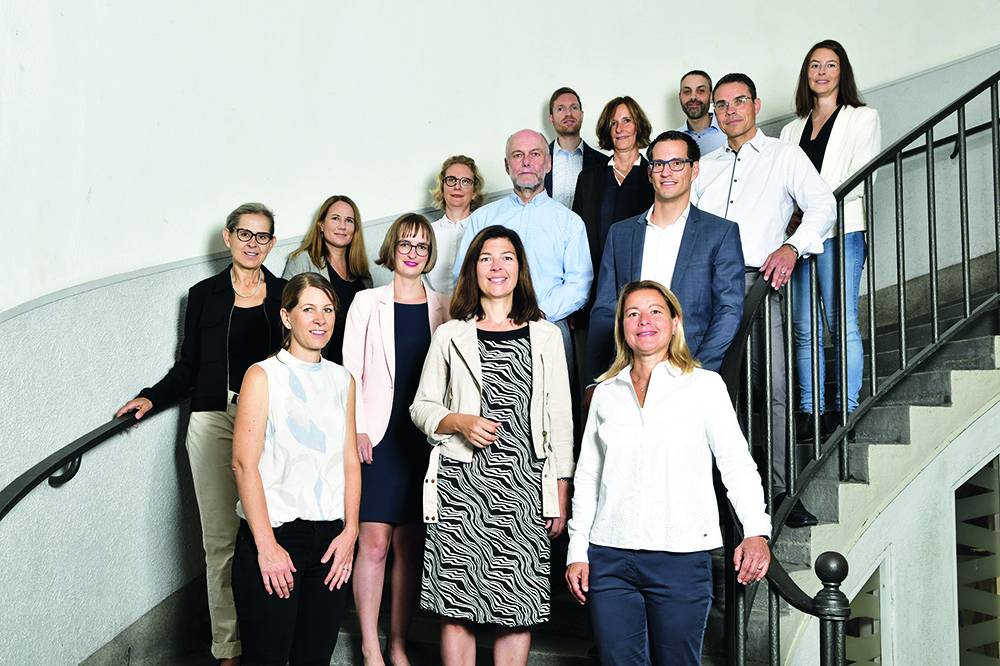
    Fabian Streiff with his team.
  • Canton of Zurich – on the pulse of the action

    Canton of Zurich – on the pulse of the action

    The canton of Zurich is an important growth driver in the Swiss economy. Its gross domestic product (GDP) was more than CHF 143 billion in 2017. That corresponds to more than 20 percent of Swiss GDP. This means that the canton of Zurich has the greatest economic output and added value within Switzerland. The added value can be increased by companies, research and educational institutions and specialist organizations cooperating along the value chain in clusters such as financial services, life sciences, creative industries, cleantech, aerospace, information and communication technology. According to the Statistical Office, the canton of Zurich generates more than 20 percent of the Swiss gross domestic product (GDP) with an annual GDP volume of over CHF 120 billion. This is the greatest cantonal economic added value in Switzerland.

    Maintaining international relationships is also an opportunity to directly follow and actively influence international developments in both the economic and political spheres. The business contacts acquired in this way are of direct benefit to the representatives from business, science and administration based in the canton.

    In terms of quality of life and standard of living, Zurich has held top positions in international rankings for many years. The city of Zurich emerged as the winner of the well-known Mercer study on quality of life seven times in a row. It has been in second place since 2009. The study compares 230 cities based on 39 criteria such as health care, entertainment, shopping, schools, housing, environmental issues, and the political and economic situation.

    A new index also measures the economic and social distribution of prosperity for the first time, and the metropolis on the Limmat ranks first among 113 cities, as zh.ch writes: The “Prosperity and Inclusion in Cities Seal and Awards Index” not only measures economic growth, but above all its quality and what proportion the different population groups have in it. Zurich scored particularly well in terms of work, living, leisure, security and education. Vienna follows in second place, ahead of Copenhagen, Luxembourg and Helsinki. In the inner Swiss city ranking, Zurich ranks first and Winterthur third.

    Testimonials

    Carmen Walker Spah
    Government Councilor,
    Director of Economics

    Thanks to the first-class universities, the availability of specialists, the excellent infrastructure and the high innovative strength of our economy, the canton of Zurich is a highly attractive location for companies.

    David Allemann
    Co-founder On

    Zurich is cosmopolitan, cool and rethinks. It is important that many creative minds live and work in Zurich who drive the location forward in terms of creativity and innovation. So Zurich remains unique.

    René Kalt
    Managing Director
    Innovation Park Zurich

    Universities and numerous innovative companies make Zurich a perfect location for networking science and business. The Innovation Park Zurich contributes to this knowledge and technology transfer, making Zurich even more innovative.

    Mario Jenni
    Co-Founder &
    CEO Bio-Technopark Schlieren-Zurich

    Zurich is an excellent life sciences location due to numerous health and technology companies as well as excellent universities. The “Paradeplatz” of the biotech scene is located in Schlieren and is becoming more and more important nationally and internationally.

  • The ground floor is used correctly

    The ground floor is used correctly

    Ground floor locations in major Swiss cities and medium-sized centers, but also in smaller communities, are increasingly leading a bleak existence – at least away from the coveted prime locations. According to real estate market experts, there has been a clear functional change in this type of land use not just since the Covid 19 pandemic. Where there used to be a restaurant, a café or a hairdresser, a butcher or an owner-managed fashion store, today there is a yawning emptiness in many places.

    In the focus of science
    Nicole Hartmann, research assistant at the Institute for Interior Design (IIA) at the Lucerne University of Applied Sciences and Arts (HSLU), is currently working on the possibilities of converting this very special type of building space. With her colleagues Markus Gmünder, Christoph Hanisch and Katharina Kleczka, she is currently looking at the “question of the conversion of the ground floor from the inside out” in her “PARTERRE” project. Hartmann says: "Ground floor zones are an important part of buildings, but also of the cityscape." However, restructuring processes in the industry and the growth of online trading have recently brought about a change in the function of the ground floor locations. Social and cultural shifts in values as well as legal framework conditions also played a role in the subject, according to Hartmann. The project team collected very specific practical examples in the Portuguese city of Porto, where, thanks to new ideas and innovations, city quarters could be revitalized with SMEs and start-ups. Or recently in the city of Lucerne, where currently pronounced vacancies and unused business and retail space are visible and omnipresent due to the lack of international tourists.

    One solution: pop-up shops
    The company founding pop-up shops by founder and managing director Chalid A. El Ashker is committed to precisely such vacancies. With his “online marketplace” he has free space in Baden, Brugg and Dietikon on offer. The internet platform of the start-up based in Zollikon brings providers of free retail and promotional space together with those interested in renting space for a limited period of time. Even the rental agreement and rent payments are processed online in pop-up shops. Target groups are landlords with vacant space on the one hand and new innovative brands, companies, designers or artists on the other hand who need space to display their products. “Regardless of the type of space – we optimize the letting process,” says El Ashker, whose business idea does not stop at the Swiss borders. He also lists international business spaces, for example in Germany, the UK or the USA, many of them on the ground floor of a building. For the start-up founder, his platform has several advantages: "We increase the availability of retail space and promote the local economy by supporting new, emerging and established companies." In Switzerland, pop-up shops are already working with customers such as SBB, Swiss Post, Migros, SPG Intercity and Wincasa.

    Flexible office space close to where you live
    But retail solutions are not the only option for vacant commercial space on the ground floor of Swiss municipalities and cities. This type of commercial space can, for example, be converted into office space depending on the requirements of the administration and depending on the definition of the urban zone. The Village Office company offers one of the new German “coworking space” concepts. It is aiming to create several hundred flexibly rentable coworking spaces throughout Switzerland. There are currently more than 80 federal “coworking spaces” from Village Office in the country – for example in Aarau, Bottighofen, Frauenfeld, Lucerne or in Laax, Nyon and Davos.

    Conceived and founded as a cooperative, it wants to promote new forms of work and build up a whole network of “coworking spaces”. "In doing so, we are also creating bridges between communities, companies, property owners and coworkers," says Jenny Schäpper-Uster, who co-founded the new branch association Coworking Switzerland in 2015 and 2016 and village offices on the other. “Our vision is that by 2030 every person in Switzerland will reach the next 'coworking space' within 15 minutes. In this way, we relieve the traffic infrastructure, increase local added value and improve the quality of life with shorter commutes. "

    «Revitalizing inner cities»
    Interior designer Nicole Hartmann from HSLU brings into play another option for converting vacant ground floor areas in inner-city areas: living space. "Depending on the existing floor plans, room heights, window fronts and surface types, the focus should be on an actual revitalization of the inner cities," she said. This could then also mean making old towns attractive, liveable and worth living in again for new residents. In many places in Switzerland, people have been displaced in peripheral zones or in agglomerations because contemporary and modern floor plans may have been created in new neighborhoods. "A discussion about new mixed uses and the redefinition of public zones could initiate a new trend and revitalize many city centers and inner cities," Hartmann is convinced.

    This is exactly what the current “PARTERRE” project aims to investigate. It is also about the question of how a change of use affects the quality of life and amenity of the city dwellers and how the interfaces between public city life and private living can be designed. "The project takes into account the entire structure of effects with the interests of the various actors and develops a sustainable and future-oriented conversion strategy for vacant ground floors," says Hartmann. We can already look forward to your project results.

    The city of Baden – a positive example
    Baden, the third largest municipality in the canton of Aargau with over 19,000 inhabitants, is one of the top 5 of Switzerland's 110 economic regions. Around 2500 companies are based here, including many international companies. Thanks to the connection to the local and long-distance transport networks and the distance of only around 20 kilometers to Zurich, the canton capital Aarau and the city of Waldshut-Tiengen in Germany, it is a regional economic center and also a popular place to live.

    So it is not surprising that location promoter Thomas Lütolf can report a very low vacancy rate in the inner-city retail space: "Of 220 spaces, only three are currently empty." This means that the vacancy rate on the city's ground floor is lower than it has been in six years – despite the ongoing corona pandemic. A trend that he sees in the retail space is the increased use by gastronomy and food concepts. The retail stores also showed new concepts and tried-and-tested products: for example, Ohne.ch on Stadtturmstrasse 15 offers fair and sustainable food unpackaged. In addition, the Sprüngli confectionery chain, which is well-known and popular across national borders, was able to move into the Baden train station.

    And when it comes to pop-up stores, too, Lütolf sees more opportunities than risks: "Pop-up shops are not unknown in Baden." In his opinion, this trend will hold up in the long term and whether the active art and cultural scene in the city will be able to quickly and easily use the areas that have become free. Only when it comes to rent levels does it show a slight downward trend. "But that in turn makes it interesting for other groups of providers in this usage segment," says Lütolf. (mr).

  • Smart cities work together

    Smart cities work together

    Basel, Bern, Lugano, Lucerne, St.Gallen, Winterthur and Zurich are already working together on the next national exhibition, " NEXPO – the new Expo ". Now, within this framework, they also want to jointly develop models for future cooperation between intelligent cities, according to a media release from the canton of Basel-Stadt. Its cantonal and urban development in the presidential department is taking the lead in a first pilot project of the initiative.

    With “Smart Inter-City – our common path into the future”, the participants not only want to develop models of cooperation between so-called Smart Cities, but also to implement them. By networking the seven cities, existing synergies are to be used. The project is also open to partners from business, science and the general public.

    The pilot project is to be promoted at the respective innovation locations of the participating cities. In Basel, for example, this includes the Smart City Lab Basel , which was launched by the canton and the SBB.