Tag: Wohnbauprojekt

  • Regensberg fights for survival

    Regensberg fights for survival

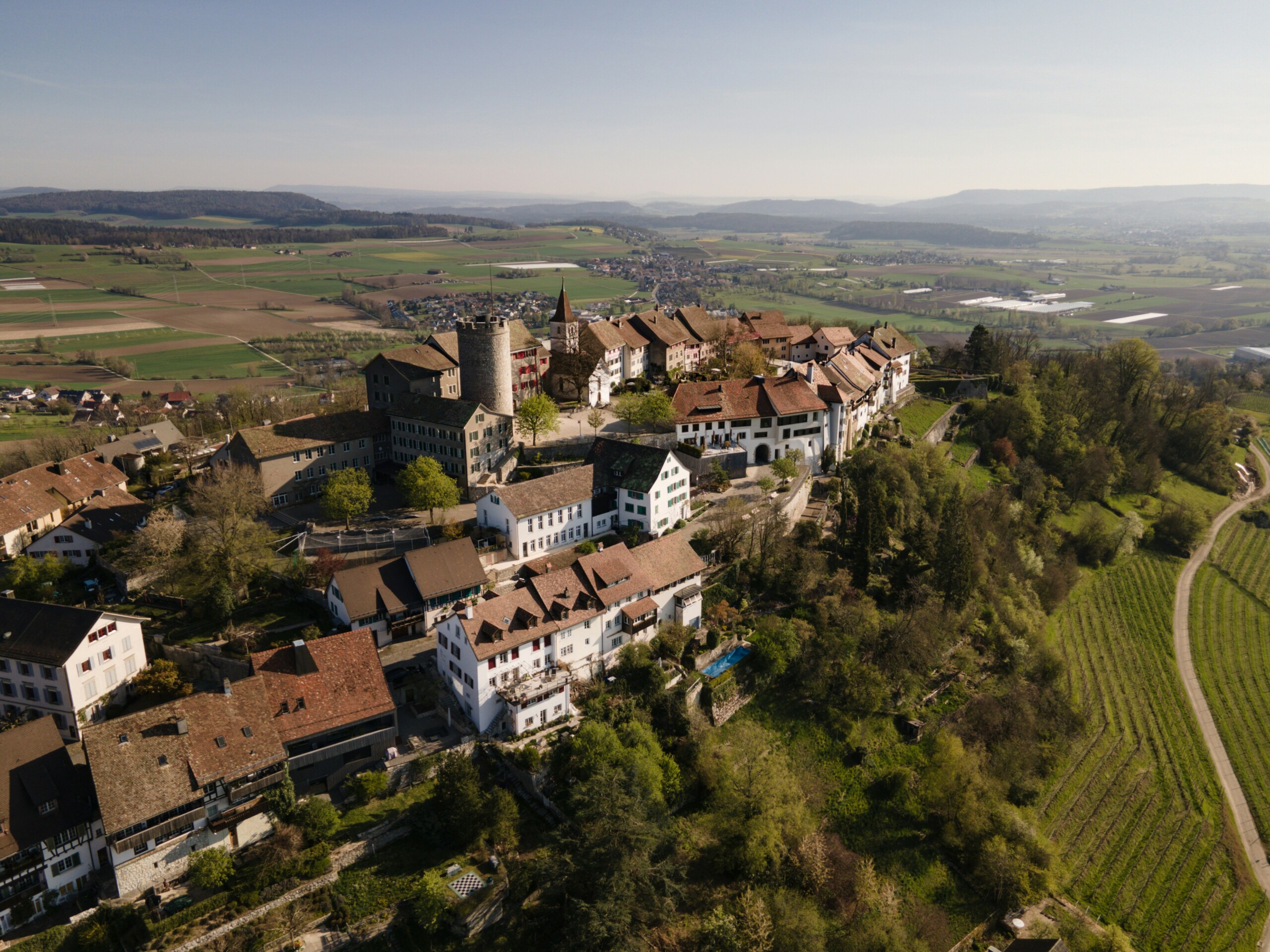
    Regensberg has exactly 477 inhabitants at the end of 2024. Despite two tax increases in recent years, there is not enough revenue to finance the municipality’s tasks. The structural deficit threatens the independence of the medieval country town on the rocky spur above Dielsdorf. A merger with a neighboring municipality is on the cards, a scenario that many Regensberg residents want to avoid.

    A meadow as a turning point
    The impetus came in April 2024 at a Future Day, where the population openly discussed the fate of their municipality for the first time. On the agenda was the Pünt meadow, the last major building site in the village. This discussion gave rise to the idea of a cooperative. In July 2025, the Pünt Regensberg building cooperative was officially entered in the commercial register.

    40 apartments, 80 new people
    The project, a four-storey building with 41 apartments, is to be built on the Pünt, around three quarters of which will be large family apartments with 4.5 to 5.5 rooms, the rest smaller units with 2.5 to 3.5 rooms. The cooperative anticipates 60 to 80 new residents. For a community the size of Regensberg, this corresponds to a population increase of around 15 percent. A competition to find the project team was held back in 2025.

    More than taxes
    The goal is not just fiscal. Regensberg has the fourth-highest average age of all Zurich municipalities. Younger families should come and thus also secure the elementary school, because without a school there are no families and without families there is no village life. The flexible usage concept also allows older people to move from their single-family home to a suitable smaller apartment without having to leave the village.

    non-profit instead of speculative
    If the project had ended up in private hands, the apartments in the attractive location would have primarily been investment properties. In contrast, the cooperative lets on a cost-rent basis, i.e. without the intention of making a profit. The project is being financed via share certificates, member loans, state subsidies and bank mortgages, with a target equity ratio of 35 to 40 percent.

    the cranes will rise in 2028
    Because Regensberg is listed in the federal inventory of sites worthy of protection, particularly strict conditions apply to construction. The building permit is due to be issued in 2027, with construction scheduled to start in 2028. The first apartments could be occupied one or two years later. Whether the cooperative can solve the structural deficit on its own remains to be seen. But it proves that sometimes a village saves itself.

  • Strüby Unternehmungen receives first certificate for realised Minergie site

    Strüby Unternehmungen receives first certificate for realised Minergie site

    Energy efficiency, energy self-sufficiency and heat protection are currently major issues and will become even more important in the future. Since 2023, not just a single house, but an entire site can be certified by Minergie, meaning that the surrounding area can also be increasingly included in the planning of residential construction projects. On 2 September 2024, the “Fischermätteli” in Burgdorf BE received the first definitive site certificate from Minergie in Switzerland and thus reached a new level in sustainable construction.

    Label with high requirements
    The new, comprehensive Minergie site standard is supported by the Minergie Association, the cantons, the business community and the Swiss Federal Office of Energy. The Minergie site is characterised by very low energy consumption, minimised greenhouse gas emissions during construction and operation and maximum self-sufficiency with renewable energies. The buildings have above-average heat insulation and controlled air exchange. The design of the outdoor space increases climate resilience and the quality of stay, for example through suitable planting and shading. The Minergie site also incentivises climate-friendly mobility.

    Over 6600m3 of Swiss wood
    The Fischermätteli residential construction project was successfully completed by Strüby Unternehmungen in autumn 2023 after a construction period of around three and a half years. The ten apartment blocks with a total of 168 condominiums were built on a former commercial site in Burgdorf BE. Over 6600m3 of Swiss timber was used in the construction, making “Fischermätteli” the largest project in Switzerland to combine the Minergie-A-ECO standard and Swiss timber.

    Climate-friendly environmental design
    One hundred per cent of the energy for the entire site comes from renewable sources: the electricity from the photovoltaic systems on the building roofs, the heat for heating and hot water from a heating centre supplied with Swiss pellets. The finely meshed mobility concept focuses on electromobility, car sharing, bicycles and public transport. A co-working space promotes working from home and thus indirectly relieves traffic congestion. In addition, the climate-friendly environmental design based on the sponge city principle ensures natural and efficient cooling in summer and makes the “Fischermätteli” a hotspot of biodiversity thanks to the countless native plants.

    Success thanks to a climate-friendly overall concept
    Pius Kneubühler, Managing Director Real Estate Development & Construction at Strüby Unternehmungen, can confirm that the climate-friendly overall concept in line with the Minergie site standard pays off not only for the residents, but also for the investor. “The success has already manifested itself in the marketing of the condominiums. Demand was so pleasing that all flats were sold by the time construction was completed.”

  • Halter takes over residential project near Schaffhausen

    Halter takes over residential project near Schaffhausen

    Schlieren-based property developer Halter AG has acquired the Waldstadt residential development site in Pantli between Schaffhausen and Stetten SH, according to a press release. The seller is DOST Architektur GmbH in Schaffhausen. The two companies will jointly realise the planned construction of 200 owner-occupied flats.

    According to the plans, over 200 condominiums are to be built on 47,600 square metres of land. In a first step, 100 condominiums will be realised. This will be followed seamlessly by the other stages, according to the company press release. Over 40 different types of flat are available for different living requirements. The sizes range from 2.5-room to 5.5-room flats. The flats are orientated on several sides and offer rooms with plenty of natural light and a direct view of nature and the forest. The new living space is suitable for families, couples and commuters from the region.

    A new bus stop and direct access to the motorway in the direction of Schaffhausen, Winterthur and Zurich ensure optimal transport connections. An integrated kindergarten and a day care centre round off the offer and make Waldstadt im Pantli attractive for families too.

    The construction time for the first stage is estimated at around two and a half years. If everything goes according to plan, the first flats can be occupied in 2026, according to Halter AG.

  • “Fischermätteli” first site with Minergie certificate

    “Fischermätteli” first site with Minergie certificate

    The innovative and long-term residential construction project Fischermätteli was successfully completed by Strüby Unternehmungen in autumn 2023 after a staggered construction period of around three and a half years. The ten apartment blocks with a total of 168 condominiums were built on a former commercial site in Burgdorf BE. Over 6600 m3 of Swiss wood was used in the construction, which serves as a natural CO2 reservoir and has an excellent ecological footprint thanks to the short transport routes.

    One hundred per cent of the energy requirements for the entire site are covered by renewable sources. The electricity comes from the PV systems on the roofs of the buildings, while the heat for heating and hot water comes from a heating centre that runs on Swiss pellets. The well thought-out mobility concept is based on electric mobility, car sharing, bicycles and public transport. A co-working space supports working from home and thus indirectly relieves traffic congestion. In addition, the environmental design based on the sponge city principle ensures natural and efficient cooling in summer and turns the project into a true biodiversity hotspot thanks to the wide variety of native plants.

    Label with high requirements
    In April 2024, the largest real estate project to date was awarded the coveted certificate by the Minergie association: the Minergie-Areal label, having already been awarded the Minergie-A-ECO label. The new standard, which has been in place since September 2023, is supported by various organisations such as the Minergie Association, the cantons, the business community and the Swiss Federal Office of Energy. The Minergie site is characterised by minimal energy consumption, minimised greenhouse gas emissions during construction and operation and maximum self-sufficiency with renewable energies. The buildings have particularly efficient heat insulation and controlled air exchange. In addition, the outdoor space of the Minergie site is designed in such a way that climate resilience and quality of stay are increased, for example through green planting and shading options. Another advantage of the Minergie site is the promotion of climate-friendly mobility.

    The development in Burgdorf BE sets new standards in timber construction for flats. With 168 owner-occupied flats in ten apartment blocks, it is the largest construction project of its kind to combine Swiss timber and the Minergie-A-ECO standard. Sustainability aspects were at the centre of the project right from the start, which earned it the first Minergie-Areal certificate for a completed project.

    Thanks to the elegant timber façades, the ensemble blends in perfectly with its natural surroundings. The clearly defined meeting and play zones with village charm promote relationships between the residents. At the same time, the architecture ensures privacy and creates living spaces with ideal air, light and sound characteristics. Community-enhancing elements such as a spacious communal pavilion and the professional home office zone “fm produktiv” round off the offer.

    The flats offer 2.5 to 5.5 rooms and are designed for singles, couples and families of all ages. The floor plans are flexibly designed so that they can be adapted to future needs. From the ground floor upwards, the building was constructed using timber elements.

    The energy supply is consistently based on renewable sources. The electricity for the approximately 400 residents comes from the PV systems on the roofs of the apartment blocks (700 MWh/year). Heat is generated in a heating centre using Swiss wood pellets.

    The mobility concept focuses on cycling, public transport, electric vehicles and car sharing. Bicycle stands, charging stations, repair and cleaning areas are available. Residents can also use one of the two electric cars from the neighbourhood’s own car-sharing scheme via an app or conveniently use the bus, which runs every half hour from the neighbourhood to Burgdorf. Demand for the condominiums and rental flats was very high right from the start. All 168 flats were sold or rented months before completion. The fair sales and rental prices certainly contributed to the great success, e.g. a flat with 4.5 rooms was already available from CHF 610,000 (minus Minergie subsidies from the Canton of Berne).

  • National Council sets new priorities for the environment, spatial planning and energy

    National Council sets new priorities for the environment, spatial planning and energy

    The National Council’s Committee for the Environment, Spatial Planning and Energy (UREK-N) has decided to restrict the right of appeal of environmental protection organisations in smaller residential construction projects. The amendment to the Federal Act on the Protection of Nature and Cultural Heritage aims to adapt the legal framework for small and medium-sized residential construction projects in order to equalise unequal financial resources between parties.

    In addition, the Commission has begun discussing the Federal Act on Supervision and Transparency in Wholesale Energy Markets in order to ensure appropriate supervision and transparency. As part of the discussion on an electricity market agreement with the EU, the Commission discussed the economic importance of a secure electricity supply and the need to harmonise Swiss regulations with those of the EU.

    In the area of the circular economy, the Commission resolved most of the differences with the Council of States, particularly with regard to the relaxation of the municipal waste monopoly. However, there is still disagreement on the question of whether unsold biogenic products should be unpackaged.

    Further discussions by the committee included the partial revision of the Environmental Protection Act, which focuses on noise protection and the remediation of contaminated sites. The motion “Combating the housing shortage with densification and non-profit housing construction” was rejected by the committee, as it is of the opinion that the existing legal basis is already sufficient. A postulate on optimising the use of energy wood was also submitted.

    The committee meetings on 22 and 23 January 2024 were chaired by National Councillor Christian Imark and were partly held in the presence of Federal Councillor Albert Rösti in Bern.

  • Holcim completes first part of 3D-printed settlement

    Holcim completes first part of 3D-printed settlement

    Holcim has announced the successful completion of the largest 3D-printed affordable housing complex to date. For this, 14Trees, a joint venture between Holcim and British International Investment, has printed the first ten housing units in Kenya, according to a media release. A total of 52 affordable buildings are planned in the gated community called Mvule Gardens near the town of Kilifi. Each new phase of construction will test further innovations, according to Holcim. The project is part of the Green Heart of Kenya regenerative ecosystem, a model for inclusive and climate-resilient cities.

    Building on the world’s first 3D-printed school by 14Trees in Malawi, the Mvula Gardens complex will also help close the country’s infrastructure gap and create affordable, climate-friendly housing on a large scale. In addition, this new technology will create highly skilled jobs: local workers will be trained as 3D machine assistants and specialists.

    The 3D printing of these ten housing units was made possible with TectorPrint, Holcim’s innovative 3D printing ink, produced for the first time in Kenya. The sustainability profile of this project was recognised by the International Finance Corporation, the development bank of the World Bank Group, with the EDGE Advanced certificate for sustainable design.

    “I am very proud of 14Trees’ work in Africa, where our innovations in 3D printing technology are accelerating affordable and sustainable construction,” Miljan Gutovic, Holcim’s regional director for Europe, is quoted as saying in the statement. “I look forward to 14Trees replicating these successes in Europe and other parts of Africa in the near future.”

  • Zurich relies on Madaster

    Zurich relies on Madaster

    The real estate division of Zurich Insurance Group’s investment management is testing Madaster’s material passport in a housing project in Holland, Madaster Switzerland informs in a statement . All materials used in the building are recorded in the Madaster material pass. In this way future recycling of the material is made possible. Zurich wants to use the building ID card for future decisions about the development of its own real estate portfolio.

    “Through the data transparency of a material passport, we want to learn more about the impact of a building on people and the environment,” Roger Baumann, Chief Operating Officer and Head of Global Real Estate Product Development at Zurich, is quoted in the statement. “We hope to be able to identify new decision-making scope for a significant decarbonization of our real estate portfolio.”

    Madaster wants to strengthen the circular economy in the construction and real estate sector. To this end, it offers digital tools on its platform, such as material passports and indices for recording the economic and circular value of buildings. In addition, companies that are committed to the circular economy in the construction and real estate sector are networked. “We want to show that buildings are dynamic systems whose value retention can be realized through data transparency,” explains Marloes Fischer, Managing Director of Madaster Services Switzerland.

  • Steiner AG sells housing project in Suhr to Corpora

    Steiner AG sells housing project in Suhr to Corpora

    13 apartment buildings with a total of 146 apartments are to be built on Neumattweg Ost in Suhr. The superstructure is designed for use by different age groups and family sizes, Steiner AG informed in a press release . The real estate developer from Zurich has decided to sell the project to Corpora Immobilien AG from Aarau before it is actually implemented.

    "With Corpora Immobilien AG, Aarau, we were able to sell this extensive project to an investor with development expertise and local roots, who will ensure the successful further development and realization of this attractive residential development," project manager Daniel F. Hauri is quoted as saying in the press release. No information is given there on the purchase price for the approximately 1.6 hectare area. Steiner cites an adjustment to the portfolio that was initiated last year as the reason for the sale.