Tag: Wohngebäude

  • Revitalisation of an icon – living in the former PTT tower block

    Revitalisation of an icon – living in the former PTT tower block

    The high-rise building, once an important research and development centre for the former PTT, will be renovated by Pensimo and HRS over the next two years. In future, the ground floor is expected to house a day care centre and the 17 upper floors will offer 87 modern flats with far-reaching views. The tower block, which is only surpassed by Bern Minster, was the tallest non-sacred building in Switzerland when it was completed in 1972. After years of use for telecommunications research and start-ups, it is now being converted into a residential building.

    The 75-metre-high high-rise at Ostermundigenstrasse 93, built by Frey, Egger + Peterhans Architekten between 1967 and 1972, was inspired by Le Corbusier and is designed as a filigree disc. Future residents will be able to reach the centre of Bern quickly thanks to the nearby public transport links. The rental flats offer loft-like spaces with 1.5-5.5 rooms, high ceilings and a solid fit-out standard. Residents benefit from a breathtaking view of the Bernese Alps from their flats and the communal roof terrace at a height of 75 metres.

    The conversion of the derelict commercial and office space helps to promote urban development and the supply of housing. Utilising the existing structures significantly reduces CO2 emissions compared to a new building. Completion and occupation are planned for spring 2026.

  • Long-term cost benefits and environmental friendliness of heat pumps

    Long-term cost benefits and environmental friendliness of heat pumps

    The decision to replace or renew a heating system is a long-term investment. Many consumers focus mainly on the initial installation costs, but often neglect to calculate the total costs over the life cycle of the heating system. In a new study, researchers at the Fraunhofer Institute for Solar Energy Systems ISE have analysed the costs of various heating technologies in existing residential buildings over a period of 20 years. They took into account future energy prices and the development of CO2 prices. Their conclusion: heat pumps and district heating are not only more climate-friendly, but also cheaper than gas heating in the long term.

    The study focused on existing residential buildings and took into account the subsidies that came into force on 1 January 2024 as part of the Building Energy Act (GEG) and the funding guideline “Federal funding for efficient individual building measures”. The researchers assessed the costs of replacing heating systems and analysed the emissions of various technologies.

    “When investing in a new heating system, all expected costs, in particular the energy costs including the CO2 price component, should be taken into account over the entire life cycle,” explains Robert Meyer from Fraunhofer ISE. According to the study, switching to heat pumps or district heating also results in a positive cost balance for old buildings.

    The study showed that heat pumps in single-family homes are not only more environmentally friendly, but also more economically advantageous. The use of photovoltaics for self-consumption can further reduce overall costs. Even in apartment blocks, switching to heat pumps or district heating is more cost-effective than a new gas heating system.

    The study included various heating technologies such as gas condensing boilers, air source heat pumps (with and without photovoltaic systems), geothermal heat pumps, pellet heating systems and district heating. The researchers recommend providing consumers with transparent information on expected emissions and energy prices, including CO2 prices, to facilitate decision-making.

  • Zurich Investment Foundation increases real estate funds

    Zurich Investment Foundation increases real estate funds

    Zurich Investment Foundation has completed a capital increase for its Immobilien Wohnen Schweiz investment group with new capital of CHF 250 million, which was launched in mid-July, Zurich Invest AG announced in a press release. The subsidiary of the Zurich Insurance Group is responsible for the management of the investment foundation. The new funds are to be used to purchase a property in Zurich where a construction project has already started and six fully rented residential buildings in Lucerne.

    In the project in Zurich, three residential buildings with a total of 269 apartments are being built on Austrasse. According to the statement, the buildings should meet the requirements of the gold level of the Swiss Sustainable Building Standard. According to her, the six newly built apartment buildings with a total of 61 apartments in the canton of Lucerne are also sustainable development.

    Residential properties throughout Switzerland with a value of almost 3 billion Swiss francs are pooled in the investment group Immobilien Wohnen Schweiz, Zurich Invest explains. The portfolio is "well diversified in terms of size, age structure and geographic distribution".

  • Basel Rosental Tower enters the planning phase

    Basel Rosental Tower enters the planning phase

    HRS Real Estate is taking over the overall management of the further project development, the search and selection of investors as well as the realization and marketing of the Basel project Rosentalturm at the Basel exhibition center. According to a press release , MCH Messe Basel and HRS Real Estate have signed a corresponding agreement.

    A project competition is now being held in cooperation with the construction and transport department of the canton of Basel-Stadt and with the support of the Zurich planning specialists Planpartner . According to the information, seven architectural firms were invited: Buchner Bründler Architects, Herzog & de Meuron and Morger Partner Architects from Basel. Burkard Meyer Architekten from Baden AG as well as the two Zurich offices Michael Meier and Marius Hug Architekten and Armon Semadeni Architekten are competing for the best design.

    The assessment committee made up of national experts is chaired by Thomas Hasler from Staufer + Hasler Architekten from Frauenfeld. The results are expected in autumn 2022. Construction is scheduled to start in summer 2023.

    The Rosentalturm building is to be erected on the site of the existing trade fair car park. The parking lot will be underground. Of the total of 48,000 square meters planned, 40,000 are intended for housing and 8,000 for commercial use.

  • Holcim takes over Malarkey Roofing in the USA

    Holcim takes over Malarkey Roofing in the USA

    The global Zug-based building materials company Holcim has signed an agreement to take over Malarkey Roofing Products . Malarkey is a leader in the American residential roofing market, according to a press release . It is headquartered in Portland, Oregon. The transaction is valued at $ 1.35 billion and will be 100 percent cash-funded. Holcim expects to realize synergies of $ 40 million per year by year three.

    Malarkey Roofing Products is forecast to have net sales of $ 600 million in 2022. According to the announcement, the company can point to double-digit growth in the highly profitable roof-top housing market in the USA with a volume of 19 billion dollars. Both companies have set themselves the goal of sustainable building.

    “The acquisition of Malarkey Roofing Products is an excellent start for our ‘Strategy 2025 – Accelerating Green Growth’, with which we are expanding our Solutions & Products division and becoming one of the world’s leading providers of roofing systems,” Holcim CEO Jan Jenisch is quoted as saying. With Malarkey, Holcim is positioning itself as a full-range roofing provider. The strategy to accelerate green growth is to expand this area to 30 percent of the Group’s net sales by 2025.

    Gregory Malarkey, President of Malarkey Roofing, founded in 1956, sees Holcim as the right partner. “For decades we have been looking for a company that aligns with our vision, shares our values and can help us accelerate our growth strategy.” Like Malarkey, Holcim also focuses heavily on promoting the circular economy and the transition to sustainable construction, Malarkey becomes further quoted.

  • Steiner AG can realize the residential building project Haus Weiler

    Steiner AG can realize the residential building project Haus Weiler

    The building permit for the new building project Haus Weiler in Winterthur's Neuhegi district is legally binding. As Steiner AG , which was commissioned with the planning, informed in a press release , the first apartments should be ready for occupancy in spring 2025. Residents will find peace and quiet and close to nature, but at the same time can reach the city in around 15 minutes by bike or bus, according to the message.

    The new residential development will close another gap in the KIM area. A modern building with 80 modern apartments with two and a half to five and a half rooms is to be built on 3328 square meters. The extraordinary room heights are a special feature. "While the apartments on the ground floor are equipped with private garden seating, the residential units on the top floors will impress with their large, private terraces," the company reports. The plans also provide for “a cozy inner courtyard”, which offers space for “cozy get-togethers, lingering, relaxing and playing”.

    The KIM quarter, launched in 2018 in the Oberwinterthur district , sees itself as “a lively and multi-layered quarter with commercial and residential buildings of various sizes”. The new district combines the advantages of urban structures with high recreational value at the same time. Green areas, playgrounds and car-free zones as well as attractive shopping opportunities in the area are named as strengths.

  • From office building to residential building

    From office building to residential building

    The office building with the plate facade from 1992 has been empty since the beginning of January. The five-story building was last used by artists from the Lemon Association. Mobimo decided to convert and build a new property at Im Tiergarten 7 in Zurich-Friesenberg: “We already own a commercial property with the neighboring building,” says Daniel Garcia, the project manager in charge at Mobimo. In addition, there is great demand for apartments in the city of Zurich. “The conversion was therefore obvious,” explains Garcia.

    59 rental apartments in the medium price segment are to be built here by 2022. The architecture contract went to Theo Hotz Partner Architects: “With this architecture office we have found a partner who optimally embeds the property in the surroundings and does not make it look like a foreign body. Architectural details that reflect Mobimo’s values in the context of sustainable construction were incorporated into the project, ”says Garcia.

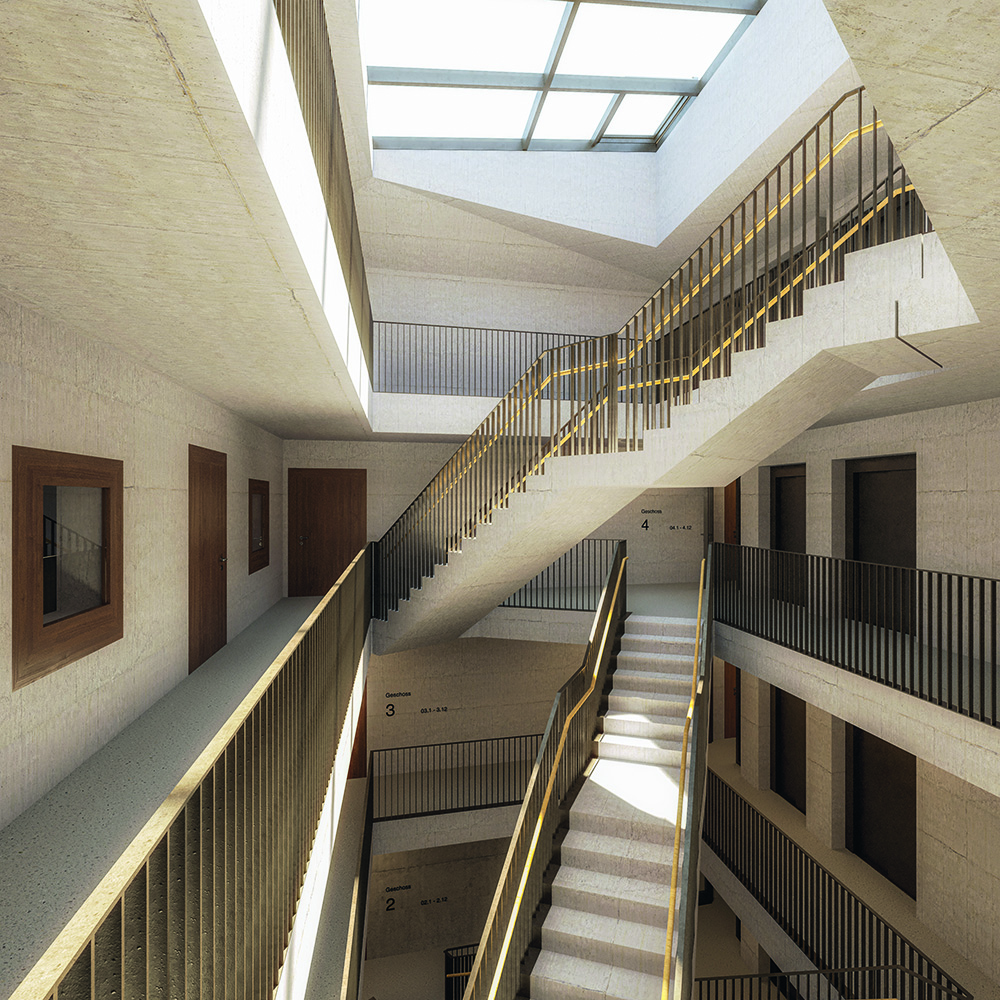
    Visualization of the stairwell.

    The architectural office has planned a free-standing, triangular block of flats that will form an urban hinge between the neighboring Friesenberg office building and the surrounding residential area. The 1.5 to 4.5 room apartments are intended for singles, families and senior citizens. The energy concept provides for central heat generation by means of a heat pump and the use of waste heat from the cooling network of the data center in the neighboring building.

    Mobimo commissioned W. Schmid AG as total contractor for the new building. The owner is spending around 49 million francs on the new project. The first occupancy is planned for December 1, 2022.

  • Baden's tallest building is called Akara Tower

    Baden's tallest building is called Akara Tower

    In addition to other projects, the tallest residential and office building in the city is being built on the former ABB site near Baden's train station. In the meantime, the name for the 66 meter high tower is also known: Akara Tower. The client is Akara Funds based in Zug, planning and construction are carried out by HRS Real Estate from Frauenfeld TG. The real estate company Markstein AG , based in Baden, has been commissioned to market the commercial and office space in the Akara Tower and the rental apartments.

    In terms of traffic, 150 rental apartments are being built in the Akara Tower in the best traffic location, just a four-minute walk from the train station. They have 1.5 to 4.5 rooms. Office and service space can be rented on floors two to four. There are two commercial spaces on the ground floor. Marketing of the office space will start this autumn. The apartments will be advertised for rent from summer 2022. The move into the Akara Tower is planned for the fourth quarter of 2023.

    The planning also includes the establishment of parking spaces. Next to the high-rise building and under the future town square, an underground parking garage with almost 500 parking spaces is being built. The parking spaces provided for the high-rise are also located there. There are also around 350 bicycle parking spaces available.

  • 14Trees is building schools in Africa with 3D printing

    14Trees is building schools in Africa with 3D printing

    14Trees is using 3D printing on a large scale to build affordable residential and school buildings in Africa. Starting in Malawi, such buildings should be realized in record time in this way. The walls of the first school in Salima were printed in just 18 hours, according to a media release . In addition, the CO2 footprint is reduced by up to 70 percent through “optimized use of materials”.

    14Trees is a joint venture between the building materials group LafargeHolcim and the London-based impact investor CDC Group . "I am thrilled with the work our joint venture 14 Trees is doing," said Miljan Gutovic, Head of the Middle East and Africa region and member of the LafargeHolcim Executive Committee, quoted in the press release. "Starting in Malawi, we will use the technology throughout the region and already have projects in the pipeline for Kenya and Zimbabwe."

    Tenbite Ermias, Managing Director Africa of CDC, is convinced that “the broad application of the groundbreaking cutting-edge technology” of 14Trees enables “enormous development effects”. "This is a wonderful example of our investments in companies that contribute to the UN Sustainable Development Goals."

    As the message goes on to say, UNICEF estimates that Malawi is short of 36,000 classrooms. With conventional technology, this would take 70 years. According to 14Trees, this gap could be closed in ten years with 3D printing. In addition, the local projects would create qualified jobs.