The “ALTO” project, initiated by the
property company HIAG, fits seamlessly into the urban transformation of Zurich Altstetten, a district that is changing from an industrial to a lively residential and working area. The plan is for an 80-metre-high residential building that is characterised by its integration into existing structures and its sustainable construction.
The ground floor of the new building will be used for commercial purposes and open to the public, while the first floor will serve as a social centre for residents with communal spaces, a roof garden and studios. In addition, modern flats will be built on the 25 floors above, reflecting the new urban lifestyle in Altstetten.
In addition to the residential use, the neighbourhood will be further enhanced by the project. The Shedhalle, formerly part of the Fiat garage, will be converted into a food market with an attractive range of fresh produce and will take on the function of a local supplier. There are also plans to construct an urban loggia, which will serve as a public meeting place that incorporates the community concept and emphasises the urban quality of the area.
Sustainability plays a central role in the development of the “ALTO” construction project. The use of resource-conserving materials and the design of permeable open spaces emphasise the commitment to environmentally friendly urban development. As the first residential tower block in the canton of Zurich, the façade will be fitted with photovoltaic panels throughout, allowing tenants to benefit from the electricity they generate themselves. An innovative mobility concept, which provides for a significant reduction in parking spaces, rounds off the future-oriented overall concept.
With completion scheduled for spring 2026, the “ALTO” construction project will not only offer new living space in Zurich Altstetten, but will also serve as a showcase project for sustainable urban development and social coexistence.
Tag: Wohnhaus
-

The “ALTO” construction project
-

Kriens: Old brickworks to shine in new splendour
The Old Brickworks below Bellpark in Kriens is well-known in the city. It was built during the economic boom at the end of the 19th century. Between 1889 and 1899, Lucerne expanded its housing stock by 25 percent, and the demand for fired bricks was high. However, insufficient clay deposits and unsteady management led the brickyard into bankruptcy in 1900.
After several changes of ownership, the building was converted into a residential house in the 1920s. Since then, it has undergone several structural changes and has grown historically as a result. In the meantime, it has been included in the list of buildings worthy of protection in the Canton of Lucerne. Until recently, young families, creative people, craftswomen and artists lived and worked in the Old Brickworks.
The building is in great need of renovation. As the landowner, Schmid Immobilien AG decided to redevelop the Alte Zieglei and develop a building project in an accompanied process.
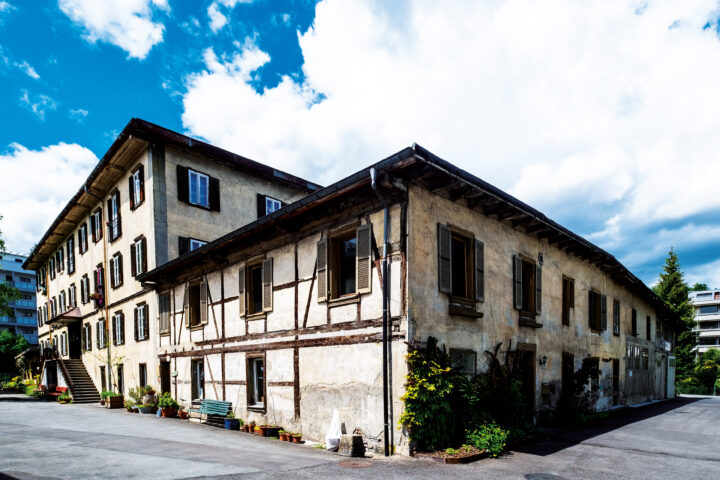
The Alte Ziegelei is well-known in the city and has been in Kriens for over 100 years. An expert committee consisting of representatives of the client, the preservation of historical monuments and the city of Kriens as well as external architects and engineers evaluated the project designs of four invited architectural teams. The projects were to fulfil the reference to the history of the Old Brickworks, implement the interests of the preservation of historical monuments and take into account the economic interests of the owner. The winning project was designed by Seiler Linhart Architekten from Lucerne.
It envisages the removal of the historically grown three-sided extensions to the building and the reconstruction of the Old Brickworks to its core. The historic façades are to be renovated and the central element of the naturally lit inner courtyard restored. On the east and west sides, the residential building is to be supplemented with an arcade construction. A total of 18 flats are planned, distributed over the three upper floors, and four studios on the ground floor. Even after the renovation, the focus will be on communal living under one roof in the Old Brickworks.
Construction work will start in spring 2023 and should last until the end of 2024. The investment amounts to around eleven million Swiss francs.
-

Renovation and extension: Hospiz Zentralschweiz Luzern
Building worthy of protection: medical practice with residential building in Littau
The original building – a residential building with an integrated doctor’s practice – was built by the Lucerne architect Josef Gasser in 1959. He was inspired by the well-known American architect Frank Lloyd Wright: In particular, by the prairie style influenced by Wright, which refers to the broad, flat landscape in the American Midwest. Accordingly, the architecture is characterized by an open room design, a horizontal, two-dimensional orientation and the use of natural materials. In cooperation with the Monument Preservation of the Canton of Lucerne, a prudent way of dealing with the building worthy of protection was found.Clinker brick building inspired by Frank Lloyd Wright is being gently renovated
Little was changed during the renovation of the external appearance of the existing clinker building. Interventions in the external appearance of the house were only carried out in the direction of the garden, in which the foundation had the extension built. The room layout and use was adapted for the necessary communal, administration, practice and care rooms. Work rooms, guest rooms and a “room of silence” were created on the existing upper floor. The whole house is now accessible with a lift.Pavilion-like wooden structure for inpatient hospice
A single-storey wooden pavilion with 12 rooms was created in the inner courtyard. Each room has its own wet room and a view of the garden. The two buildings are connected by a corridor that surrounds the new inner courtyard. The pavilion has a basement and is connected to the existing building underground. For a harmonious appearance, the new building was realized with a clinker brick and wooden facade and a roof edge made of pre-patinated copper.Renggli AG supported the Central Switzerland Hospice Foundation as general planner. As part of the planning team, she helped design the architecture and coordinated the demanding specialist areas and partners involved. Renggli AG also acted as general contractor in the project. ■